Wine Labs Research · Bordeaux / Older vintages / Wine prices
Older Bordeaux vintages: what 2000–2010 bottles cost
Published . US merchant prices extracted 17 November 2026. Single 750ml bottles, USD before sales tax and shipping.
We compared current US prices for older and recent vintages of 27 Bordeaux red wines. The 2000–2010 group costs a median 18.5% more than the 2019–2022 group of the same wine. Each wine gets equal weight.
11 of those labels have at least one 2000–2010 vintage with a merchant-group median below $200. The table below gives the exact year, price and seller count.
These are prices asked today for different vintages. They do not show what a bottle originally cost, how its value changed, or whether it is ready to drink. Storage history and the particular vintage still matter.
18.5%
Median older-vintage price gap
27
Same-wine comparisons
11
Labels with an older vintage below $200
3+
Independent seller groups per vintage
Older and recent vintages of the same wine
For each label, we take the median of its eligible 2000–2010 vintage prices and compare it with the median for 2019–2022. A wine must have at least three vintages in each group, with at least three independent seller groups behind every vintage price.
The comparison uses 183 older wine-vintage prices and 105 recent ones. Each vintage counts once within its wine’s group. More listings do not give a vintage extra weight.
17 November 2026. Current US 750ml merchant-group medians in USD, before sales tax and shipping. Group prices are medians across eligible vintages; they are not individual bottle offers.
| Wine | 2000–2010: USD | Older vintages | 2019–2022: USD | Recent vintages | Older price gap |
|---|---|---|---|---|---|
| Château d’Armailhac | $124.89 | 4 | $81.23 | 4 | 53.7% more |
| Château Lascombes | $124.94 | 3 | $89.48 | 3 | 39.6% more |
| Château Duhart-Milon | $139.58 | 6 | $106.17 | 4 | 31.5% more |
| Château Talbot | $165.49 | 4 | $93.49 | 4 | 77.0% more |
| Château Gruaud-Larose | $183.95 | 5 | $100.66 | 3 | 82.7% more |
| Château Beychevelle | $195.00 | 3 | $130.75 | 4 | 49.1% more |
| Château Calon Ségur | $199.00 | 4 | $169.61 | 4 | 17.3% more |
| Château Lynch-Bages | $209.50 | 9 | $194.13 | 4 | 7.9% more |
| Clos Fourtet | $240.00 | 3 | $135.23 | 4 | 77.5% more |
| Château Cos d'Estournel | $299.00 | 9 | $227.49 | 4 | 31.4% more |
| Château Montrose | $299.48 | 9 | $233.75 | 4 | 28.1% more |
| Château Léoville Las Cases | $329.50 | 10 | $295.53 | 4 | 11.5% more |
| Château Figeac | $346.78 | 6 | $287.97 | 4 | 20.4% more |
| Château La Mission Haut-Brion | $349.61 | 10 | $388.78 | 4 | 10.1% less |
| Château La Conseillante | $353.94 | 3 | $306.99 | 4 | 15.3% more |
| Château Palmer | $394.00 | 9 | $353.12 | 4 | 11.6% more |
| Château Trotanoy | $419.98 | 5 | $370.00 | 4 | 13.5% more |
| Château L'Évangile | $430.49 | 3 | $290.51 | 4 | 48.2% more |
| Château Angélus | $549.00 | 7 | $490.74 | 4 | 11.9% more |
| Château Haut-Brion | $626.37 | 10 | $640.97 | 4 | 2.3% less |
| Château Mouton Rothschild | $839.00 | 10 | $742.50 | 4 | 13.0% more |
| Château Margaux | $877.49 | 11 | $774.00 | 4 | 13.4% more |
| Château Lafleur | $948.99 | 5 | $1,187.50 | 4 | 20.1% less |
| Château Lafite Rothschild | $999.00 | 11 | $882.74 | 4 | 13.2% more |
| Château Ausone | $1,004.50 | 6 | $847.48 | 4 | 18.5% more |
| Château Cheval Blanc | $1,175.00 | 8 | $754.36 | 4 | 55.8% more |
| Petrus | $5,797.25 | 10 | $4,299.00 | 3 | 34.9% more |
The price gap varies by wine
3 of the 27 wines have a lower median in the older group: Château La Mission Haut-Brion and Château Haut-Brion and Château Lafleur. That is a comparison of vintage groups, not a claim that every older bottle of those wines is cheaper.
A percentage gap also needs a dollar price beside it. A small difference on a first growth can mean more money than a large difference on a lower-priced label.
Older-vintage price gaps across the matched wines
Share of 27 wines in each band. Gap = older-group median ÷ recent-group median − 1. Current US prices.
Five lower-priced labels, with both vintage groups
The chart takes the five lowest older-group medians in the full table. Both bars for a label use the same method and market. It is a starting point for comparing budgets, rather than a ranking by quality.
Older and recent vintage-group prices
Five lowest older-group medians in the sample. US 750ml prices before sales tax and shipping.
Older Bordeaux vintages below $200
38 eligible 2000–2010 wine-vintage prices are below $200 across 11 of the matched labels. To keep the list short, this table shows the lowest-priced qualifying vintage for each of those labels. Ties go to the earlier vintage.
For example, Château d’Armailhac 2000 has a median of $99.99 across 4 seller groups. This is a calculated market benchmark; a particular merchant’s offer can be higher or lower. Follow the vintage link to check the current listings.
One lowest-priced eligible older vintage per label, strictly below $200. Same matched-wine sample and three-seller minimum as above.
| Wine | Vintage | US median: USD | Independent seller groups |
|---|---|---|---|
| Château d’Armailhac | 2000 | $99.99 | 4 |
| Château Lascombes | 2000 | $99.99 | 4 |
| Château Duhart-Milon | 2008 | $124.98 | 4 |
| Château Talbot | 2010 | $137.75 | 8 |
| Château Gruaud-Larose | 2003 | $149.50 | 4 |
| Château Lynch-Bages | 2004 | $152.50 | 6 |
| Clos Fourtet | 2003 | $159.00 | 5 |
| Château Cos d'Estournel | 2007 | $169.94 | 3 |
| Château Beychevelle | 2006 | $178.74 | 4 |
| Château Montrose | 2004 | $179.00 | 3 |
| Château Calon Ségur | 2005 | $195.00 | 7 |
What the harvest year cannot tell you
A 2000 wine and a 2020 wine share a label, but their growing seasons, blends, production volumes and reputation can differ. This study does not separate those effects from age or availability.
The years refer to harvests, not time spent in bottle. Nor does an older vintage automatically mean a wine is at its peak. WSET explains that ageing potential varies by wine; The Wine Society also identifies vintage, storage and bottle size as factors in when a wine is ready.
Before choosing an older bottle, ask the merchant about its storage history and condition. Our extract removes listings explicitly flagged with non-standard condition codes, but every retained offer is missing at least one condition field. These prices do not certify the condition or provenance of a bottle.
Does the result survive stronger coverage rules?
Raising the minimum from three to five seller groups per vintage leaves 19 matched wines. Their median older-group gap is 25.1% more. Requiring four vintages in each group, while keeping the three-seller minimum, leaves 20 wines and a 13.4% more median gap.
The candidate list contained 32 red grand-vin labels from our earlier Bordeaux study. 5 did not meet both vintage-group requirements: Château Le Pin, Château Lafleur-Pétrus, La Mondotte, Château Rocheyron, Château Quintus. The surviving wines are a selected sample of traded Bordeaux, not the whole region.
Sensitivity checks change coverage rules, not the source date or price basis.
| Minimum coverage | Matched wines | Median older price gap |
|---|---|---|
| 3 seller groups; 3 vintages per group | 27 | 18.5% more |
| 5 seller groups; 3 vintages per group | 19 | 25.1% more |
| 3 seller groups; 4 vintages per group | 20 | 13.4% more |
Questions
Are older Bordeaux vintages more expensive?
In this 27-wine US sample, the 2000–2010 group costs a median 18.5% more than the 2019–2022 group of the same label. Each group needs at least three eligible vintages. The result varies by wine and does not isolate the effect of age.
Can you find older Bordeaux below $200?
Yes. In this snapshot, 11 matched labels have at least one 2000–2010 vintage with a merchant-group median strictly below $200. Each vintage has at least three independent seller groups. Tax, shipping and bottle condition need separate checks.
Is a 2000 or 2010 Bordeaux ready to drink?
The harvest year alone cannot establish that. Wine style, vintage, storage and the condition of the particular bottle all matter. This is a price study; it does not assign drinking windows.
Do these figures show how much wine prices rose with age?
No. They compare current asking prices of different vintages. They do not track the same bottle through time or measure investment performance.
Use this research
Download the main comparison table or the headline chart. When citing a finding, include the data date and link to this report so readers can check the sample and method.
Download the comparison table (CSV)Download the credited chart (SVG)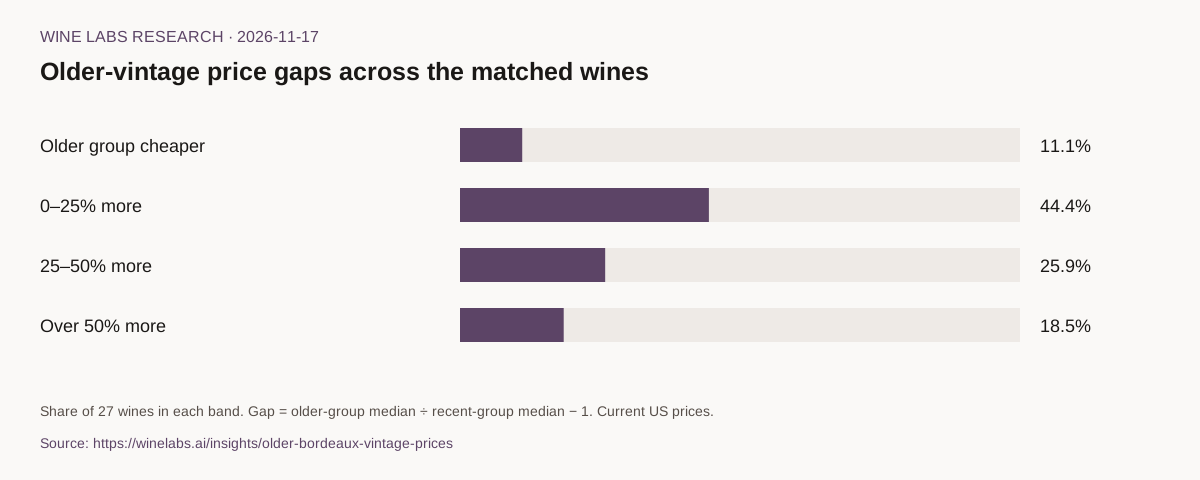
Suggested citation: Wine Labs (2026). Older Bordeaux vintages: what 2000–2010 bottles cost. Published 17 November 2026. https://winelabs.ai/insights/older-bordeaux-vintage-prices
Sources and method
Read-only merchant extract at 2026-11-17T20:44:17.323Z. The fixed 32-wine roster uses estate top wines marked as grand vin in our saved Bordeaux study, restricted to slugs also recorded among its red top wines. This selection was fixed before inspecting price gaps. It is not all Bordeaux, and an estate’s Michelin selection is not a separate award for a bottle.
US merchants, original currency USD, single 750ml bottles, positive finite prices and offers checked within the preceding seven days. We exclude ignored merchants, outlier flags, cases and conflicting sizes in titles, source formats or packaging, non-physical/request-only offer types and explicit unavailable/zero stock. Missing stock quantities can remain; listings are not guaranteed inventory.
Source records are deduplicated by merchant and source-offer ID before eligibility checks, preferring the serving priority then latest check. Merchant branches share a seller group by chain, then normalised website domain, then merchant ID. We take a median within each seller group and a median across groups for every wine-vintage.
There are 2,966 eligible offer rows behind the matched cells, after deduplication. Missing condition fields are retained as unknown; 2,966 rows lack at least one of the five condition fields. Explicit non-standard condition codes are excluded. We have not inspected the bottles or verified storage, recorking or authenticity.
The vintage groups are 2000–2010 inclusive and 2019–2022 inclusive. Each cell needs three seller groups; each wine needs three eligible vintages in each group. We take the median vintage price within each group, then calculate 100 × (older-group median ÷ recent-group median − 1) per wine. The headline is the median of those wine-level gaps. Different numbers and mixes of eligible vintages remain a limitation.
Stored US prices are before sales tax and shipping. Import costs, storage costs and merchant fulfilment are outside the comparison. These are current asking-price benchmarks for different vintages, not release prices, transaction prices, past returns or an estimate of the effect of ageing alone.