Wine Labs · Market intelligence
10 Wine Management Software Suites for Smarter Operations
Compare 10 wine management software suites for merchants, distributors, wineries, restaurants, and collectors, with workflow and market-data guidance.
Most advice on wine management software starts with the wrong assumption, that one system can serve a merchant, distributor, restaurant, winery, and collector equally well. In practice, the useful comparison starts one layer lower, with cataloging, valuation, transaction or POS integration, and market-data freshness. A winery needs a production record and cost visibility, a restaurant needs live depletion and menu sync, and a merchant needs clean identities plus current pricing across channels.
That's why Wine Labs sits beside operational systems instead of replacing all of them. It consolidates retail, auction, exchange, and restaurant pricing into one comparable view, normalizes messy product identities, and feeds data into existing workflows through APIs and custom feeds. The right way to read this list is by operating environment, not by generic feature checklist. Pricing, onboarding effort, and data provenance matter as much as the feature list, and governance disciplines such as governance and KPIs for enterprise operations shape whether the software gets used well.
Table of Contents
- 1. Wine Labs
- 2. WineDirect
- 3. Commerce7
- 4. InnoVint
- 5. vintrace
- 6. BinWise Pro
- 7. Vinosmith
- 8. Wine Owners Business Hub
- 9. Liv-ex
- 10. CellarTracker
- Top 10 Wine Management Software, Features & Pricing
- Build the Data Layer Around the Workflow
<a id="1-wine-labs"></a>
1. Wine Labs

Wine Labs matters most where the problem is market intelligence. It gathers pricing from retail, auction, exchange, and restaurant channels into one comparable view, which helps teams source, price, and value inventory against the same reference point. The company positions the product as wine price intelligence, and that framing fits a market where the main constraint is usually not data volume, but inconsistent product identity across channels. Visit the product site at Wine Labs.
<a id="why-it-stands-out-in-a-fragmented-market"></a>
Why it stands out in a fragmented market
Fine wine workflows break down when teams compare listings that do not match cleanly. Wine Labs addresses that with canonical matching through Wine Matching and Wine Label APIs, REST endpoints, and custom feeds, so merchant, exchange, and catalog systems can share one product record instead of reconciling separate versions later.
That identity layer is the value. Price feeds only help when the bottle in one system is the same bottle in another, which is why canonical matching matters more than raw feed volume for quoting, buying, and valuation.
A 2024 ProWein Business Survey report summarized by Research Nester found that over 75% of wine producers and trade businesses use digital solutions such as ERP systems for finance and accounting, more than half use CRM systems for direct-to-consumer sales, and 50% use digital data management for marketing, while adoption is lower on the production side (Research Nester summary of the ProWein Business Survey). Wine Labs fits the commercial side of that stack, where pricing evidence can change decisions quickly and where cleaner data routing improves downstream systems.
For portfolio work, the platform also includes Cellar Pricer, watchlists, alerts, and portfolio tracking, so valuation does not have to live in spreadsheets. Its editorial layer, including auction digests across 60+ houses and daily news digests from 296 outlets and 215 influencers, gives traders and buyers a faster read on market catalysts without confusing commentary with the pricing engine.
<a id="best-fit-and-trade-offs"></a>
Best fit and trade-offs
- Best fit for: merchants, investors, marketplaces, distributors, and producers that need comparable market pricing.
- Strongest value: canonical identity matching and programmatic delivery into existing systems.
- Main trade-off: it is a market-intelligence layer, not a production suite or a DTC commerce engine.
- Watch before buying: enterprise onboarding can be more technical than a simple SaaS signup, especially for custom feeds or private datasets.
The company does not publish pricing on the site, so buyers need a demo to assess scope and integration effort. That is a drawback for small collectors, but it also signals a product built for teams with active data workflows rather than casual browsing.
<a id="2-winedirect"></a>
2. WineDirect
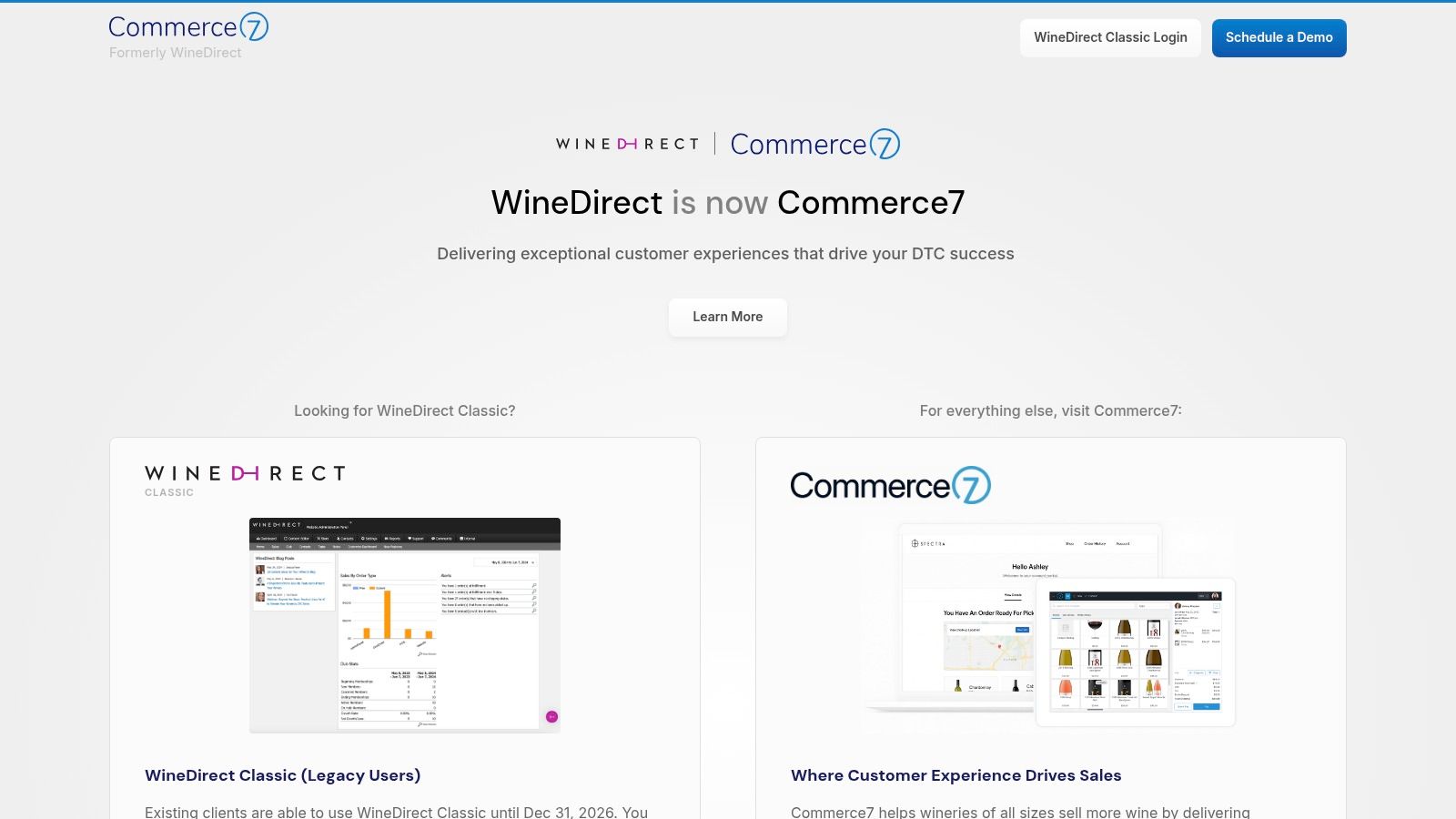
WineDirect makes sense when the business lives and dies by DTC execution. It brings ecommerce, wine club, POS, CRM, and fulfillment into one environment, which is useful for wineries that need tasting room sales and online orders to stay aligned without stitching together multiple vendors. The appeal is operational simplicity, especially for teams that would rather manage clubs, fulfillment, and customer records in one place than debug integrations all week.
<a id="dtc-depth-matters-more-than-broad-feature-count"></a>
DTC depth matters more than broad feature count
WineDirect's strength is not abstract flexibility, it's the practical shape of its workflow. Clubs, loyalty, segmentation, templates, upsell tools, and real-time sync are all aimed at recurring customer relationships and conversion. That makes it a better fit for wineries with active club programs than for businesses that want to model production costs or manage wholesale complexity.
The platform's published pricing also helps buyers plan around growth stages, which isn't always true in winery software. The cost question still matters, especially because transaction fees apply on Starter and Pro tiers, but transparent tiers are easier to evaluate than a fully hidden quote process.
<a id="where-it-fits-and-where-it-doesnt"></a>
Where it fits, and where it doesn't
WineDirect is strongest if the immediate pain is scattered DTC systems, manual order handling, or club churn. It's weaker if you need deep cellar production logic, vineyard planning, or wholesale controls, because those jobs usually require other software alongside it. The right comparison is not “best overall.” It's “best when DTC is the operating center.”
Strong DTC software reduces hidden handoffs. If staff keep rekeying the same customer, order, and fulfillment data, the stack is too loose for a winery that sells directly.
For wineries that want a single vendor to handle the customer-facing side, WineDirect is one of the more coherent options. For businesses that are still evolving their club strategy or fulfillment process, it gives enough structure to support growth without forcing a rebuild later.
<a id="3-commerce7"></a>
3. Commerce7
Commerce7 is the more API-first choice for wineries that want to customize the stack instead of accepting a rigid bundle. It combines ecommerce, clubs, POS, reservations, and CRM, but the draw is how easily it can sit inside a broader digital ecosystem. That matters for brands that already work with design agencies, third-party developers, or specialty tools and don't want their DTC platform to become the bottleneck.
The internal setup for merchants is especially relevant, and Commerce7 even routes users toward a merchant-specific path through its merchant solutions page, which shows how the vendor ecosystem is maturing around specialization rather than one-size-fits-all deployments.
<a id="flexible-plans-are-useful-but-the-platform-still-centers-dtc"></a>
Flexible plans are useful, but the platform still centers DTC
Commerce7 works well when the business wants personalization, allocations, reservations, and club mechanics without giving up control over front-end experience. Its partner ecosystem and API posture make it attractive to teams that care about integration quality as much as checkout flow. That said, production and compliance are not the center of gravity here, so wineries with serious cellar operations will still need adjacent systems.
The platform also gives smaller brands a lower-friction entry path through Lite, which is appealing when a business wants modern commerce tooling without committing to an oversized implementation. The trade-off is that the platform can still charge transaction fees on some plans, so buyers need to model cost against order volume, not just headline price.
The right question isn't whether a DTC suite has every feature. It's whether the APIs, reservations, club logic, and checkout controls match the way your team actually sells.
Commerce7 is a strong fit for wineries that iterate often, test offers quickly, and care about customer experience. It's less compelling if the main challenge is production planning or back-office accounting, because the platform's advantage comes from commerce orchestration, not cellar operations.
<a id="4-innovint"></a>
4. InnoVint
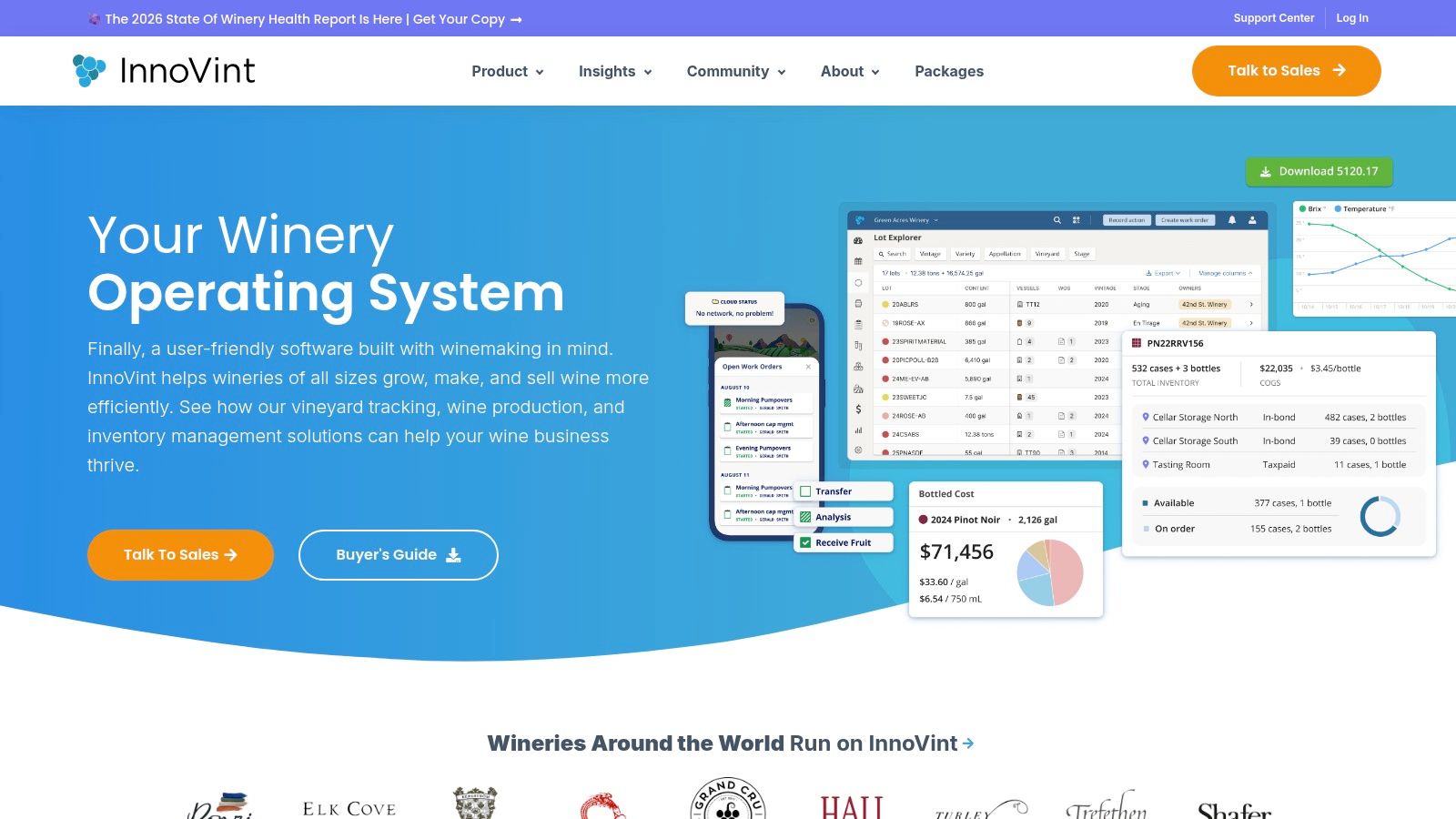
InnoVint is built for producers who need a true winery operating system. It tracks cellar work, production stages, vineyard blocks, and finance in a way that makes sense for people dealing with tanks, lots, harvest timing, and cost visibility. If your pain is not selling bottles online but understanding what they cost and where they are in the production chain, this belongs near the top of the shortlist.
<a id="production-visibility-changes-pricing-decisions"></a>
Production visibility changes pricing decisions
The Finance module's real-time COGS by lot and SKU is the most important part of the product for commercial decision-making. That's because producers can't price confidently if they only know top-line inventory counts. They need to understand the cost of the wine that's moving, aging, and being allocated. InnoVint's Grow module also extends the system into block tracking, estimates, and harvest planning, which makes it more useful than generic cellar software.
Its integrations with labs, tank monitoring systems, and DTC platforms matter because production data becomes more valuable when it can flow outward. A winery doesn't need another isolated dashboard. It needs production truth that can inform fulfillment, reporting, and margin management.
<a id="where-the-complexity-pays-off"></a>
Where the complexity pays off
The downside is predictable. Quote-based pricing and advanced costing workflows can be too much for very small producers, especially if the team is still running lean and doesn't have someone who can own the implementation. The learning curve is also real, because finance and production workflows are less forgiving than simple inventory lists.
That said, the payoff is operational clarity. Teams that need lot-level cost insight and live cellar tracking usually end up outgrowing lightweight tools anyway. InnoVint is built for that moment, when the business needs production control more than it needs another sales dashboard.
<a id="5-vintrace"></a>
5. vintrace
vintrace is the enterprise-leaning pick for wineries that need scale, compliance discipline, and connected back-office operations. It covers production management, finished goods, tax handling, costing, and integrations, which makes it better suited to mid-size and larger wineries than to hobbyist or micro-producer setups. The product's value is not just that it stores information, but that it links maker-to-market processes without forcing staff to reconcile everything by hand.
<a id="built-for-complex-winery-operations"></a>
Built for complex winery operations
The reason vintrace stands out is that it treats winery work as a chain of dependent events. Work orders, stock movement, accounting links, and finished goods all matter because each stage affects the next. That's especially relevant for custom crush operations, where different clients, lots, and accounting requirements can overlap inside the same facility.
Its ecosystem connections, including accounting and weigh-scale integrations, are practical rather than flashy. They reduce manual entry and make stock, costing, and compliance easier to maintain across departments. The documentation and knowledge base also help buyers evaluate whether the workflow fit is strong enough before committing to a sales cycle.
<a id="best-for-teams-that-have-outgrown-lighter-tools"></a>
Best for teams that have outgrown lighter tools
vintrace will feel heavy if your winery is tiny and your process is simple. That's not a flaw, it's a clue. This platform is for businesses where the cost of error is high enough that a more structured system is worth the onboarding effort.
If you need one system to anchor production, compliance, and costing while still connecting to accounting and external tools, vintrace is a strong enterprise option. If you mainly need marketing, ecommerce, or direct sales, it's the wrong layer of the stack.
<a id="6-binwise-pro"></a>
6. BinWise Pro
BinWise Pro is the clearest fit for on-premise beverage operations. Restaurants, hotels, clubs, and wine bars use it to manage cellar inventory, vintage-level tracking, depletion, purchasing, and digital wine lists. That makes it a better category match than generic inventory software, because beverage teams need bottle-level accuracy and live menu coordination, not just stock counts.
<a id="pos-connectivity-is-the-operational-backbone"></a>
POS connectivity is the operational backbone
The platform's value comes from its integrations with major POS systems such as Micros, Toast, Lightspeed, and Square. That matters because restaurant teams often lose time reconciling sales, pour counts, and list changes across separate tools. When the POS and the wine list stay in sync, staff spend less time fixing discrepancies and more time serving guests.
BinWise Pro also supports digital and QR wine lists, which are useful when the menu changes often or when a property manages multiple outlets. Purchasing, invoicing, and variance analytics add another layer of control, so beverage managers can watch depletion and cost behavior instead of reacting after the fact.
Practical rule: for restaurant wine programs, the software is only as good as the POS data and the team's discipline around updates.
The trade-off is that the system depends on good process. If the property enters sales poorly or lets inventory drift, the reporting will reflect that mess. Pricing is not public, so buyers should expect a sales conversation before they can judge whether the platform fits the size and complexity of their beverage program.
<a id="7-vinosmith"></a>
7. Vinosmith
Vinosmith is tuned for the wholesale side of the wine business, especially distributors and importers that need CRM, inventory, orders, allocations, and depletion tracking in one place. It is not trying to be a winery production suite or a consumer-facing commerce platform. Its strength is helping sales teams and warehouse operations stay coordinated as products move from supplier to customer.
<a id="wholesale-workflows-need-more-than-contact-management"></a>
Wholesale workflows need more than contact management
A lot of CRM tools stop at pipeline visibility. Vinosmith goes further by tying tasting notes, warehouse inventory, allocations, and order handling together. That's important in a distributor environment, where the same bottle may need to be tracked across sales reps, stock locations, and customer commitments.
The fact that accounting integrations are available during onboarding is also useful, because wholesale businesses rarely run on isolated software. Orders need to reach finance without manual cleanup, and inventory needs to reflect actual depletion, not just planned movement. That's the kind of operational fit that makes a specialty platform worth considering.
<a id="good-for-structure-not-for-production-depth"></a>
Good for structure, not for production depth
Vinosmith is less attractive if you need vineyard, cellar, or fermentation workflows. It isn't meant for that. But for importers and distributors trying to tighten portfolio visibility and sales execution, it offers a more relevant workflow than general CRM software or simple inventory tools.
The lack of public pricing means buyers will need to validate scope through a demo. For wholesalers with moving parts across sales and warehouse teams, that extra step is usually worth it if the alternative is patching together spreadsheets.
<a id="8-wine-owners-business-hub"></a>
8. Wine Owners Business Hub
Wine Owners Business Hub is strongest for fine-wine merchants who need inventory, purchasing, channel-specific pricing, CRM, webshop, and private client reserve management in one merchant system. It's built around the realities of resale, reserves, and multi-channel pricing rather than around winery production or consumer cellar tracking. That makes it a better fit for retailers, importers, and wholesalers who need the system to understand inventory as a commercial asset.
<a id="merchant-logic-is-the-point"></a>
Merchant logic is the point
Private client reserves and collection management are not minor extras. They're central to how fine-wine merchants manage scarce bottles, client relationships, and fulfillment obligations. Add marketplace and exchange connections, and the platform becomes a commercial hub rather than a simple stock list.
The modular structure is helpful for firms that want to start with core functionality and expand as they grow. That can reduce the risk of overspending on features that the business won't use immediately. It also makes the platform more adaptable for merchants who need a stronger back office as their channel mix gets more complicated.
<a id="the-caution-is-implementation-weight"></a>
The caution is implementation weight
The materials available publicly feel a bit dated, and pricing isn't easy to verify. That makes evaluation harder than it should be. Still, the category fit is strong, especially for businesses that want a wine-specialist data model rather than a generic retail system.
If your operation depends on fine-wine inventory discipline, client reserve handling, and channel-specific pricing, Wine Owners deserves attention. If you need a light, modern DTC tool, it's probably more system than you want.
<a id="9-liv-ex"></a>
9. Liv-ex
Liv-ex is the most relevant choice when the workflow is exchange access and market data, not general wine operations. It combines live trading, market data, indices, and standardized product codes, which makes it useful for merchants and investment-led wine businesses that need a reliable reference layer for pricing and trade execution.
<a id="standardization-is-the-hidden-value"></a>
Standardization is the hidden value
Its LWIN identifiers matter because product identity is the first place wine data breaks down. When lists use inconsistent naming conventions, every downstream process gets noisier, from valuation to trading to reconciliation. Liv-ex also offers data services and Wine Matcher tools that help standardize lists and clean up merchant records.
A standardized identity model becomes even more useful when paired with market intelligence. That's where Wine Labs' fine wine market data can complement exchange workflows, especially for teams comparing prices across retail, auction, exchange, and restaurant channels before making a move.
<a id="best-for-merchants-and-investors-not-full-operators"></a>
Best for merchants and investors, not full operators
Liv-ex is not a DTC platform and it is not a production suite. It's an exchange-centric environment with trading and pricing context. That makes it ideal for businesses that care about liquidity, market reference prices, and broker support, and less suitable for wineries that need cellar, club, or hospitality workflows.
The access model also matters. Membership and data requirements are part of the value proposition, but they create a barrier for casual users. For serious market participants, that trade-off is acceptable because the platform is built around actual trading behavior rather than passive browsing.
<a id="10-cellartracker"></a>
10. CellarTracker
CellarTracker remains one of the most useful choices for private collectors who want bottle-level tracking, valuations, and community insight. It's not built for commercial winery operations or restaurant inventory, but it excels at helping collectors see what they own, where it is, and what the broader community thinks about drinking windows and quality. For many households and advisors, that's enough.
<a id="community-scale-is-useful-but-not-always-clean"></a>
Community scale is useful, but not always clean
The platform's strength is its massive database and active user base. That gives collectors a broad body of tasting notes and valuation context, which is helpful when the goal is personal cellar management rather than commercial reporting. Mobile access and import-export tools also make it practical for people who manage collections across multiple devices.
The downside is the same one that affects many user-generated systems, data consistency varies. That doesn't make CellarTracker bad, but it does mean advisors and collectors should check entries carefully before using them as the basis for valuation or purchase decisions.
Community data helps with context. It doesn't replace a controlled market-data layer when the decision is financial.
For collectors who want a cellar tool with a low barrier to entry, CellarTracker is hard to ignore. If the work involves commercial pricing, exchange trading, or programmatic feeds, it should sit alongside a more structured market-intelligence platform rather than stand alone. Wine Labs' Cellar Pricer is the kind of complement that turns a personal inventory file into a valuation workflow.
<a id="top-10-wine-management-software-features-and-pricing"></a>
Top 10 Wine Management Software, Features & Pricing
| Product | Core features | Quality ★ | Price & Value 💰 | Target 👥 | USP ✨/🏆 |
|---|---|---|---|---|---|
| Wine Labs 🏆 | Cross-channel price DB (retail/auction/exchange/restaurant), real-time ingestion & alerts, canonical matching, APIs, Cellar Pricer & AI MCP | ★★★★★ | 💰 Quote/demo; free account option & enterprise feeds | 👥 Merchants, collectors, exchanges, analysts, investors | ✨ Canonical identity + cross-channel like‑for‑like pricing; API‑first; AI agents; editorial digests |
| WineDirect | DTC suite: ecommerce, POS, wine club, CRM, fulfillment & templates | ★★★★ | 💰 Transparent tiered plans; starter/pro tiers have txn fees | 👥 Wineries focused on DTC & club growth | ✨ Integrated DTC + fulfillment; strong club tooling |
| Commerce7 | API‑first DTC: ecommerce, clubs, POS, reservations, personalization | ★★★★ | 💰 Multiple plans incl. low‑cost Lite; some txn fees on plans | 👥 Brands wanting customizable, integrable DTC stacks | ✨ API‑forward, partner ecosystem, Lite plan option |
| InnoVint | Winery production OS: cellar, Grow, Finance, tank & lab integrations | ★★★★ | 💰 Quote-based; can be significant for small producers | 👥 Producers needing production workflows & COGS visibility | ✨ Deep production & cost-accounting workflows |
| vintrace | Enterprise production, compliance, costing, finished‑goods & integrations | ★★★★ | 💰 Quote/enterprise sales | 👥 Mid-to-large wineries, custom crush facilities | ✨ End‑to‑end compliance + accounting integrations |
| BinWise Pro | Beverage inventory, vintage tracking, POS integrations, digital lists | ★★★★ | 💰 Quote-based; typically premium | 👥 Restaurants, hotels, bars, multi‑site operators | ✨ POS sync, BTG control, live digital wine lists |
| Vinosmith | CRM, inventory, orders/allocations, depletion & analytics for wholesalers | ★★★★ | 💰 Quote/demo based | 👥 Distributors, importers, sales teams | ✨ Wholesale-focused CRM & allocation workflows |
| Wine Owners (Business Hub) | Merchant inventory, channel pricing, CRM, webshop, private client reserves | ★★★★ | 💰 Modular pricing; limited public details | 👥 Fine‑wine merchants, retailers, importers | ✨ Merchant data model + marketplace/accounting links |
| Liv‑ex | Global exchange: live trading, market data, indices, LWIN & Wine Matcher | ★★★★★ | 💰 Membership tiers; data‑only access available | 👥 Merchants, investors, brokers, traders | ✨ Live liquidity + LWIN standardization for market reconciliation |
| CellarTracker | Consumer cellar app: bottle tracking, valuations, tasting notes, mobile apps | ★★★★ | 💰 Low‑cost subscriptions; community-driven | 👥 Private collectors, advisors, enthusiasts | ✨ Massive user community, tasting notes & practical cellar tools |
<a id="build-the-data-layer-around-the-workflow"></a>
Build the Data Layer Around the Workflow
The decision process should start with the operating environment, not with a feature list. A winery that needs lot-level costing and harvest planning should start with production software. A restaurant needs POS-linked beverage control. A merchant needs clean cataloging, pricing, reserves, and channel management. A collector needs bottle-level tracking and valuation support. Once that environment is clear, the next question is the system of record, because the best platform is the one your team will maintain.
From there, test catalog and identity quality. Wine software often succeeds or fails at this stage. If names, vintages, and pack formats are inconsistent, everything downstream gets harder, from inventory to valuation to search. In a category where fragmented tools are common and teams can end up acting as “human middleware,” canonical identities are not a luxury, they're the mechanism that lets software work at all.
Then verify valuation sources and update frequency. A static price file is not enough for a market that changes across retail, auction, exchange, and restaurant channels. If your team needs current market context, ask whether the platform refreshes often enough to support quoting and buying decisions. If you need market data inside existing workflows, look for APIs, REST endpoints, or custom feeds, not just exports.
After that, map the integration surface. POS, accounting, exchange access, and custom feeds matter because the software must fit the business around it. For wineries, that might mean DTC and production systems. For merchants, it might mean pricing and catalog automation. For restaurants, it might mean menu sync and depletion tracking.
Before migrating anything important, pilot representative products and workflows. Test a mix of common and difficult bottles, not just easy records. Validate how the platform handles messy product names, stale data, reserve stock, and edge cases that mirror real operations. That's the fastest way to see whether the tool is fit for purpose or just polished in a demo.
For teams that need to compare retail, auction, exchange, and restaurant prices, automate matching, or push market data into existing systems, a separate intelligence layer such as Wine Labs is often the cleaner answer. Operational suites keep the business moving. Market-intelligence software keeps the numbers honest. Use both where the workflow demands both.
If your team needs a clean market-data layer on top of existing winery, merchant, or collector workflows, Wine Labs is built for that job. It consolidates cross-channel pricing, normalizes product identities, and delivers data through APIs and custom feeds so your current systems can keep working. Visit Wine Labs to see how it can support smarter pricing, sourcing, and valuation decisions.