Wine Labs · Market intelligence
Wine Auction Database Guide 2026: Fields, Sources, Uses
Wine auction database guide for 2026: learn what fields, sources and ingestion methods power fine-wine pricing, plus vendor evaluation and integration tips.
Wine auction databases are only useful when they behave like engineered market infrastructure, not like a loose stack of hammer prices. A serious dataset can hold millions of trades across hundreds of thousands of wines, but scale alone doesn't make the numbers comparable. Whether the system can normalize catalogues, resolve identity, and preserve provenance well enough that a valuation team, merchant, or collector can trust the output is the fundamental question.
That's why the best way to judge a wine auction database is to inspect its field design and ingestion logic before you look at its headline size. A database that spans 4 million+ trades and 250,000+ unique wines can support meaningful benchmarks only if the records are structured around canonical identities and consistent lot-level fields, not just scraped into a table. The same goes for coverage over time, because an archive that stretches from 1985 to the present gives you a different kind of market memory than a short snapshot does, especially when you're trying to separate real signal from venue noise.
Table of Contents
- What a Wine Auction Database Actually Is
- Core Data Fields in a Wine Auction Database
- How Auction Records Get Ingested and Normalized
- Use Cases That a Wine Auction Database Enables
- Vendor Evaluation Checklist for a Wine Auction Database
- Coverage Bias and the Limits of Auction Benchmarks
- Integrating a Wine Auction Database Into Your Stack
- Building a Wine Auction Database You Can Actually Trust
<a id="what-a-wine-auction-database-actually-is"></a>
What a Wine Auction Database Actually Is
A wine auction database is a data product, not a spreadsheet of sale prices. It ingests house catalogues, extracts lot details, resolves messy listings to canonical wines, and exposes the result in a form analysts can query, compare, and automate against. That distinction matters because auction houses do not describe the same bottle in the same way, and a raw export rarely tells you whether two records are comparable.
<a id="scale-only-matters-after-structure"></a>
Scale only matters after structure
Wine Market Journal says it reports over 4 million trades across more than 250,000 unique wines, and its archive and search coverage says the archive contains over 3.6 million wine values with auction coverage from 1985 to the present across Europe, Asia, North America, and online venues Wine Market Journal's archive and search coverage. Those figures matter because they show what an engineered archive can support when it spans multiple market cycles and venue types. A few hundred sale results can hint at a market. Several million transactions can support repeated price points, liquidity checks, and vintage-by-vintage comparison.
<a id="queryable-is-not-the-same-as-complete"></a>
Queryable is not the same as complete
A market dataset becomes useful when it answers the same question the same way every time. That means one record per lot, one canonical wine identity, one sale date, and one realized price convention. iDealwine's auction estimate base says it holds more than 3 million prices registered in French auctions since 1992. Another dataset says it holds 753,000+ auction records from 170+ auction houses worldwide with coverage from 1911 to today and daily updates iDealwine's pricing base and global auction dataset coverage. Breadth only helps when the records can be aligned and reused.
Canonical identity resolution is the critical test. If two lots can't be matched to the same wine with enough confidence, the system is still a lookup table, just with a larger surface area.
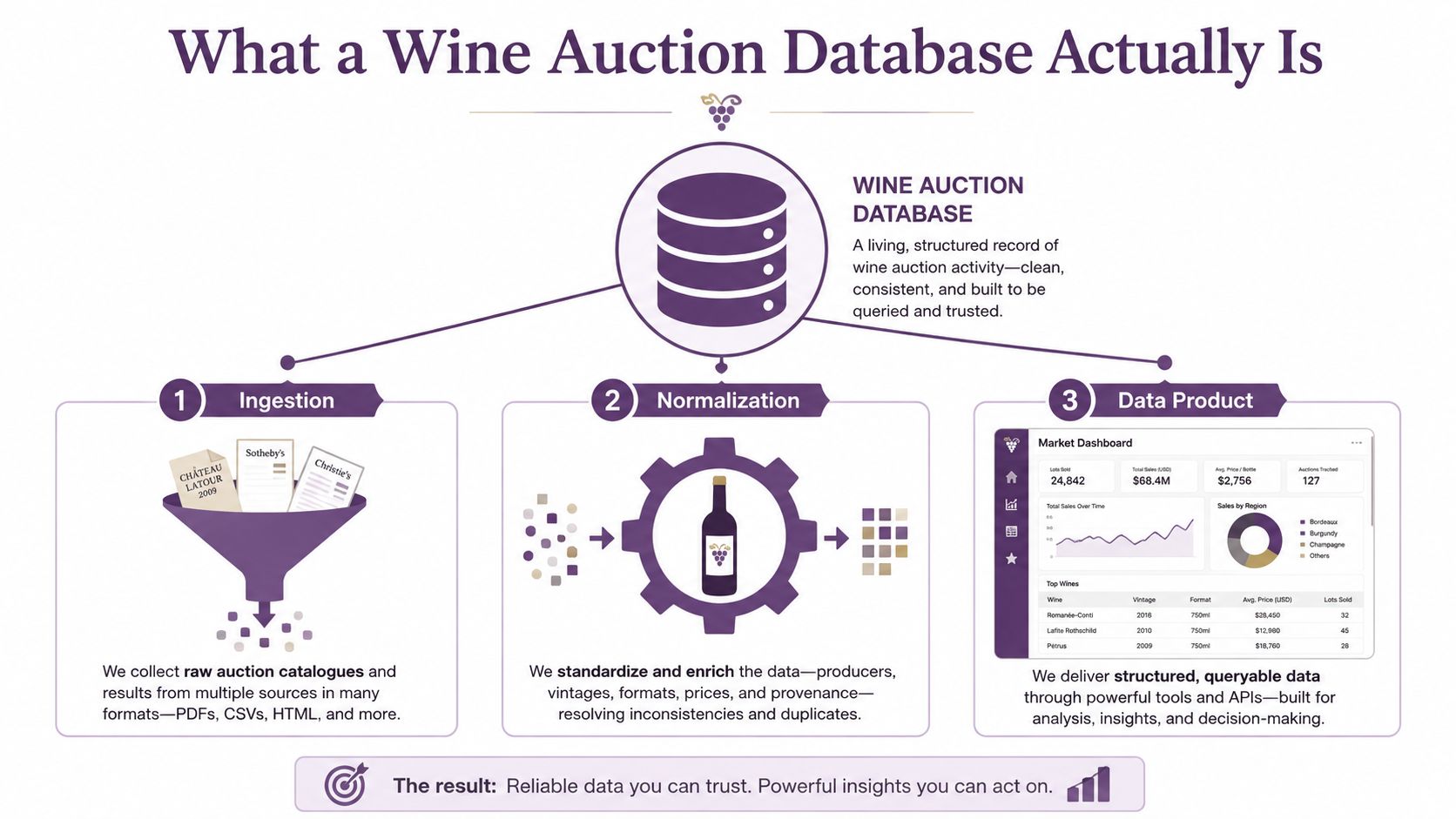
A polished data product should also make normalization visible. If the record still depends on free text for bottle format, label variant, or condition, the analyst has to clean the data again before any valuation work starts. That is the line between a raw archive and a decision system.
<a id="core-data-fields-in-a-wine-auction-database"></a>
Core Data Fields in a Wine Auction Database
A wine auction database is only useful if its fields support comparison, not just storage. It has to show what the lot was, who sold it, when it sold, how it was packaged, and how the price was calculated. If those elements stay implicit, valuation work drifts into guesswork.
<a id="the-lot-header-should-anchor-every-record"></a>
The lot header should anchor every record
Each record should start with a lot identifier, auction house, sale date, lot URL, producer, wine name, and vintage. Bottle format and lot composition matter just as much, because a single lot can contain multiple bottles and mixed lots are not equivalent to homogeneous ones. A peer-reviewed study built training data from 2,450,000 auction prices across 14 houses and separately tracked 6,946 heterogeneous lots, which shows how much lot design affects model quality and comparability the study on auction-price training data and heterogeneous lots.
<a id="provenance-and-condition-are-value-fields-not-metadata"></a>
Provenance and condition are value fields, not metadata
Provenance should be treated as a first-class field set. Expert auction guidance treats chain-of-custody, storage location, prior ownership, bottle format, fill level, label state, and documentation as value-bearing attributes, not optional notes auction software guidance on provenance and condition fields. Structured fields for acquisition source, cellar movement, and image attachments belong in the schema. Free text is too weak when the same bottle can command different buyer confidence depending on its history.
<a id="realized-price-needs-decomposition"></a>
Realized price needs decomposition
Realized price needs decomposition. The record should separate hammer price, buyer's premium, and tax or VAT handling. Market datasets often price by realized hammer value for a uniform lot and include buyer's premium while excluding tax or VAT, so apples-to-apples comparison depends on a defined convention. Currency and conversion date also matter, especially in a dataset that spans multiple regions. Without those fields, two sales can look comparable when they are not.
| Field Group | Examples | Why It Matters |
|---|---|---|
| Lot header | Lot ID, auction house, sale date, lot URL | Creates a stable record anchor and supports traceability |
| Wine identity | Producer, wine name, vintage, canonical wine ID | Makes cross-house comparison possible |
| Physical lot details | Bottle format, lot composition, quantity | Separates homogeneous lots from noisy mixed lots |
| Provenance and condition | Ownership chain, storage history, fill level, label state, images | Captures value-bearing quality signals |
| Price and currency | Hammer price, buyer's premium, tax/VAT treatment, currency, conversion date | Enables clean realization comparisons across markets |
The analytical sweet spot is a homogeneous lot, where all bottles share the same label, vintage, size, and ideally condition. When those fields are missing or vague, the record should be flagged, not averaged. That is where many price systems lose precision before analysis even begins.
Explore how structured market fields can support fine-wine workflows
<a id="how-auction-records-get-ingested-and-normalized"></a>
How Auction Records Get Ingested and Normalized
A wine auction database is only as useful as its ingestion layer. Catalogue pages arrive as PDFs, image-heavy lot pages, and inconsistent HTML, and each format has to be converted into one schema before analysis starts. If that step is weak, the archive may still look large, but the records are not reliable enough to compare.
<a id="from-catalogue-to-canonical-record"></a>
From catalogue to canonical record
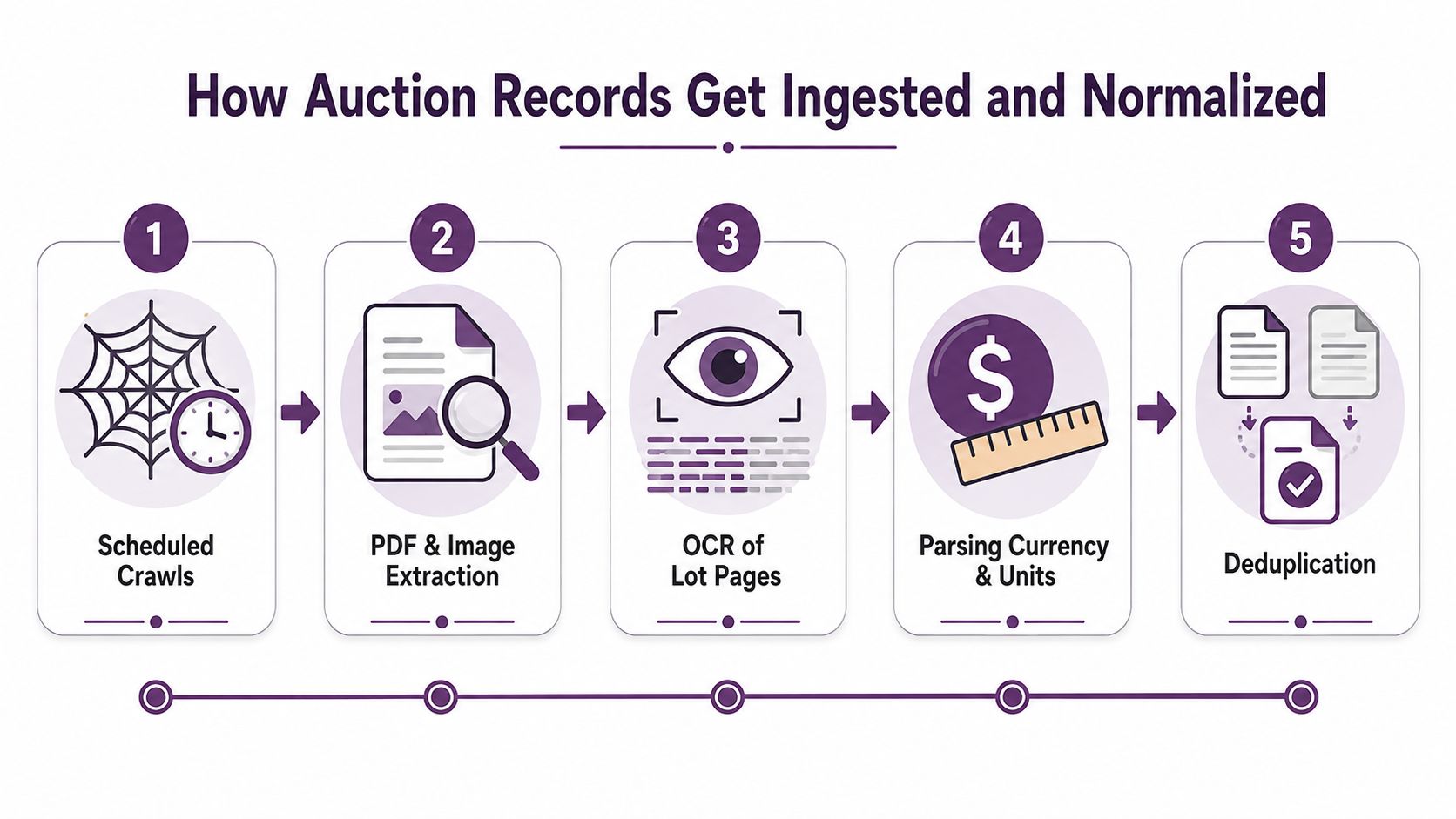
A practical pipeline starts with scheduled crawls, then moves through PDF and image extraction, OCR of lot pages, parsing of currency and units, and deduplication against canonical wine identities. Each stage removes a different kind of noise. Spelling drift, vintage formatting changes, and house-specific shorthand can all make two listings look different when they represent the same wine.
<a id="identity-resolution-is-the-central-bottleneck"></a>
Identity resolution is the central bottleneck
Canonical identity matching stitches fragmented listings into one usable record. Wine labels, lot notes, and LWIN-style identity logic all need to point to the same wine concept, or cross-house analysis breaks down. Wine Labs describes its platform as using canonical identity matching to link heterogeneous listings and normalize messy names and LWIN codes into one record, which is the right engineering problem to solve before any price comparison is trusted. That is why an API should be judged on identity quality, not only on endpoint count.
A fresh record with unresolved identity is less useful than a slightly delayed record that is correctly matched.
<a id="real-time-should-mean-current-enough-for-the-job"></a>
“Real time” should mean current enough for the job
In auction data, real time rarely means continuous market ticks. It usually means the system ingests new catalogue material, sale results, and backfill updates fast enough to affect sourcing and valuation decisions. Daily updates matter in that context, especially when the provider also supports historical replay, because archive value comes from pairing fresh records with long-run context, as noted earlier.
Read the daily market workflow behind auction digestion and backfill to see how that ingestion and cleanup cycle works in practice.
The harder question is not whether a platform updates often. It is whether it can show how stale a live record may be, and whether its normalization rules are consistent enough to support benchmark design without manual cleanup.
<a id="use-cases-that-a-wine-auction-database-enables"></a>
Use Cases That a Wine Auction Database Enables
The same database can support very different workflows depending on the question. A merchant wants a quote anchor. A portfolio analyst wants a mark. A sourcing team wants to know where a target bottle is most likely to appear. A collector wants alerts when a specific wine enters a house sale. The schema stays the same, but the query shape changes.
<a id="pricing-intelligence-asks-for-comparables-not-headlines"></a>
Pricing intelligence asks for comparables, not headlines
If you are pricing a bottle for resale, the useful query is not “what did it sell for last month.” It is “what did the same canonical wine sell for in comparable venue types, formats, and condition bands.” That requires explicit lot fields, realized price decomposition, and a clean identity layer. Without those, a pristine three-bottle lot gets compared with a mixed case, and the result looks precise while being misleading.
<a id="valuation-is-a-portfolio-problem"></a>
Valuation is a portfolio problem
For mark-to-market work, the database has to support repeated valuation across a full cellar, not just one trophy bottle. That means the analyst needs canonical IDs, historical price paths, and enough coverage depth to avoid leaning on a one-off result. Liv-ex says its Fine Wine 100 lets users see the price a wine has sold at for the past 26 years and in real time, including current offers and live bids, which shows how long-run price visibility changes portfolio tooling Liv-ex Fine Wine 100 coverage. Auction data serves a different role, it captures realized sale behavior when a bottle changes hands.
<a id="sourcing-and-alerts-depend-on-freshness"></a>
Sourcing and alerts depend on freshness
A sourcing team needs to know where a target lot is appearing, while an alerting workflow needs to know when a target wine crosses a price band or enters a curated sale. In that setting, ingestion cadence matters more than archive glamour. If a database can surface new sale inclusions quickly, it becomes a decision feed, not just a research archive.
A merchant does not need more data points. The merchant needs the right comparable at the moment a quote has to be made.
One practical example is a search for a mature Burgundy from a known producer. A broad archive can show repeated auction appearances, but the team still needs to inspect lot composition, provenance fields, and premium handling before deciding whether the realized result is comparable. At that point, the database is no longer reference material. It is workflow infrastructure.
<a id="vendor-evaluation-checklist-for-a-wine-auction-database"></a>
Vendor Evaluation Checklist for a Wine Auction Database
Buying a wine data product is closer to evaluating a supply chain than evaluating a report. You're not just asking whether the dataset is large. You're asking whether it is current, comparable, and safe to operationalize. If a vendor can't answer those questions cleanly, the database will create more cleanup work than it saves.
<a id="score-the-provider-on-the-fields-that-change-outcomes"></a>
Score the provider on the fields that change outcomes
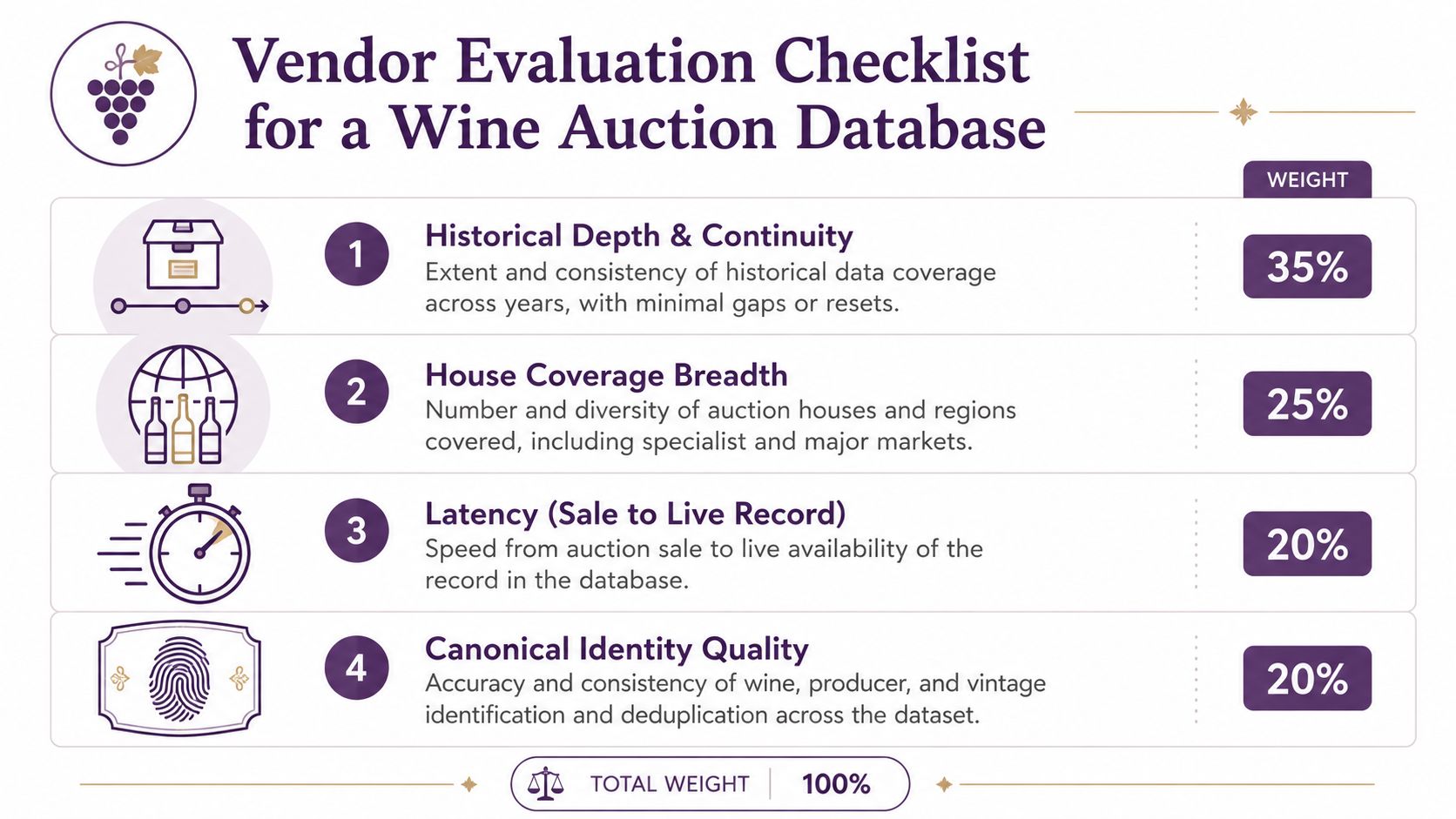
A useful checklist should weight historical depth, house coverage breadth, latency, canonical identity quality, provenance and condition support, currency handling, API design, historical replay, and licensing terms. If you already run vendor reviews elsewhere in your stack, it helps to treat this the same way you'd improve vendor management with automation, because the evaluation logic should be repeatable, not ad hoc.
| Criterion | What to Verify | Pass Signal |
|---|---|---|
| Historical depth | Does the archive span enough years to support trend analysis? | Records extend across multiple market cycles |
| House coverage breadth | Are major venues and relevant regional houses included? | Broad, documented venue list with gaps disclosed |
| Latency | How fast do sale results and new lots appear? | Clear freshness policy and update rhythm |
| Canonical identity quality | Are label variants, LWIN-style IDs, and name changes resolved? | Same wine matches consistently across houses |
| Provenance and condition support | Are these structured fields, not free text? | Dedicated fields for history and condition |
| Currency handling | Are premiums, tax, and FX logic explicit? | Comparable realized values across regions |
| API design | Can you query lots, identities, and price history cleanly? | Stable endpoints and documented schema |
| Historical replay | Can you reconstruct a past view of the market? | Time-aware outputs and backfill support |
| Licensing terms | Can the data be used in your workflows? | Rights align with internal and customer use |
<a id="the-questions-to-ask-before-you-sign"></a>
The questions to ask before you sign
Ask how the provider handles backfill, duplicate lots, and mixed-format records. Ask whether the same canonical wine ID survives house-specific naming changes. Ask how premiums and taxes are represented. If the answers are vague, the platform may be fine for browsing, but it won't be reliable for pricing or valuation.
The right vendor conversation is often about workflow discipline. Wine Labs, for example, positions its market data around canonical identities, real-time ingestion, and programmatic access, which is exactly the type of architecture a buyer should inspect before integrating any auction feed into a live system. The product label matters less than whether the schema and update logic can stand up to repeated use.
<a id="coverage-bias-and-the-limits-of-auction-benchmarks"></a>
Coverage Bias and the Limits of Auction Benchmarks
Auction data looks objective because it records realized sales, yet it still reflects what a dataset captured, not the full market. That is the core limitation. If an archive misses certain houses, regions, or bottle formats, average prices can drift toward the venues that publish most consistently or are easiest to ingest.
<a id="benchmarks-are-samples-not-censuses"></a>
Benchmarks are samples, not censuses
Academic work notes that auction records can be incomplete because not every auction is captured in the dataset, so missingness itself shapes the result thesis on incomplete auction records and market coverage. If a database under-captures one house or one bottle format, the apparent average can skew up or down depending on what is absent. A benchmark only works if its coverage limits are explicit.
<a id="channel-mix-can-distort-the-story"></a>
Channel mix can distort the story
Recent market reporting shows why a single auction price can mislead. iDealwine's 2026 barometer said organic and biodynamic wines reached 29.9% of volume and 36.2% of value in 2025, while demand for older vintages softened in aggregate even as some houses saw strong interest in mature bottles iDealwine's 2026 barometer. That kind of mix shift means a benchmark needs adjustment for region, maturity, provenance, and venue mix. Otherwise, the average price can describe the channel more than the wine.
<a id="treat-the-average-with-suspicion"></a>
Treat the average with suspicion
If your dataset misses private sales, off-market transfers, or lower-visibility venues, it may overstate active auction appetite. If it overweights one geography, it can misread regional demand as a global price trend. The right response is to measure the coverage pattern first, then use auction data as one input among several. If you are evaluating a platform's stated reach, check the platform's documented data coverage before trusting any benchmark.
<a id="integrating-a-wine-auction-database-into-your-stack"></a>
Integrating a Wine Auction Database Into Your Stack
Integration is where data quality gets tested by real workflows. If the database sits outside your tools, it stays a reference library. Once it plugs into your portfolio tracker, marketplace, or merchant system, every schema decision starts to matter.
<a id="lock-the-identity-model-first"></a>
Lock the identity model first
Before the API goes live, decide whether your internal object is a canonical wine ID, a house-specific SKU, or both. That choice affects duplicate handling, pricing rollups, and how alerts fire across venues. REST endpoints for lot lookup and identity lookup are useful only if the same record can be resolved the same way in every downstream app.
<a id="build-for-backfill-and-change-detection"></a>
Build for backfill and change detection
Bulk feeds matter when you're backfilling catalogues or rebuilding history, while webhook-style alerts matter when you want to react to fresh sale inclusions or price movements. The key integration question is whether the provider can support both historical replay and forward updates without breaking your own data model. The practical concern is freshness, but the primary concern is consistency across time.
Integration rule: don't connect on the basis of one happy-path record. Test how the feed behaves when labels shift, lots split, or currency fields change.
A good implementation checklist should also cover rate limits, versioning, and how null values are represented. If the provider exposes raw lot records, make sure your system can retain source URLs and provenance notes alongside normalized fields. That way, analysts can trace a valuation back to the original catalogue instead of treating the API response as unquestionable truth.
For teams documenting internal workflows, essential data integration tips for 2025 is useful background on how to think about schema stability, sync cadence, and failure handling before you wire up any external data feed.
<a id="building-a-wine-auction-database-you-can-actually-trust"></a>
Building a Wine Auction Database You Can Actually Trust
A trusted wine auction database comes down to four things, field design, ingestion discipline, canonical identity, and honest coverage disclosure. If any one of those is weak, the archive may still look broad, but the numbers won't be dependable enough for pricing or portfolio decisions. That's the difference between a brittle historical dump and a decision-grade market product.
The fastest way to test a database is simple. Pick one wine, trace it across three houses, and check whether the fields align, the prices reconcile, and the history reaches far enough back to support the decision you need to make. If the record breaks on identity, hides condition, or glosses over lot composition, you've found the weak point before the weak point found you.
Wine Labs builds around those same constraints, with canonical identities, real-time market data across channels, and programmatic access for pricing and sourcing workflows. If you're evaluating a wine auction database for portfolio, merchant, or catalog use, visit Wine Labs and test whether the data model fits the decisions you need to make.