Wine Labs · Market intelligence
Vermentino Di Gallura: A Practical Guide to the DOCG
Explore Vermentino di Gallura, Sardinia's only DOCG white. Learn about its terroir, styles, leading producers, and current market price ranges.
Vermentino di Gallura is Sardinia's first and only DOCG, yet its production base remains surprisingly concentrated. Depending on the reference and measurement method, the denomination represents about 1,150 to 1,416 hectares, with one source reporting just under 536,000 cases annually and another recording 40,900 hectolitres of average production in 2021 (Wine With Seth's denomination reference). That contrast explains the buying opportunity: this is more than just another Mediterranean white; it is a tightly defined regional wine whose price can reflect geology, classification, producer scale, and scarcity.
For merchants, the label offers a useful market distinction. A bottle carrying Vermentino di Gallura DOCG comes from a legally bounded appellation with strict compositional and production requirements. For buyers, the practical question is whether a higher shelf price represents terroir and category depth, or merely a premium label attached to a familiar grape.
Table of Contents
- What Makes Vermentino di Gallura a Distinct Place
- The Legal Milestones Behind the DOCG
- Terroir and How Granite Shapes the Wine
- Standard, Superiore, and Passito Styles Compared
- Producers Worth Knowing Across Price Tiers
- Current Market Prices and Supply Signals
- Why Demand Is Growing Beyond Italy
- How to Buy Vermentino di Gallura With Confidence
<a id="what-makes-vermentino-di-gallura-a-distinct-place"></a>
What Makes Vermentino di Gallura a Distinct Place
Gallura occupies Sardinia's wind-exposed northeast, where weathered granite meets the Mediterranean. The appellation's wines often open with citrus pith and white peach, then tighten into a saline, mineral finish reminiscent of crushed stone. That sequence gives the category a useful market profile: broad enough for retail appeal, yet more structured and site-marked than softer, more neutral Vermentino.
Geography does the differentiating work. Vermentino is grown across coastal Italy, including Sardinia, Liguria, and Tuscany, while Vermentino di Gallura comes from Gallura's particular mix of granite, heat, light, and maritime exposure. Technical coverage connects its fast-draining, heat-retentive granite soils with deep rooting, preserved acidity, and a pronounced mineral edge (Great Italian Food Trade's overview of Vermentino di Gallura).
<a id="a-bounded-category-not-a-generic-island-white"></a>
A bounded category, not a generic island white
The distinction is practical at the shelf. “Vermentino di Sardegna” identifies the grape and island, but the DOCG label narrows the proposition to origin within the Gallura denomination and compliance with its production rules. Merchants can therefore segment the wine by appellation, rather than relying on the grape name alone.
Supply also supports that positioning. A 2023 academic case study recorded 1,317 hectares claimed in 2020, 80,515 quintals of grapes, 31,645 hectolitres of certified wine, and 28,010 hectolitres of bottled wine (the OIV case study). The figures indicate a meaningful Sardinian quality category, while also showing why Gallura DOCG should not be treated as an unlimited supply pool.
Buyer's read: The strongest premium is usually traceable to place, legal status, site selection, or production method. A broad “Sardinia” signal carries less information than a clearly identified Gallura DOCG origin.
Texture gives merchants the clearest selling language. Salinity, bright acidity, stone-fruit weight, and a slightly bitter finish form a recognisable profile. Those traits justify a distinct shelf position beside other Italian whites, rather than framing the wine as a lower-cost substitute. For buyers comparing bottles, the appellation is the first filter, while producer choices and style determine whether the price reflects terroir or branding.
<a id="the-legal-milestones-behind-the-docg"></a>
The Legal Milestones Behind the DOCG
Vermentino di Gallura's legal status rests on two dates: DOC status on 24 March 1975 and promotion to DOCG on 11 September 1996, which made it Sardinia's first and only DOCG (Italian Wine Central's denomination reference). The change established more than a prestige marker. It tied the name to grape composition, analytical thresholds, yields, and a defined geographical origin, giving buyers a legal basis for separating appellation value from a generic Sardinian label.
<a id="what-the-label-has-to-prove"></a>
What the label has to prove
The base wine must contain at least 95% Vermentino under the denomination's regulation (Vermentino di Gallura's DOCG regulation). That requirement preserves varietal identity while leaving limited room for permitted complementary white grapes.
For standard still wine, the regulation sets minimums of 12.0% total alcohol, 4.5 g/L total acidity, and 16 g/L non-reducing extract. These figures do not predict flavor by themselves, but they establish a floor for alcoholic strength, freshness, and concentration. They also help explain why the appellation can occupy a more structured position than a lightly made island white.
The denomination reference specifies a maximum vineyard altitude of 500 metres, a standard yield ceiling of 10 tonnes per hectare, and a lower 9 tonnes per hectare limit for Superiore (Italian Wine Central's denomination reference). For merchants, those limits are useful screening criteria. They connect the origin claim to measurable vineyard controls rather than leaving “Gallura” as a purely geographic marketing signal.
| Style | Minimum alcohol | Maximum yield | Aging requirement |
|---|---|---|---|
| Standard still wine | 12.0% | 10 t/ha | Regulation-specific |
| Superiore | 13.0% | 9 t/ha | Regulation-specific |
| Passito | 14.0% | Regulation-specific | Regulation-specific |
Use the table as a label-checking aid, then confirm details in the producer's technical sheet. The regulation also recognises oak-aged expressions, which can show greater intensity and faint vanilla notes. The commercial conclusion is clear: DOCG is a regulated origin category, not a loose synonym for Sardinian Vermentino. That distinction helps buyers assess whether a higher shelf price reflects appellation rules, producer execution, or branding.
<a id="terroir-and-how-granite-shapes-the-wine"></a>
Terroir and How Granite Shapes the Wine
Granite is the denomination's central analytical clue. Gallura's granite-dominated ground drains quickly and retains heat, while its reported mineral composition is low in limestone and rich in potassium and phosphorus (Great Italian Food Trade's technical overview). That combination helps explain a familiar stylistic tension: ripe white-fruit character supported by firm acidity and a saline, mineral finish.
The mechanism is more useful than the slogan. Fast drainage limits prolonged water retention, while heat stored in the rock can support ripening. Deep rooting gives vines access to a more stable soil environment, and the resulting wines can combine concentration with freshness rather than choosing one or the other.
<a id="reading-altitude-and-exposure"></a>
Reading altitude and exposure
Altitude adds another layer, but it shouldn't be treated as a complete style guarantee. The denomination's maximum altitude is 500 metres, and wines from more exposed or higher sites may present greater aromatic lift and tension, while warmer locations can produce broader fruit expression. The legal threshold defines the permitted geography. It doesn't erase variation among vineyards.
Wind also matters operationally. Gallura's maritime exposure encourages ventilation, which can support clean fruit and reduce the conditions that favour disease pressure. That doesn't make every vineyard low-intervention, but it helps explain why the region's wines can preserve clarity alongside ripe Mediterranean character.
The most useful buyer distinction is not a rigid subzone hierarchy. It's the balance in the glass:
- Fruit weight: peach and other white-fruit notes suggest ripeness and body.
- Acid structure: a brisk, linear palate keeps the wine from feeling heavy.
- Mineral finish: saline or crushed-stone impressions strengthen the sense of place.
- Phenolic edge: a slight bitterness can add length and make the wine more suitable for food.
Those elements also help merchants describe price differences without resorting to vague quality language. A more expensive bottle may offer deeper extract, more site-specific fruit, oak influence, or longer lees handling. Granite alone doesn't justify a premium. The premium becomes credible when the wine converts that geology into persistent structure and distinctiveness.
The denomination's production history supports the view that this is a commercially substantial but geographically focused category. Vermentino cultivation increased by 47% between 2009 and 2020, while certified Vermentino di Gallura production increased by 8% between 1990 and 2020 (the OIV case study). Growth has expanded the category's relevance without making the origin interchangeable with generic island production.
<iframe width="100%" style="aspect-ratio: 16 / 9;" src="https://www.youtube.com/embed/ZVokQu_NK74" frameborder="0" allow="autoplay; encrypted-media" allowfullscreen></iframe><a id="standard-superiore-and-passito-styles-compared"></a>
Standard, Superiore, and Passito Styles Compared
These three expressions are separate buying propositions, not a simple quality ladder. Their production rules shape expected alcohol, concentration, sweetness, and ultimately the price a merchant can justify.
The standard still wine is the broadest entry point. It contains predominantly Vermentino and is built for dry, versatile service. Buyers can expect citrus, white fruit, salinity, and a slightly bitter finish, without committing to the added weight of Superiore or the sweetness of Passito. For retail, this is the clearest benchmark for separating appellation character from style-driven premiums.
<a id="superiore-signals-concentration"></a>
Superiore signals concentration
Superiore occupies the more structured end of the dry category. Where Standard stops at 12% minimum alcohol, Superiore pushes to 13%, with a yield penalty of 1 t/ha. That trade-off is the economic logic behind the price step: fewer grapes per hectare and a higher minimum alcohol requirement create a denser production proposition, although the label alone cannot guarantee greater quality.
Look for more palate density, a longer finish, and firmer phenolic texture. Oak can add intensity and subtle vanilla, yet excessive use may cover the mineral signature. Strong examples retain their saline drive beneath the extra weight. For buyers, the premium makes more sense when concentration is matched by persistence rather than by alcohol alone.
Passito belongs to a different commercial and sensory category. It reaches a 14.0% minimum alcohol under denomination guidance and uses dried or late-harvested grapes to produce a sweeter, more intense wine. Its likely occasions are dessert or after-dinner service, so it should not be priced or assessed as a direct substitute for a dry Standard bottle.
| Style | Minimum alcohol | Yield cap | Aging required | Typical buying profile |
|---|---|---|---|---|
| Standard | 12.0% | 10 t/ha | Check technical sheet | Dry, fresh, saline |
| Superiore | 13.0% | 9 t/ha | Check technical sheet | Fuller, more concentrated |
| Passito | 14.0% | Check technical sheet | Check technical sheet | Sweet, dense, dried-fruit driven |
Practical rule: Compare like with like. Standard and Superiore share the grape name, but their alcohol and yield thresholds create different expectations for body, concentration, and price. A Passito premium should be assessed against sweetness, intensity, and serving occasion, not against the dry wines' retail benchmark.
<a id="producers-worth-knowing-across-price-tiers"></a>
Producers Worth Knowing Across Price Tiers
A useful producer map connects reputation with verifiable commercial signals. For Vermentino di Gallura, scale, vineyard sourcing, distribution, and cellar decisions help explain why bottles carrying the same appellation can occupy very different price positions.
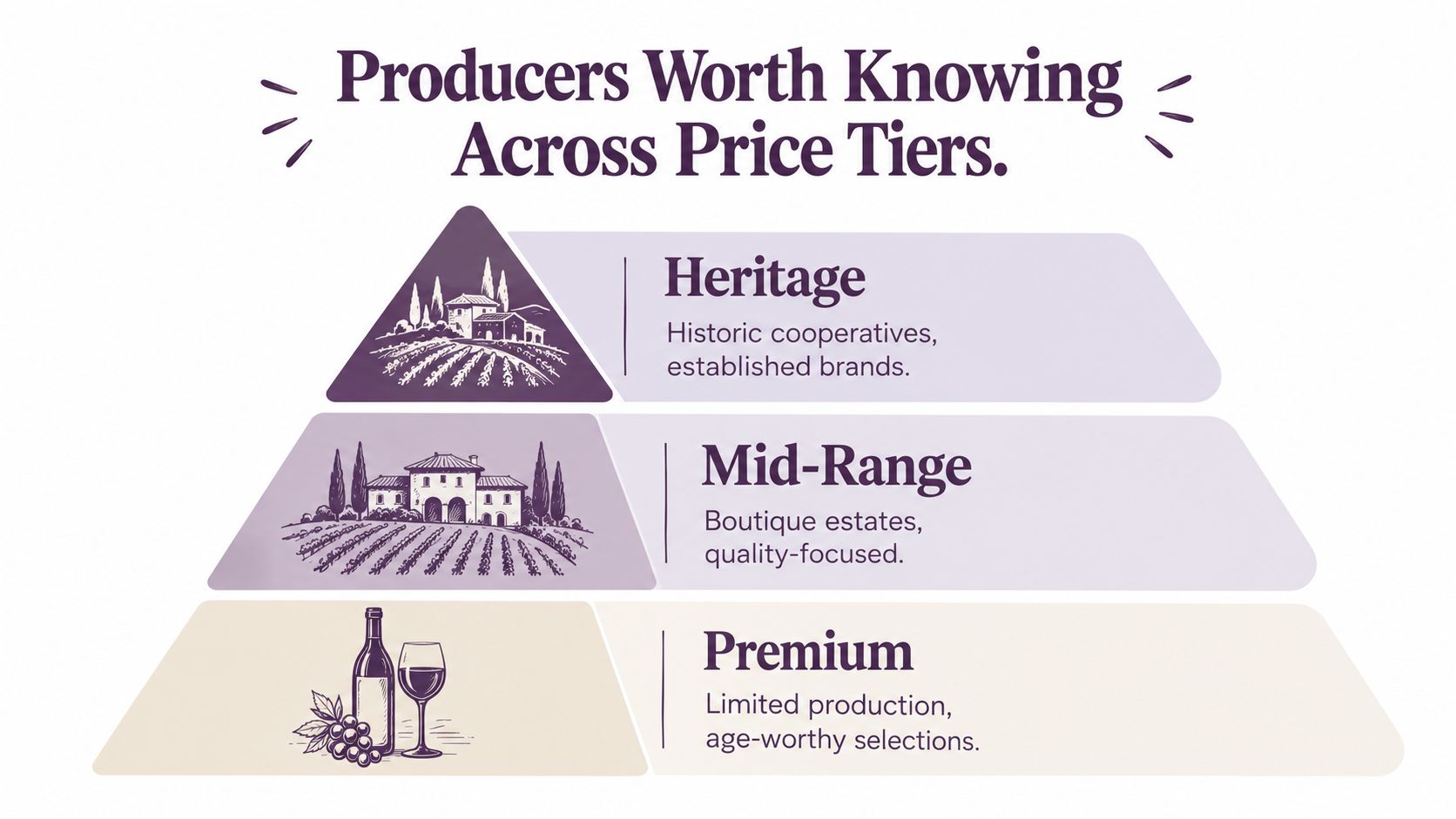
The heritage tier is best represented by established operators such as Cantina di Gallura, whose Karagnanj Vermentino di Gallura provides a widely available reference point in the accessible retail band, and Cantina del Vermentino, associated with the Seleme Oro bottling. Their scale supports regular supply for restaurants and retailers. That availability can keep prices below small-allocation wines, while still giving buyers a clear expression of the denomination.
The mid-range tier includes producers that attach greater commercial weight to vineyard identity, selection, or Superiore positioning. Locosoru offers a useful example through its estate-focused Vermentino releases, while Cantina Li Duni gives merchants another producer to examine in this bracket. Bottles in this band should justify their premium through a named site, tighter selection, more concentrated fruit, or more deliberate ageing. An artisanal label alone is weak evidence.
<a id="scarcity-is-a-production-signal"></a>
Scarcity is a production signal
The premium tier depends on restricted supply and a specific reason for it. Tenuta di Pietra is a practical example for buyers assessing estate-led positioning, while Capichera represents a more established premium reference through its Vign'Angena Vermentino. Small parcels, older vines, skin contact, extended lees ageing, or selective harvesting can raise labour costs and reduce volume. They do not guarantee a better wine, so the merchant should identify the feature that supports the higher price and explain how it appears in the glass.
The denomination supports this tiered structure because it combines defined supply boundaries with meaningful production. The producer base includes cooperatives, family estates, and smaller specialist wineries, creating different distribution economics. A broadly available heritage bottle may compete on consistency. A premium release may compete on parcel identity and limited allocation.
| Positioning | Producer examples | What the price should signal |
|---|---|---|
| Heritage | Cantina di Gallura, Cantina del Vermentino | Reliable supply and category familiarity |
| Mid-range | Locosoru, Cantina Li Duni | More specific vineyard or cellar positioning |
| Premium | Tenuta di Pietra, Capichera | Estate identity, specialised handling, or scarcity |
Two bottles at a similar price can therefore reflect different economics. One may buy distribution and brand recognition. The other may buy limited supply and a more explicit site proposition. Merchants should state which factor is operating instead of relying on prestige language.
<a id="current-market-prices-and-supply-signals"></a>
Current Market Prices and Supply Signals
Retail evidence places Vermentino di Gallura across a wide price band. A current listing for a 2025 bottling shows prices from about €8 to more than €20, depending on the product and merchant. The spread makes label interpretation necessary. Buyers are comparing producer scale, style, distribution, and perceived scarcity alongside grape and origin.
A different channel can sharpen that comparison. The upper end should represent a specific proposition, such as Superiore classification, a distinct vineyard source, oak influence, or limited availability. Price alone cannot show which factor supports the premium, so merchants should test the label against comparable offers in the same market.
<a id="use-retail-dispersion-as-a-diagnostic"></a>
Use retail dispersion as a diagnostic
A merchant assessing a shelf should ask three questions:
- Is the bottle standard or a more structured expression? The style designation provides the first explanation for a premium.
- Does the producer communicate a site or production distinction? A named vineyard, estate, or cellar treatment can make the price easier to defend.
- Is the listing scarce or merely expensive? A high price without restricted availability may indicate positioning rather than supply pressure.
The supply base is substantial. The OIV study records 28,010 hectolitres of bottled wine in 2020 and describes annual output of around 6 million bottles for the consortium context. That volume supports international recognition, while the category still contains premium bottlings with distinct allocation and positioning.
Channel comparison must remain disciplined. A retail price should be measured against other retail offers, while a restaurant listing or specialist auction result may include different margins, provenance standards, and service costs. For merchants assessing whether a €20 listing reflects genuine scarcity or channel markup, cross-channel fine-wine demand reporting provides macro context before a purchase decision. The final test remains bottle-level comparison within the relevant market.
Pricing insight: The gap between a low-priced standard bottle and a premium Gallura release matters only when the label explains what the buyer is paying for.
<a id="why-demand-is-growing-beyond-italy"></a>
Why Demand Is Growing Beyond Italy
Foreign demand for Vermentino in Gallura is reported to be rising by 5% to 7%, giving the appellation a measurable export signal rather than simple international visibility (L'Unione Sarda's report on export demand). The figure does not establish that every bottle commands a premium, but it does indicate growing attention beyond Italy.
The commercial case rests on more than grape familiarity. Freshness, mineral texture, saline finish, and regional specificity give the wine a distinct position for restaurants and retailers seeking a recognisable white-wine identity outside the most crowded international categories. Those traits can support a terroir premium when the label, producer, and price communicate them clearly.
<a id="the-export-question-is-about-pull-not-visibility"></a>
The export question is about pull, not visibility
International distribution alone is weak evidence of durable demand. A stronger signal appears when restaurants reorder, retailers maintain listings, and consumers seek the wine despite having many alternatives. Food compatibility and regional differentiation therefore matter more than one-off placement.
The appellation also offers a concise sales proposition. “Sardinian white” describes a broad origin. “A DOCG made from at least 95% Vermentino, shaped by Gallura's granite soils, and governed by defined alcohol, acidity, extract, and yield rules” connects the label to production constraints and expected style. That explanation helps buyers distinguish an appellation premium from a generic Italian-white markup.
Scarcity requires the same discipline. Meaningful production means export growth will not make every bottle rare. Supply pressure is more likely at the producer, vineyard, vintage, or style level. A limited Superiore or Passito release may therefore command different buyer interest from a widely distributed standard bottling.
Retailers can compare this signal with international Italian-estate recognition coverage, while separating broad Italian-wine momentum from evidence specific to Vermentino di Gallura. Reorders, allocations, restaurant listings, and stable cross-market pricing provide the most useful checks for merchants assessing whether demand is durable.
<a id="how-to-buy-vermentino-di-gallura-with-confidence"></a>
How to Buy Vermentino di Gallura With Confidence
A reliable purchase starts with the label, then moves to style, price, and provenance. “Vermentino di Gallura DOCG” identifies the appellation. A bottle marked only “Vermentino” belongs to a broader category until its Gallura origin is confirmed.
<a id="a-practical-buying-checklist"></a>
A practical buying checklist
-
Confirm the origin. Check for the DOCG designation and government seal. The DOCG rules are fixed: 95% Vermentino, 12% minimum alcohol for standard wine, and 13% for Superiore, with the full requirements set out in the official DOCG regulation. Skip repeating technical thresholds. Verify the seal and the appellation wording on the bottle.
-
Identify the style. Standard, Superiore, and Passito serve different buying purposes. Standard wine suits a fresh, dry table white. Superiore generally signals a more concentrated and structured version, while Passito is made for sweetness and dried-fruit intensity. Check the designation rather than assuming that a higher shelf price means a more prestigious style. The denomination categories and their production rules are summarized in Italian Wine Central's denomination reference.
-
Read price against comparable bottles. A retail listing can indicate an entry-to-premium spread from about €8 to above €20 (Gerardo's retail listing). Treat that range as an orientation point, not a valuation. A higher price is more defensible when it corresponds to a named producer, Superiore or Passito style, distinctive vineyard sourcing, a specific vintage, or limited availability.
-
Match the profile to the occasion. Select standard wine for brightness and food flexibility. Choose Superiore when texture and structure matter more. Choose Passito when the purchase is centered on sweetness rather than aperitif freshness.
-
Check provenance and storage. Ask the merchant how the bottle was sourced and stored. Heat exposure, poor handling, or uncertain turnover can erase the advantage of a lower price, particularly for a white wine bought for freshness.
-
Compare like with like. Retail, restaurant, and auction prices measure different markets. Fine-wine pricing tools can help compare the same producer, style, vintage, and sales channel, separating a genuine appellation or producer premium from an isolated listing.
For merchants, the shelf label should explain the price through DOCG origin, producer positioning, style, site expression, and availability. If it offers only the word “premium,” further checking is warranted.
Wine Labs helps merchants, collectors, and importers compare wine prices across retail, auction, exchange, and restaurant channels in one market view. Use Wine Labs to track producer and vintage identities, benchmark Vermentino di Gallura listings, and support sourcing or pricing decisions with clearer market context.