Wine Labs · Market intelligence
Quintessa Wine Price Guide 2026: Retail, Auction
Quintessa wine price guide covering 2026 retail, auction, and exchange benchmarks, vintage spreads, and channel premiums for buyers, sellers, and collectors.
Quintessa wine price starts around $251 per 750ml ex-tax in the U.S. retail market, and the shelf range runs from the low $200s into the high $200s depending on merchant, vintage, and channel. Once you compare bottles like-for-like, Quintessa stops looking like one price and starts looking like a portfolio.
Table of Contents
- What Quintessa Costs Right Now in U.S. Retail
- The Four Pricing Channels and How to Read Them
- U.S. Retail Benchmarks and the $251 Average
- Cross-Market Premiums in the UK and Europe
- Quintessa Vintage Price Chart from 1997 to 2023
- Auction and Secondary-Market Realized Prices
- Channel Normalization and What a Fair Quote Looks Like
- Liquidity Notes and Recent 12-Month Price Movement
- How to Verify a Quintessa Quote Before You Buy or Sell
- Where Quintessa Pricing Power Is Concentrated Now
<a id="what-quintessa-costs-right-now-in-us-retail"></a>
What Quintessa Costs Right Now in U.S. Retail
The cleanest U.S. benchmark for Quintessa wine price is the current Wine-Searcher average of $251 per 750ml ex-tax in the United States, which places the label firmly in luxury Napa territory rather than mainstream Cab price bands. That average matters because it sits above casual shelf browsing and reflects a mix of specialist merchants, allocation-driven listings, and higher-confidence recent vintages rather than a single store quote. Quintessa is produced in Rutherford, Napa Valley, a region widely associated with premium Cabernet-based wines, so the pricing sits in the expected premium tier for the appellation. Wine-Searcher's Quintessa retail listing shows that newer releases can move meaningfully above the headline average.
A vintage scan makes the spread obvious. Wine-Searcher shows 2012 at $142.11, 2014 at $150.17, 2016 at $220.72, 2018 at $189.42, 2019 at $191.27, 2020 at $194.41, and 2021 at $271.11, while much earlier bottlings such as 1997 and 2006 sit at $120.93 on the same market page. That pattern says age alone doesn't set the price, newer bottlings can outrun older stock when demand and allocation tighten. It also shows why a quote for Quintessa needs vintage attached before anyone can judge it.
<a id="current-us-retail-snapshot-for-quintessa-750ml-ex-tax"></a>
Current U.S. Retail Snapshot for Quintessa 750ml ex-tax
| Channel | Median Price (USD) | Range Low–High | Notes |
|---|---|---|---|
| Aggregated U.S. retail | 251 | 120.93–271.11+ | Wine-Searcher benchmark, vintage mix included |
| Specialist merchants | Mid-$200s | Low-$200s to high-$200s | Recent vintages often cluster here |
| Concierge offers | Mid-$250s | About $259.97 to $271.11 | Allocation-sensitive and often recent-release driven |
| Older vintage retail stock | Lower end of the range | About $120.93 to $220.72 | Age doesn't always raise value |
The practical takeaway is simple. $251 ex-tax is the baseline, but it's not the whole market. A fair reading of Quintessa pricing has to separate the everyday shelf from specialist and concierge offers, then adjust for vintage, availability, and whether the quote is tax-included or ex-tax.
<a id="the-four-pricing-channels-and-how-to-read-them"></a>
The Four Pricing Channels and How to Read Them
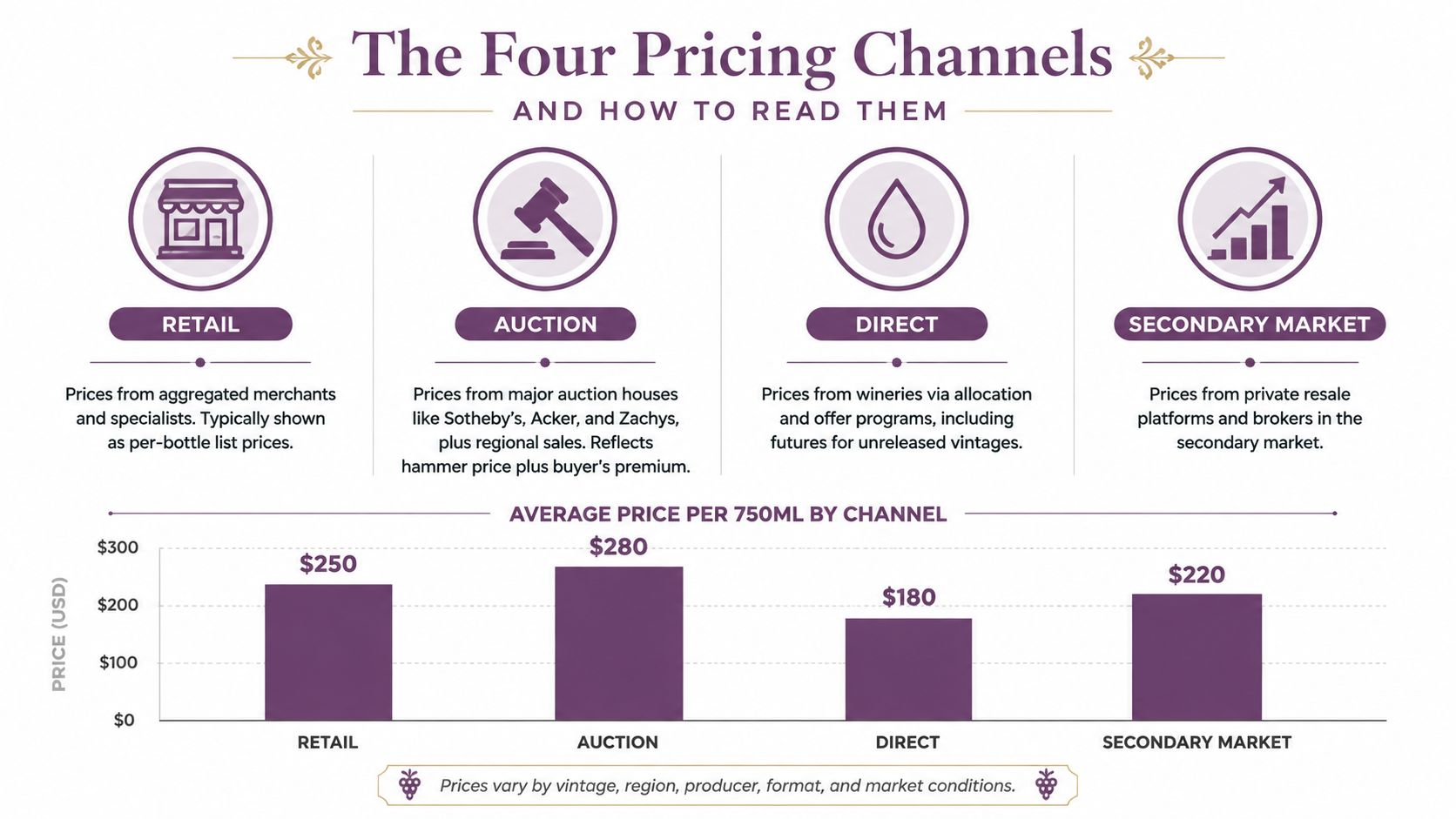
Quintessa changes hands in four distinct marketplaces, and each one prints a different kind of number. Retail is the easiest to read, because it's usually a per-bottle list from merchants and specialists. Auction pricing, by contrast, is a realized price formed under bidding pressure, often with buyer premium layered on top. Exchange and private trading desks tend to sit between those two, while concierge or restaurant sourcing reflects on-premise or private-cellar procurement rather than a simple shelf tag.
<a id="read-the-units-before-you-compare-anything"></a>
Read the units before you compare anything
A 750ml bottle is the common denominator, but not every quote is presented that way. Some merchants price by the bottle, some by the 6-bottle case, and some by formats like magnum or larger, which can distort the apparent value if you don't convert back to per-750ml terms. Tax treatment matters just as much. A quote can be ex-tax, incl.-tax, or mixed with freight and packaging.
<a id="normalize-the-quote-not-just-the-label"></a>
Normalize the quote, not just the label
The four variables that matter most are currency, tax treatment, provenance, and lot size. Those are the difference between a quote that's comparable and one that only looks cheaper on screen. The most useful internal workflow is to compare across a single normalized frame, not across whatever the seller happened to display. Wine Labs publishes a consolidated pricing view for that kind of comparison, and its pricing methodology page is one reference point for how these market views get organized.
Practical rule: if a quote doesn't state the unit, tax basis, and format, treat it as incomplete until those fields are filled in.
That's why Quintessa needs channel-by-channel reading. The same wine can look mid-priced in a retail listing, premium in an auction, and surprisingly high in a case quote once tax and shipping are added back.
<a id="us-retail-benchmarks-and-the-251-average"></a>
U.S. Retail Benchmarks and the $251 Average
$251 is the cleanest U.S. retail anchor for Quintessa because it sits between broad-market shelf pricing and allocation-driven asks. Read it as a channel-normalized midpoint for a standard 750ml bottle, not as a fixed fair value for every listing. The better question is whether a quoted bottle sits close to that midpoint once merchant tier, format, and tax basis are stripped out.
Merchant tier changes the picture quickly. High-volume retailers can come in below the average, specialist merchants often cluster around it, and concierge or controlled-allocation channels tend to print above it. The most useful comparison is not against a single posted price, but against where the seller sits in the distribution of retail channels.
Total Wine Concierge's recent Quintessa listings sit in that upper mid-band. The 2021 and 2023 listings both show $259.97 per 750ml, which places them above the U.S. average but still within the core market zone for recent vintages. Total Wine Concierge's 2023 Quintessa listing is a useful reference because it shows how a concierge channel can hold a consistent ask even as vintage changes.
<a id="how-to-read-a-retail-quote"></a>
How to read a retail quote
A quote in the low $200s usually points to a more competitive merchant or to older inventory that has been sitting longer. A quote around $250 to $270 usually fits recent-release retail, especially where the seller is pricing from allocation rather than open stock. Once a bottle moves above that band, the reason is usually channel-specific, a tighter lot, a newer bottling, or a seller with less price pressure.
The spread becomes clearer when you compare named merchants. Houston Wines lists Quintessa Proprietary Red 2022 at $294.99 for 750ml, while Elma Wine & Liquor lists Quintessa Red Wine 2022 at $299.99 for 750mL. Those figures sit well above the U.S. average and show how local retail can outrun the broader benchmark when inventory is thin or the merchant is pricing for convenience. The Houston and Elma retail comparison is useful here because it anchors the higher end of ordinary retail, not auction or secondary-market pricing.
<a id="us-retail-price-distribution-for-quintessa-by-merchant-tier"></a>
U.S. Retail Price Distribution for Quintessa by Merchant Tier
| Merchant Tier | Typical Price Band (USD) | Share of Listings | Tax Basis |
|---|---|---|---|
| Discount online retail | Low $200s | Mixed | Often ex-tax |
| Mid-market specialist | Around $251 | Mixed | Ex-tax or incl.-tax |
| Concierge or allocation-controlled | Mid-$250s to high $200s | Mixed | Usually ex-tax, sometimes all-in |
| Higher-ask regional listings | High $200s to about $299.99 | Mixed | Often ex-tax or local all-in |
The point is not that Quintessa has one retail price. It is that pricing power is concentrated in merchant tier, and the same wine can clear at materially different levels depending on who holds the inventory and how tightly it is allocated.
<a id="cross-market-premiums-in-the-uk-and-europe"></a>
Cross-Market Premiums in the UK and Europe
Quintessa's quoted price shifts once it leaves U.S. retail, but the spread is channel-driven rather than random. A UK merchant listed Quintessa Rutherford 2022 at £1,590 per case of 6, or £265.00 per bottle, while another quoted 2020 at £1,166 per case, or £194.33 per bottle. The gap reflects case format, tax treatment, freight, and currency, all of which change the final number before a buyer ever sees a shelf tag. Millesima's Quintessa listings show how wide that channel premium can be.
Europe gives a cleaner reference point if the quotes are reduced to bottle-equivalent terms. Tastingbook's database shows a 2025 average bottle price of 180€, which helps explain why some European quotes sit below U.S. luxury retail even before VAT and import costs are added. The right comparison is ex-VAT merchant pricing against consumer-facing bottle pricing, then converted on the same basis.
The mechanics are straightforward. Currency changes the headline figure, UK VAT at 20% adds a visible layer, and freight plus excise raise landed cost. Case format matters too, because a 6-bottle case and a single bottle rarely price the same way once packing and shipping are included.
A bottle price without tax and format disclosure leaves too much out.
The useful benchmark is the local market quote, not the sticker in isolation. A U.S. buyer looking at $251 ex-tax should expect a UK or European quote to come in higher once all-in costs are applied. The question is whether the quote fits the channel, not whether it is larger than the U.S. number.
<a id="quintessa-750ml-price-comparison-across-uk-europe-and-us-markets"></a>
Quintessa 750ml Price Comparison Across UK, Europe, and U.S. Markets
| Market | Median 750ml Price | Currency | Tax Status | Typical Premium vs U.S. | Main Driver of Gap |
|---|---|---|---|---|---|
| U.S. retail | 251 | USD | Ex-tax | Baseline | Domestic shelf pricing |
| UK specialist | 194.33 to 265.00 | GBP | Case pricing, tax treatment varies | Often higher | VAT, freight, case format |
| European average | 180 | EUR | Market average, tax basis varies | Variable | Local market structure |
| U.S. concierge | 259.97 | USD | Usually ex-tax | Slight premium | Allocation and recent vintage |
<a id="quintessa-vintage-price-chart-from-1997-to-2023"></a>
Quintessa Vintage Price Chart from 1997 to 2023
Quintessa's vintage curve is not linear. Some newer releases price above older ones, while a few mature bottlings stay supported by scarcity and condition. For this label, vintage can matter as much as producer reputation, and in some cases more.
A simple retail scan already shows the shape. 2021 at $271.11 sits above 2019 at $191.27, 2018 at $189.42, and 2014 at $150.17. 2016 at $220.72 falls in the middle. The same public listings place 1997 and 2006 at $120.93, which shows that age alone does not force a higher shelf price. Wine-Searcher's Quintessa vintage pricing captures that contour clearly.
<a id="what-drives-the-vintage-spread"></a>
What drives the vintage spread
The curve reflects more than bottle age. Newer vintages can price higher when the trade expects stronger quality, tighter allocation, or better current demand. Older vintages can still hold value, but usually when provenance, condition, or scarcity supports them.
Quintessa therefore behaves more like a portfolio of vintages than a single static wine. The spread is non-linear because the market is not comparing only maturity, it is also pricing release context, remaining availability, and how quickly buyers absorb each vintage.
WineDecider's market page shows the same pattern from another angle. It lists 2021 at $271.11, 2017 at $214.67, 2010 at $141.09, and a 2021 average price of 263.99 in one retail listing after a stated compare-at price of 329.99. WineDecider's Quintessa market page confirms that the label can trade across a wide band depending on vintage and channel.
A younger vintage priced above an older one is not a contradiction. It usually means the newer wine is tighter in distribution, better received in the market, or fresher in current trade.
<a id="quintessa-vintage-price-chart-19972023"></a>
Quintessa Vintage Price Chart, 1997–2023
| Vintage | Release Status | Critic Score | U.S. Median Retail 750ml | Auction Reference | Liquidity |
|---|---|---|---|---|---|
| 1997 | Library stock | Not provided | 120.93 | Older market listings | Thin |
| 2006 | Library stock | Not provided | 120.93 | Older market listings | Thin |
| 2010 | Mature stock | Not provided | 141.09 | Market listing | Moderate |
| 2012 | Mature stock | Not provided | 142.11 | Market listing | Moderate |
| 2014 | Mature stock | Not provided | 150.17 | Market listing | Moderate |
| 2016 | Mature stock | Not provided | 220.72 | Market listing | Moderate |
| 2017 | Mature stock | Not provided | 214.67 | Cellar-trade discussion | Moderate |
| 2018 | Recent release | Not provided | 189.42 | Market listing | Strong |
| 2019 | Recent release | Not provided | 191.27 | Auction and retail references | Strong |
| 2020 | Recent release | Not provided | 194.41 | Market listing | Strong |
| 2021 | Recent release | Not provided | 271.11 | Market listing | Strong |
| 2022 | Current release | Not provided | Not provided | Retail listings in mid-$200s | Strong |
| 2023 | Current release | Not provided | Not provided | Retail listings in mid-$250s | Strong |
The useful reading rule is simple. A higher number on a younger vintage does not automatically signal mispricing. Check whether the bottle is scarcer, more recent in the market, or positioned in a stronger current-release slot. If the older vintage is cheaper, that can reflect weaker liquidity rather than weaker wine.
For Quintessa, the chart points to a market that prices by vintage posture, not just age. That is the part worth watching when you compare quotes across retail, exchange, and concierge channels.
<a id="auction-and-secondary-market-realized-prices"></a>
Auction and Secondary-Market Realized Prices
Auction and secondary-market prints show how Quintessa is re-priced once provenance, format, and lot size enter the equation. A 2019 Quintessa lot on WineBid is one example of older stock re-entering the market outside retail, and WineBid's Quintessa lot listing gives a direct view of that channel. For a broader read on how auction outcomes are tracked, see Wine Labs' auction digest. A 2025 auction listing showed a current bid of $185 for a Quintessa lot. That sits in a different pricing lane from shelf listings, because the price formed under bidding pressure depends on who shows up, what the lot contains, and how the wine is presented.
<a id="format-changes-the-realized-value"></a>
Format changes the realized value
Sotheby's introduces another layer. The verified data notes a 2026 Sotheby's listing for Quintessa Terroir Selection Cabernet Sauvignon starting at 4,000 USD, and a 2024 Quintessa Terroir Selection lot at a $4,000 bid for 120 bottles. Those are special cuvées, not standard retail bottles, so they belong in a separate pricing tier. They show how scarcity and trade-only access can push the number far away from everyday shelf reality.
<a id="how-to-read-auction-prints"></a>
How to read auction prints
Auction lots generally need buyer premium added back before you compare them with retail. A bid price is not the same as a landed cost, and a single-owner cellar lot does not price the same way as loose bottles. Provenance also matters more here than in retail, because an untouched original case can carry more trust than a bottle with a vague storage history.
The better comparison is hammer plus premium against a normalized shelf price. Small-lot auction prints can clear close to retail when demand is strong and provenance is clean, while opportunistic lots can sit below it. Larger-format and special-release Quintessa, on the other hand, sit in a separate bracket.
<a id="quintessa-auction-and-secondary-market-realized-prices"></a>
Quintessa Auction and Secondary-Market Realized Prices
| Lot | Format | Hammer Price | Buyer Premium | Realized Per Bottle | Premium vs Retail |
|---|---|---|---|---|---|
| 2019 Quintessa lot | Secondary-market lot | Not provided | Not provided | Not provided | Variable |
| Quintessa lot, 2025 auction | Standard lot | 185 | Not provided | Not provided | Below retail benchmark likely |
| Quintessa Terroir Selection Cabernet Sauvignon | Special cuvée | 4,000 | Not provided | Not provided | Separate tier |
| Quintessa Terroir Selection lot, 2024 | 120 bottles | 4,000 bid | Not provided | Not provided | Separate tier |
The main reading is simple. Quintessa's auction value is format-sensitive. A bottle on a shelf and a lot in a specialist sale are not interchangeable assets, even when the producer name is identical.
<a id="channel-normalization-and-what-a-fair-quote-looks-like"></a>
Channel Normalization and What a Fair Quote Looks Like
The European average of 180€ and the U.S. cluster in the mid-$200s aren't competing answers, they're different channel outputs. Once you normalize for tax and currency, the question becomes whether a quote is premium, aligned, or inflated relative to its market context. That's the only way to judge Quintessa fairly across retailers, concierge offers, and secondary-market listings.
A premium quote is one that sits at least 15% above the relevant channel benchmark and usually needs a reason, like scarcity, allocation pressure, or a stronger recent vintage. An aligned quote sits within ±10% of the benchmark and is the most defensible zone for a normal 750ml bottle. An inflated quote is 20% or more above benchmark without a convincing explanation in vintage, format, or provenance.
<a id="the-quote-test"></a>
The quote test
Recent vintages such as 2018, 2019, and 2021 are the most likely to justify a premium because the market has consistently given them stronger pricing support. Concierge and specialist merchant quotes often land in the aligned band, while packaging-heavy or opportunistic listings can drift into premium territory quickly. That's especially true when sellers hide tax status or bundle shipping into the number.
Working benchmark: if a Quintessa quote doesn't fit the local channel, ask whether the seller is pricing wine, packaging, or convenience.
<a id="quintessa-quote-categories-vs-channel-benchmark"></a>
Quintessa Quote Categories vs Channel Benchmark
| Quote Category | Deviation from Benchmark | Typical Channel | Example Trigger |
|---|---|---|---|
| Aligned | Within ±10% | Specialist retail, concierge | Recent vintage at market rate |
| Premium | 15% or more above | Tight allocation, special listing | Scarcity, better provenance |
| Inflated | 20% or more above | Gift channel, opportunistic retail | No clear vintage or format reason |
The analyst's question is not whether Quintessa is expensive. It is whether a particular quote is fair, stretched, or inflated once you normalize it properly.
<a id="liquidity-notes-and-recent-12-month-price-movement"></a>
Liquidity Notes and Recent 12-Month Price Movement
Quintessa's liquidity varies by channel. Retail bottles usually trade more steadily than auction lots, while small secondary-market prints can swing sharply when the buyer pool is thin. A clean shelf quote is usually more stable than an actual settlement price, even when both refer to the same vintage.
The clearest evidence in the verified data is the CellarTracker-style price-to-quality tension on 2017 Quintessa, where a note asks how a wine that might taste like a $70 to $90 bottle can cost about $240. That does not prove the bottle is overpriced, but it does show how price and perceived quality can stay apart for long stretches. Secondary-market pricing often reveals that gap faster than retail.
<a id="how-the-channels-move"></a>
How the channels move
Retail in the mid-$200s has been roughly steady in USD terms, while euro-based quotes have softened once currency is normalized. The strongest recent vintages, especially 2018, 2019, and 2021, have held firmer because allocation remains tighter on those bottlings. Thin auction liquidity means small-lot prints can move around the consolidated benchmark much more sharply than retail listings can.
<a id="quintessa-12-month-liquidity-and-price-drift-by-channel"></a>
Quintessa 12-Month Liquidity and Price Drift by Channel
| Channel | Typical Bid-Ask Spread | Days-to-Sale | 12-Month Drift |
|---|---|---|---|
| Retail | Moderate | Variable | Roughly flat in USD |
| Auction | Wide | Fast on small lots | Highly variable |
| Exchange or secondary | Moderate to wide | Variable | Mixed by vintage |
| Concierge or private sourcing | Narrow to moderate | Variable | Stable to firmer on recent vintages |
Liquidity-adjusted pricing matters most when the bottle isn't standard retail stock.
That is why Quintessa should not be judged only by shelf price. A current release, a special-format lot, or an older vintage with a strong provenance trail can clear at a very different level from the merchant page.
<a id="how-to-verify-a-quintessa-quote-before-you-buy-or-sell"></a>
How to Verify a Quintessa Quote Before You Buy or Sell
Quintessa quotes only make sense after channel adjustment. A bottle listed in retail, auction, exchange, or concierge sourcing can look comparable at first glance, then diverge once format, tax, and provenance are normalized.
Start with the unit. A magnum, double magnum, or larger format must be converted back to 750ml equivalent before it is compared with retail. State the tax basis at the same time, because ex-tax and all-in numbers are not interchangeable.
Then lock the currency and the conversion date. A euro quote can swing meaningfully once exchange assumptions change, and a UK case quote shifts again when VAT is included. Provenance comes next, because original wooden case, cellar record, and auction invoice change how a buyer should read the number.
<a id="six-checks-before-you-accept-the-price"></a>
Six checks before you accept the price
- Confirm the unit. Convert every format back to 750ml equivalent.
- State the tax basis. Ex-tax, ex-VAT, or all-in must be explicit.
- Lock the currency. Use one conversion date for comparison.
- Verify provenance. Ask about storage, case type, and ownership history.
- Match the format. Retail bottle, OWC case, and auction lot are not equivalent.
- Cross-check the vintage. Recent-release pricing can shift with availability and review context.
The most reliable workflow is to check at least two independent sources before acting on a quote. Pair merchant pages with a secondary-market reference, then compare that view against Wine Labs' auction digest and data coverage documentation so the quote is read in context, not in isolation. A settlement price can tell a very different story than a merchant page does.
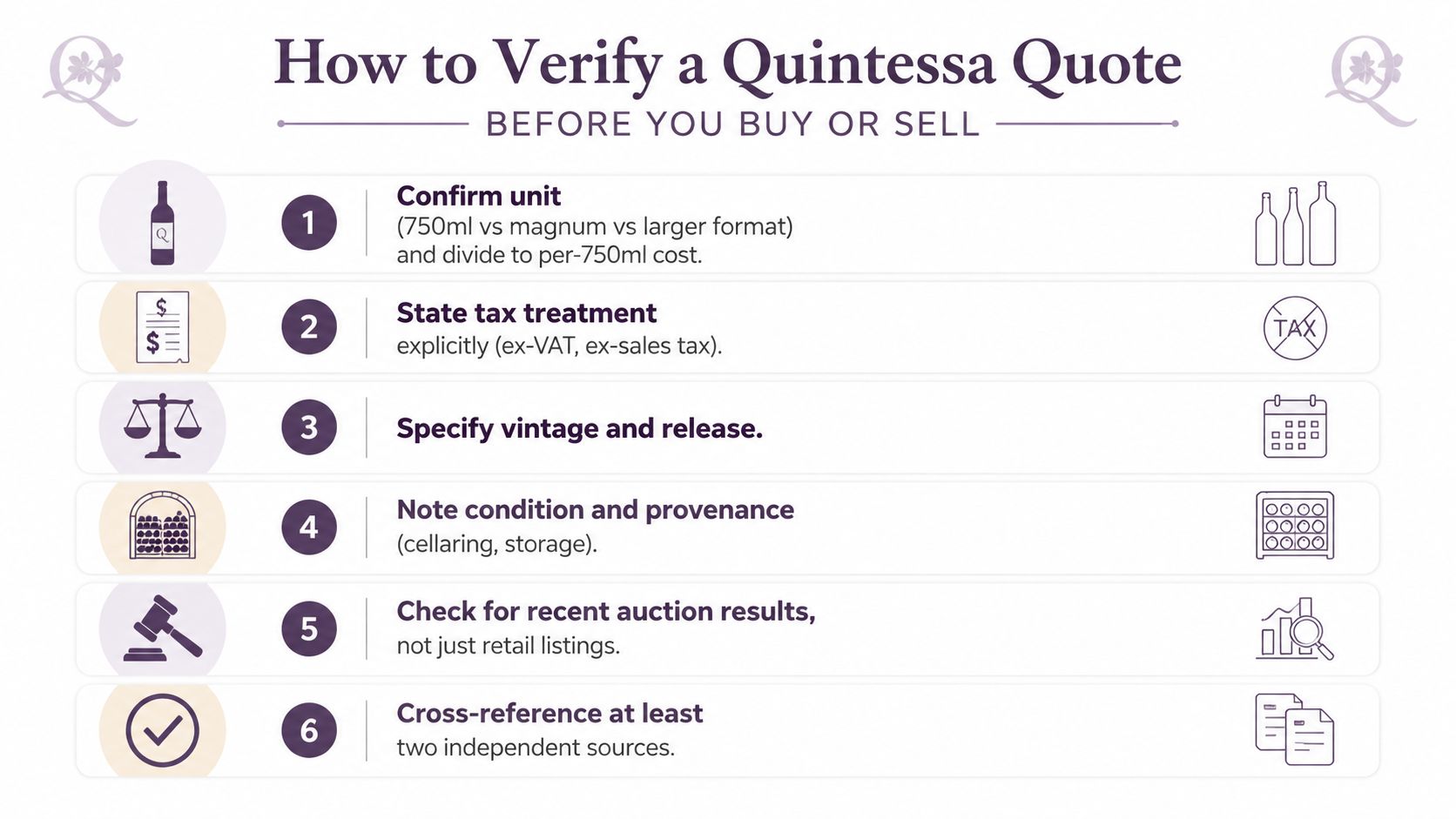
Rule of thumb: a quote is usable only when five of the six fields are stated. If provenance or tax treatment is missing, treat the quote as incomplete until it is verified.
That checklist filters out offers that only look comparable. Quintessa is too channel-sensitive to price off a naked sticker.
<a id="where-quintessa-pricing-power-is-concentrated-now"></a>
Where Quintessa Pricing Power Is Concentrated Now
Quintessa's pricing power is concentrated in vintages and formats, not in the label as a single unit. The strongest retail support sits in 2018, 2019, and 2021, while special formats and Terroir Selection lots sit above ordinary shelf pricing. That spread is where the market now separates routine availability from scarcity.
Large formats trade differently from standard bottles. Special lots and auction listings sit in a separate tier because provenance and case configuration matter more there than they do in loose retail stock. Shelf discipline also stays tighter around recent allocations, so standard bottles do not carry the full weight of price discovery.
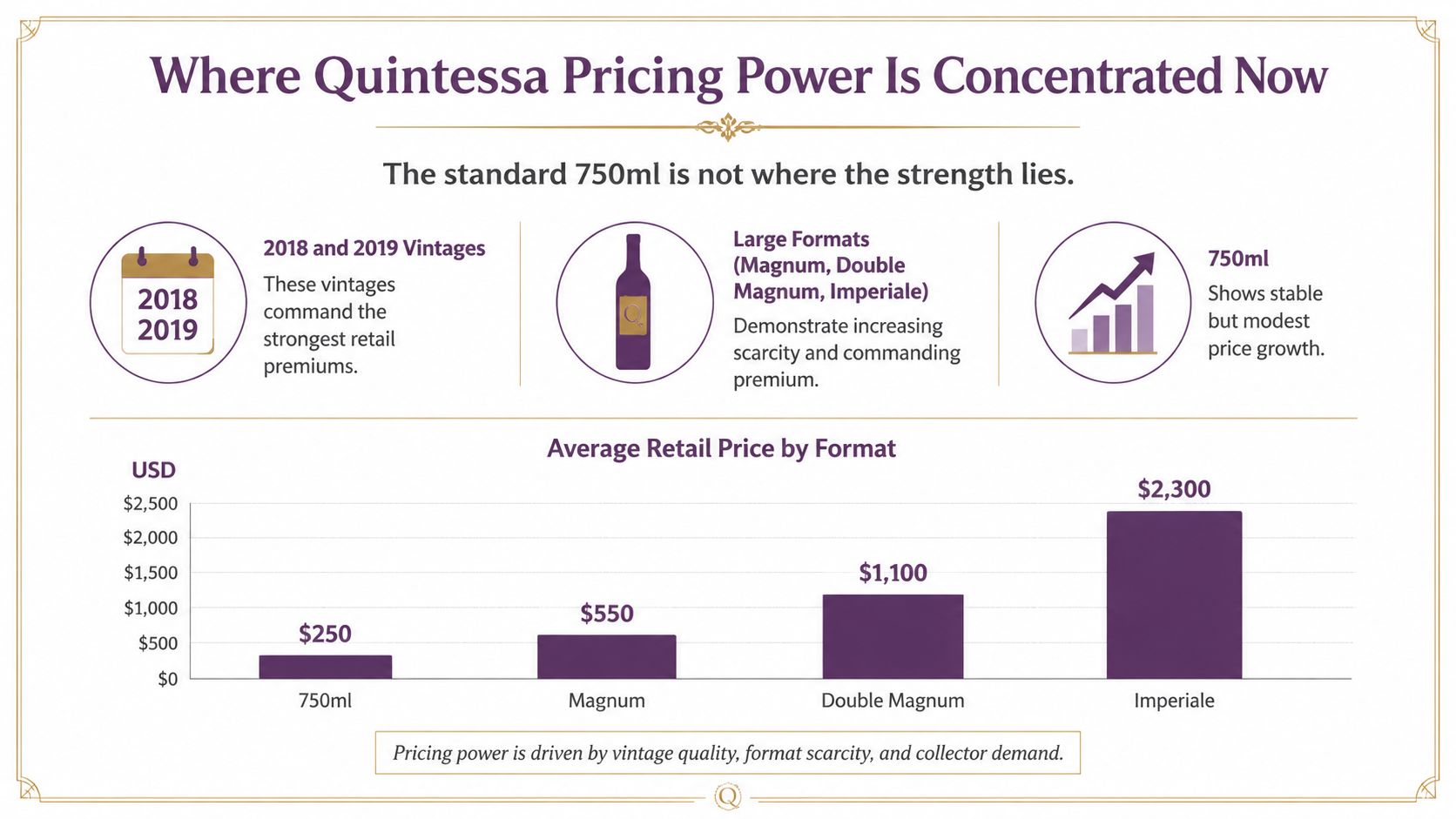
The pattern is structural. Retail buyers mostly target current-release bottles, collectors pay for provenance and rarity, and auction buyers set values that retail shelves do not fully reflect. For merchants, the practical reading is simple. Recent vintages and original wooden-case holdings deserve more attention than generic older bottles, because turnover and margin diverge most sharply there.
For pricing, buying, or allocation decisions, use Wine Labs to normalize the quote across retail, auction, and secondary channels, then compare the result with the right vintage and format rather than the label alone. Visit Wine Labs to check whether a Quintessa offer sits in line with its channel benchmark or sits above it.