Wine Labs · Market intelligence
Primitivo Di Manduria: Grape, DOC, and Market Guide
Explore Primitivo di Manduria — the Puglia DOC's grape, terroir, key producers, and typical price ranges for buyers, importers, and collectors.
Primitivo di Manduria is often treated as a small, indulgent corner of southern Italian wine. The production figures tell a different story. Independent industry data place its five-year average at about 216,600 hectoliters, or roughly 2,406,000 cases, across a zone covering at least 18 municipalities east of Taranto and toward Brindisi. Italian Wine Central's denomination profile therefore describes a commercially substantial appellation, not a marginal curiosity.
That scale matters because the category combines high volume, high ripeness, and firm legal identity. Its wines must meet high alcohol thresholds, while the climate creates the dark fruit, broad texture, and concentration that buyers associate with Puglia. Yet its next phase won't be defined by export growth alone. Harvest dates are moving earlier under climate projections, and authorities are defending the Manduria name more aggressively. For merchants, importers, and collectors, the useful question is no longer just whether Primitivo di Manduria is rich and affordable. It is how the appellation's rules, producers, pricing, and climate risk are changing its market position.
Table of Contents
- Why Primitivo di Manduria Matters in 2026
- What a DOC Actually Means for Primitivo di Manduria
- The Grape and the Puglia Terroir Behind It
- Rules That Shape the Style and Aging Requirements
- Key Producers and How to Read the Category
- Typical Price Ranges Across Retail and Auction
- Climate Pressure and the Fight Over the Name
- Where Primitivo di Manduria Fits Next
<a id="why-primitivo-di-manduria-matters-in-2026"></a>
Why Primitivo di Manduria Matters in 2026
An average output of about 216,600 hectoliters, or roughly 2,406,000 cases over a five-year average, gives Primitivo di Manduria unusual weight among Italian Primitivo regions. Industry production data place the denomination across at least 18 municipalities east of Taranto, along the Ionian coast and toward Brindisi. This is a high-volume DOC, not a niche appellation whose market depends only on scarcity.
Scale creates a practical advantage for buyers. The denomination can support broad retail distribution, several quality tiers, and regular supply, while old-vine or tightly selected parcels create less common bottlings. Standard wines therefore serve as dependable commercial reds. Riserva and single-vineyard examples provide a more collectible upper layer.
<a id="scale-does-not-mean-uniformity"></a>
Scale does not mean uniformity
The category also includes value-bearing specialty formats. In 2017, about 95,000 liters of DOCG wine were bottled, equivalent to approximately 127,000 bottles, a 33.45% increase over the prior year, according to historical denomination data. The figure concerns the DOCG sweet category rather than total appellation production, so it should not be used as a proxy for the whole denomination. It does, however, show that premium and specialty styles have commercial relevance.
Climate pressure complicates that model. A warm southern setting already favors ripe, concentrated fruit, and earlier harvest timing can intensify the need for decisions about alcohol, freshness, and balance. Tighter protection of the Manduria name adds another market variable: merchants must distinguish legally defined regional identity from the broader use of “Primitivo.”
For a broader view of Italian wine market dynamics, see Wine Labs' coverage of recent Italian wine releases. Wine Labs retail and auction observations are most useful when paired with production and denomination records from outside sources, rather than treated as a substitute for them.
Market reading: Primitivo di Manduria is a scaled DOC with a premium ladder, not one uniform wine style.
The category's market position follows from that structure. The DOC defines place and production, the grape supports the ripe profile, aging tiers separate styles, and retail or auction evidence indicates whether a bottle behaves like a value red, a specialist import, or a collectible. Buyers who separate those layers will make sharper comparisons than shoppers relying on “Primitivo” alone.
<a id="what-a-doc-actually-means-for-primitivo-di-manduria"></a>
What a DOC Actually Means for Primitivo di Manduria
A Denominazione di Origine Controllata, or DOC, is a protected Italian designation. It links a wine to a defined production area and a regulated set of conditions, including permitted grapes, yields, alcohol, acidity, aging, and production methods. The label therefore makes a narrower promise than a broad regional designation. It tells the buyer that the wine belongs to a legally described place and has passed the requirements for that category.
For Primitivo di Manduria, the geographic point is essential. The DOC is restricted to the southern part of the province of Taranto, while the broader denomination also reaches into Brindisi. Independent Wine's denomination guide places the zone around Manduria and records DOC production in 2018 at 14,717,200 liters, approximately 19.6 million 75cl bottles. Those figures come from an outside industry reference and should be read separately from Wine Labs market observations.
<a id="the-legal-timeline"></a>
The legal timeline
The denomination's history explains why the name now carries commercial weight:
- Late 18th century: Don Francesco Filippo Indellicati identified the early-ripening vine around 1799 in Gioia del Colle.
- 19th century: The grape spread south into the Manduria plain.
- 1891: A bottle labeled “Primitivo di Campo Marino” was recorded.
- 30 October 1974: Primitivo di Manduria received DOC status.
- 23 February 2011: The sweet Dolce Naturale style was awarded DOCG.
This progression moved Primitivo from mixed rural use into a protected appellation with distinct commercial tiers. The standard DOC sits within the narrower Manduria identity, while broader Puglia or Salento Primitivo wines may fall outside the DOC's geographical and production requirements. A bottle labeled with a broader regional designation shouldn't be treated as interchangeable with Primitivo di Manduria DOC.
The Riserva designation adds another regulated level inside the dry DOC framework. It isn't merely a producer's marketing phrase. Its aging and alcohol requirements create a formal distinction that importers can use when specifying a range, comparing offers, or assessing whether a higher shelf price reflects a legally meaningful category.
<a id="the-grape-and-the-puglia-terroir-behind-it"></a>
The Grape and the Puglia Terroir Behind It
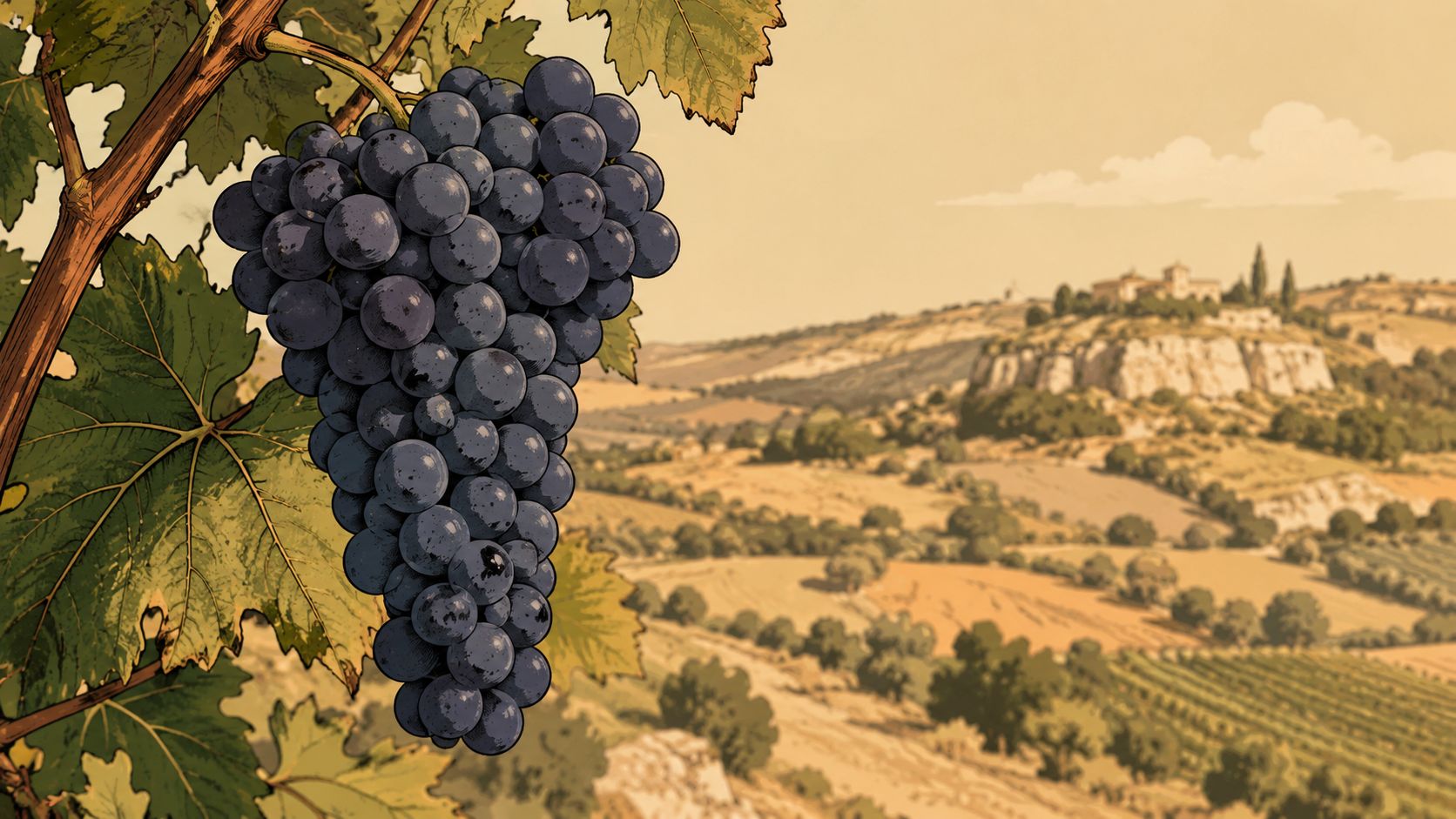
Primitivo ripens early and accumulates sugar quickly. It is genetically identical to California's Zinfandel and Croatia's Crljenak Kaštelanski, yet genetic identity does not produce identical wines. Local selection, vineyard conditions, harvest timing, and cellar practice separate the styles. In Manduria, the central technical challenge is controlling a grape that reaches maturity readily in a hot Mediterranean climate. Producers need enough ripeness for the appellation's richness, while preserving freshness so the wine does not become heavy.
The production specification requires a minimum natural alcohol of 13.0% vol and a finished minimum of 13.5% vol for the dry DOC. Riserva reaches 14.0% vol. The Italian Ministry's denomination specification also sets minimum total acidity at 5.0 g/L. These thresholds formalize the category's preference for advanced maturity while retaining an acidity floor that supports balance.
<a id="soil-wind-and-extraction"></a>
Soil, wind, and extraction
Regional descriptions identify clay-limestone or loam soils, with iron oxides contributing to the red topsoil found in parts of Puglia. Calcareous subsoils and well-draining profiles can encourage deeper rooting. Hot, dry summers and sea breezes add water stress and moderate conditions within the vineyard. Wines commonly show deep color, dark fruit, jam, spice, and a broad tannic frame.
Old vines trained in alberello systems may restrain vigor and concentrate fruit, although site and producer decisions remain decisive. Fermentation around 23 to 25°C, malolactic conversion, and partial oak élevage are tools for extracting supple tannins and stabilizing structure, as described in Firstleaf's regional reference.
The same evaluation of provenance, condition, and intended use applies to adjacent seasonal sourcing, including long-lasting Christmas plants for seasonal programs. Appearance alone is an incomplete buying signal.
The grape supplies power. Vineyard conditions and harvest timing determine whether that power arrives as freshness, warmth, or excess.
<a id="rules-that-shape-the-style-and-aging-requirements"></a>
Rules That Shape the Style and Aging Requirements
Primitivo di Manduria's regulations function as a style filter. They don't guarantee that every bottle will taste the same, but they establish a floor for maturity, acidity, yield, and aging. The dry DOC requires a finished minimum of 13.5% alcohol, while the Riserva category rises to 14.0% and requires 24 months of total aging, including 9 months in oak. The standard DOC commonly reaches the market no earlier than 31 March of the year after harvest, according to Italian Wines' denomination guide.
The yield ceiling also matters. The DOC rules specify a maximum grape yield of 90 quintals per hectare, equivalent to 9 tonnes per hectare, while the sweet DOCG has a lower grape yield cap of 7 tonnes per hectare. Lower yields can support concentration, but they also raise the economic stakes for growers when climate or market conditions make each harvest more difficult.
<a id="three-tiers-three-buying-signals"></a>
Three tiers, three buying signals
| Tier | Min. Alcohol | Yield Limit | Aging Requirement | Key Restriction |
|---|---|---|---|---|
| Primitivo di Manduria DOC | 13.5% finished | 90 quintals/ha | Standard release no earlier than 31 March after harvest | Dry DOC must meet regulated alcohol and acidity thresholds |
| Primitivo di Manduria DOC Riserva | 14.0% | 90 quintals/ha | 24 months total, including 9 months in oak | Higher alcohol and mandatory wood aging |
| Primitivo di Manduria Dolce Naturale DOCG | 13.0% actual at release, 16% total alcohol at harvest | 7 tonnes/ha | Governed by the DOCG specification | Minimum 50 g/L residual sugar, no chaptalization |
The Dolce Naturale rules create a different product, not a sweeter version of the standard red. The grapes may undergo appassimento, the wine must reach at least 16% total alcohol at harvest, and it must retain a minimum of 50 g/L residual sugar without chaptalization. Wine with Seth's DOCG specification identifies those requirements, including the minimum 13% actual alcohol at release.
The official production rules also distinguish appassimento thresholds for dry DOC and Riserva wines, at 13.0% and 13.5% natural alcohol, respectively. The Producers of Manduria production disciplinary provides that detail. For importers, the lesson is simple: ask whether the bottle is standard DOC, Riserva, or Dolce Naturale before comparing costs, drinking windows, or expected consumer demand.
<a id="key-producers-and-how-to-read-the-category"></a>
Key Producers and How to Read the Category
A producer list is less useful than a producer map. Primitivo di Manduria includes large cooperative-linked operations, established estates, and boutique projects whose wines occupy very different commercial roles. Cantine San Marzano, Tormaresca, and Produttori di Manduria represent the accessible, distribution-friendly side of the category. Their scale and recognition make them relevant to broad retail, restaurant programs, and import portfolios seeking dependable availability.
The specialist end is more selective. Gianfranco Fino, Masseria Li Veli, and Agricole Vallone are associated with more ambitious estate expressions and can help define the upper quality conversation. A buyer shouldn't assume that every bottling from a named house belongs in the same price or maturity bracket. The label, vineyard source, vintage, and tier still do the work.
<a id="what-separates-house-style"></a>
What separates house style
Four questions usually reveal more than a producer's reputation alone:
- Old-vine sourcing: Fruit from mature alberello vineyards can bring concentration and structural depth, but buyers should verify the specific cuvée rather than generalize across the portfolio.
- Oak treatment: New oak can emphasize vanilla, toast, and sweetness, while restrained élevage leaves more room for dark fruit and savory notes.
- Appassimento: Drying grapes can increase richness and weight, but it also changes the wine's balance and should be disclosed clearly to buyers.
- Subzone and vineyard identity: Sava, Lizzano, and other localities can signal different soils, exposures, and sourcing patterns, although the producer's farming and blending decisions remain decisive.
Sourcing rule: Treat the producer name as a starting point, not a quality verdict. The useful unit is producer plus vineyard source, vintage, tier, and cellar method.
This approach also clarifies auction potential. A consistently labeled Riserva from a recognized estate may attract more attention than a standard bottling from the same producer, while a small single-vineyard release can command specialist interest even without the broadest distribution. Merchants should compare like with like before using a house's flagship reputation to justify a listing.
<a id="typical-price-ranges-across-retail-and-auction"></a>
Typical Price Ranges Across Retail and Auction
Price discussion needs a clean separation between Wine Labs market data and outside regional references. The following bands are the stated Wine Labs benchmarks for the category, organized by commercial tier and channel rather than presented as a single average. They describe typical observed positioning, while a specific bottle can move outside the band because of vintage, provenance, critic attention, format, or scarcity.
| Tier | Retail Price (EUR) | Auction Range (EUR) | Price Driver |
|---|---|---|---|
| Standard Primitivo di Manduria | €8 to €18 | Usually secondary to retail | Volume, broad distribution, accessible positioning |
| Riserva | €18 to €45 | Higher for mature or scarce examples | Oak aging, producer reputation, vintage |
| Premium Riserva and Dolce Naturale | €50 to €150 | Can exceed retail substantially | Limited supply, specialist demand, provenance |
| Top Riserva and single-vineyard bottlings | Specialist pricing | Above €200 per 750ml in suitable lots | Provenance, vintage, rarity, auction competition |
For broader context, an outside tasting reference lists a 2016 Varvaglione Papale Linea Oro at $23.95 per bottle, with 14.5% alcohol and 13 g/L residual sugar. That source describes a rich, oak-aged example, but it isn't a Wine Labs benchmark and shouldn't be merged with the euro bands. Wine It Up a Notch's bottle profile is useful as an illustrative retail reference, not as a market-wide price survey.
<a id="how-channel-changes-the-number"></a>
How channel changes the number
Large retail tends to reward recognizable labels, reliable supply, and simple consumer positioning. Specialist importers can support higher prices when they explain vineyard origin, Riserva aging, or the difference between a dry wine and Dolce Naturale. Restaurants add another layer through glass pricing, list curation, vintage depth, and service costs.
Auction pricing behaves differently. Mature bottles need credible provenance, correct storage history, and a buyer pool that understands the producer. A high hammer result shouldn't be used to reprice an entire range, especially when the lot is a rare single-vineyard bottling rather than a standard DOC.
For merchants, useful Wine Labs dashboard watch points include:
- Listing depth: Are more offers appearing in standard DOC, or is supply concentrating in fewer labels?
- Tier spread: Is the price gap between standard wine and Riserva widening or narrowing?
- Auction recurrence: Do the same producers return regularly, or are results isolated?
- Vintage comparison: Does a mature release earn a premium after provenance is adjusted?
Wine Labs fine-wine market data can support those comparisons across retail and auction channels. The analytical discipline is to compare the same canonical bottle identity, format, vintage, and tier before drawing a conclusion.
<a id="climate-pressure-and-the-fight-over-the-name"></a>
Climate Pressure and the Fight Over the Name
The climate question is more specific than “Puglia is getting hotter.” For Primitivo growers, the commercial issue is how quickly harvest dates move and whether the traditional balance between alcohol, fruit, and acidity remains repeatable. A 2024 Springer study on historical and future scenarios for Primitivo in Apulia projects that, by 2080 to 2100, the Primitivo di Manduria PDO area could shift into much warmer and drier classes. It projects harvest advancing by 14 days under a milder scenario and by as much as 32 days under a high-emissions scenario, as reported in Vinetur's summary of the research.
Those are projections, not current harvest records. Their practical importance is immediate, however. Earlier picking may protect acidity and moderate alcohol, but it can also reduce phenolic maturity if growers move too quickly. Canopy management, crop load, irrigation decisions where permitted, and parcel-specific harvest timing will become more important to style consistency.
<a id="protection-is-also-a-market-issue"></a>
Protection is also a market issue
Name protection adds a second pressure. Reporting in 2026 describes tighter rules around the use of the protected Manduria name on processed products, including sauces and jams. The concern extends beyond label misuse on wine bottles. If the name spreads across unrelated goods, consumers may find it harder to distinguish an appellation from a general flavor or regional reference.
The supply side is moving at the same time. 2025 harvest reporting noted a 10% increase in grape volumes alongside concerns about pressure on grape prices, according to Vineyards Magazine's report. That combination creates a strategic tension: producers need stronger origin protection while growers face the economics of increased supply.
| Pressure | Mechanism | 2026 Implication |
|---|---|---|
| Earlier ripening | Warmer and drier scenarios advance harvest timing | Buyers should track alcohol and acidity by vintage |
| Narrower picking decisions | Sugar and phenolic maturity may diverge | Parcel-level sourcing becomes more valuable |
| Name dilution | Protected identity can be used beyond wine without strict control | Stronger enforcement may support clearer premium positioning |
| Supply pressure | Higher grape volumes can weigh on grower economics | Standard-tier margins may face more scrutiny |
The California Zinfandel connection makes this protection especially important. Primitivo may be genetically identical to Zinfandel, yet the Manduria appellation refers to a specific place, rule set, and production identity. Buyers should ask whether each vineyard continues to deliver the expected balance as the climate changes, rather than assuming that a familiar label guarantees a fixed style.
Wine Labs' coverage of climate pressure and wine market trends offers a useful framework for monitoring how environmental change affects category positioning without reducing the issue to a generic heat narrative.
<a id="where-primitivo-di-manduria-fits-next"></a>
Where Primitivo di Manduria Fits Next
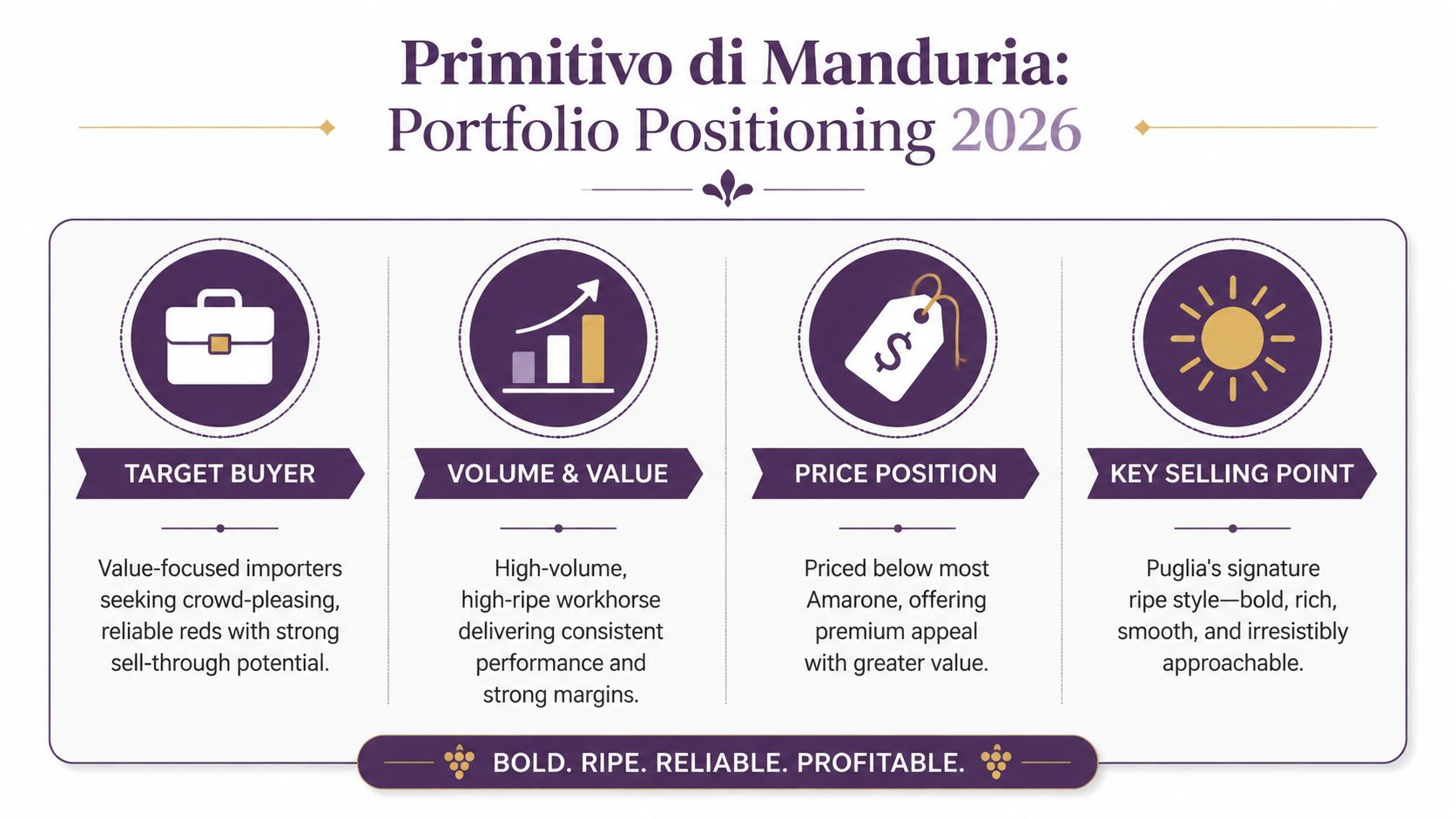
Primitivo di Manduria has a clear role in a modern wine portfolio. The standard DOC is a high-volume, high-ripe Puglia workhorse, suited to merchants who need dark-fruited Italian red with broad consumer appeal and dependable regional identity. Its price position generally sits below most Amarone and Barolo equivalents, which gives retailers room to sell richness without presenting the bottle as an ultra-premium purchase.
Riserva is the natural step up for collectors who want more tannic depth, oak influence, and bottle-age potential. Dolce Naturale belongs elsewhere in the range. Its residual sugar, appassimento-related production, and narrower audience make it a specialty dessert-wine position, not a substitute for the dry DOC.
<a id="three-signals-deserve-ongoing-attention"></a>
Three signals deserve ongoing attention
Average vintage alcohol versus historical norms is the first. A rising alcohol profile could confirm that harvest timing and sugar accumulation are shifting, while stable acidity would indicate successful vineyard adaptation.
The share of Riserva and single-vineyard bottlings is the second. If those formats occupy more retail and auction listings, the category may be developing a stronger premium ladder. If standard DOC dominates, volume remains the central commercial story.
Producer movement between tiers is the third. As yield and climate pressures intensify, watch whether producers reduce standard DOC output, prioritize Riserva, or leave certain vineyard sources outside the appellation. That decision could reveal more about future economics than headline export claims.
A practical sourcing heuristic follows:
- By-the-glass programs: Use standard bottlings where ripe fruit, recognizable origin, and accessible pricing matter most.
- Cellaring selections: Prioritize recent Riserva vintages from named houses, then verify the specific vineyard and élevage.
- Specialty retail: Treat Dolce Naturale as a limited dessert-wine line with a clear food-pairing proposition.
- Auction buying: Require provenance and compare the exact bottle identity before accepting a premium.
A video introduction to the denomination can add useful visual context before a buying review:
<iframe width="100%" style="aspect-ratio: 16 / 9;" src="https://www.youtube.com/embed/ggphV53o8zU" frameborder="0" allow="autoplay; encrypted-media" allowfullscreen></iframe>Primitivo di Manduria is therefore for buyers who want Puglia's ripe signature with a scalable supply base, and for collectors willing to move beyond the standard label into Riserva, old-vine, and single-vineyard expressions. Its next advantage won't come from being merely powerful. It will come from proving that power can remain balanced, traceable, and commercially distinct as harvests move earlier and the Manduria name becomes more tightly defended.
Wine Labs gives merchants, importers, and collectors a comparable view of retail and auction pricing, helping you benchmark Primitivo di Manduria by exact bottle identity, vintage, tier, and channel. Visit Wine Labs to track listings, compare market signals, and build a more disciplined sourcing strategy for this evolving Puglia category.