Wine Labs · Market intelligence
Napa Valley Chardonnay Styles Pricing and Investment
Discover Napa Valley Chardonnay styles by sub-AVA and producer with insights on market pricing and investment potential. Elevate your wine knowledge.
Napa Valley Chardonnay spans 5,662 bearing acres and produced 18,951 tons in Napa County's 2024 agricultural report, with fruit valued at an average of $3,790 per ton (Napa County agricultural report). That scale changes how buyers should think about the category. Napa Valley Chardonnay isn't a single, predictable style or a simple alternative to Cabernet Sauvignon. It's a market made up of cool, bay-influenced vineyards, warmer valley-floor parcels, oak-shaped cellar programs, recognizable brands, and pricing tiers that don't always move together.
For merchants, collectors, and investors, the important question isn't whether a Napa Chardonnay tastes rich or crisp. The more useful question is why a particular bottle tastes that way, which vineyard source supports the style, and whether its price reflects genuine scarcity, producer positioning, or both. This guide follows that chain from vineyard history to sensory profile, sub-AVA sourcing, winemaking choices, climate exposure, and market behavior.
A useful regional comparison can also sharpen the conversation. Readers weighing Napa against its northern neighbor may find Sonoma County Navigator's insights helpful for understanding how the two regions differ in terrain, identity, and wine positioning. The distinction matters because a Napa label can command attention for reasons that have little to do with Chardonnay's generic reputation.
Table of Contents
- Introduction to Napa Valley Chardonnay
- Historical Growth and Vineyard Footprint
- Understanding Napa Valley Chardonnay Styles
- Analyzing Sub AVA and Producer Differences
- Illustrative Case Studies of Premier Producers
- Winemaking and Climate Impact on Style
- Pricing Trends and Investment Strategies
- Conclusion and Next Steps
<a id="introduction-to-napa-valley-chardonnay"></a>
Introduction to Napa Valley Chardonnay
Napa Valley Chardonnay occupies a substantial commercial position, but its market identity is fragmented. Napa County's 2024 report places Chardonnay at 2,147 bearing acres above Merlot, while a Napa Valley Vintners fact sheet lists 5,906 acres, or 13% of planted vineyard area. A 2024 Capstone California guide identifies Chardonnay as Napa Valley's second most planted grape variety. The differing totals reflect different reporting scopes, yet they establish the same conclusion: Chardonnay is a durable foundation of Napa's wine economy, not a minor white-wine category.
That scale does not produce one standard style. Cooler, bay-influenced Carneros sites can support acidity, citrus character, and restraint. Warmer locations generally favor broader stone-fruit and tropical-fruit profiles. Barrel fermentation, oak aging, and malolactic fermentation can add weight and creaminess, while stainless-steel lots, limited malolactic conversion, or extended sur lie contact preserve a firmer, more textured profile.
The result is a category divided by both origin and cellar strategy.
<a id="why-the-category-needs-closer-analysis"></a>
Why the category needs closer analysis
A broad Napa Valley appellation conceals meaningful differences in source, production, and price positioning. Two bottles can share the same appellation while addressing different consumers, occasions, and expectations. Sub-AVA, vineyard sourcing, perceived alcohol, oak intensity, and producer reputation provide a more accurate reading framework than the grape name alone.
For merchants, these variables help separate complementary styles within an assortment. Collectors can distinguish immediate richness from structure that may develop with time. Investors can also examine whether a bottle's pricing reflects vineyard scarcity, recognizable branding, direct-to-consumer demand, or a combination of those factors.
A regional comparison sharpens that analysis. Sonoma County Navigator's insights outlines differences between Sonoma and Napa in terrain, regional identity, and wine positioning. Those distinctions matter because Napa Chardonnay pricing can reflect producer and place signals that extend beyond generic Chardonnay demand.
The central proposition is clear: Napa Chardonnay's value is built at the intersection of site, cellar decisions, and brand scarcity. Evaluating those factors together explains why the category spans accessible bottles and prestige offerings, even within the same broad appellation.
<a id="historical-growth-and-vineyard-footprint"></a>
Historical Growth and Vineyard Footprint
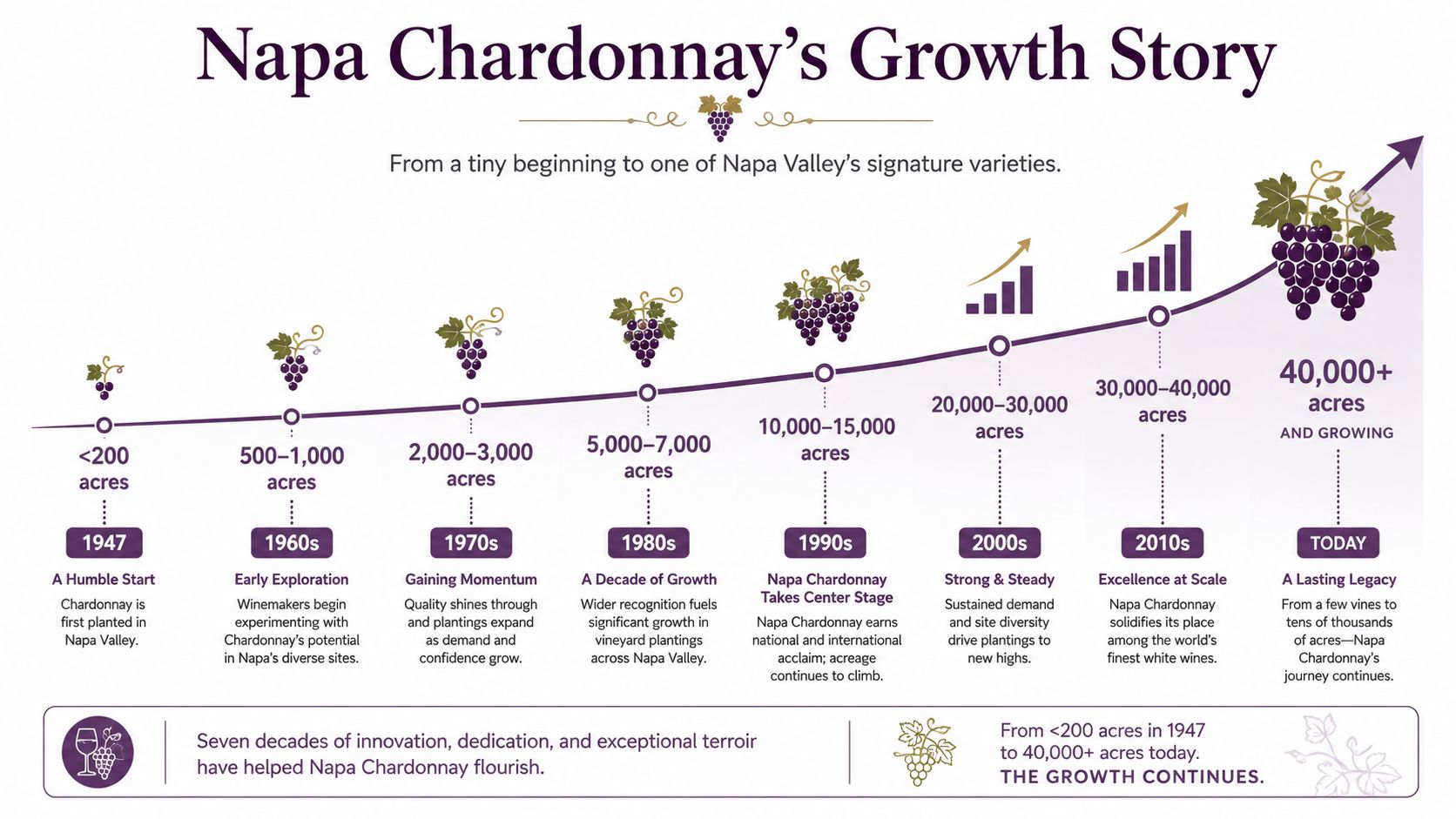
Napa Chardonnay expanded from a small experimental planting into a significant regional crop. In 1947, Stony Hill planted Chardonnay on Spring Mountain when California had only 200 acres of the variety, according to Foundation Plant Services at UC Davis. California had about 150 acres in 1960, approximately 986 bearing acres by 1968, and more than 10,000 acres by the mid-1970s. These statewide figures establish the scale of the shift that Napa growers joined.
Napa County then became a major center of that expansion. Chardonnay acreage increased from 3,700 acres in 1980 to 9,300 acres in 1990, a rise of roughly 151% in one decade. Statewide acreage reached 17,000 acres by 1980 and 102,568 acres by 2000. The sequence shows how quickly Chardonnay moved from limited experimentation to an established commercial foundation.
<a id="reputation-converted-into-vineyard-decisions"></a>
Reputation converted into vineyard decisions
The period after 1976 connected Chardonnay with both fine-wine prestige and broad consumer appeal. Industry commentary associates the Judgment of Paris era with an increase of more than 400% in Chardonnay grown and crushed during the first five years after the tasting. That response helps explain why growers planted more vines instead of treating critical recognition as temporary publicity. Commercially, Chardonnay offered a flexible crop, capable of supporting regional volume and higher-status bottlings.
The acreage also clarifies Chardonnay's role in a Cabernet-led county. Napa County's 2024 report records 5,662 bearing acres and 18,951 tons of Chardonnay, with an average fruit value of $3,790 per ton (Napa County agricultural report). Those figures indicate substantial production alongside meaningful fruit value. They also support different sourcing models, from broad regional wines to selective vineyard-designated releases.
Napa Valley covers roughly 225,000 acres, while about 45,000 acres are planted to wine grapes, according to the Napa Valley AVA overview. Within that bounded agricultural base, vineyard location can influence both stylistic identity and price positioning. Sub-AVA sourcing therefore matters: it links limited site access and established vineyard recognition to the producer decisions that separate Napa Chardonnay's market segments.
<a id="understanding-napa-valley-chardonnay-styles"></a>
Understanding Napa Valley Chardonnay Styles
The easiest way to read Napa Valley Chardonnay is to place each bottle on a spectrum between energy and amplitude. Cooler southern and bay-influenced sites tend to preserve natural acidity, creating profiles that can feel like green apple, lemon zest, pear, or wet stone. Warmer areas encourage riper stone fruit and tropical fruit, producing a wider, softer impression when the cellar team doesn't deliberately restrain the wine.
That distinction isn't only about climate. Winemaking can move the same fruit toward a different sensory destination. Barrel fermentation and oak aging can add toast, spice, and texture. Partial or full malolactic fermentation can increase the perception of creaminess and butter, while sur lie aging can broaden the mid-palate. Stainless steel, concrete, or a limited malolactic program can preserve a cleaner line.
<a id="a-practical-tasting-sequence"></a>
A practical tasting sequence
Start with aroma. Citrus, green apple, and restrained pear usually signal freshness and a lighter textural direction, although they don't prove that a wine is unoaked. Peach, pineapple, baked fruit, vanilla, toast, and butter suggest riper fruit or a stronger secondary-winemaking influence.
Next, test the palate's shape rather than focusing only on flavor. High natural acidity creates lift and a mouthwatering finish. Alcohol and ripe fruit can add warmth and breadth. Oak contributes texture and aromatic seasoning, but heavy oak can cover the grape's varietal character, especially in more delicate, aromatic selections.
| Tasting cue | Likely interpretation | Buying implication |
|---|---|---|
| Bright citrus and firm finish | Cooler source or restrained cellar treatment | Useful for seafood, aperitif service, and freshness-focused lists |
| Ripe stone fruit and broad texture | Warmer source, later maturity, or richer élevage | Suits richer foods and consumers seeking immediate generosity |
| Vanilla, toast, and cream | Oak and malolactic influence | Check balance before assuming the wine will age well |
| Saline or mineral impression | Site character and preserved acidity | Can support a more precise, food-oriented positioning |
The label may not disclose every cellar choice, so tasting notes and technical sheets become valuable. A wine's style is best understood as a combination of fruit maturity, acidity, alcohol, oak, and malolactic proportion, not as a simple warm-site versus cool-site binary. That approach helps merchants match bottles to customers and helps collectors avoid paying a prestige premium for a style they don't prefer.
<a id="analyzing-sub-ava-and-producer-differences"></a>
Analyzing Sub AVA and Producer Differences
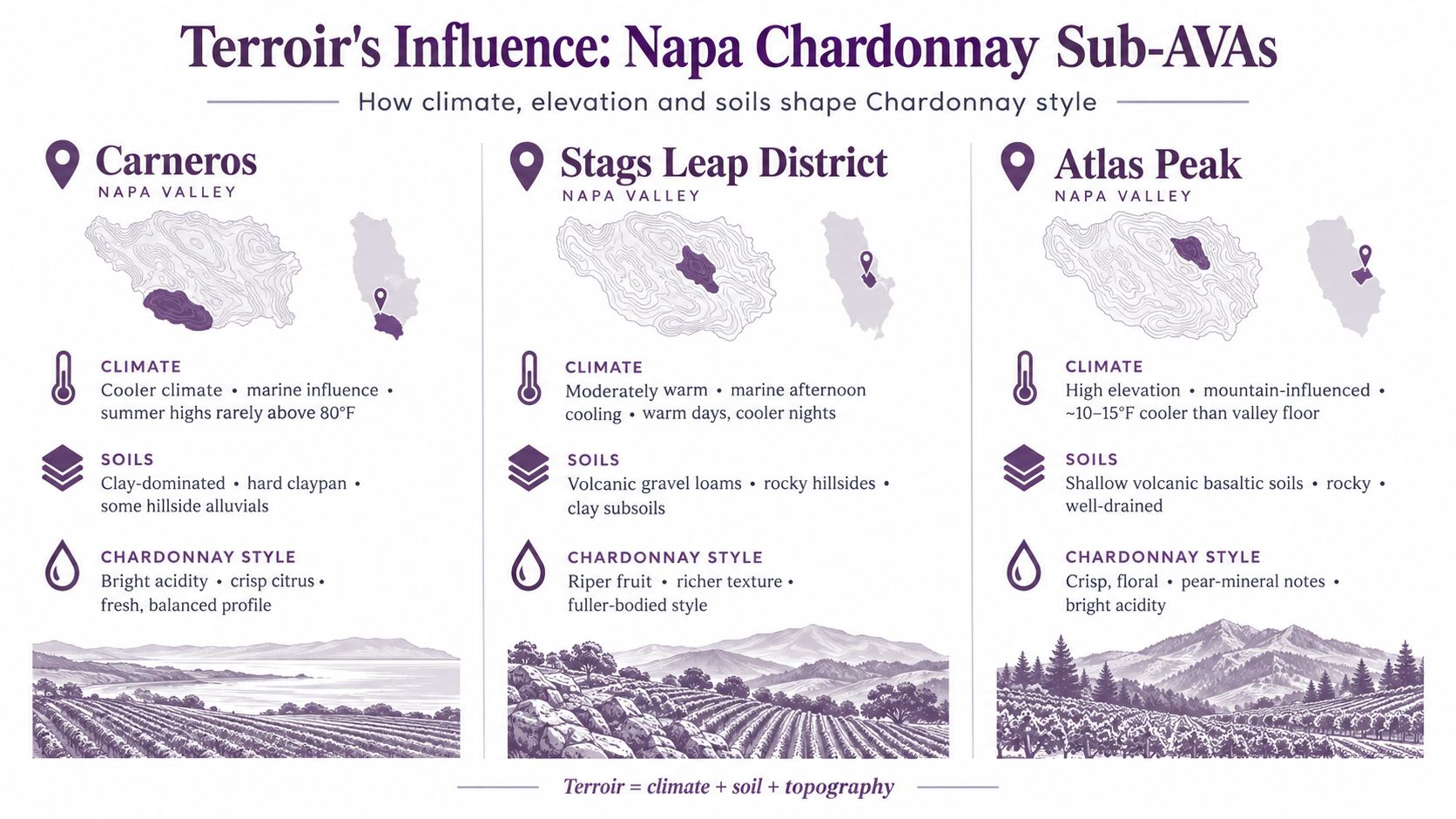
Sub-AVA sourcing often predicts Napa Chardonnay's behavior more precisely than the broad Napa Valley designation. Carneros and other southern areas generally ripen more slowly and retain firmer natural acidity. Warmer valley-floor parcels tend to deliver greater fruit weight and earlier phenolic maturity, while higher-altitude sites can preserve freshness through cooler nights and produce a more linear profile. These differences create distinct style and pricing segments within the same appellation.
Carneros provides a clear example of how origin influences balance. A documented producer sources most of its Chardonnay from Carneros and harvests across a defined late-summer window, producing a wine with moderate alcohol, marked acidity, and a relatively low pH. The significance is qualitative: a cooler source can preserve acid structure even when grapes reach substantial sugar maturity. That relationship helps explain why Carneros bottlings often appeal to buyers seeking precision rather than sheer richness.
<a id="comparing-source-texture-and-positioning"></a>
Comparing source, texture, and positioning
| Source profile | Typical stylistic direction | Commercial interpretation |
|---|---|---|
| Carneros and other cooler southern areas | Brighter acidity, citrus and orchard fruit, more tensile structure | Appeals to buyers seeking finesse, food compatibility, and freshness |
| Warmer valley-floor parcels | Riper stone fruit, tropical notes, broader palate weight | Supports an opulent, immediately accessible proposition |
| Higher or more exposed sites | Leaner shape, mineral impressions, and cooler-night freshness | Can attract collectors who prioritize tension and site distinction |
Stags Leap District and Atlas Peak should not be treated as fixed flavor formulas. Their significance depends on the interaction of elevation, exposure, soil, and cellar technique in a particular bottling. A valley-floor Chardonnay may justify a higher price through richness and producer recognition, while a Carneros wine may support its position through precision and identifiable cool-site sourcing. Both represent luxury, but they answer different consumer preferences.
Producer decisions can reveal or obscure those site differences. Musqué and other Chardonnay clones often call for lighter oak and a restrained malolactic approach because heavy secondary influence can cover delicate aromatics. Sub-AVA therefore establishes a starting point, while the producer determines how clearly that origin reaches the glass.
For readers comparing producer identities and regional context, For Napa Valley wine enthusiasts offers a useful adjacent resource. Compare bottles within the same source style before comparing prices. A premium for Carneros finesse and a premium for valley-floor opulence may appear similar on a shelf, yet they reflect different consumer demands and different expectations for development.
<iframe width="100%" style="aspect-ratio: 16 / 9;" src="https://www.youtube.com/embed/EsmO8TQgBgs" frameborder="0" allow="autoplay; encrypted-media" allowfullscreen></iframe><a id="illustrative-case-studies-of-premier-producers"></a>
Illustrative Case Studies of Premier Producers
Producer comparisons clarify why a broad Napa appellation can hide distinct commercial segments. These examples function as style archetypes, not evidence of specific release prices or secondary-market returns. The available technical and sourcing information supports differences in fruit origin and cellar decisions, while verified pricing records for the named producers are not established here.
<a id="a-cool-source-freshness-led-model"></a>
A cool-source, freshness-led model
A Carneros-focused Chardonnay occupies the freshness-led end of Napa's range. One documented bottling sources 91% of its fruit from Carneros, harvests between August 25 and September 15, and finishes at 14.3% alcohol (technical sheet). The combination links a cool sub-AVA with ripe fruit and retained acidity.
The expected profile includes orchard fruit, citrus lift, and a finish that feels saline or tensile rather than broadly creamy. Restrained oak and limited malolactic conversion can make the site easier to identify. Its pricing segment depends less on sheer weight than on precision, food compatibility, and a clear cool-site narrative. That distinction matters when comparing it with richer valley-floor bottlings carrying a similarly premium image.
<a id="a-richer-cellar-shaped-model"></a>
A richer, cellar-shaped model
A warmer-site Napa Chardonnay serves a different buyer. Riper stone and tropical fruit create immediate generosity, while barrel fermentation, oak aging, and malolactic fermentation add body, toast, and creaminess. Those choices can broaden appeal at release, yet they also create a quality risk: excessive oak or secondary influence can obscure the fruit and weaken the evidence for a distinctive origin.
Collectors should separate richness from complexity. A full first impression may attract attention, but balanced acidity and integrated oak determine whether the wine remains persuasive over time. Without verified release or resale figures, assessment should rely on sensory balance, technical transparency, and the producer's consistency rather than numerical investment claims.
<a id="a-multi-source-complexity-model"></a>
A multi-source complexity model
A blended Napa Chardonnay can join cool-site acidity with warmer-site breadth. The producer's central decision is whether the lots retain complementary roles or become stylistically indistinguishable. Stainless steel may preserve freshness in one component, while barrel fermentation or sur lie aging contributes texture in another.
The resulting bottle can occupy a broader market segment, offering approachability for immediate consumption alongside enough structure for a serious wine list. Buyers should check whether the label identifies vineyards, whether production notes explain oak and malolactic treatment, and whether the producer maintains a recognizable style across releases.
The Wine Labs case studies provide a broader framework for examining producer narratives alongside available evidence. A premier producer label does not replace analysis. Source, cellar calibration, and repeatable identity create the premium together, while unsupported assumptions about release price or resale performance should not substitute for verified market records.
<a id="winemaking-and-climate-impact-on-style"></a>
Winemaking and Climate Impact on Style
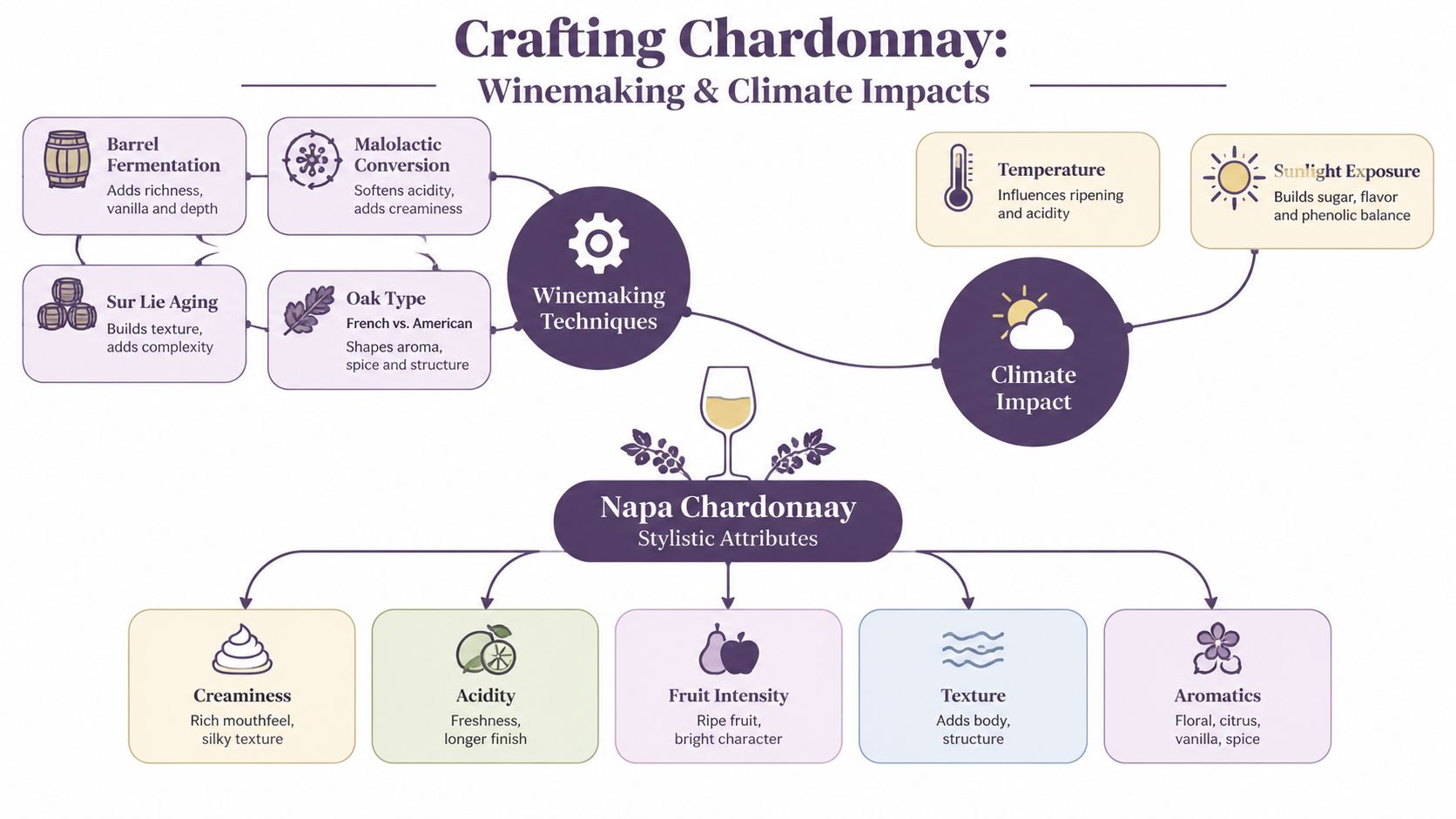
Napa Chardonnay's style is partly grown in the vineyard and partly constructed in the cellar. Barrel fermentation can add texture and toast. Malolactic fermentation can soften acidity and create creamy or buttery impressions. Sur lie aging can widen the palate, while oak selection controls how much spice and vanilla sit beside the fruit.
Producers often split lots between stainless steel and oak rather than choosing one vessel for the entire production. One documented Napa technical example reports 96% barrel fermentation, 31% malolactic completion, eight months sur lie in French oak, 14.3% alcohol, pH 3.43, and 0.65 g/100 ml total acidity (Wine Folly's Chardonnay overview). The figures illustrate a ripe, high-alcohol style that still depends on acidity for balance.
<a id="reading-the-technical-sheet"></a>
Reading the technical sheet
A technical sheet gives buyers a way to test tasting impressions against production choices.
- Barrel fermentation: Expect more integrated texture and possible toast compared with a stainless-led program.
- Malolactic completion: A limited fraction can preserve freshness, while a larger fraction generally pushes the wine toward softness and creaminess.
- Sur lie aging: Lees contact can add breadth and a more substantial mid-palate.
- Oak type and intensity: French oak often functions as a seasoning layer, but new oak can dominate if the fruit lacks enough concentration.
Practical rule: Read alcohol and acidity together. A higher alcohol figure doesn't automatically mean a heavy wine if the producer has preserved sufficient acid structure.
Climate adds another layer. Cooler southern areas slow ripening and retain acidity, while warmer valley-floor sites accumulate sugar and phenolic maturity earlier. Producers respond by choosing harvest timing, lot separation, vessel mix, and malolactic proportion. A style that tastes “opulent” may therefore reflect both warmer fruit and a deliberate cellar decision to amplify that fruit.
Climate risk complicates the investment picture. Recent reporting and climate research indicate that premium grape-growing suitability in Napa and Sonoma could decline under warming and wildfire pressure, while a 2026 study found Chardonnay quality tends to be higher in years without extreme fire weather and lower in high-fire-danger years (Decanter climate coverage). Buyers should treat site resilience, producer adaptation, and vintage conditions as part of long-term risk analysis, not as separate sustainability topics. For related reporting on vineyard sustainability and strategic shifts, see this Wine Labs sustainability digest.
<a id="pricing-trends-and-investment-strategies"></a>
Pricing Trends and Investment Strategies
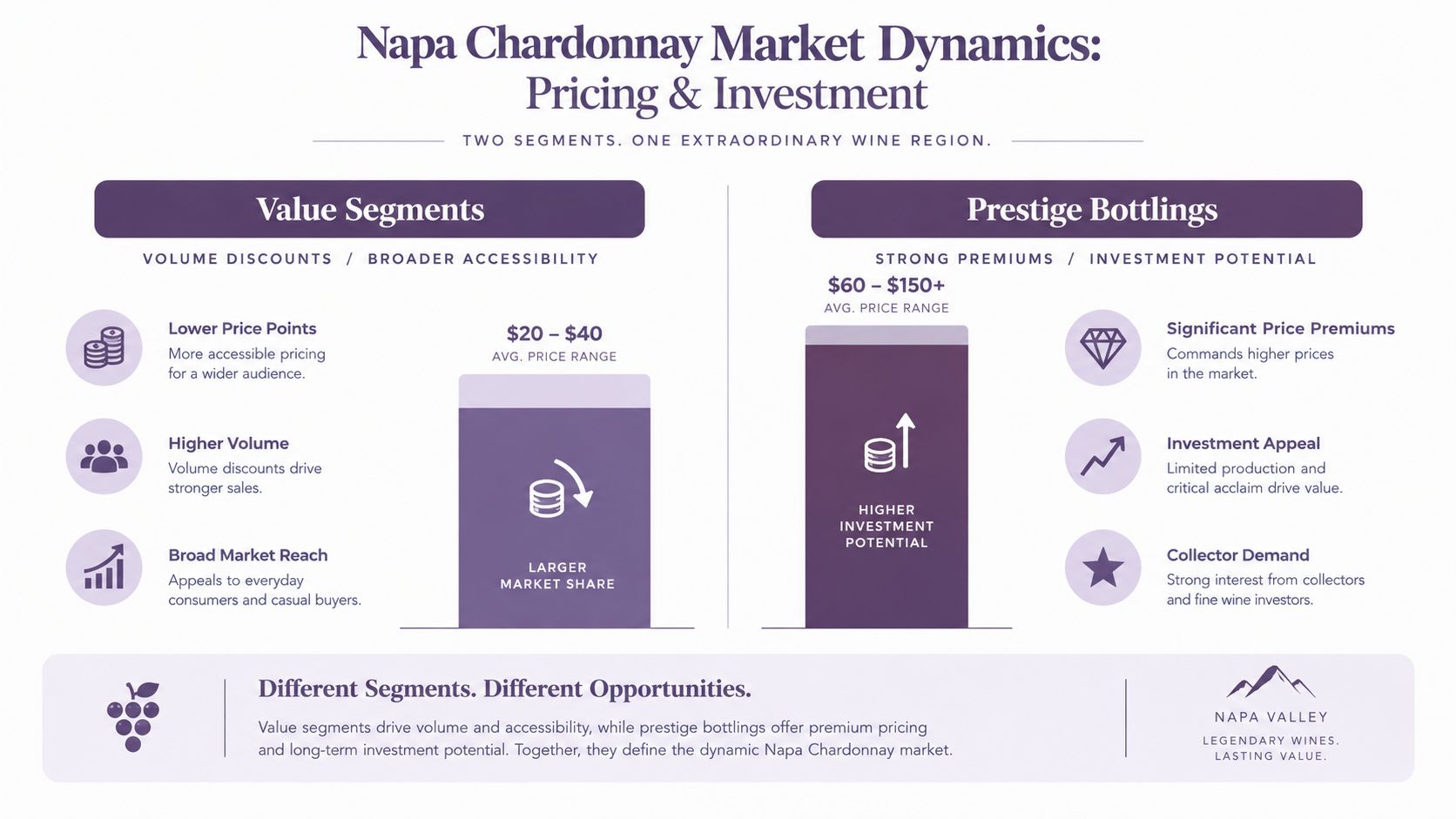
Napa Chardonnay's market has split into distinct layers. The value segment depends on accessibility, distribution, and repeat purchase. Prestige bottlings depend more heavily on vineyard identity, producer reputation, allocation, scarcity, and a buyer's willingness to pay for a specific expression of Napa.
The recent direct-to-consumer data makes that separation visible. Napa Chardonnay recorded a 14% value gain and a 17% increase in average price in 2025, even as volume fell 2%, according to The Drinks Business. That result sits beside weak broader California Chardonnay grape pricing in the same period, showing that bottle-level brand strength and upstream grape economics can move in different directions.
<a id="what-the-split-means-for-buyers"></a>
What the split means for buyers
A merchant shouldn't use a broad California Chardonnay benchmark to price every Napa bottle. The DTC result suggests branded Napa Chardonnay retained pricing power even as volume contracted, but that doesn't mean every producer or sub-AVA benefited equally. A collector should ask whether a price premium is supported by limited vineyard supply, a strong producer allocation, a distinctive style, or current shelf presentation.
A practical portfolio can include different roles:
- Value-facing Napa bottlings: Useful for restaurant lists and retail customers who want recognizable regional identity without chasing scarcity.
- Cool-site selections: Appropriate for buyers prioritizing acidity, food compatibility, and a more restrained style.
- Prestige bottlings: Better suited to allocation-led purchasing, provided the producer has a clear identity and verifiable market history.
- Vintage-sensitive holdings: Require closer monitoring because climate and fire-danger conditions can affect both quality and supply.
Buying discipline: Compare like with like. A Carneros Chardonnay, a multi-source Napa blend, and a famous single-vineyard bottling shouldn't share one pricing benchmark simply because all three say Napa Valley.
Collectors should record bottle identity, vintage, source language, channel, and condition before judging price movement. Direct-to-consumer pricing can show brand demand, while auction and restaurant offers reveal different forms of market acceptance. Wine Labs fine-wine market data is one option for consolidating those comparisons across channels, with price histories, alerts, and portfolio-oriented views.
Merchants also need operational awareness. Shipping constraints can affect where a bottle can be sold and how quickly inventory moves, so this guide to California spirits shipping regulations provides useful context for direct-to-consumer planning. The broader investment conclusion is cautious but constructive: Napa Chardonnay can support premium positioning, but bottle-level evidence matters more than the appellation name alone.
<a id="conclusion-and-next-steps"></a>
Conclusion and Next Steps
Napa Valley Chardonnay makes more sense when buyers read it as a system. Sub-AVA source signals likely acidity and fruit shape, producer technique determines texture and oak influence, and market data reveals whether a premium reflects durable demand or temporary scarcity. Start by comparing technical sheets, then track producer and vintage pricing across relevant channels. Add climate exposure and supply continuity to the checklist, especially for long-term holdings. That process helps merchants build sharper assortments and gives collectors a more defensible basis for buying, storing, and selling.
Wine Labs helps merchants, collectors, and investors compare fine-wine prices across retail, auction, exchange, and restaurant channels while tracking bottle identities, histories, portfolios, and alerts. Visit Wine Labs to evaluate Napa Valley Chardonnay with market context alongside vineyard and producer analysis.