Wine Labs · Market intelligence
Montepulciano Red Wine: Grape vs Region Guide
A practical guide to Montepulciano red wine covering the grape, Montepulciano d'Abruzzo, Vino Nobile di Montepulciano, pricing tiers, and what
You're standing in a wine shop with two bottles in hand. One says Montepulciano d'Abruzzo. The other says Vino Nobile di Montepulciano. The labels look related, but the wines can differ in grape, region, ageing rules, structure, and price.
That confusion comes from one name doing two jobs. Montepulciano is an important Italian red grape, while Montepulciano is also a hilltop town in Tuscany. The Abruzzo wine is built around the grape. The Tuscan appellation takes its identity from the town and is based principally on Sangiovese.
This guide turns that distinction into a practical buying system. You'll see how production scale, appellation rules, vineyard conditions, winemaking, ageing, and label language affect the bottle in front of you. For wider context on Italian releases and wine-market developments, you can also browse Wine Labs' Italian wine news digest.
Table of Contents
- Two Wines That Share a Confusing Name
- The Grape Behind Most Montepulciano Bottles
- Montepulciano d'Abruzzo Versus Vino Nobile
- How the Wine Actually Gets Its Style
- Where Pricing Falls Across the Quality Spectrum
- How to Read Labels, Vintages, and Listings
- What This Means for Your Next Bottle
<a id="two-wines-that-share-a-confusing-name"></a>
Two Wines That Share a Confusing Name
<a id="start-with-the-word-after-montepulciano"></a>
Start with the word after Montepulciano
The fastest way to avoid a bad assumption is to read the complete name, not just the shared word.
Montepulciano d'Abruzzo identifies an Abruzzo appellation whose wine is made primarily from the Montepulciano grape. Vino Nobile di Montepulciano identifies a Tuscan wine from the town of Montepulciano, made principally from Sangiovese, locally called Prugnolo Gentile. The two labels overlap linguistically, but they point to different production systems.
That distinction changes what you should expect in the glass. Montepulciano d'Abruzzo is generally a dark, dry, fruit-driven red with substantial tannin and a rounded feel. Vino Nobile is a Sangiovese-based Tuscan wine shaped by appellation rules and required maturation, so it tends toward firmer structure, savoury detail, and more deliberate ageing potential.
Practical rule: If the label says “d'Abruzzo,” think grape and Abruzzo. If it says “Vino Nobile,” think Tuscan town and Sangiovese.
<a id="why-the-shelf-creates-the-problem"></a>
Why the shelf creates the problem
Wine labels often foreground place names, grape names, or both. In this case, the same spelling appears in two different contexts, and many online listings shorten the names in ways that remove the clue. A listing described only as “Montepulciano red wine” might refer to a grape-based Abruzzo bottling, a Tuscan wine from the town, or a different Rosso di Montepulciano category.
The practical consequences are significant:
- Grape identity: Abruzzo bottles centre on Montepulciano. Vino Nobile requires at least 70% Sangiovese, according to the official Vino Nobile production rules.
- Origin: Montepulciano d'Abruzzo comes from Abruzzo. Vino Nobile comes from the Tuscan town of Montepulciano.
- Ageing: The Tuscan appellation has a formal minimum maturation period before release. Abruzzo wines span a broader range of fresh, everyday, Riserva, and DOCG styles.
- Price expectation: Large-scale Abruzzo production supports an accessible everyday tier, while regulated ageing and Tuscan positioning can move Vino Nobile higher.
The right question at the shelf isn't “Which Montepulciano is better?” It's “Which Montepulciano does this label mean?”
<a id="the-grape-behind-most-montepulciano-bottles"></a>
The Grape Behind Most Montepulciano Bottles
<a id="a-major-agricultural-category"></a>
A major agricultural category
Montepulciano is a grape variety, not a town. Census-based figures recorded 34,824 hectares in 2010, an increase of 14.3% from the previous census, as reported in WineMaker Magazine's Montepulciano profile. Other industry references place Italian plantings at roughly 34,000 hectares, with about 35,000 hectares globally, while Abruzzo alone is described as having around 17,000 hectares of the variety in the same source.
Those figures explain why Montepulciano red wine appears so often in export ranges, supermarket selections, restaurant lists, and regional blends. It isn't a small local grape with occasional commercial visibility. It's one of Italy's major red-wine crops.
Abruzzo is the core stronghold, but plantings also extend through central and southern Italy, including Molise, Lazio, Marche, and Puglia. The grape's agricultural usefulness helps explain that spread. Growers value its late ripening, deep colour, generous production potential, and naturally substantial tannin. Those traits give wineries raw material for both straightforward fruit-led bottlings and more ambitious oak-aged wines.
<a id="from-workhorse-to-named-identity"></a>
From workhorse to named identity
Historically, Montepulciano often served as a dependable bulk-wine workhorse. High-volume production gave the region a reliable commercial base, but it also contributed to a reputation for inexpensive, uncomplicated reds. The creation of the Montepulciano d'Abruzzo DOC in 1968, documented by Italian Wine Central, helped standardize the category and establish a clearer identity.
The denomination's scale is substantial. A widely cited industry reference reports a five-year average production of 840,300 hectolitres, equivalent to about 9.336 million nine-litre cases, and records roughly 8,718 hectares under the DOC in 2014, with 857,500 hectolitres produced that year. More than two-thirds of that output was concentrated in Chieti province, showing how strongly supply is clustered within Abruzzo.
| Region | Approx. planted hectares | Production role | Typical style cue |
|---|---|---|---|
| Abruzzo | About 17,000 hectares | Core source and dominant red category | Dark fruit, colour, tannin |
| Italy overall | About 34,000 hectares | National-scale red variety | Versatile, deeply coloured |
| Molise, Lazio, Marche, and Puglia | Significant plantings, without one consolidated figure in the supplied data | Regional blending and varietal production | Style varies by site and élevage |
The result is a grape with two reputations. It remains a high-volume commercial variety, yet producers can use careful site selection, lower yields, longer élevage, and named bottlings to present it as a serious regional red. The name becomes confusing only when shoppers mistake this grape for the Tuscan town.
<a id="montepulciano-dabruzzo-versus-vino-nobile"></a>
Montepulciano d'Abruzzo Versus Vino Nobile
<a id="the-label-level-comparison"></a>
The label-level comparison
The two wines become much easier to separate when you compare their governing rules.
Montepulciano d'Abruzzo is an Abruzzo appellation centred on the Montepulciano grape. Vino Nobile di Montepulciano is a Tuscan appellation centred on the town of Montepulciano and based primarily on Sangiovese. The shared name signals historical and geographic language, not a shared principal grape.
The supplied production information describes Vino Nobile as requiring at least 70% Sangiovese, locally called Prugnolo Gentile, with approved complementary red grapes making up the balance. The wine must mature for at least two years and can't be released before that minimum period ends. That mandatory ageing gives the category a slower release rhythm and helps integrate tannin before the bottle reaches consumers.
For Montepulciano d'Abruzzo, the applicable style depends on the specific designation and producer. Base DOC bottlings can be designed for earlier drinking, while Riserva and Colline Teramane examples pursue greater concentration, ageing, and site expression. The result is a broader range than the name alone suggests.
| Factor | Montepulciano d'Abruzzo | Vino Nobile di Montepulciano |
|---|---|---|
| Meaning of Montepulciano | The principal red grape | The Tuscan town |
| Main region | Abruzzo | Tuscany, near Montepulciano in Siena province |
| Principal grape identity | Montepulciano | At least 70% Sangiovese, locally Prugnolo Gentile |
| Appellation logic | Grape-led regional denomination | Town-led Tuscan appellation |
| Minimum ageing | Depends on the specific category | At least two years under the official rules |
| Common buying expectation | Fruit-forward, dark, approachable styles, with premium exceptions | Firmer, more savoury, ageworthy Sangiovese character |
<a id="how-the-rulebook-affects-the-glass"></a>
How the rulebook affects the glass
Montepulciano's naturally dark skins and tannin can produce a plush, deep-fruited wine, especially when the producer prioritizes ripe fruit and controlled extraction. Many examples are appealing relatively young because their fruit is generous and their texture is rounded.
Vino Nobile starts from a different foundation. Sangiovese contributes a more recognizably Tuscan combination of red-fruit lift, savoury notes, acidity, and tannic structure. Its required maturation doesn't guarantee that every bottle will taste identical, but it does establish a minimum technical and commercial commitment before release.
That makes the buying choice straightforward. Choose Montepulciano d'Abruzzo when you want a fuller, darker, more immediately accessible red. Choose Vino Nobile when you want a Sangiovese-based Tuscan wine with more structural patience and a stronger connection to appellation ageing rules.
<a id="how-the-wine-actually-gets-its-style"></a>
How the Wine Actually Gets Its Style
<a id="vineyard-conditions-set-the-starting-point"></a>
Vineyard conditions set the starting point
Montepulciano d'Abruzzo production is tied to hilly areas of Abruzzo. The DOC rules set an elevation ceiling of 500 metres above sea level, with an exceptional allowance to 600 metres for south-facing vineyards, as described by Great Italian Food Trade's overview of the denomination. Those limits keep the category connected to sites where ripeness and exposure can be managed within the regional climate.
Colline Teramane adds a stricter production control. Its specialized vineyards have a maximum grape yield of 9.5 tonnes per hectare, according to the Colline Teramane production rules. Lower permitted yields can help a producer concentrate attention on a smaller crop, although the final result still depends on vineyard work, harvest decisions, fermentation, and maturation.
Vino Nobile begins with Tuscan Sangiovese rather than Abruzzo Montepulciano. That single change affects the raw material before the cellar choices begin. Sangiovese's structure and acidity give the Tuscan wine a different framework for oak, extraction, and bottle ageing.
<a id="fermentation-and-extraction-explain-texture"></a>
Fermentation and extraction explain texture
Commercial technical sheets for Montepulciano d'Abruzzo describe examples around 12.5% to 14.5% alcohol, approximately 5.5 grams per litre of acidity, mid-October picking, temperature-controlled fermentation, and 15 to 20 days of maceration, as outlined by Torri Cantine's technical description. Later harvest supports ripeness, while extended contact with skins extracts colour and tannin from the grape's strongly pigmented skins.
Stainless steel protects direct fruit and keeps the texture clean. Wood, especially larger vessels, can soften the presentation and add savoury or toasted layers without dominating the fruit. That combination helps explain why many bottles taste broad, dark, and juicy rather than sharp or angular.
Vino Nobile commonly carries a firmer profile because Sangiovese supplies a different balance of acidity and tannin, and the appellation requires maturation before release. Producers may use larger casks or smaller oak depending on the estate, but the key point is that oak isn't the only driver. Grape variety, extraction, acidity, tannin, and mandatory ageing work together.
| Factor | Montepulciano d'Abruzzo | Vino Nobile di Montepulciano |
|---|---|---|
| Starting grape | Montepulciano | Sangiovese, locally Prugnolo Gentile |
| Colour extraction | Naturally deep colour, supported by skin contact | More dependent on Sangiovese structure and cellar choices |
| Common fermentation direction | Temperature-controlled fermentation, stainless steel or wood | Sangiovese-based fermentation followed by regulated maturation |
| Texture | Rounder, fuller, dark-fruited | Firmer, more savoury, tannic |
| Release logic | Ranges from fresh styles to extended-aged bottlings | Minimum two-year maturation under the appellation rules |
<a id="where-pricing-falls-across-the-quality-spectrum"></a>
Where Pricing Falls Across the Quality Spectrum
Price isn't determined by the word “Montepulciano” alone. It reflects production scale, designation, yield controls, ageing time, estate reputation, distribution, and the market in which the bottle is sold.
<a id="montepulciano-dabruzzo-has-a-wide-ladder"></a>
Montepulciano d'Abruzzo has a wide ladder
At the accessible end, base Montepulciano d'Abruzzo benefits from the denomination's industrial scale. The large production base described earlier supports supermarket and everyday restaurant placement, where buyers typically want a reliable red for immediate drinking rather than a cellar project.
The middle tier includes estate bottlings, named areas, more selective fruit, and more deliberate élevage. These wines may retain Montepulciano's generous dark fruit while adding greater texture, oak integration, or a longer finish. A restaurant list may position them as a step above the house red, especially when the producer or subzone is clearly identified.
At the premium end, look for Riserva and Colline Teramane DOCG. Colline Teramane's maximum yield rule creates a concrete distinction from broad volume production, while extended ageing adds cellar and inventory costs. The premium is therefore tied to both production choices and the time required before sale, not merely to a more impressive label.
<a id="vino-nobile-begins-from-a-different-commercial-position"></a>
Vino Nobile begins from a different commercial position
Entry-level Vino Nobile occupies the value end of Tuscan Sangiovese, but its appellation identity and required maturation give it a different baseline from a basic Abruzzo red. Mid-tier estate bottles can command a stronger position because buyers are paying for Tuscan origin, producer selection, and the expected ability to develop with time.
At the top, Riserva, single-vineyard, and especially site-focused releases move toward collector territory. These bottles appeal to buyers who care about vintage, producer, provenance, and storage rather than only immediate flavour.
| Tier | Montepulciano d'Abruzzo | Vino Nobile di Montepulciano |
|---|---|---|
| Entry | High-volume, everyday DOC wines for immediate drinking | Accessible Tuscan Sangiovese-based appellation wines |
| Mid | Estate, named-area, and more carefully matured bottles | Estate bottlings with stronger producer and site identity |
| Premium | Riserva and Colline Teramane DOCG, with stricter production or longer ageing | Riserva and single-vineyard wines with greater cellar and collector appeal |
For a current comparison across retail, restaurant, auction, and other channels, Wine Labs' fine wine market data can help separate a true quality premium from a listing that uses a prestigious-sounding name.
<a id="how-to-read-labels-vintages-and-listings"></a>
How to Read Labels, Vintages, and Listings
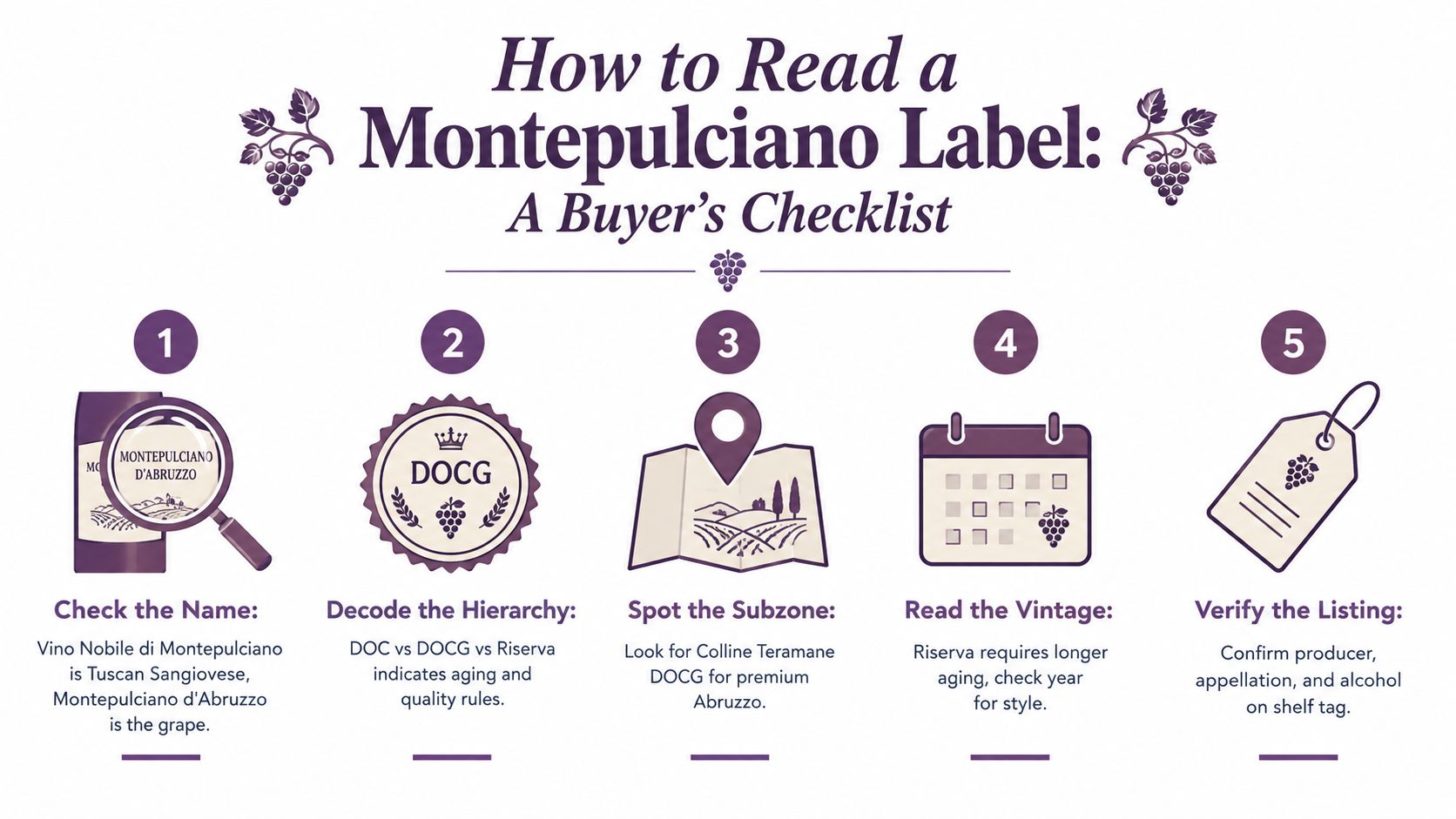
A reliable buying decision starts with the legal name, not the front-label artwork. Use the checklist below before you compare producers or decide whether a bottle looks underpriced.
<a id="five-checks-at-the-shelf"></a>
Five checks at the shelf
-
Read the full appellation. “Montepulciano d'Abruzzo” points to Abruzzo and the grape. “Vino Nobile di Montepulciano” points to Tuscany and Sangiovese. A listing that shortens either name deserves closer inspection.
-
Decode DOC, DOCG, and Riserva. DOC and DOCG are regulated appellation categories, but they don't automatically tell you that two wines will taste alike. Riserva signals a more demanding ageing category where the applicable rules specify additional maturation.
-
Look for the subzone. “Colline Teramane DOCG” identifies the stricter Abruzzo appellation, where specialized cultivation has a maximum grape yield of 9.5 tonnes per hectare. It's a useful quality clue, but producer and vintage still matter.
-
Treat the vintage as a style clue. A younger Montepulciano d'Abruzzo is often selected for direct fruit and earlier drinking. Vino Nobile's required maturation means the bottle has already spent time developing before release, but the vintage remains important for freshness, tannin, and balance.
-
Verify the listing details. Confirm the producer, complete appellation, vintage, alcohol statement, bottling information, and importer or distributor details. Wine Labs' wine label imagery tools can be useful when a digital listing has incomplete or poorly transcribed label information.
<a id="when-an-online-listing-deserves-caution"></a>
When an online listing deserves caution
A vague description such as “Italian red wine” doesn't give you enough information to compare bottles. Missing appellation language, an unclear vintage, or a claimed DOCG wine with no visible certification details should prompt questions rather than an immediate purchase.
Price can also expose a mismatch. An unusually low offer may reflect a clearance, a damaged label, an older listing, a storage concern, or a mistake in the product identity. It isn't proof of fraud, but it means you should verify the bottle before treating it as a bargain.
Vintage comparison requires restraint. Abruzzo's warmer conditions can support a consistent fruit profile, while Tuscan Sangiovese is more sensitive to growing-season variation. Neither pattern replaces tasting data, producer knowledge, or storage information, so use the vintage as one signal within the wider label check.
<iframe width="100%" style="aspect-ratio: 16 / 9;" src="https://www.youtube.com/embed/JxhmbF6C-hs" frameborder="0" allow="autoplay; encrypted-media" allowfullscreen></iframe><a id="what-this-means-for-your-next-bottle"></a>
What This Means for Your Next Bottle
The market is moving beyond the old assumption that Montepulciano means only an inexpensive red for casual meals. Premium producers are using Riserva bottlings, site selection, lower yields, and more careful maturation to show what the grape and its appellations can do. Vino Nobile is also sharpening its identity around Sangiovese-based Tuscan terroir, rather than relying only on the familiarity of the town name.
Export demand adds another layer. Recent industry coverage reports that the United States represented 35% of Vino Nobile exports, while U.S. sales from January through August 2025 rose 4.8% by volume and 4.2% by value, as reported by Vinetur's coverage of Vino Nobile sales. Those figures describe Vino Nobile specifically, but they show why importers and producers are paying attention to the name in major markets.
<a id="match-the-bottle-to-the-occasion"></a>
Match the bottle to the occasion
For a weeknight meal, a fresh Montepulciano d'Abruzzo may make more sense than a structured Tuscan bottle that needs time to open. For a formal dinner or a cellar purchase, Vino Nobile or a serious Abruzzo Riserva may better fit the occasion.
Single-vineyard and Riserva labels are useful signals because they usually indicate a producer has made a narrower, more deliberate selection. They aren't guarantees of quality, but they give you more information than a generic regional label. Colline Teramane DOCG is another meaningful cue for buyers seeking a more tightly controlled Abruzzo category.
<a id="use-market-context-not-just-tasting-notes"></a>
Use market context, not just tasting notes
If you're buying for a restaurant, wine bar, or retail programme, selection also depends on audience education and presentation. A clear explanation of “grape versus town” can prevent customer confusion, while research on local influencer ROI for pubs, gastropubs, and wine bars offers broader context for communicating unfamiliar categories.
Your final decision can follow three questions:
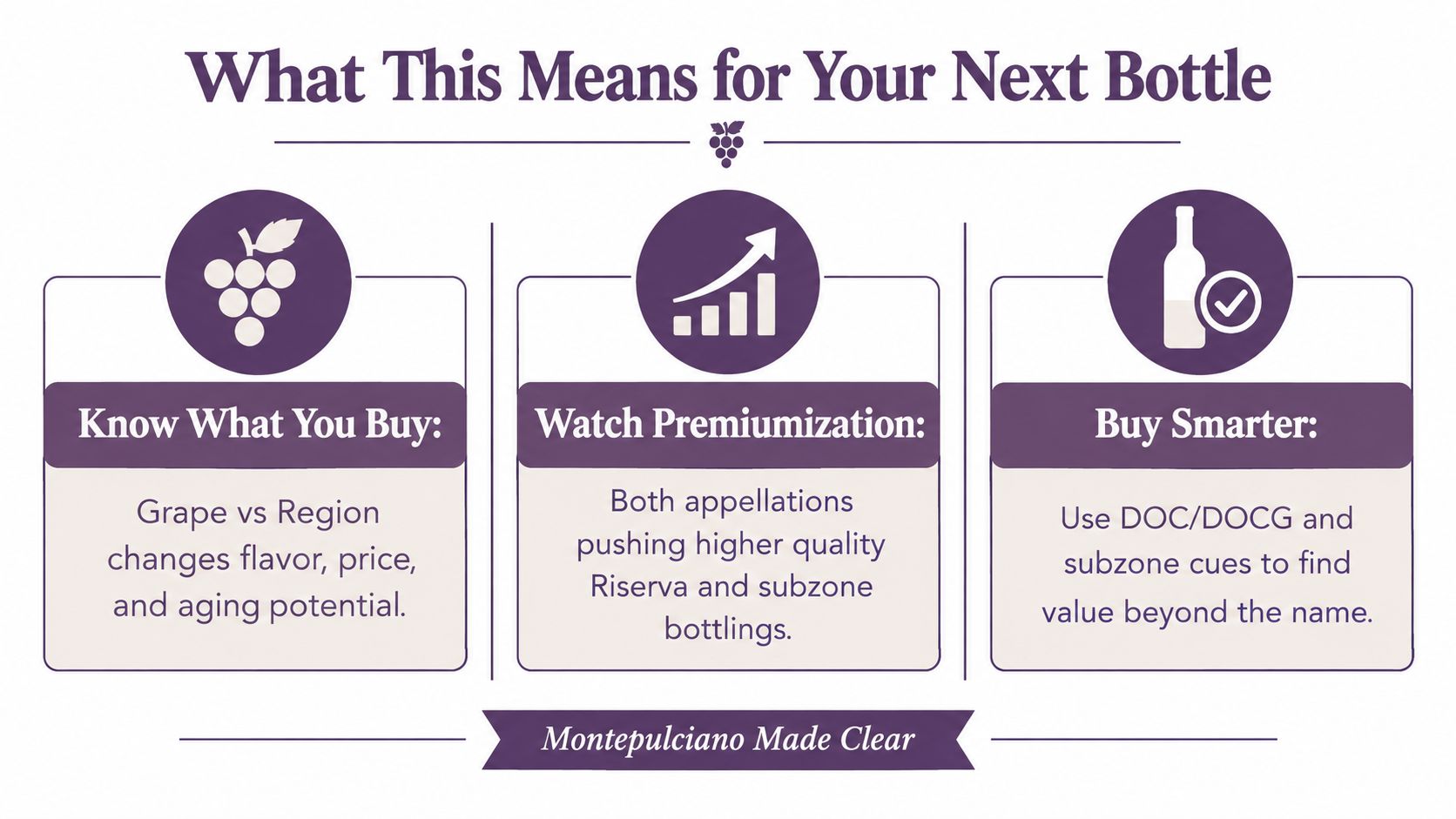
- What identity do you want? Choose Abruzzo Montepulciano for dark, generous fruit, or Tuscan Vino Nobile for Sangiovese structure and ageing potential.
- What tier fits the occasion? Match a base DOC, estate bottling, Riserva, or DOCG wine to how soon you'll drink it and how much provenance matters.
- What evidence supports the listing? Verify the appellation, vintage, producer, importer, and storage history before paying a premium.
Montepulciano becomes simple once you stop treating the shared name as the answer. Read the full appellation, identify the grape, then judge the ageing rule and production tier.
Wine Labs helps buyers compare fine-wine prices across retail, auction, exchange, and restaurant channels, with identity matching and market analytics that can clarify how specific Montepulciano bottles are positioned. Visit Wine Labs to research comparable listings and make your next purchase with stronger market context.