Wine Labs · Market intelligence
French White Wines: A Guide to Regions and Styles
Explore the major French white wines regions, tasting profiles, and quality tiers. A practical guide for buyers, collectors, and merchants navigating
Fine white wine trading has risen 650% in value since 2010, while red wine trading declined 15% over the same period, according to independent Liv-ex market coverage. That headline makes French white wines look like one unified opportunity. They aren't. The strongest signals are regional, and buyers who treat Burgundy, Loire, Alsace, and Bordeaux as interchangeable will confuse category enthusiasm with durable pricing momentum.
France remains the essential reference point because it combines scale, appellation discipline, historic producer networks, and styles that occupy very different commercial niches. The useful question isn't which French white wine tastes best. It's which region is gaining demand, where liquidity exists, and whether the bottle's price reflects a real market signal or inherited prestige.
Table of Contents
- Why French White Wines Anchor the Global Market
- Burgundy Whites and the Chardonnay Template
- Loire Whites and the 2025 Outperformance Story
- Alsace Whites and Reading the Label
- Bordeaux Whites Beyond the Stereotype
- Where the White-Wine Trading Surge Is Actually Concentrated
- A Practical Buyer's Checklist for French White Wines
<a id="why-french-white-wines-anchor-the-global-market"></a>
Why French White Wines Anchor the Global Market
France produced 18.4 million hectoliters of white wine in 2021, compared with 12.2 million hectoliters of red wine and 6.5 million hectoliters of rosé, making white the country's largest color segment in that harvest year, according to the OIV analysis of world wine production by color. France's total harvest reached 37.6 million hectoliters, making it the world's second-largest wine producer in 2021. White wine therefore isn't a niche within French production. It represents roughly half the output of a major global supplier.
The category also has structural reach. France makes still whites across Burgundy, the Loire, Alsace, Bordeaux, and the Rhône, while sparkling production adds another route to consumers. The OIV data shows that white wine's share of global production rose from about 46% around 2000 to about 49% in recent years, a long-term shift that gives French producers a larger category context in which to compete.
<a id="why-appellations-create-commercial-discipline"></a>
Why appellations create commercial discipline
The AOC system, established as a foundation of modern French wine regulation in the 1930s, formally protects origin, permitted grape varieties, and production rules, as documented by the OIV's world production outlook. That framework does more than preserve tradition. It gives merchants a vocabulary for comparing wines, gives buyers a basis for judging scarcity, and lets producers defend distinctions between vineyard sites and appellation tiers.
Négociant and domaine structures reinforce that discipline. A négociant can assemble fruit or wine from multiple growers and offer broader distribution, while a domaine's estate holdings may be tightly limited by vineyard ownership. The result is a market where availability, appellation, producer identity, and provenance interact rather than a simple volume ladder.
Market lens: French white wines anchor global attention because the country combines large production with unusually granular ways to classify scarcity and quality.
The four pillars used in this guide are Burgundy, Loire, Alsace, and Bordeaux whites. Burgundy supplies the benchmark Chardonnay template and much of the fine-wine gravity. Loire provides the clearest recent regional outperformance. Alsace makes the label itself a buying tool, while Bordeaux requires a sharper separation between dry blends and sweet wines.
| Region | Primary White Grapes | Approx. Share of French White Volume | Market Role |
|---|---|---|---|
| Burgundy | Chardonnay, Aligoté | Not specified in the verified data | Fine-wine benchmark and Chardonnay reference |
| Loire | Sauvignon Blanc, Chenin Blanc, Melon de Bourgogne | Not specified in the verified data | Export growth, freshness, and value discovery |
| Alsace | Riesling, Gewurztraminer, Pinot Gris, Muscat | Not specified in the verified data | Varietal-led shelf choice and still or sparkling diversity |
| Bordeaux | Sauvignon Blanc, Sémillon, Muscadelle | Not specified in the verified data | Dry blends, classified whites, and sweet-wine prestige |
For a portfolio view of how white-wine demand can affect broader category strategy, see Wine Labs' white-wine market analysis.
<a id="burgundy-whites-and-the-chardonnay-template"></a>
Burgundy Whites and the Chardonnay Template
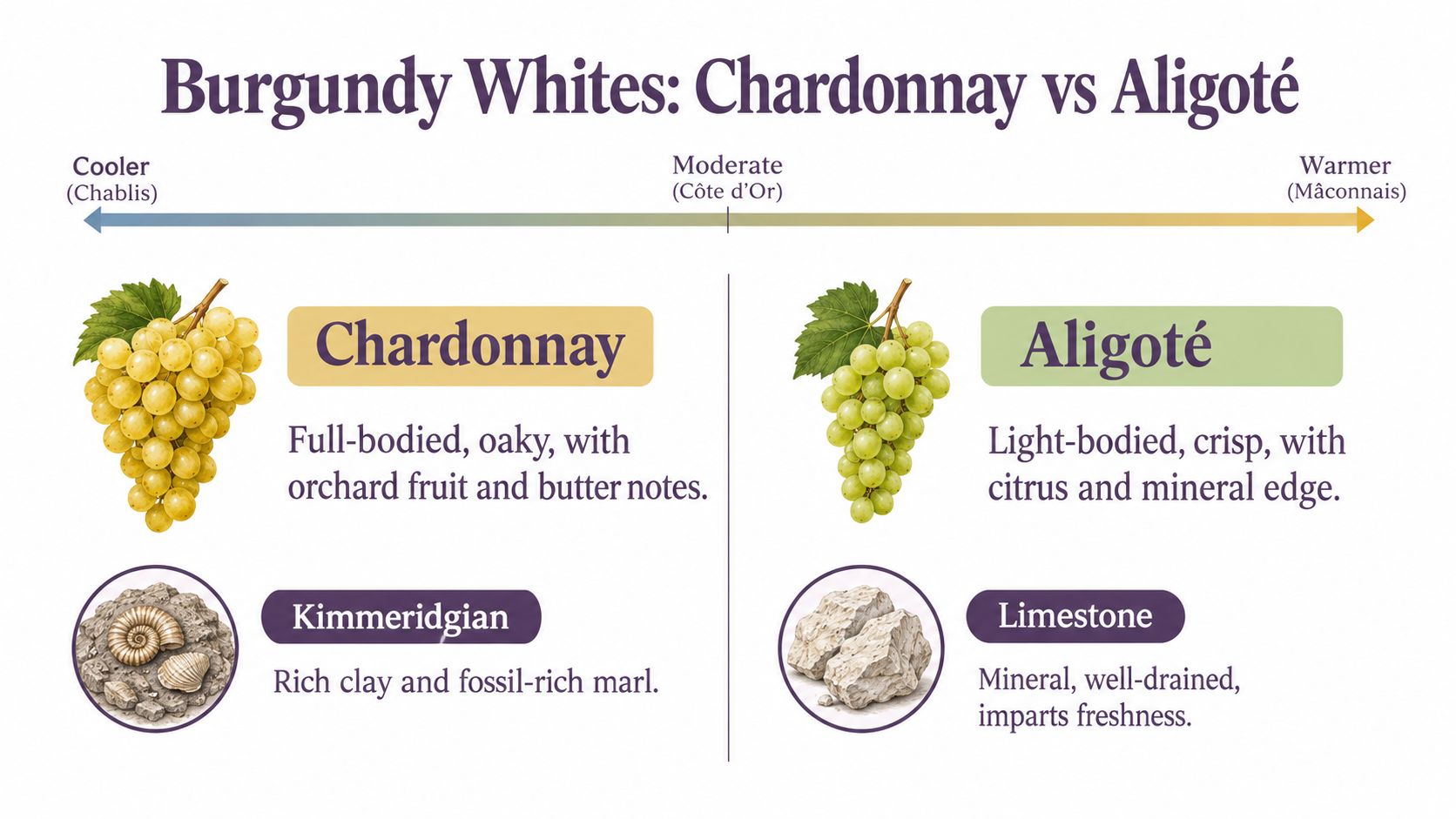
Burgundy's white-wine identity is overwhelmingly a Chardonnay story. Britannica identifies Chardonnay and Aligoté as Burgundy's white grapes, while Majestic's Burgundy overview notes that the vast majority of white Burgundy is 100% Chardonnay, with Aligoté also permitted. That distinction matters commercially because Chardonnay carries the region's most powerful global recognition, while Aligoté occupies a narrower, often more value-oriented lane.
Burgundy's geography supplies the template's internal contrast. Chablis sits farther north, with Kimmeridgian soils associated with clay and fossil-rich marl. The Côte d'Or emphasizes limestone and carefully differentiated vineyard sites, while the Mâconnais generally offers a warmer southern expression. These are not interchangeable versions of one grape. Climate, soil, élevage, and appellation tier alter the balance between citrus, orchard fruit, mineral tension, richness, and oak.
<a id="acidity-malolactic-fermentation-and-price-architecture"></a>
Acidity, malolactic fermentation, and price architecture
The verified technical benchmarks available for Burgundy Chardonnay show pH 3.29, acidity 4.51 g/L, and 12.53% ABV in one regional technical sheet. Another Burgundy example recorded pH 3.30, acidity 3.76 g/L, and residual sugar 0.9 g/L, with partial malolactic fermentation, according to the Louis Jadot Chablis technical sheet. These figures point to a dry style where freshness remains central, even when partial malolactic conversion rounds the palate.
The broader acid decision is important. In a controlled white-wine study, wines that completed malolactic fermentation showed total acidity around 5.75 g/L, compared with about 7.15 g/L in wines that did not, while pH moved from roughly 3.35 to 3.65, as reported in the peer-reviewed study on malolactic fermentation. Buyers should read that not as a universal Burgundy formula, but as evidence that cellar choices materially change tension, softness, and stability.
Village, premier cru, and grand cru labels create a hierarchy that consumers recognize, but the hierarchy doesn't eliminate producer variation. A well-sited Chablis Premier Cru can offer a more convincing combination of freshness and site character than a weakly positioned village Burgundy, while a famous grand cru commands attention partly because supply is constrained and provenance is easier to verify.
Buying rule: In Burgundy, start with appellation and vineyard position, then test whether the producer's availability and style justify the premium.
Négociant bottles can make established names easier to find across markets. Domaine bottlings may offer tighter estate identity but less consistent availability. Aligoté, particularly from Bouzeron, gives buyers a separate path into Burgundy's white identity without pretending that every bottle needs to compete with grand cru Chardonnay.
For a market-focused view of Burgundy valuation and auction performance, consult Wine Labs' Burgundy market digest.
The video below provides an additional visual introduction to Burgundy's white-wine offerings.
<iframe width="100%" style="aspect-ratio: 16 / 9;" src="https://www.youtube.com/embed/4kK_ox_FqAk" frameborder="0" allow="autoplay; encrypted-media" allowfullscreen></iframe><a id="loire-whites-and-the-2025-outperformance-story"></a>
Loire Whites and the 2025 Outperformance Story
The Loire is the clearest evidence that French white-wine momentum isn't distributed evenly. In 2025, Loire white wines were the only French region to grow in both volume and value, with export value up 4.9% and volume up 4.3%, according to WineBusiness coverage of French wine exports. Loire whites represented two-thirds of Loire exports by volume and helped drive all-time highs for the category, even as French wine exports overall fell to €14.3 billion, down 8% by value and 3.3% by volume.
That divergence changes how buyers should interpret the word “French.” A rising French-white category headline can conceal a portfolio where Loire listings are expanding while other regions face pressure.
<a id="the-appellations-behind-the-signal"></a>
The appellations behind the signal
Muscadet is built around Melon de Bourgogne and a saline, brisk profile that fits seafood-focused restaurants and high-turnover retail. Sancerre and Pouilly-Fumé use Sauvignon Blanc to deliver citrus, herbal lift, and mineral impressions, but their commercial identities aren't identical. Sancerre has broader consumer recognition, while Pouilly-Fumé often appeals to buyers seeking a more site-specific alternative within the same grape family.
Vouvray and Savennières show why Chenin Blanc deserves separate treatment. Chenin can range from taut and dry to richly textured and sweet, with the ability to develop complexity over time. Savennières is the more uncompromising, mineral-driven reference, while Vouvray gives merchants a wider sweetness and accessibility spectrum.
Touraine adds breadth and an important value conversation. Its Sauvignon Blanc and Chenin Blanc offerings can sit below the most famous Loire names, allowing retailers to test consumer interest without assuming that recognition alone creates pricing power.
Commercial reading: Loire momentum is strongest where a clear grape identity meets a usable price ladder. The export data supports regional growth, but it doesn't mean every Loire appellation will move together.
The renewed attention to Chenin is especially relevant for collectors and merchants because ageworthy dry whites can occupy a different shelf role from immediate, aromatic Sauvignon Blanc. Buyers should compare vintage condition, producer reputation, and format rather than treating “Chenin” as a single price category. For a related view of the grape's changing market narrative, read Wine Labs' Chenin Blanc market digest.
<a id="alsace-whites-and-reading-the-label"></a>
Alsace Whites and Reading the Label
Alsace makes the bottle label unusually useful. Instead of forcing buyers to infer the grape from an appellation name, producers commonly foreground the varietal, so the first decision is often whether you're looking at Riesling, Gewurztraminer, Pinot Gris, or Muscat.
That varietal-first approach supports a practical sensory map:
- Riesling: Look for petrol-like development, slate, citrus, and linear freshness.
- Gewurztraminer: Expect lychee, rose petal, floral intensity, and a broader palate.
- Pinot Gris: Smoke, pear, and a fuller texture define the usual expectation.
- Muscat: Fresh grape character and herbal notes make it the most immediately aromatic of the group.
<a id="sweetness-requires-a-second-reading"></a>
Sweetness requires a second reading
The grape name doesn't tell you enough. A buyer also needs to identify the sweetness indication. Vin Sec signals a dry style, while Demi-Sec indicates some perceptible sweetness. Moelleux moves toward a richer, sweeter expression. Vendanges Tardives, abbreviated VT, and Sélection de Grains Nobles, abbreviated SGN, indicate more concentrated late-harvest categories.
The practical implication is simple: don't shelve Alsace by producer reputation alone. A Riesling Vin Sec and a late-harvest Gewurztraminer may share a regional origin but serve different customers, food pairings, and inventory roles.
| Grape | Sensory Markers | Sweetness Range | Grand Cru Eligible |
|---|---|---|---|
| Riesling | Petrol, slate, citrus, freshness | Dry through sweet depending on label | Yes |
| Gewurztraminer | Lychee, rose petal, floral breadth | Dry through late-harvest sweetness | Yes |
| Pinot Gris | Smoke, pear, rounded texture | Dry through sweet | Yes |
| Muscat | Fresh grape, herbs, aromatic lift | Usually dry to sweet styles | Yes |
<a id="grand-cru-and-cremant"></a>
Grand Cru and Crémant
The Grand Cru category includes 51 vineyard sites, and eligible wines can include late-harvest expressions. That number comes from the required regional information, but it shouldn't be treated as a promise of uniform market value. Price dispersion inside the category can be wide because vineyard recognition, producer quality, vintage condition, and sweetness level all influence buyer interest.
Crémant d'Alsace belongs in a separate mental column. It's a volume driver for the region and a sparkling product rather than a still-wine substitute. On the shelf, decode Alsace in this order: sparkling or still, grape, sweetness indication, vineyard or Grand Cru designation, then producer and vintage.
<a id="bordeaux-whites-beyond-the-stereotype"></a>
Bordeaux Whites Beyond the Stereotype
Many buyers hear “Bordeaux white” and immediately think of Sauternes. That association is powerful, but it describes only one part of the market. The larger commercial reality is a dry white category built around Sauvignon Blanc-led blends from areas such as Entre-deux-Mers, Graves, and Pessac-Léognan.
Bordeaux white blends typically use Sauvignon Blanc for acidity and citrus, Sémillon for body and waxy texture, and Muscadelle for aromatic lift. The proportions and élevage determine whether the wine feels brisk and direct or broad, layered, and suitable for cellaring.
<a id="dry-white-bordeaux-is-the-volume-conversation"></a>
Dry white Bordeaux is the volume conversation
Generic Bordeaux Blanc often emphasizes freshness and immediate drinkability. Oak treatment may be restrained, especially in wines designed for broad distribution. Classified Pessac-Léognan whites can receive more ambitious barrel work and lees contact, producing a richer, more integrated style where texture becomes as important as citrus definition.
That distinction matters for inventory. Dry Bordeaux Blanc usually serves a wider wholesale and restaurant audience than Sauternes or Barsac, whose sweet-wine positioning creates a more specialized buyer pool. A merchant who groups all Bordeaux whites under a single “premium” narrative risks mismatching price, customer, and occasion.
Shelf discipline: Keep dry Bordeaux Blanc, classified dry whites, and Sauternes or Barsac in separate analytical buckets. Their demand is not interchangeable.
Sauternes remains the consumer-facing prestige story because sweetness, botrytis, and historic château names make the style memorable. Yet dry white Bordeaux drives the broader category conversation and gives buyers more ways to enter the region without committing to a dessert-wine use case.
The fine-wine trade treats dry Bordeaux whites as a niche. Classified Graves whites can attract serious collectors, but they trade at a fraction of their red counterparts because the market assigns different levels of scarcity, demand, and cultural prestige to the two colors. That doesn't make the whites irrelevant. It makes them a category where careful sourcing can matter more than headline recognition.
The right question is therefore not whether Bordeaux makes great white wine. It does. The question is whether you're buying a fresh blend for rotation, a structured Pessac-Léognan for a cellar, or a sweet Sauternes for a specialist customer.
<a id="where-the-white-wine-trading-surge-is-actually-concentrated"></a>
Where the White-Wine Trading Surge Is Actually Concentrated
The fine-white boom is real, but it isn't broad enough to justify a single French-white investment thesis. Liv-ex data reported by En Primeur Club's market coverage shows fine white wine trading value up 650% since 2010, while red wine trading fell 15%. White wine's share of auction volume reached 20.1% in 2025, compared with 20.8% in 2024, after rising from 17.7% in 2022.
Those figures show sustained category relevance, but concentration changes the interpretation. Burgundy represented 69.3% of white-wine trading by value on Liv-ex in 2026, which means Burgundy is carrying much of the fine-white market's financial weight. The phrase “white-wine boom” therefore describes a Burgundy-led phenomenon more accurately than an evenly distributed French regional surge.
<a id="read-the-market-by-concentration-not-color"></a>
Read the market by concentration, not color
Burgundy's dominance supports a buy-and-hold case where provenance, producer, appellation, and storage are strong. It also creates concentration risk. If a portfolio holds only celebrated white Burgundy, it may appear diversified by label while remaining heavily exposed to one regional demand center.
Loire presents a different signal. Its export growth in both value and volume gives merchants evidence of current commercial traction, but export momentum isn't the same as auction liquidity. Loire can be compelling for discovery, restaurant placement, and selective accumulation, while Burgundy remains the more established fine-wine trading reference.
Bordeaux whites sit in a thinner market. The available data doesn't support calling them a broad momentum category, so buyers should focus on producer, classification, and actual transaction evidence rather than assuming that the general white-wine rise will lift every bottle. Champagne also requires discrimination. Trophy cuvées may attract strong attention, but that doesn't make the broader sparkling category equally liquid or equally scarce.
| Region or Category | Price Momentum | Liquidity | Sourcing Implication |
|---|---|---|---|
| Burgundy whites | Strongest concentration in fine-white trading | Established specialist demand | Suitable for provenance-led holding and disciplined replenishment |
| Loire whites | Export value and volume growth in 2025 | More commercial than auction-led | Test regional growth through selective buying and account placement |
| Bordeaux whites | Thin fine-wine trading profile | Limited compared with Burgundy | Buy by producer and use case, not category hype |
| Champagne trophy cuvées | Momentum concentrated at the top | Selective | Separate prestige cuvées from broader sparkling inventory |
Portfolio conclusion: Burgundy supplies the clearest secondary-market signal, while Loire supplies the more interesting regional growth signal. Those are different opportunities and shouldn't be priced with the same assumptions.
For merchants, the operational distinction is useful. Burgundy can support recurring monitoring of specific labels and vintages. Loire requires more attention to appellation, producer, and customer adoption. Bordeaux rewards patience and disciplined cost control, not automatic speculation.
<a id="a-practical-buyers-checklist-for-french-white-wines"></a>
A Practical Buyer's Checklist for French White Wines
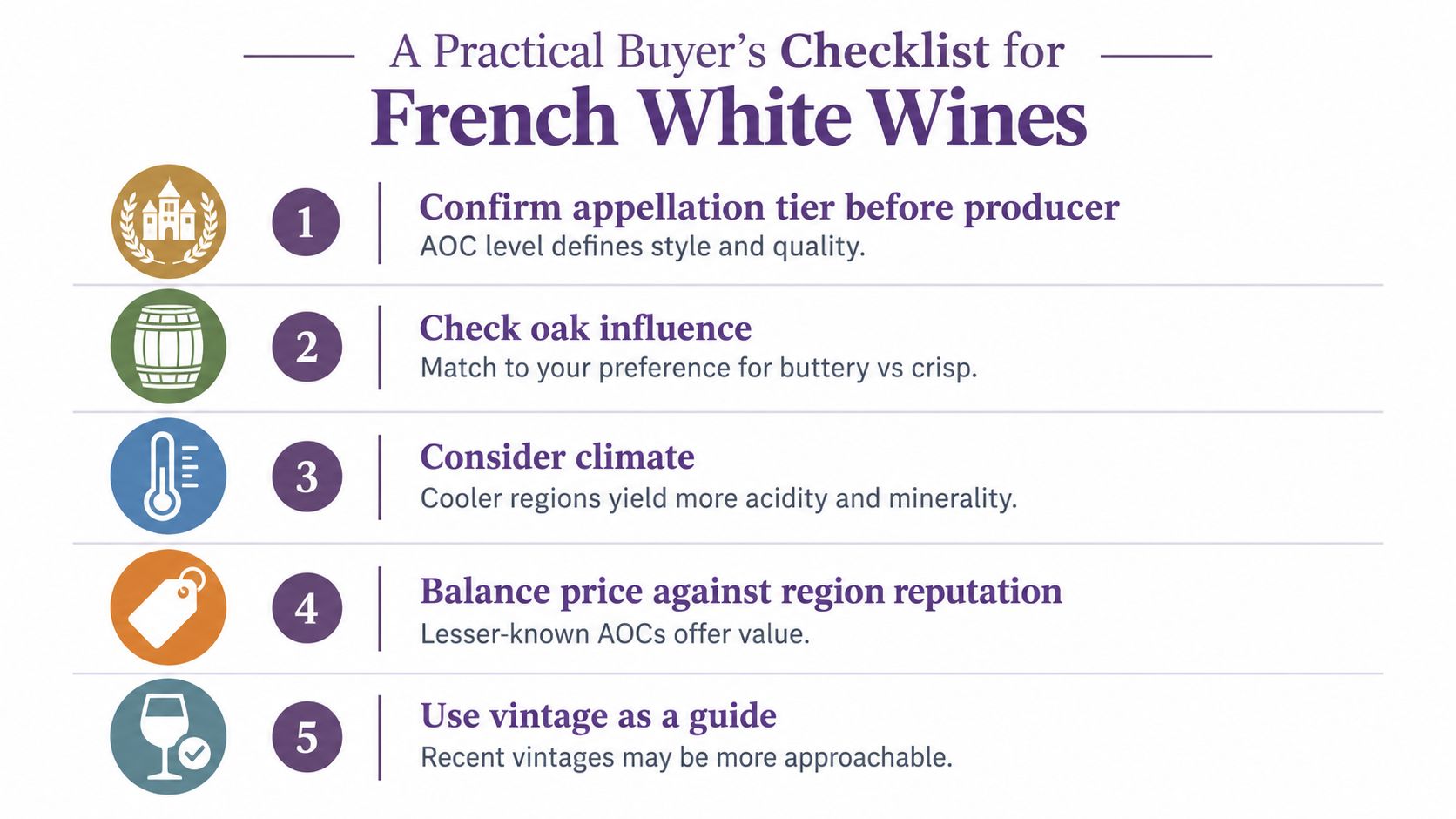
A buyer can turn the regional analysis into five checks. The point isn't to predict every market move. It's to stop a famous name, grape variety, or broad category headline from doing all the analytical work.
-
Confirm the appellation tier before the producer reputation. In Burgundy, village, premier cru, and grand cru labels establish different expectations, but site position still matters. Compare a Chablis Premier Cru with a village Burgundy on actual provenance, style, and availability before assuming the better-known producer is the better purchase.
-
Cross-reference Loire listings with vintage context. Sancerre, Pouilly-Fumé, Vouvray, Savennières, Muscadet, and Touraine don't serve the same customer. Sauvignon Blanc provides immediate recognition, while Chenin Blanc can support a more ageworthy, cellar-oriented proposition. The Loire export data shows regional momentum, but each listing still needs producer and vintage scrutiny.
-
Read Alsace bottle by bottle. Start with still or sparkling status, then grape, sweetness indication, Grand Cru designation, producer, and vintage. Vin Sec, Demi-Sec, Moelleux, VT, and SGN are portfolio decisions, not decorative label language.
-
Separate dry Bordeaux Blanc from Sauternes and Barsac. The dry category serves broader wholesale and restaurant demand, while sweet Bordeaux has a more specialized buyer pool. Reconcile them separately in inventory and don't let Sauternes recognition inflate the expected turnover of a dry blend.
-
Monitor Burgundy white trading signals on a recurring schedule. Liv-ex's concentration data supports watching Burgundy closely, but a market signal becomes useful only when matched to producer identity, provenance, and replacement cost. Cross-channel tools such as Wine Labs consolidate retail, auction, exchange, and restaurant pricing into comparable records, which can help merchants and collectors track those decisions without treating every listing as equivalent.
The strongest French white-wine strategy is selective. Use Burgundy for established fine-wine signals, Loire for regional outperformance, Alsace for label-led assortment, and Bordeaux for disciplined segmentation. Visit Wine Labs to compare French white-wine pricing across retail, auction, exchange, and restaurant channels, then build watchlists and sourcing decisions around the specific appellations and producers that matter to your portfolio.