Wine Labs · Market intelligence
Elixir D Anvers
Elixir d anvers. Explore Elixir d'Anvers in depth — its 1863 origins, herbal recipe, flavor profile, retail and on-trade pricing, and whether it belongs
Elixir d'Anvers starts with a date, not a flavor note: 19 March 1863. That matters because it shifts the bottle from “old Belgian herbal liqueur” into a cleaner trade category: a continuously marketed heritage SKU with a documented founding moment, a stable production identity, and enough historical continuity to deserve catalog discipline rather than gift-shop treatment. The company's own history ties the brand directly to that date, when François-Xavier de Beukelaer finalized the recipe after years of experimentation and founded a distillery in Antwerp the same year, first at Paardenmarkt and later, as demand grew, at Haantjeslei by 1894 (Elixir d'Anvers history).
That combination of exact origin, fixed recipe narrative, and recognizable production method is why Elixir d'Anvers sits in an unusual place. It isn't just a digestif. It isn't just a local curiosity. For merchants, restaurant buyers, and catalog managers, it's a product identity problem: where should it be indexed, how should it be priced against amari and bitters, and what signals tell you whether it belongs in a core list or a heritage-only slot?
Table of Contents
- The 1863 Origin Story and Belgian Roots
- How Elixir d'Anvers Is Made
- Flavor Profile and Serving Traditions
- Price Ranges Across Retail and On-Trade
- Sourcing Tips for Merchants and Catalogs
- Is Elixir d'Anvers a Collectible
- Where the Brand Goes Next
<a id="the-1863-origin-story-and-belgian-roots"></a>
The 1863 Origin Story and Belgian Roots
1863 is more than a heritage date. In spirits catalogs, a precisely documented launch year is uncommon enough to function as a commercial attribute, because it gives buyers a verifiable origin point rather than a vague 19th-century claim. Elixir d'Anvers traces that origin to François-Xavier de Beukelaer in Antwerp, linking the product to a named founder, a defined city, and a fixed start date that still anchors brand positioning today (brand history).
Antwerp matters because the product emerged in a port city with active trade flows, urban pharmacy culture, and a mature retail base for tonic, medicinal, and alcoholic preparations. De Beukelaer's background as a pharmacist and medical student supports that reading. Elixir d'Anvers entered the market in a commercial zone where herbal formulas could move across more than one use case, which helps explain why the bottle has long sat between digestif, specialty liqueur, and remedy-adjacent categories instead of fitting neatly into one shelf code.
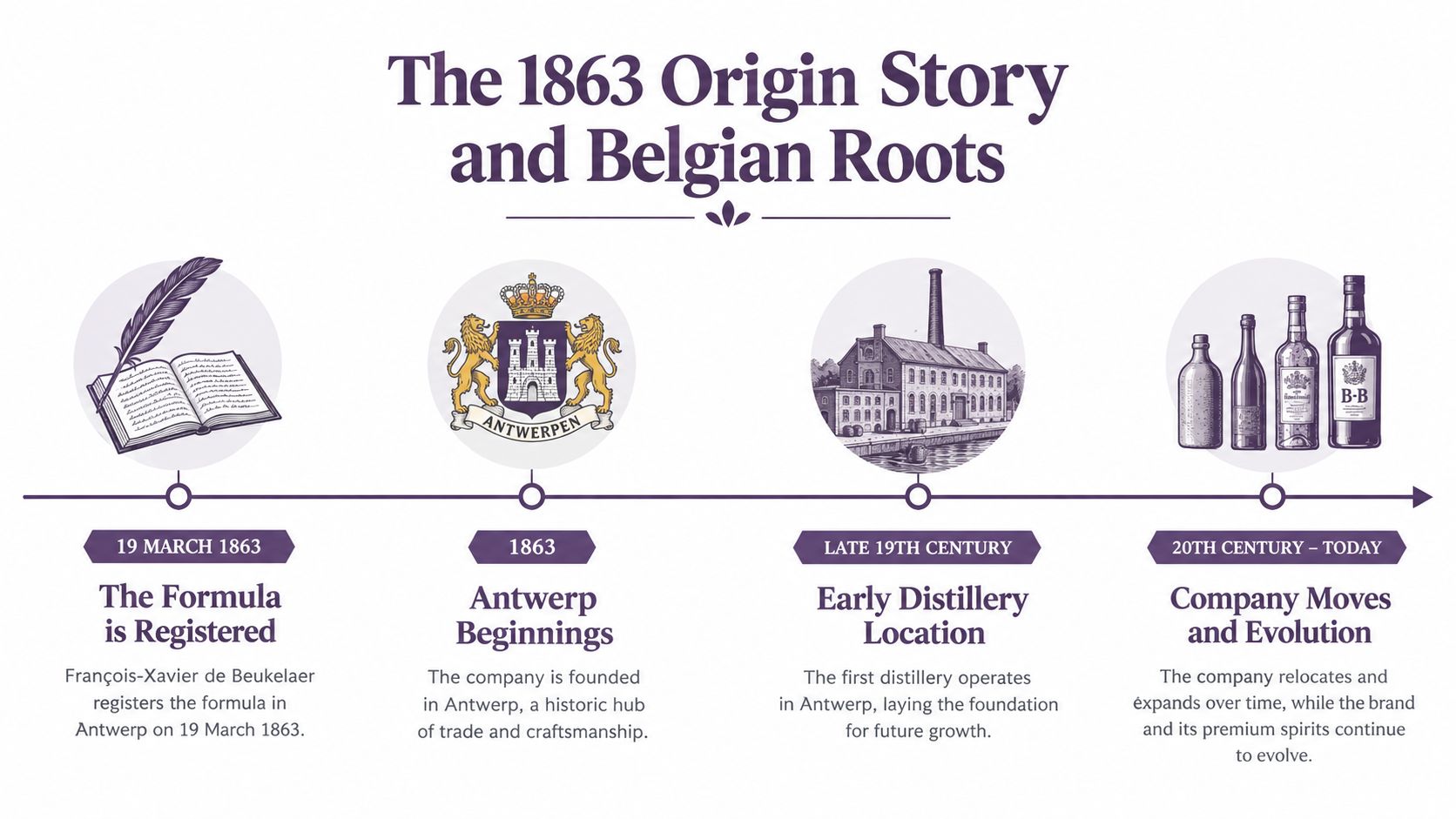
A visual timeline helps clarify how quickly the product moved from formula to industrial scale.
<a id="from-paardenmarkt-to-haantjeslei"></a>
From Paardenmarkt to Haantjeslei
The more useful historical signal is the facility history. The company's account notes that production shifted as demand increased, with a larger distillery established at Haantjeslei by 1894. For catalog work, that matters more than the usual founder anecdote. Early relocation into a larger site suggests the brand moved beyond a small local preparation and into repeatable commercial production within a few decades of launch.
That changes how merchants should classify the bottle.
- Origin data is unusually clean. A named founder, a specific city, and a documented 19th-century start date give the SKU stronger provenance than many heritage liqueurs.
- Expansion supports commercial relevance. A larger distillery by 1894 points to demand strong enough to justify production growth, not just historical survival.
- Antwerp is part of the sales story. The city signals Belgian identity, export adjacency, and local specialty status at the same time.
The practical implication is simple. Elixir d'Anvers belongs in product records as a traceable heritage liqueur with cross-category placement potential, not as a generic after-dinner bottle.
That cross-category problem is still unresolved in modern retail taxonomy. Historical framing around digestive and medicinal use has never fully disappeared, but current shelf logic often pushes similar bottles toward amari, bitters, or national-specialty liqueurs. For buyers, that means origin history affects pricing and placement together. A bottle with this kind of continuity can justify listing in Belgian heritage assortments, giftable premium liqueur sets, and back-bar programs that want provenance with a clear archival record.
Recent coverage of heritage brand milestones in distribution and category context uses that same lens. The relevant question is not whether the story is charming. It is whether the story is specific enough to support modern distribution, shelf placement, and price credibility.
<a id="how-elixir-danvers-is-made"></a>
How Elixir d'Anvers Is Made
A production cycle of about five months places Elixir d'Anvers outside the quickest end of the herbal-liqueur market, where some products are compounded and bottled on shorter timelines (industry profile on production). For buyers, that matters less as a romantic detail than as a cost and positioning signal.
The brand's published method is straightforward: herbs are macerated in pure alcohol, the infusion is slowly steam-distilled in a copper pot still, the distillate is blended with pure alcohol, soft water, and sugar, and the liquid is then matured in old oak casks (production method).
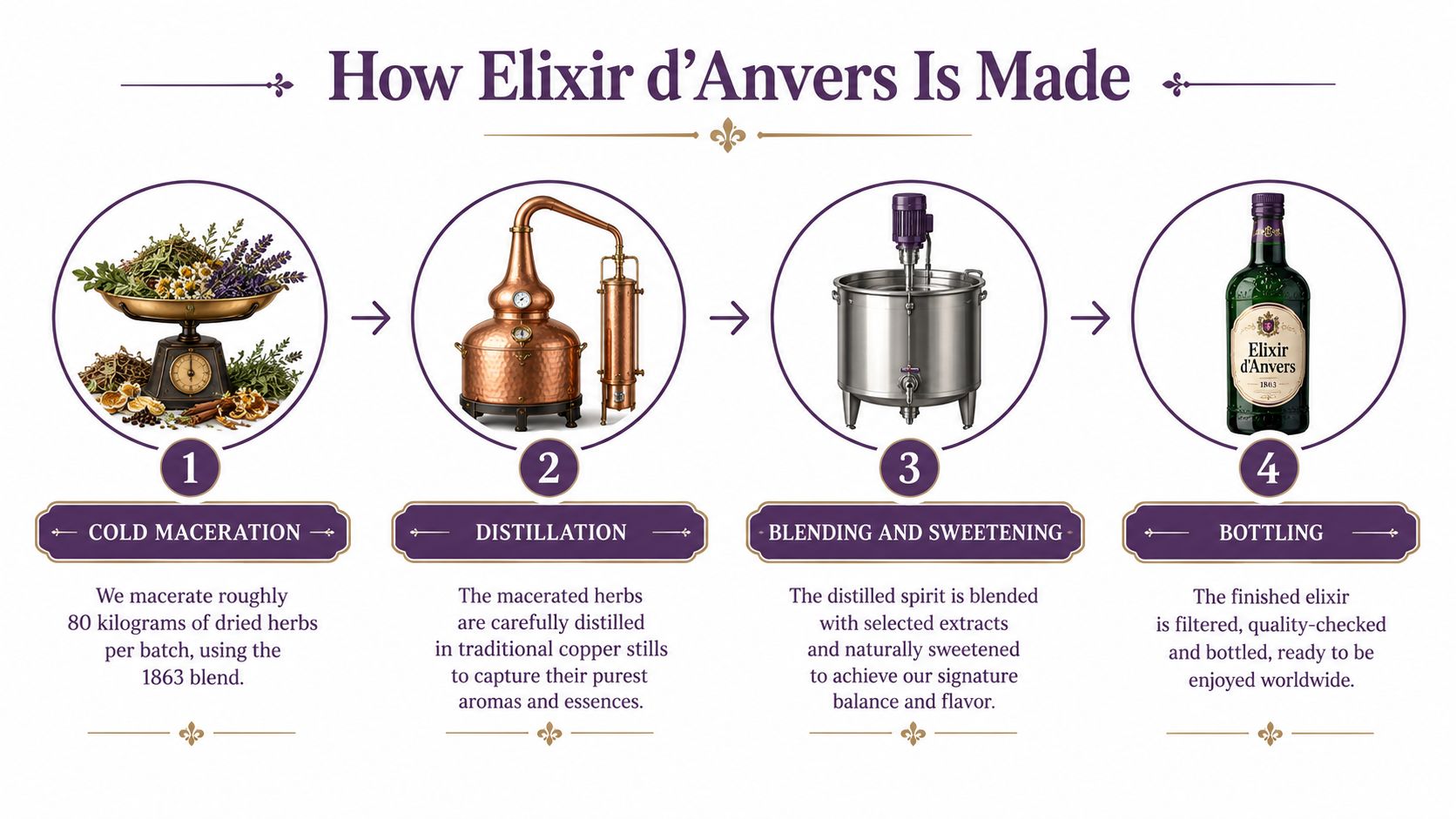
The useful analytical point is not the existence of four stages. Many heritage liqueurs can claim a multi-step process. The more relevant distinction is that Elixir d'Anvers combines extraction, distillation, sweetening, and cask rest in one production chain, which gives merchants a clearer basis for classification than labels such as "herbal specialty" or "digestive."
One quantitative marker stands out. The independent profile reports more than 80 kg of herbs per distillation. That suggests a meaningful botanical input, not a light seasoning approach, and helps explain why the product can sit near amari in buyer discussions even though its market identity remains Belgian liqueur first.
The blending stage carries the clearest trade implication. Once the distilled herbal base is adjusted with alcohol, water, and sugar, the product's commercial lane is effectively set. A sweeter balance supports back-bar use as a stand-alone digestif and specialty pour. A drier, more aggressively bitter profile would have pushed it closer to classic amaro set-building. Elixir d'Anvers appears to occupy the middle ground, which is why catalog teams often have to decide between listing it under herbal liqueurs, digestifs, or country-specific specialties.
Maturation in old oak casks matters for a different reason. Old oak usually signals integration rather than strong wood extraction, so the cask stage supports texture and consistency more than an overt barrel-led flavor claim. That is commercially useful because it lets the brand argue process depth without forcing merchants to position the bottle as a barrel-aged novelty.
For retail and on-trade buyers, the manufacturing sequence points to a product with a higher replication barrier than a generic sweetened herbal cordial. The value is not scarcity. The value is process credibility, which supports premium-but-accessible pricing and gives the bottle a defensible place between mainstream liqueurs and more explicitly bitter amari.
<a id="flavor-profile-and-serving-traditions"></a>
Flavor Profile and Serving Traditions
Elixir d'Anvers is easiest to understand when you separate sensory profile from serving logic. Too much writing on herbal liqueurs blends the two. That confuses buyers because a bottle can taste one way and still succeed commercially for a different reason.
On the nose, the broad family cues are familiar: sweet herbal lift, spice warmth, and a bitter undercurrent that signals digestif territory rather than dessert liqueur. On the palate, the experience tends to start rounder and sweeter than many bitter aperitifs, then move into a more herbal center before tapering into a finish that reads as warming and spice-led rather than aggressively dry. That profile is why Elixir d'Anvers sits adjacent to amari without mapping neatly onto the Italian set.
<a id="traditional-serve-versus-modern-serve"></a>
Traditional serve versus modern serve
The classic service logic is simple. Pour a small measure at room temperature in a modest stemmed glass after a meal. That approach preserves the bottle's historic digestif identity and, from an operator's perspective, protects bottle yield because the pour remains restrained.
A colder serve changes the commercial message. Chilling softens aromatic expression and makes the liqueur more approachable for drinkers who resist strongly herbal after-dinner drinks. That can help restaurants and bars reposition the bottle from “old-world digestif” to “Belgian specialty pour.”
Here's the useful distinction:
- Room temperature service supports heritage storytelling and after-dinner placement.
- Chilled small pours lower the barrier for first-time drinkers.
- Cocktail use shifts Elixir d'Anvers into a modifier role, where consumers compare it less with digestifs and more with versatile back-bar bitters and liqueurs.
<a id="what-on-trade-buyers-should-do-with-that"></a>
What on-trade buyers should do with that
If you're listing Elixir d'Anvers in a bar or restaurant, don't let it drift without context. Give it a function. The bottle works best when the list answers one of three questions clearly:
- Is this the house digestif with a Belgian identity?
- Is it a heritage bottle for a curated back bar?
- Is it a cocktail ingredient that adds sweet herbal depth?
A bottle without a serving script becomes dead inventory faster than a bottle with a narrower audience but a clear role.
Modern integration usually follows one of three paths. Some operators fold it into a spritz-style serve with sparkling wine and soda. Others substitute it into spirit-forward classics where they want a softer herbal profile than a harsher bitter can provide. A third group keeps it simple and lengthens it with tonic or soda, which turns the bottle into an easier upsell in casual settings.
That matters because serving ritual is also a pricing mechanism. A digestif pour emphasizes measured value and tradition. Cocktail deployment prioritizes throughput and visibility. The liquid doesn't change. The revenue model does.
<a id="price-ranges-across-retail-and-on-trade"></a>
Price Ranges Across Retail and On-Trade
Elixir d'Anvers creates a familiar pricing challenge for merchants: the same bottle can behave like a mainstream local liqueur in one channel and a heritage specialty product in another. There's no verified cross-market pricing dataset in the source material, so the right analytical move is qualitative positioning rather than invented benchmarks.
The core distinction is between standard retail formats and story-driven placements. In everyday retail, Elixir d'Anvers usually competes with other herbal liqueurs, digestifs, and regional specialties where shoppers compare bottle size, sweetness expectations, and familiarity. On-trade, the bottle often gains margin because staff can sell the Antwerp origin, the fixed nineteenth-century recipe story, and the digestif tradition.
<a id="where-the-price-logic-shifts"></a>
Where the price logic shifts
A supermarket or specialty store shopper sees a packaged bottle. A café guest sees a ritual. That difference explains why the same product can tolerate a wider value perception in hospitality than on shelf.
The adjacent-category issue matters too. If a retailer shelves Elixir d'Anvers next to amari, customers may compare bitterness, versatility, and cocktail use. If the bottle sits in a Belgian heritage section, the comparison set changes entirely. Then the buyer is judging authenticity, gift appeal, and regional character.
| Channel | Format | Indicative Price | Notes |
|---|---|---|---|
| Belgian retail | Standard bottle | Varies by retailer | Usually functions as a heritage liqueur purchase rather than an impulse mixer |
| Export specialty retail | Standard bottle | Varies by importer and duty structure | Positioning often depends on whether the merchant files it under digestifs, amari, or Belgian specialties |
| Belgian on-trade | By-the-glass pour | Varies by venue and serve style | Staff explanation and digestif placement have an outsize effect on perceived value |
| Back-bar bottle listing | Full bottle or table service | Varies by list design | Better suited to heritage venues and Belgian-focused programs than broad casual lists |
| Travel retail and transport hospitality | Gift-oriented format | Varies by operator | Works as a place-linked souvenir bottle when presented with Antwerp context |
| Presentation or large formats | Special packaging | Higher than core SKU in most cases | Value comes from display and gifting more than from liquid differentiation |
<a id="what-to-benchmark-instead-of-guessing"></a>
What to benchmark instead of guessing
A merchant shouldn't anchor on a single sticker price. Track three things instead:
- Category neighborhood: Is Elixir d'Anvers being sold against digestifs, bitters, liqueurs, or Belgian souvenirs?
- Serve format: Is the bottle earning its place through neat pours, cocktails, or retail gifting?
- Catalog consistency: Does the bottle description match the commercial role?
If you skip that work, price comparisons become noisy. A standard bottle in a supermarket, a museum-adjacent gift shop, and a restaurant digestif list might all be “correctly” priced for their context while looking inconsistent in isolation.
<a id="sourcing-tips-for-merchants-and-catalogs"></a>
Sourcing Tips for Merchants and Catalogs
Merchants should source Elixir d'Anvers the way they'd source any heritage product with multiple route-to-market paths: start with identity control, then verify channel fit, then record price freshness. Too many catalogs reverse that order. They scrape a listing, copy a title, and only later discover they've mixed a current retail bottle with a presentation format or older stock image.
<a id="start-with-the-canonical-identity"></a>
Start with the canonical identity
The first job is to define what counts as the reference product in your own system. For Elixir d'Anvers, that means the bottle's visual identity, producer naming, and product wording need to be captured before you compare offers.
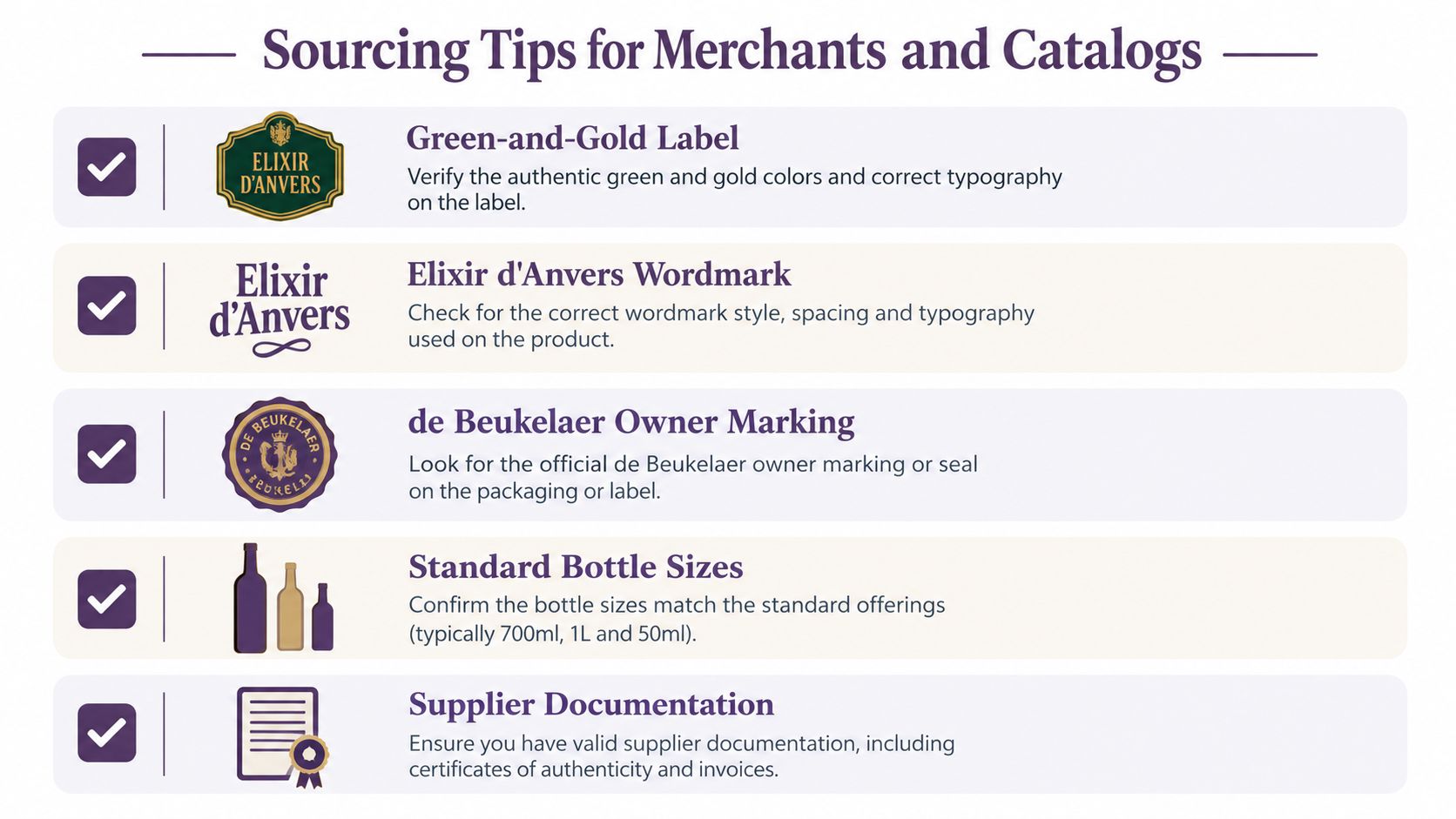
Use a checklist, not memory:
- Label first: Confirm the green-and-gold presentation is consistent with the offer you're recording.
- Wordmark match: Make sure the listing uses the Elixir d'Anvers name cleanly rather than a shortened or translated variant that could fragment your catalog.
- Producer marking: Capture de Beukelaer or current owner information exactly as shown on pack or official listing material.
- Format control: Separate standard bottles from gift packs, large formats, and decorative editions.
- Documentation trail: Keep invoice date, listing date, and image timestamp together.
Catalog rule: Heritage bottles produce bad data when one product identity absorbs several packaging identities.
<a id="choose-channels-by-purpose"></a>
Choose channels by purpose
Source by intended use, not by convenience. If you need current drinking stock, favor active wholesale and retail channels that turn inventory regularly. If you need a discontinued presentation bottle for a collector-facing catalog, secondary-market routes make more sense, but condition review becomes part of procurement.
A practical sourcing ladder looks like this:
- Primary commercial channels for current-release stock and regular replenishment.
- On-trade and specialty distributors when the bottle is intended for restaurant or bar programs.
- Auction and exchange-style channels for older labels, unusual formats, or presentation pieces.
Merchants who build lists also need menu logic, not just bottle logic. If you're fitting heritage liqueurs into a broader beverage program, TopFoodApp's guide to designing a restaurant wine list is useful because the same structural issue applies here: guests order more confidently when category placement is obvious.
For teams that need cross-channel normalization rather than manual spreadsheet work, Wine Labs merchant tools provide a way to consolidate pricing and listing views across retail, auction, exchange, and restaurant channels. That's relevant when a bottle like Elixir d'Anvers appears in several commercial contexts with inconsistent naming.
<a id="refresh-dates-matter-more-than-perfect-prose"></a>
Refresh dates matter more than perfect prose
The easiest way to improve catalog accuracy is to timestamp everything. Record when the wholesale invoice was issued, when the retail listing was observed, and when any marketplace offer was last visible. Then review the record on a fixed cadence.
That sounds procedural, but it solves a real problem. Heritage products don't change identity often, so stale records can look trustworthy long after their price and availability have drifted.
<a id="is-elixir-danvers-a-collectible"></a>
Is Elixir d'Anvers a Collectible
Collectors often over-apply fine-spirit logic to heritage liqueurs. Elixir d'Anvers is where that mistake becomes obvious. The bottle has age, continuity, and local significance, but those traits alone don't make it a true auction-grade collectible.
A better test uses three benchmarks: vintage depth, secondary liquidity, and format dispersion. On the first two, Elixir d'Anvers sits in a modest position. The current product identity is stable, production continuity reduces scarcity drama, and the bottle's strongest appeal remains regional and category-specific rather than globally speculative.
<a id="where-the-collectible-case-weakens"></a>
Where the collectible case weakens
Vintage depth is limited because the market doesn't usually treat standard old bottles of Elixir d'Anvers the way it treats iconic age-statement whisky, famous vintage Chartreuse, or cult amari with sharp supply breaks. Secondary liquidity is also uneven. Bottles can surface, but turnover is irregular and pricing confidence can be thin because buyers and sellers don't always agree on whether they're trading drinking stock, decor, or memorabilia.
That leaves format dispersion as the strongest argument in its favor. Presentation bottles, unusual packaging, older labels, and oversized formats can create a collectible-adjacent premium because they add display value and visual differentiation even when the liquid itself isn't traded as a major investment object.
| Benchmark | Vintage Depth | Secondary Liquidity | Format Dispersion | Auction Presence |
|---|---|---|---|---|
| Elixir d'Anvers | Limited | Modest | Meaningful in select formats | Occasional rather than central |
| Mainstream amari benchmarks | Stronger in some brands | More active in enthusiast circles | Often broader | More visible in specialist trading |
| Classic bitters benchmarks | Mixed | Mixed | Packaging can matter greatly | Usually selective |
| Top-tier collectible herbal liqueurs | Strong | Stronger | Strong | Established and watched |
<a id="where-it-does-belong"></a>
Where it does belong
Elixir d'Anvers belongs in a catalog as a heritage reference SKU and a regional Belgian benchmark, not as a primary fine-spirit investment line. That's still useful. Not every bottle needs a deep auction market to earn inclusion. Some products matter because they anchor a category map.
Treat Elixir d'Anvers like a historically important regional bottle with selective collectible upside, not like a broad speculative asset.
If you monitor auction behavior at all, the relevant question isn't “Is this a blue-chip bottle?” It's “Do special formats, older labels, or boxed examples appear often enough to justify a separate record?” That's the same kind of discipline seen in broader auction intelligence work such as Wine Labs' Zachys December 2025 auction digest, where format, provenance, and lot context drive interpretation more than simple age.
For most buyers, the conclusion is practical. Standard Elixir d'Anvers is for drinking, listing, and merchandising. Select presentation versions may deserve collection notes. Those are not the same market.
<a id="where-the-brand-goes-next"></a>
Where the Brand Goes Next
Shelf economics will decide more of Elixir d'Anvers' future than nostalgia will. For a heritage liqueur with a stable identity and limited global scale, the next question is practical: can the brand stay visible in buyer systems that reward clear pricing, clean metadata, and credible on-trade use cases?
The answer is less about reinventing the liquid and more about improving how the bottle is presented across channels. Retailers, importers, and bar programs already carry too many slow-moving specialty SKUs. A heritage product keeps its place when its catalog record is easy to classify, its pricing sits in a defensible band, and its use case is obvious enough for staff to explain in one sentence.
<a id="the-pressure-points-to-watch"></a>
The pressure points to watch
The first signal is assortment discipline. As spirits buyers trim duplication, regional liqueurs with modest turnover face stricter reviews. Elixir d'Anvers has an advantage here if merchants treat it as a benchmark Belgian herbal SKU rather than a vague specialty bottle.
The second signal is pricing coherence across channels. If retail pricing drifts too far from on-trade list pricing or from adjacent herbal liqueurs, the bottle becomes harder to reorder. Buyers do not need perfect uniformity. They do need a price story that makes sense next to amari, digestifs, and premium liqueurs already on the shelf or back bar.
The third signal is format and data quality. Older labels, gift packs, and special presentations can help specialist demand, but only if distributors and catalog teams separate those records cleanly. Otherwise the brand loses margin through muddled comparisons rather than weak demand.
| Pressure | 2026 Trigger | Likely Response |
|---|---|---|
| Assortment rationalization | Buyers reducing long-tail specialty SKUs | Position the bottle as a heritage Belgian reference with a specific role in the set |
| Channel price drift | Wider gaps between retail, bar pours, and peer products | Tighter monitoring of shelf price, list price, and menu placement |
| Record fragmentation | More gift formats, legacy labels, or presentation variants | Separate catalog entries for format and packaging differences |
| Back-bar competition | More herbal liqueurs competing for one slot | Stress proven origin, consistency, and recognizable serve formats |
The likely path is narrow, but workable. Elixir d'Anvers does not need broad-volume expansion to stay relevant. It needs disciplined distribution, consistent pricing logic, and better treatment as a catalog object.
That matters for merchants. A bottle with moderate velocity can still earn its place if it fills a clear gap in assortment planning and supports a stable gross margin. In that sense, Elixir d'Anvers competes less on hype and more on listing efficiency.
Catalog managers should track a short list of forward indicators: whether key retailers keep the SKU live year-round, whether menu placements remain concentrated in classic or low-friction serves, and whether alternate formats appear often enough to justify separate records. If those indicators hold, the brand remains commercially useful even without broad collector demand.
Wine Labs helps merchants, distributors, and catalog teams compare bottle pricing across retail, auction, exchange, and restaurant channels in one normalized view. That is useful for products like Elixir d'Anvers, where channel placement and price freshness shape buyer decisions as much as the liquid itself. If you're building or cleaning a spirits catalog, visit Wine Labs.