Wine Labs · Market intelligence
D Asti Moscato
D asti moscato. Learn what D'Asti Moscato tastes like, how it's made, when to serve it, and what drives D'Asti Moscato pricing across retail and restaurant
You're standing in front of a wine shelf with two bottles that look related. Both mention Moscato or Asti, both promise sweetness, and both have bubbles. One should suit a relaxed brunch or fruit dessert, while the other may deliver a much more forceful sparkle. Choosing correctly starts with a simple distinction: Moscato d'Asti is a specific Piedmontese DOCG wine, not a generic name for every sweet Muscat or Asti sparkling wine.

Table of Contents
- Introduction to D'Asti Moscato and Why It Confuses Buyers
- What D'Asti Moscato Tastes Like and How Sweetness Works
- Where D'Asti Moscato Comes From and Why Place Defines It
- How D'Asti Moscato Is Made and Why It Stays Lightly Sparkling
- When and How to Serve D'Asti Moscato for the Best Experience
- Understanding D'Asti Moscato Pricing and Listing Signals Across Channels
- Choosing Storing and Tracking D'Asti Moscato With Confidence
<a id="introduction-to-dasti-moscato-and-why-it-confuses-buyers"></a>
Introduction to D'Asti Moscato and Why It Confuses Buyers
The confusion usually appears at the moment of purchase. You might want a lightly sweet wine with a gentle lift, but the label gives you only a family resemblance. Moscato d'Asti, Asti Spumante, and wines labeled in shorthand as Moscato share aromatic associations, yet they don't promise the same pressure, sweetness, origin, or drinking experience.
Think of them as related members of one family rather than interchangeable names. Moscato d'Asti is tied to Moscato Bianco grown within the Asti DOCG area. Asti Spumante belongs to the same broader regional family but is more fully sparkling. Generic Moscato can come from other places and may be still, lightly sparkling, or made in a noticeably different style.
That distinction matters when you're buying for someone else. A guest who expects soft bubbles may find a fully sparkling bottle too energetic, while a drinker seeking a celebratory fizz may consider Moscato d'Asti too restrained. Sweetness creates a similar trap. A wine can taste sweet because it has natural grape sugar, ripe fruit aromas, or both, but those impressions don't tell you the wine's exact identity.
Practical rule: Read the appellation before you judge the sweetness. “Moscato d'Asti DOCG” gives you a more reliable starting point than “Moscato” alone.
This guide moves in a practical order. First, you'll learn how the wine tastes. Then you'll see how fermentation creates its sweetness and gentle sparkle, why Piedmont defines its identity, and how those production choices affect serving. The final sections connect the bottle to real market conditions, including export demand, yield controls, channel-specific listings, and storage.
For readers interested in how digital commerce can change the way shoppers discover specialist products, this Amazon marketplace growth case study offers useful context. The same principle applies to wine: clearer product identity helps buyers move from vague browsing to a confident choice.
<a id="what-dasti-moscato-tastes-like-and-how-sweetness-works"></a>
What D'Asti Moscato Tastes Like and How Sweetness Works
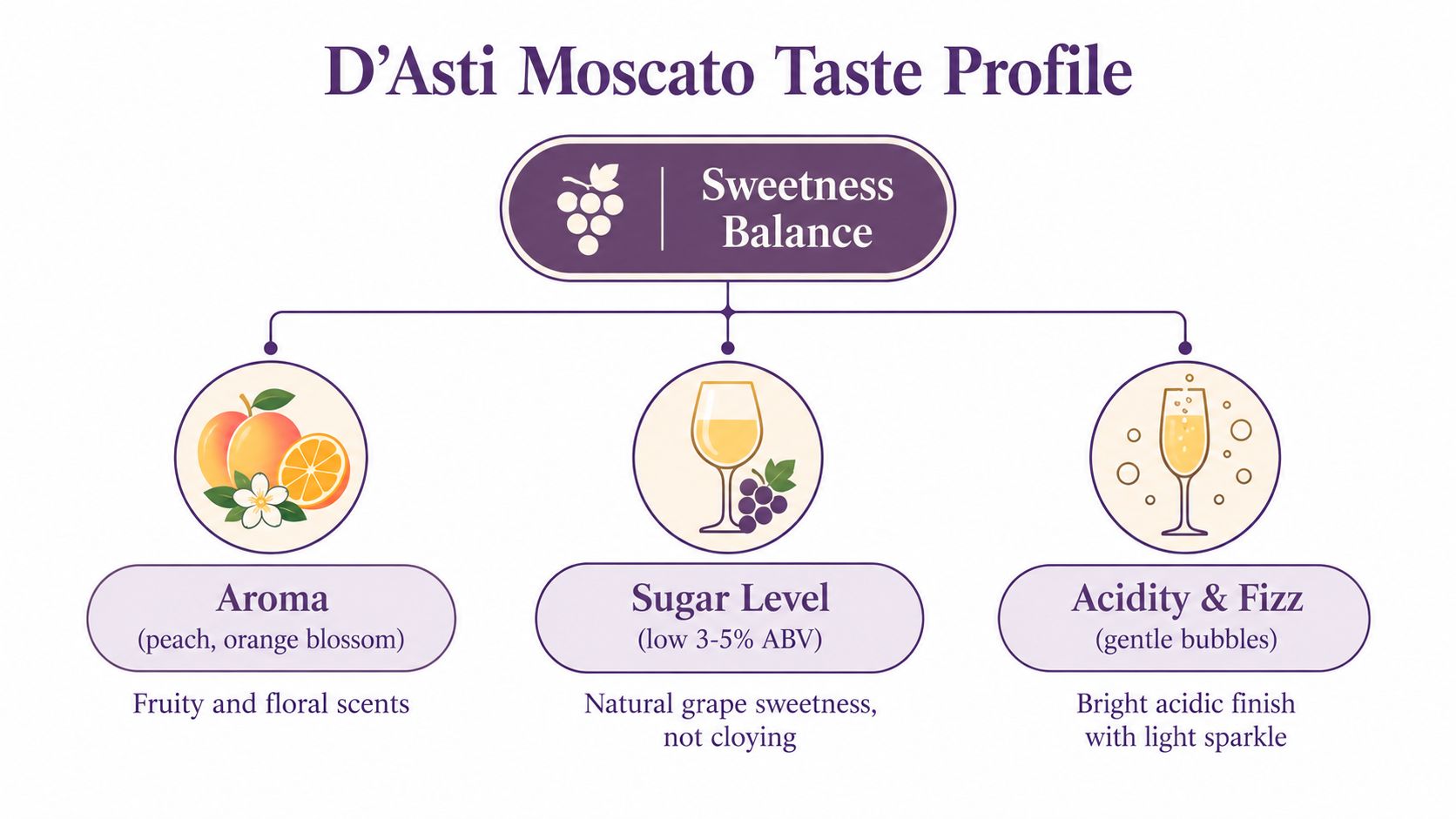
Moscato d'Asti starts with aroma before it reaches the palate. Expect a fragrant profile built around white peach, orange blossom, fresh grape, and citrus-like floral lift. These scents can make the wine seem sweeter than it feels, much as the smell of ripe fruit can suggest sugar before you take a bite.
The palate is gently sweet, but sweetness isn't the whole experience. Fresh acidity gives the wine shape and keeps the finish from feeling heavy. The effect resembles a ripe peach with a squeeze of citrus, rather than syrup poured into a glass. That balance is why the wine can work both as an aperitivo and alongside dessert.
<a id="reading-the-glass"></a>
Reading the glass
Look for three sensations working together:
- Aromatic intensity: Floral and peach-like scents arrive immediately, so the wine feels expressive even before you taste it.
- Natural sweetness: The sweetness feels connected to the grape's fruit character, not added as a separate flavor.
- Light sparkle: The bubbles create a soft, almost tingling texture rather than the assertive pressure of a fully sparkling wine.
Temperature changes the balance. Serve Moscato d'Asti well chilled and the acidity becomes more prominent, the sweetness feels cleaner, and the aromas stay lively. Serve it too warm and the sugar may seem heavier while the fizz loses some of its freshness.
The wine's gentle texture also affects how you describe it to another person. “Sweet and sparkling” is accurate but incomplete. A more useful description is fragrant, lightly sweet, fresh, and softly sparkling. That language helps a customer or guest understand that the wine isn't trying to imitate a dry, high-pressure celebratory bottle.
<iframe width="100%" style="aspect-ratio: 16 / 9;" src="https://www.youtube.com/embed/bj_DCAR54cg" frameborder="0" allow="autoplay; encrypted-media" allowfullscreen></iframe>Use that sensory vocabulary when comparing listings. If a menu calls the wine “sweet sparkling,” check whether it identifies Moscato d'Asti specifically. A canonical appellation should lead you to expect the aromatic, low-alcohol, lightly sparkling profile described above, while a broader Moscato label may require more investigation.
<a id="where-dasti-moscato-comes-from-and-why-place-defines-it"></a>
Where D'Asti Moscato Comes From and Why Place Defines It
Moscato d'Asti is a regional wine in the strongest sense. Its identity depends on where the grapes are grown, which grape is used, and whether the finished wine follows the appellation's rules. The name points to Asti in Piedmont, but the denomination extends across a defined hill country rather than a single town.
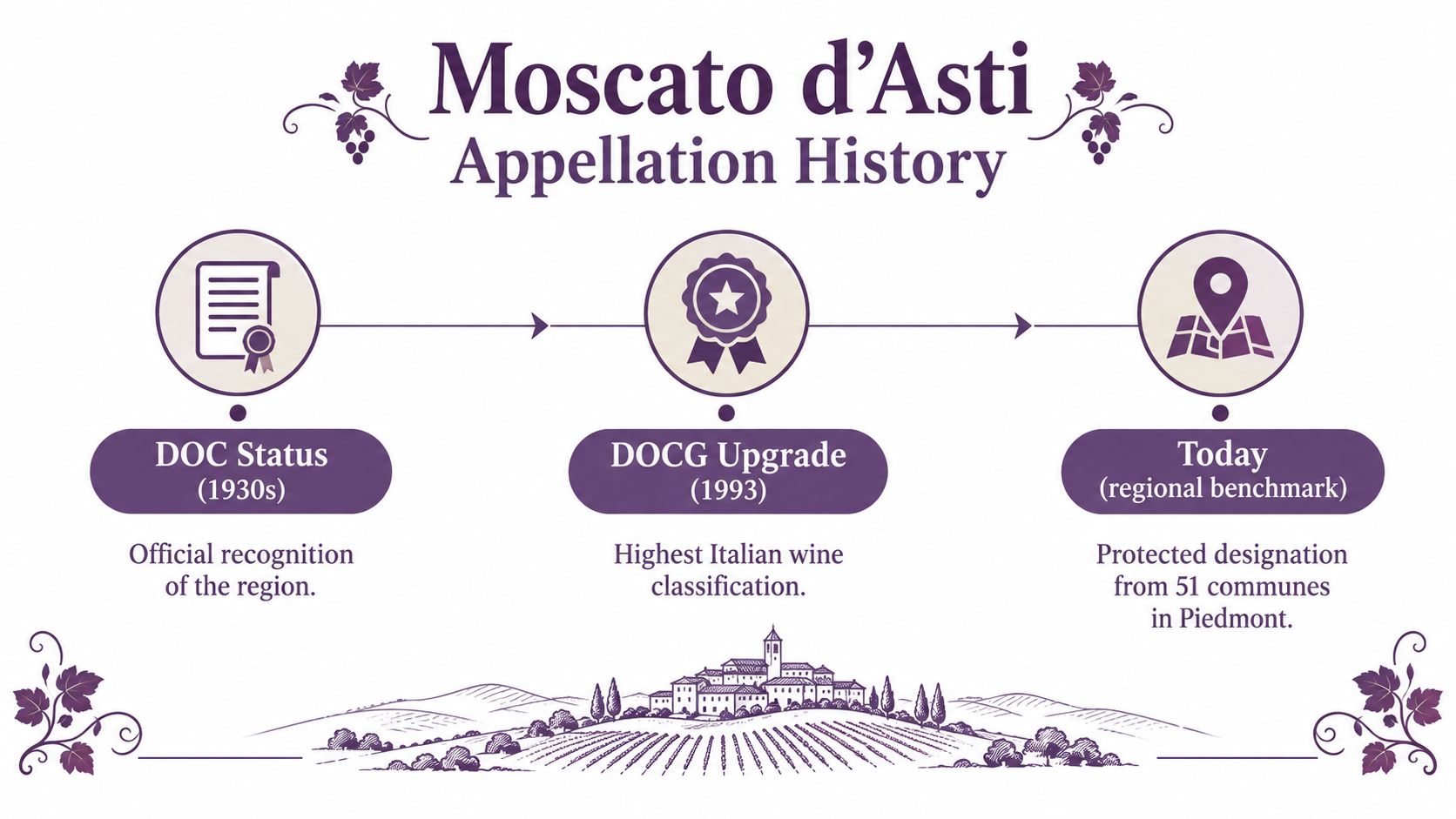
The appellation received DOC status in 1967 and was raised to DOCG in 1993, placing it among Italy's earliest wines to enter the country's highest quality category. Its modern commercial story is commonly connected with sparkling-wine innovations in the Asti area during the late nineteenth century, including Carlo Gancia's work around the 1860s and 1870s. The Asti wine consortium itself was founded on 17 December 1932, giving the category a long institutional history. These milestones are documented in the Moscato d'Asti appellation overview.
<a id="a-defined-hillside-zone"></a>
A defined hillside zone
The production area is described as covering about 50 communes across the provinces of Asti, Alessandria, and Cuneo, concentrated in the hills south of Asti and stretching roughly 50 kilometres east to west. That geography explains why the wine is treated as a regional benchmark rather than as a broad commercial category. The label isn't merely naming a flavor family. It connects the bottle to a regulated territory and to Moscato Bianco grown in named hillside communes.
That connection helps buyers compare like with like. A bottle identified as Moscato d'Asti has a clearer canonical identity than a generic sweet Muscat, even when both show floral aromas. Merchants can use the appellation to separate regional inventory, while collectors and data teams can use it to organize records across retail, restaurant, and auction listings.
Place is not decoration on this label. It's the organising principle that makes the style comparable.
For anyone following Piedmont's wider wine environment, the Piedmont wine crisis and Riesling revival discussion provides additional regional context. Serving the wine with appropriate table water can also sharpen the experience, especially when sweetness and acidity are being assessed. A product reference such as Lurisia water from IFM Gourmet Food Store fits that practical tasting setting.

<a id="how-dasti-moscato-is-made-and-why-it-stays-lightly-sparkling"></a>
How D'Asti Moscato Is Made and Why It Stays Lightly Sparkling
The simplest way to understand Moscato d'Asti is to follow the fermentation. Yeast consumes grape sugar and converts it into alcohol and carbon dioxide. If fermentation continues, the wine becomes drier and more alcoholic. If the producer interrupts it earlier, some natural sugar remains and the alcohol stays lower.
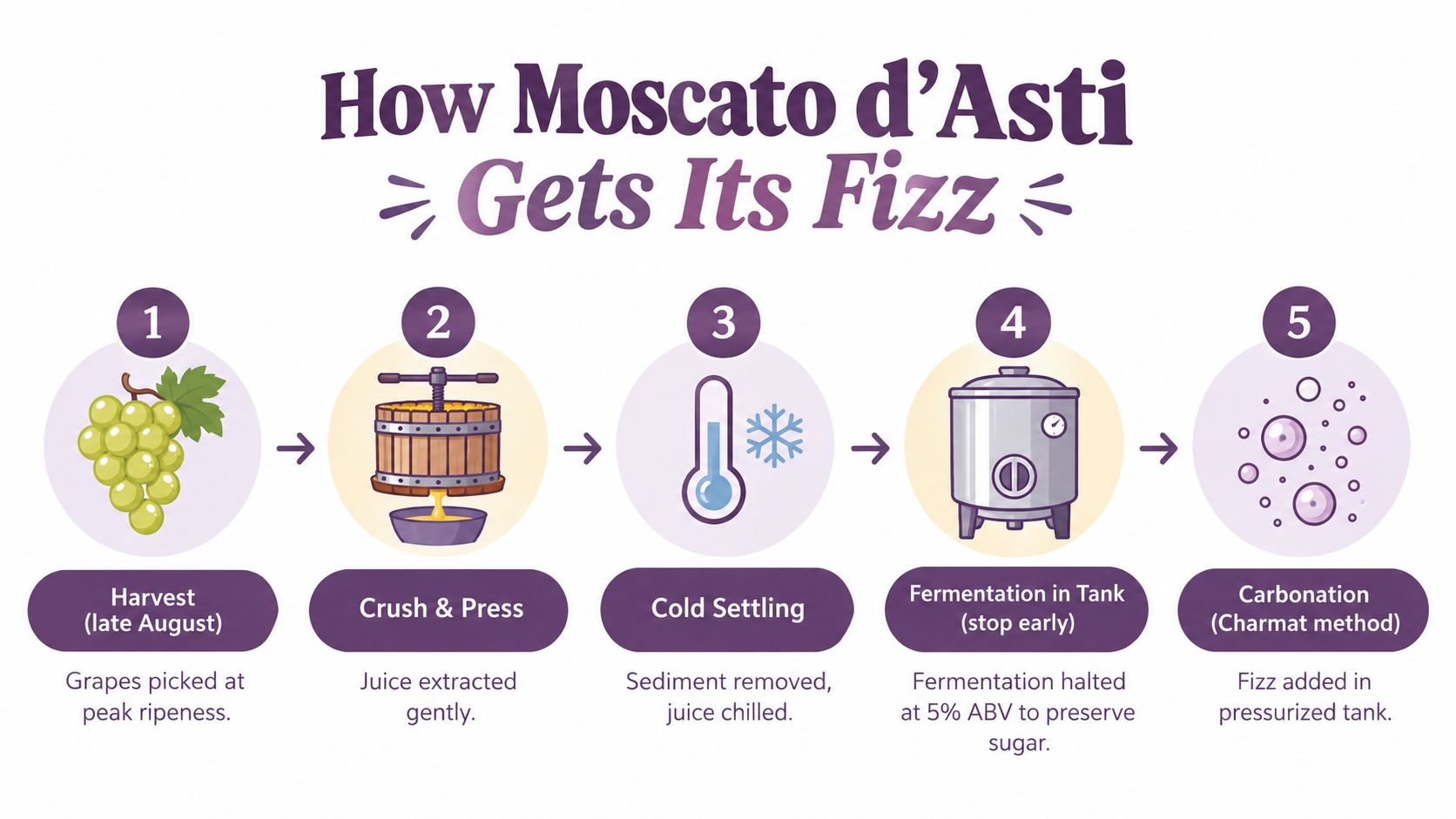
Moscato d'Asti is made by stopping fermentation before it finishes. Regulatory summaries describe the wine as typically reaching about 5% ABV before fermentation is halted, preserving natural grape sweetness rather than requiring a sweetening addition. The method also protects the intensely aromatic character associated with Moscato Bianco.
<a id="why-the-bubbles-feel-different"></a>
Why the bubbles feel different
Pressure is the key distinction between Moscato d'Asti and Asti Spumante. Moscato d'Asti has a maximum pressure of 2.5 bar, a level that creates a gentle sparkle. Asti Spumante has a higher pressure range, so its bubbles feel more energetic and its mousse more expansive. The difference is easy to recognise in the mouth: Moscato d'Asti lifts the wine, while Asti Spumante announces itself more forcefully.
The grape rule is equally important. Moscato d'Asti is reserved for wine made from Moscato Bianco within the Asti DOCG area. The production code also sets distinct alcohol and sugar targets for the different Asti styles, including Moscato d'Asti, Asti Spumante, and later permitted dry variants. The Asti production rules explain why a shared regional name doesn't mean identical wine.
<a id="the-production-sequence"></a>
The production sequence
- Grapes arrive with aromatic ripeness. The producer's priority is preserving the perfume of Moscato Bianco.
- Juice is extracted and clarified. Gentle handling helps keep the base wine bright and expressive.
- Fermentation begins under controlled conditions. Yeast starts converting sugar into alcohol.
- The producer stops fermentation early. Chilling and filtration can remove the conditions yeast needs to continue, leaving natural sugar in the wine.
- The wine retains a measured amount of carbon dioxide. That gives Moscato d'Asti its characteristic light effervescence.
This is why the sweetness, low alcohol, aroma, and sparkle feel integrated. They aren't separate features added at the end. They come from managing one transformation, fermentation, with precision.
<a id="when-and-how-to-serve-dasti-moscato-for-the-best-experience"></a>
When and How to Serve D'Asti Moscato for the Best Experience
Serve Moscato d'Asti well chilled. Cold temperature tightens the impression of sweetness, refreshes the palate, and keeps the gentle bubbles lively. A white-wine glass works well because its bowl gives the floral aromas space to collect, while a narrow sparkling glass can emphasise the visual lift and help the wine feel more celebratory.
The wine is flexible at the table, but pairing works best when the food either echoes its fruit or benefits from its sweetness. It can open an aperitivo, accompany brunch, close a meal, or provide a lighter option for guests who don't want a high-alcohol pour.
<a id="four-practical-serving-moments"></a>
Four practical serving moments
- Aperitivo: Pour it with lightly salted snacks, fresh fruit, or delicate appetisers. The acidity keeps the opening course from feeling flat.
- Brunch: Its low-alcohol profile suits a daytime table, especially with fruit, pastries, or mildly savoury dishes.
- Dessert: Match the wine's floral fruit character with fruit tarts, simple cakes, or creamy desserts. Avoid pairing it with a dessert that is dramatically sweeter than the wine, because the wine may taste thin.
- Spiced food: Gentle sweetness can soften heat in spicy dishes, while the bubbles refresh the palate between bites.
Serving insight: Use Moscato d'Asti when you want sweetness to refresh the meal, not when you want the wine to overpower it.
Open the bottle shortly before serving and reseal it promptly if you're not finishing it. Keep the remainder cold. Because this is a lightly sparkling wine, its texture is most enjoyable while the remaining effervescence still feels fresh. For a group, pour smaller glasses and refresh them rather than filling large tumblers. That preserves aroma and keeps the wine from warming too quickly.
<a id="understanding-dasti-moscato-pricing-and-listing-signals-across-channels"></a>
Understanding D'Asti Moscato Pricing and Listing Signals Across Channels
A bottle's listed price doesn't tell the whole story until you know what the listing represents. Retail, restaurants, auctions, exchanges, and specialist marketplaces may describe the same canonical wine in different ways. One listing might foreground the producer, another the appellation, and a third a shortened product name that resembles generic Moscato.
The broader Asti family has substantial scale. Wine Folly reports about 100 million bottles of total Asti-family production, divided into roughly 66 million bottles of Asti Spumante and 34 million bottles of Moscato d'Asti in its regional overview. That volume supports international distribution, but it doesn't create uniform availability in every market. A widely distributed appellation can still show uneven demand, different channel markups, and temporary supply gaps.
<a id="demand-is-not-moving-evenly"></a>
Demand is not moving evenly
The market picture became especially varied in 2025. Overall Moscato d'Asti sales were reported at about 25 million bottles, down 1.8%, while Asian sales rose 55% and represented 18% of total sales. China became the third-largest market. The United States remained the largest single market at 58% share, yet sales there fell 7.6% under tariff pressure. Germany and Russia also declined sharply. These figures come from WineNews' 2025 market report.
Supply policy adds another layer. In 2025, the Asti DOCG consortium reduced allowed yields from 100 to 90 tonnes per hectare, including a storage allocation, to balance supply and demand and protect denomination value. Broader production was estimated at around 85 million equivalent bottles, down 4% from 2024, as reported by Great Italian Food Trade's Asti DOCG market guide. The same source describes severe heat and drought stress in Piedmont during 2026 reporting, conditions that prompted earlier harvests and may challenge the freshness that defines this style.
<a id="compare-the-listing-not-just-the-number"></a>
Compare the listing, not just the number
| Signal to Check | What It Tells You | Why It Matters |
|---|---|---|
| Appellation wording | Whether the listing identifies Moscato d'Asti DOCG or generic Moscato | Confirms regional identity and prevents style mismatches |
| Producer and vintage | Which bottle record the offer refers to | Avoids comparing different wines under shortened names |
| Channel | Retail, restaurant, auction, or exchange context | Explains why offers may not be directly comparable |
| Bottle condition and availability | Whether the offer is immediately purchasable or conditional | Helps distinguish a real buying opportunity from a reference listing |
| Market location | Which region is supplying the offer | Makes tariff, demand, and distribution effects easier to interpret |
For teams that need a structured comparison, fine wine pricing tools can provide a useful starting point. The important habit is to normalise identity first, then compare channel, location, vintage, and condition. Without that sequence, a low listing may be a different product or a different type of offer.
<a id="choosing-storing-and-tracking-dasti-moscato-with-confidence"></a>
Choosing Storing and Tracking D'Asti Moscato With Confidence
Choosing Moscato d'Asti becomes easier when you treat the bottle as both a sensory product and a defined regional record. Look for the full appellation, confirm the producer, and decide whether you want soft sparkle for food or a more forceful sparkling style. Then serve it cold enough to let acidity and aroma balance the sweetness.
Storage should protect freshness. Keep an unopened bottle in a cool, dark place away from temperature swings. After opening, reseal it, refrigerate it, and plan to drink it while the remaining sparkle still feels lively. The wine isn't a long-term cellar project in the same way as a structured still red. Its appeal rests on fragrance, freshness, and gentle effervescence.
<a id="a-repeatable-buyer-checklist"></a>
A repeatable buyer checklist
- Identify the wine: Confirm Moscato d'Asti DOCG rather than generic Moscato.
- Check the style: Expect light pressure, natural sweetness, and low alcohol.
- Match the occasion: Choose it for aperitivo, brunch, dessert, or gently spiced food.
- Verify the listing: Compare producer, vintage, channel, location, and bottle condition.
- Watch supply context: Yield controls, regional demand, tariffs, and harvest conditions can affect availability.
- Track changes: Use a cellar or pricing workflow if you need to monitor comparable listings over time.
For portfolio files and repeated market checks, Cellar Pricer is one tool that can turn stock information into a more consistent valuation workflow. The underlying principle is simple: preserve the wine's canonical identity before you interpret movement in its listings.
Wine Labs consolidates wine pricing across retail, auction, exchange, and restaurant channels, helping merchants, collectors, and importers compare like-for-like records instead of chasing fragmented listings. Visit Wine Labs to explore market intelligence, canonical wine matching, portfolio tools, and alerts that can help you track Moscato d'Asti availability with greater confidence.