Wine Labs · Market intelligence
Coulee De Serrant
Coulee de serrant. Discover Coulée de Serrant's biodynamic legacy, Nicolas Joly's impact, and how Wine Labs tracks pricing across retail and auction markets
Coulee de Serrant covers 7 hectares and was first planted in 1130, which is why it occupies an outsized place in fine wine despite its tiny physical footprint. Few vineyards combine that level of scarcity with an unbroken cultivation history that stretches across nearly nine centuries, and that combination is exactly what gives the wine such durable market gravity.
For buyers, that matters more than romance alone. A site this small, this old, and this legally specific behaves differently from a broad regional category. It trades less like a generic Loire white and more like a tightly defined asset with a story, a canonical identity problem, and a supply base that has always been structurally limited.
That's where modern price intelligence becomes useful. Coulee de Serrant invites reverence, but it also demands discipline: the name has changed in law, the labels in circulation don't all match the current designation, and the wine's market presence can fragment across retail, auction, restaurant, and merchant systems. The opportunity isn't just to admire the vineyard. It's to read it correctly.
Table of Contents
- The Terroir and Spiritual Legacy of Coulee de Serrant
- Navigating the 2026 Appellation Naming Changes
- Tasting Profiles and Biodynamic Philosophy
- Price Intelligence for Merchants and Collectors
- Retail versus Auction Market Dynamics
- Strategic Sourcing and Future Outlook
<a id="the-terroir-and-spiritual-legacy-of-coulee-de-serrant"></a>
The Terroir and Spiritual Legacy of Coulee de Serrant
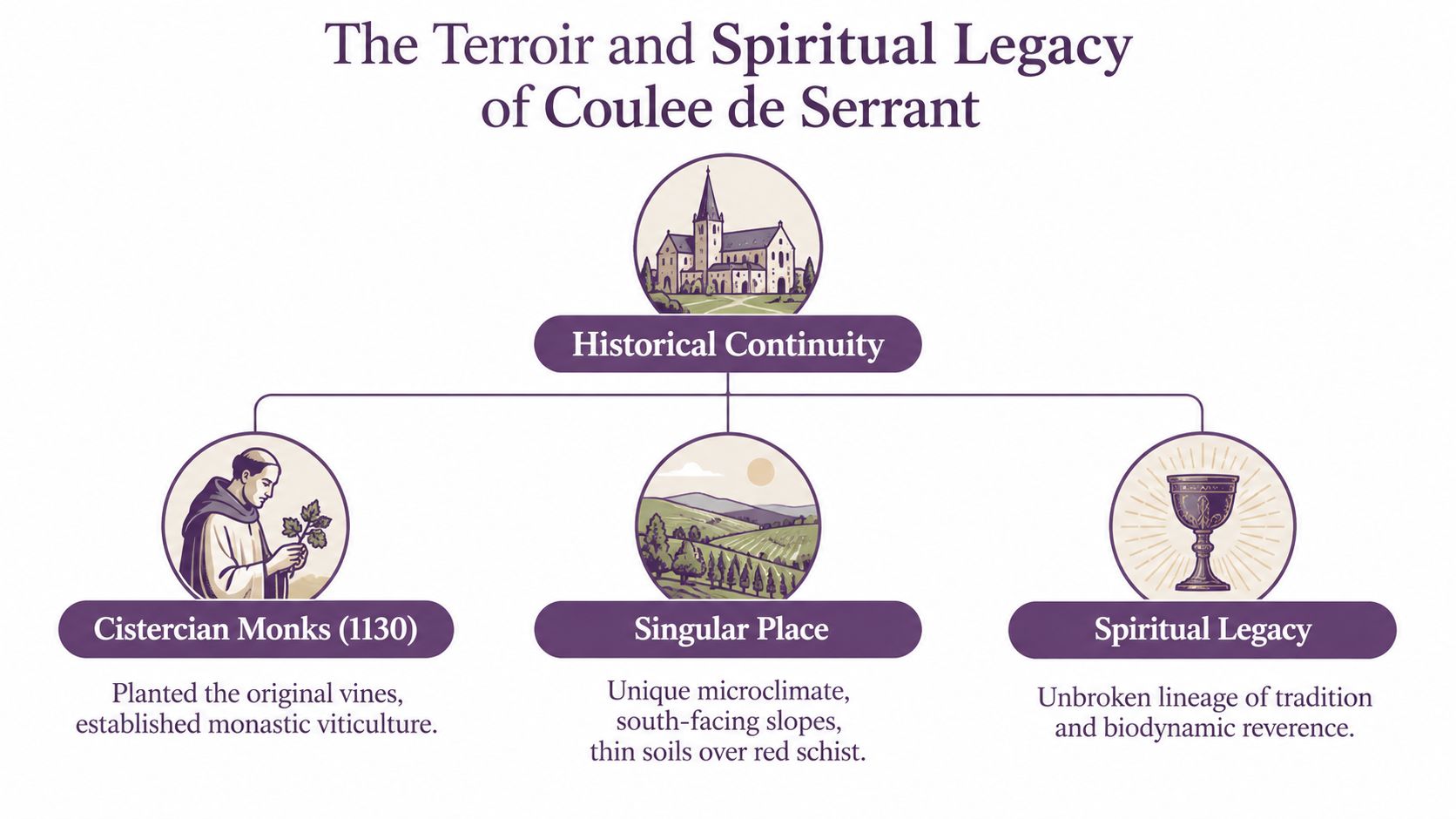
A vineyard first planted in 1130 and still read today as a live commercial benchmark is rare even by European fine-wine standards. At Coulée de Serrant, that longevity matters because the site's spiritual reputation and its pricing behavior rest on the same foundation: continuity of place, continuity of cultivation, and unusually tight legal definition estate history of the Coulée de Serrant and Millesima's Nicolas Joly Clos de la Coulée de Serrant page.
For analysts and buyers, the non-obvious point is that heritage alone does not sustain market confidence. Heritage becomes economically meaningful when it is attached to a vineyard whose boundaries, grape, and identity have remained narrow enough to preserve comparability across vintages. Coulée de Serrant meets that test more convincingly than many historically celebrated sites.
<a id="a-vineyard-that-behaves-like-a-singular-asset"></a>
A vineyard that behaves like a singular asset
La Coulée de Serrant holds its own AOC for still white wines from Chenin Blanc, with production tied to a strictly delimited parcel and rules stating that vines qualify only from the 4th year after planting INAO appellation specification for Coulée de Serrant.
That level of delimitation has practical consequences in the market. Buyers are not assessing a flexible regional style band. They are assessing one site with one long-running identity, where any shift in quality perception, release strategy, or secondary-market demand feeds back into a very small supply base. Reverence explains attention. Constraint explains pricing resilience.
<a id="geology-gives-the-spiritual-narrative-a-physical-basis"></a>
Geology gives the spiritual narrative a physical basis
The site's aura is often discussed in philosophical terms, but the INAO materials are more useful because they describe the conditions that repeatedly shape the wine. The vineyard sits on schist and schist-sandstone formations dating from the Upper Ordovician to the Lower Devonian, with phtanite beds interlayered in places. Bedrock lies close to the surface, and the soils are shallow, stony, low in fertility, and free-draining, with limited water reserve INAO cahier des charges for geological context.
Those features matter because they impose discipline on viticulture. Low-fertility, fast-draining soils tend to restrict vigor and reduce buffering against dry periods. In Chenin Blanc, that can sharpen concentration and structural tension, but only if farming decisions keep the vine in balance rather than pushing for volume.
The spiritual legacy is not separate from that reality. It is partly a cultural response to a site that has always demanded close observation and low-intervention confidence from its growers.
Independent Loire documentation cited by INAO notes south to southeast exposition, very shallow soils over schist and quartz, and biodynamic farming at the domaine since 1984 INAO and Loire documentation on exposition and farming. Taken together, those details explain why Coulée de Serrant remains a reference point in discussions of dry, ageworthy Loire Chenin. The mystique persists, but the underlying case is empirical: a narrowly bounded vineyard, difficult physical conditions, and a farming philosophy built around site expression rather than standardization.
For readers tracking how small terroir-driven vineyards now intersect with operational and pricing questions, the Wine Labs April 6, 2026 industry digest on niche terroirs and operational shifts provides useful broader context.
<a id="navigating-the-2026-appellation-naming-changes"></a>
Navigating the 2026 Appellation Naming Changes
The most important recent development around Coulee de Serrant isn't stylistic. It's legal. In March 2026, the European Union approved an amendment changing the protected designation from “Savennières Coulée de Serrant” to “Coulée de Serrant” EU regulation on the 2026 name change.
For merchants, importers, and collectors, this isn't a footnote. It's a naming transition with direct effects on cataloging, search, compliance review, and bottle matching.
<a id="what-changed-and-what-didnt"></a>
What changed and what didn't
The protected designation changed. The vineyard did not. The wine style did not. The site's identity did not suddenly widen or split into sub-categories.
That distinction is easy to miss in commerce because bottle inventories don't update all at once. Older physical labels may still show the previous legal form. Retail databases may preserve historic naming conventions. Merchant listings may abbreviate, reorder, or hybridize the old and new names.
Older bottles using the former wording aren't automatically suspect. They often reflect the legal identity in force when that vintage was labeled.
<a id="why-naming-changes-distort-price-comparison"></a>
Why naming changes distort price comparison
A naming change creates noise in three places:
- Catalog records drift. One merchant may list the wine under the former appellation name, another under the revised form, and a third under the estate bottling name.
- Search results fragment. Buyers looking for one version of the name can miss relevant listings filed under another.
- Historical continuity gets obscured. If systems fail to map both names to one canonical product identity, price comparisons can become misleading.
This is one of those moments when old-fashioned wine knowledge and modern data hygiene need each other. A collector who knows the history but ignores the legal update may miss listings. A data team that tracks strings without understanding appellation law may treat one wine as multiple products.
<a id="how-buyers-should-interpret-bottles-during-the-transition"></a>
How buyers should interpret bottles during the transition
A disciplined reading is simple:
- Read the full label wording rather than relying on shorthand in a marketplace title.
- Check vintage context. Older labels may legitimately carry the prior designation.
- Match by producer, vineyard identity, and appellation history rather than name string alone.
The market consequence is subtle but real. During transitions, clean identity work often matters more than tasting-note fluency.
<a id="tasting-profiles-and-biodynamic-philosophy"></a>
Tasting Profiles and Biodynamic Philosophy
Few Loire whites are as polarizing at the table, or as consistent in commanding serious attention, as Coulee de Serrant. That split matters. In market terms, wines that generate strong, durable disagreement often signal a product with a clear identity rather than one engineered for immediate consensus.
<a id="why-the-wine-tastes-so-distinctive"></a>
Why the wine tastes so distinctive
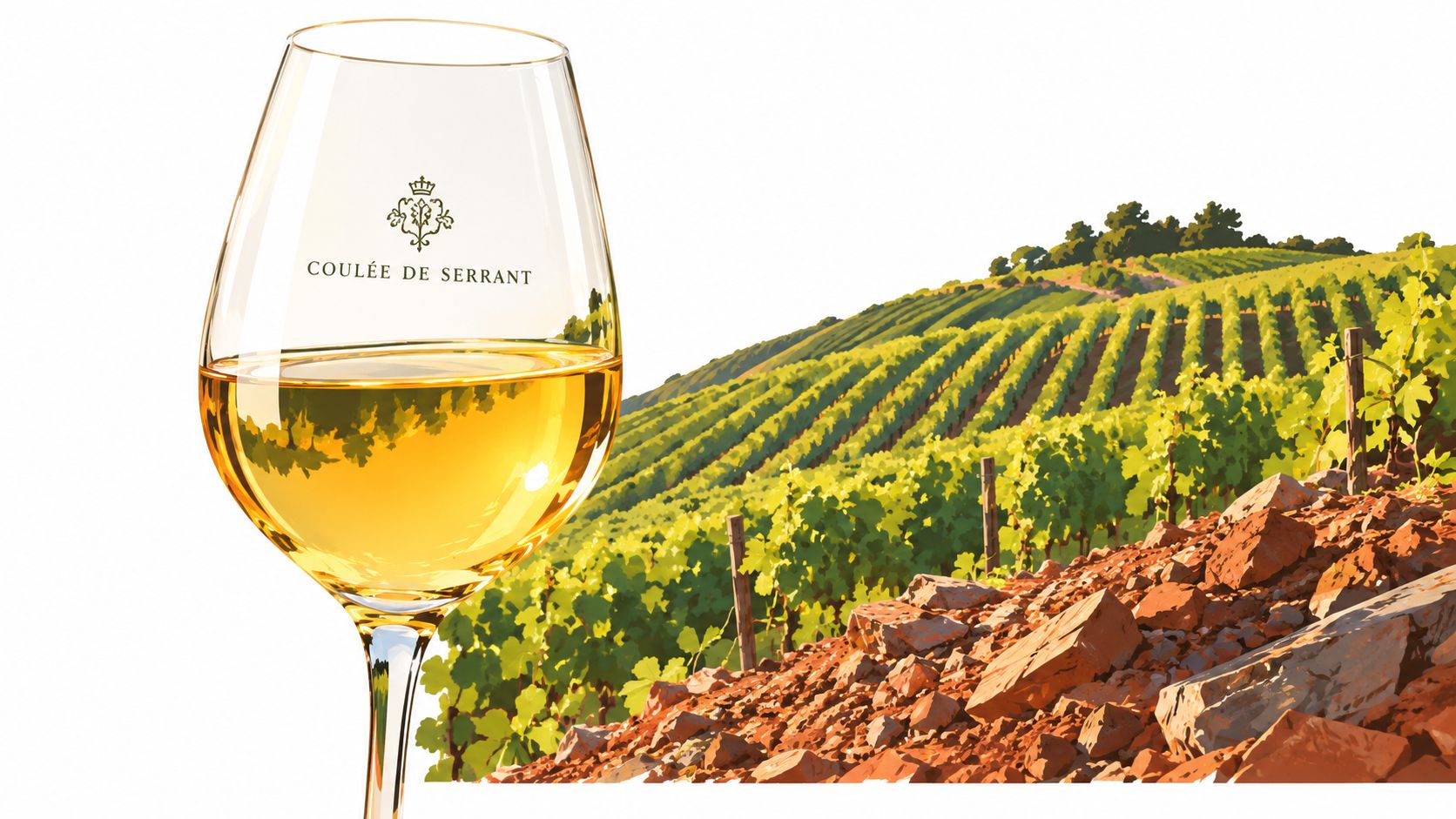
Coulee de Serrant's tasting profile starts with constraint. South-facing exposure supports ripening, while thin soils over schist and quartz limit vigor and reduce the margin for careless farming. For dry Chenin Blanc, that combination tends to produce a different shape of wine from the broader regional stereotype. Less simple freshness. More extract, phenolic grip, and structural tension.
That helps explain why the wine often shows as layered and stern in youth, then broadens with air or age. Buyers looking for easy orchard-fruit charm can find the style demanding. Buyers who track site expression usually read the same features as evidence of precision.
The result is a white wine that behaves more like a long-arc asset than a short-term crowd pleaser.
<a id="biodynamic-philosophy-tested-against-hard-vineyard-conditions"></a>
Biodynamic philosophy, tested against hard vineyard conditions
Biodynamics at Coulee de Serrant carries both symbolic and practical weight. The estate states that biodynamic farming began in 1984, and presents that date as part of its long-term viticultural identity on the official Coulee de Serrant technical sheet. For a buyer, the more interesting question is not whether the philosophy sounds compelling. It is whether the site gives that philosophy a measurable agronomic role.
Here, the answer is plausible. On shallow, low-fertility soils with meaningful exposure, farming choices directly affect canopy growth, water stress, ripening speed, and the balance between sugar accumulation and phenolic development. In other words, the vineyard does not give much room for cosmetic gestures. Spiritual language may surround biodynamics, but the test case is physical: can the method help maintain vine equilibrium on a demanding slope?
At Coulee de Serrant, that question is more than rhetorical. It is part of why tasting notes alone rarely capture the full story.
The wine makes more sense when the farming philosophy is read against the site's constraints.
<a id="what-this-means-for-collectors"></a>
What this means for collectors
Distinctiveness has a commercial consequence. Wines with a stable, recognizable profile and a farming narrative that buyers can place in historical context tend to keep attention longer than interchangeable regional benchmarks. Coulee de Serrant fits that pattern because its reputation rests on several reinforcing layers: a singular monopole site, an unusually assertive style, and a biodynamic identity maintained over decades.
That does not convert every vintage into the same buying proposition. It does mean the estate's spiritual terroir is not separate from market behavior. It feeds it. For collectors and merchants, the practical conclusion is straightforward. The wine's value proposition depends less on broad appeal than on the persistence of a well-defined identity that the market continues to recognize.
<a id="price-intelligence-for-merchants-and-collectors"></a>
Price Intelligence for Merchants and Collectors
The hardest part of valuing Coulee de Serrant isn't deciding whether it matters. It's making sure you're comparing the same wine across inconsistent records.

The estate's official technical sheet gives the supply side clearly enough: the site covers 7 hectares, is planted mainly on steep south-facing slopes, and produced its 885th consecutive vintage in 2015, with annual output of roughly 20,000 to 25,000 bottles official Coulee de Serrant technical sheet. Scarcity is therefore structural, not episodic. The analytical challenge is the demand side, where records spread across retail offers, auction catalogs, exchange systems, and restaurant lists.
<a id="start-with-canonical-identity-not-with-the-first-visible-price"></a>
Start with canonical identity, not with the first visible price
A merchant who opens five tabs can easily gather five prices and still know very little. Before comparing value, establish whether each listing refers to the same canonical wine record.
Use this sequence:
- Normalize the name. Account for the former and current appellation wording, plus estate bottling variations.
- Confirm the producer field. Coulee de Serrant is too specific a site to leave producer attribution fuzzy.
- Separate channel logic. A retail ask, an auction hammer, and a restaurant list price serve different functions.
- Check vintage granularity. A famous vineyard can still show sharp vintage-specific differences in availability and buyer appetite.
One option for this workflow is Wine Labs fine wine market data, which consolidates pricing across retail, auction, exchange, and restaurant channels while emphasizing canonical identity matching. That matters for a wine like Coulee de Serrant because naming drift can otherwise create false comparables.
<a id="common-valuation-mistakes"></a>
Common valuation mistakes
Collectors and trade buyers usually make the same errors with wines like this:
- Using one channel as the whole market. Auction can understate current replacement cost. Retail can overstate executable resale value.
- Ignoring naming variants. The 2026 legal change makes string matching less reliable on its own.
- Treating prestige as liquidity. A vineyard can be iconic and still require patient sourcing or patient selling.
- Skipping condition context. For older bottles, fill, provenance, storage, and importer history still matter.
A more disciplined process doesn't make the market simpler. It makes the comparison set cleaner.
<a id="why-cross-channel-context-beats-isolated-screenshots"></a>
Why cross-channel context beats isolated screenshots
A single posted price is a signal, not a conclusion. What buyers need is context: whether that offer is isolated, whether auctions are converging or diverging from retail, and whether older naming conventions are suppressing discoverability.
Here's a useful explainer for teams building that workflow into practice:
<iframe width="100%" style="aspect-ratio: 16 / 9;" src="https://www.youtube.com/embed/EAe6z10rPDM" frameborder="0" allow="autoplay; encrypted-media" allowfullscreen></iframe>When identity is clean, the rest of the analysis gets sharper. When identity is messy, even buyers can misread scarcity, overpay for convenience, or miss a bottle listed under an outdated legal name.
<a id="retail-versus-auction-market-dynamics"></a>
Retail versus Auction Market Dynamics
Coulee de Serrant doesn't lend itself to lazy channel assumptions. Retail and auction serve different buyer needs, and neither should be treated as superior. The right channel depends on whether you're optimizing for immediacy, condition confidence, selection, or downside control.
<a id="channel-comparison-for-fine-wine-investment"></a>
Channel Comparison for Fine Wine Investment
| Channel | Primary Advantage | Secondary Risk |
|---|---|---|
| Retail | Faster acquisition, clearer current availability, and easier replacement planning | Asking prices may sit above what buyers can realize on resale |
| Auction | Access to back vintages and occasional mispriced lots when cataloging is inconsistent | Provenance review takes more work, and transaction costs complicate headline comparisons |
| Exchange-style trading | Cleaner comparability when identities are normalized and listings are active | Not every wine has consistent depth or visible turnover |
| Restaurant lists | Useful as an upper-bound reference for end-consumer willingness to pay | Not a direct proxy for merchant or collector execution value |
<a id="what-the-gap-usually-means"></a>
What the gap usually means
The spread between retail and auction isn't just about price. It's about service bundle and certainty. Retail includes curation, storage responsibility up to sale, and immediate access. Auction often offers deeper vintage reach, but asks the buyer to do more diligence.
Market habit: Treat retail as replacement intelligence and auction as execution intelligence. The two answer different questions.
That distinction is especially relevant when nomenclature shifts. A poorly indexed auction lot can create opportunity for attentive buyers. A retailer with strong data hygiene may price more tightly because the bottle is easier to discover and compare.
For readers tracking how auction houses present and classify fine wine lots more broadly, the Christie's January 27, 2026 online auction digest offers a useful reference point for auction-side market reading.
<a id="benchmarking-without-overreaching"></a>
Benchmarking without overreaching
It's tempting to force Coulee de Serrant into a Burgundy or Bordeaux valuation template. That usually obscures more than it reveals. The wine occupies a different cultural lane. Its buyer base often overlaps with collectors interested in terroir-driven whites, biodynamic farming, and singular vineyard identities, not just conventional blue-chip categories.
That means its pricing behavior should be read on its own terms. The right benchmark is not whichever region is most famous. The right benchmark is whichever listing set preserves identity integrity and channel context.
<a id="strategic-sourcing-and-future-outlook"></a>
Strategic Sourcing and Future Outlook
Coulee de Serrant rewards buyers who can hold two ideas at once. It is a vineyard of spiritual inheritance, and it is a product record that can be mishandled by modern databases. If you ignore the first, you miss why the wine matters. If you ignore the second, you risk buying or valuing it badly.
<a id="a-sourcing-playbook-for-the-next-buying-cycle"></a>
A sourcing playbook for the next buying cycle
Start with identity. The March 2026 legal shift to “Coulée de Serrant” means contracts, stock files, and marketplace records should be reviewed with more care than usual, as shown in the earlier legal section. A buyer who treats naming as cosmetic may duplicate inventory records or miss relevant comparables under the prior wording.
Then move to channel fit.
- For allocation-minded merchants, current retail visibility matters because replacement logic drives quoting.
- For patient collectors, auctions may offer the richer field for older bottles, provided provenance and naming consistency are checked carefully.
- For portfolio managers, the most useful view is usually cross-channel rather than channel-specific, because that reveals whether an apparent bargain is real or merely mislabeled.
<a id="why-the-future-case-remains-strong"></a>
Why the future case remains strong
The core argument doesn't depend on hype. It depends on durable facts already established: an extremely small vineyard, a continuous cultivation history beginning in 1130, a tightly bounded appellation, and a production profile that stays limited at the estate level. Those features don't guarantee a straight upward line in value. Wine markets don't work that way. They do, however, support long-term relevance.
The practical implication is straightforward. As fine wine data systems improve, wines with messy aliases but clear intrinsic identity should become easier to price correctly. Coulee de Serrant is a prime example. The legal rename creates short-term friction, but it also highlights why canonical matching, clean appellation logic, and record normalization will matter more with each passing vintage.
<a id="what-disciplined-buyers-should-do-now"></a>
What disciplined buyers should do now
A careful buyer should:
- Audit naming fields across inventory, wish lists, and contracts.
- Track by canonical wine identity rather than label string alone.
- Compare channel purpose before comparing numbers.
- Document provenance assumptions, especially for older bottles.
- Treat this wine as a long-horizon holding, not a casual substitute for generic Loire white.
The broad conclusion is simple. The history of Coulee de Serrant is fixed in stone, schist, and monastic continuity. Its market efficiency is not fixed. That part depends on data quality, naming precision, and the buyer's ability to connect legal form with commercial reality.
For that reason, the next chapter in this vineyard's story won't be written only in the cellar. It will also be written in cleaner records, better matching, and more disciplined sourcing.
Wine Labs gives merchants, collectors, and investment teams a single view across retail, auction, exchange, and restaurant pricing, with identity matching that's especially useful for wines like Coulee de Serrant where naming and listing formats can diverge. If you want to compare offers more cleanly, track canonical records, and price these bottles with less guesswork, visit Wine Labs.