Wine Labs · Market intelligence
Chalk Hill Chardonnay: A Complete Guide to the AVA
Explore Chalk Hill Chardonnay's terroir, signature winemaking, producer lineup, and pricing in this in-depth guide to Sonoma's chalky-ash AVA.
A $90 price point can separate one Chalk Hill Chardonnay bottling from the rest of the lineup, while the same producer family also offers a $25 Chalk Hill Chardonnay. That gap isn't a minor retail detail. It signals that “Chalk Hill Chardonnay” describes a portfolio, not a single flavor profile or buying occasion. Rodney Strong's listed 2023 Chalk Hill Chardonnay sits at $25, while the verified lineup information places Little Patch at $90 and describes Estate Chardonnay as a richer, more age-worthy expression.
For buyers, the useful question isn't whether Chalk Hill Chardonnay is "good" or "oaky." It's which bottling combines the right acidity, ripeness, oak treatment, texture, and price for the moment. The AVA supplies the geological and climatic foundation, but vineyard selection and cellar decisions determine what reaches the glass.
Table of Contents
- What Makes Chalk Hill Chardonnay Distinct
- The AVA Behind the Bottle
- Winemaking Signature and Style Architecture
- Reading the Chalk Hill Lineup Side by Side
- The Role of Clone 97 and Vineyard Selection
- How Vintage and Climate Are Reshaping the Style
- Pricing, Pairing, and Cellaring Expectations
- Buyer Takeaways and Common Misconceptions
<a id="what-makes-chalk-hill-chardonnay-distinct"></a>
What Makes Chalk Hill Chardonnay Distinct
Chalk Hill has two connected identities. It's a Sonoma County American Viticultural Area, established on terrain known for volcanic white-ash soils, and it's also the home of a prominent Chardonnay-producing estate whose wines shape how many consumers understand the name. The first identity explains place. The second explains why bottles carrying the Chalk Hill name can taste and cost so differently.
The AVA covers about 21,120 acres, with roughly 1,600 acres under active vine cultivation, according to the Chalk Hill Estate history. Its warm conditions and volcanic, chalky white-ash soils support Chardonnay with ripe fruit and substantial body, but those traits don't dictate a uniform style. A Sonoma Coast bottling can emphasize brightness and mineral lift, while an Estate release can build its profile around barrel fermentation, malolactic texture, lees work, and French oak.
Practical rule: Treat the sub-label and technical sheet as more useful buying signals than the words “Chalk Hill” alone.
<a id="the-style-spectrum"></a>
The style spectrum
The lineup makes more sense when read as a progression of intended experiences:
- Sonoma Coast Chardonnay generally targets approachable freshness, with orchard fruit, citrus character, and a lighter oak impression.
- Estate Chardonnay occupies the richer, more structured end, where barrel fermentation, full malolactic conversion, and oak aging create creaminess and breadth.
- Little Patch Chardonnay functions as a premium, concentrated bottling, with a much higher listed price and a profile suited to buyers seeking a more luxurious expression.
Those differences matter because retail descriptions often flatten the wines into the same set of Chardonnay cues, such as pear, apple, vanilla, or toast. The more reliable interpretation is architectural. Acid gives shape, alcohol and ripeness add weight, malolactic conversion softens the palate, and oak supplies aromatic and structural seasoning.
| Category | Typical Profile | Buyer Implication |
|---|---|---|
| Sonoma Coast Chardonnay | Bright fruit, freshness, approachable texture | Choose it for earlier drinking and flexible weeknight pairing |
| Estate Chardonnay | Creamy, broad, oak-influenced, age-worthy | Choose it for richer food or structured cellaring |
| Little Patch Chardonnay | Premium, concentrated, more luxurious | Choose it for gifting, collecting, or a centerpiece bottle |
The central market insight is simple: appellation, vineyard source, and cellar treatment can move shelf value substantially within one producer family. A buyer who wants lean seafood Chardonnay shouldn't automatically reach for the most expensive bottle, while a collector may find the entry tier too immediate for a long-term cellar strategy.
<a id="the-ava-behind-the-bottle"></a>
The AVA Behind the Bottle
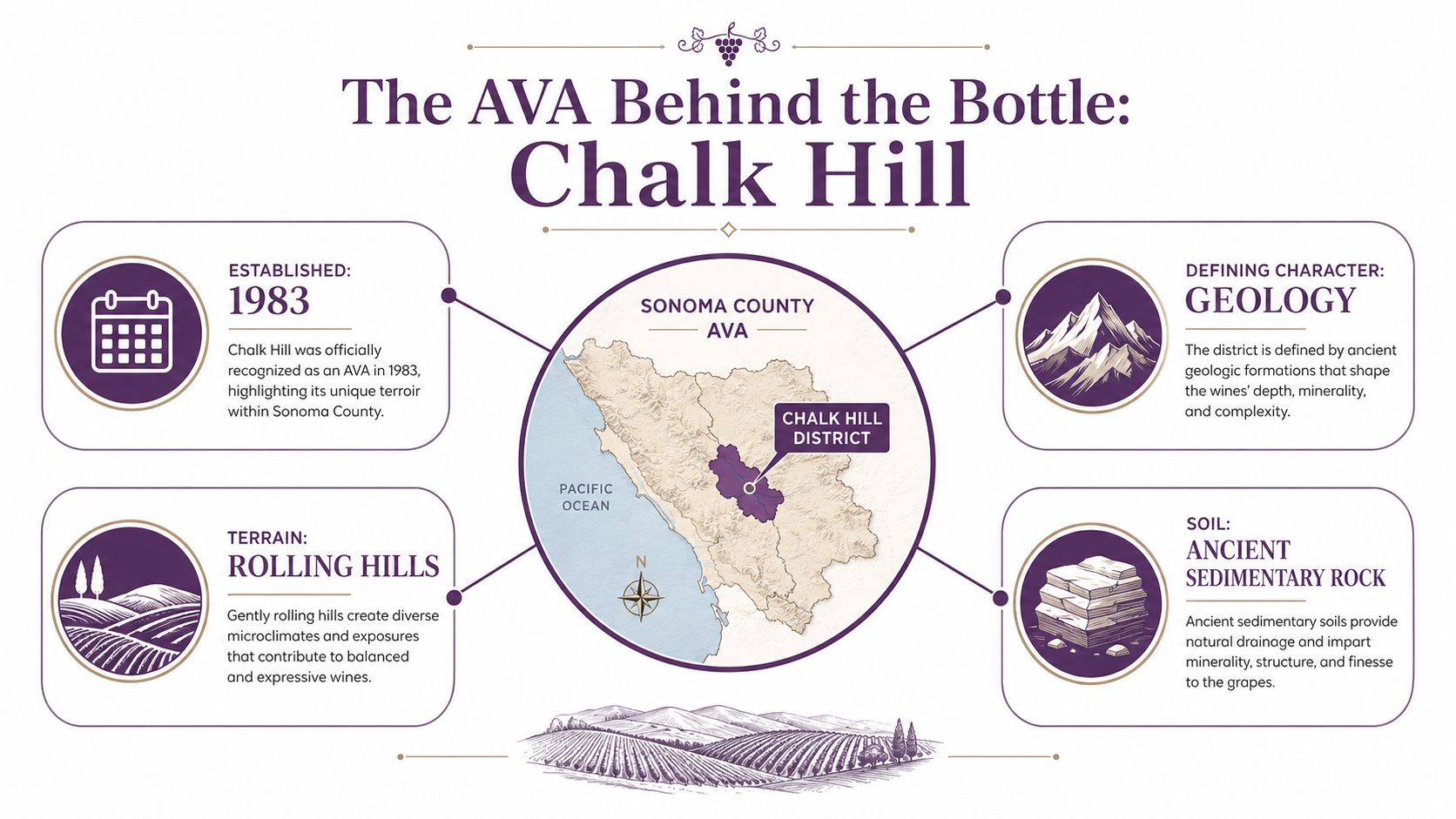
Chalk Hill became an official AVA on October 21, 1983, the 49th AVA in the United States and the fourth in Sonoma County, according to the Chalk Hill AVA overview. The designation identifies a distinct growing area, not a legally fixed Chardonnay flavor. Geography sets the conditions. Producers still determine how they farm, harvest, ferment, and age the fruit.
The district lies roughly 8 miles north of Santa Rosa near Windsor and covers rolling terrain rather than one uniform vineyard floor. Volcanic activity left chalky white volcanic tuff and white-ash soils that are porous and well drained. Those conditions can limit excess water around the roots. Hillside position, aspect, and elevation then create differences between vineyard blocks, giving producers several ways to shape the fruit before it reaches the cellar.
<a id="why-the-geography-affects-chardonnay"></a>
Why the geography affects Chardonnay
Chalk Hill is warmer and more sheltered than the Russian River Valley floor, while Pacific influence can help preserve acidity. The combination supports full flavor development, including ripe orchard or tropical fruit, without requiring the wine to feel heavy. It also helps explain why Chalk Hill bottles can diverge in style even when they share an appellation.
Ripeness and balance remain separate variables. Warm conditions can produce generous fruit and higher potential alcohol, but harvest timing determines how much energy the finished wine retains. Slope exposure and elevation add another layer. Higher or more wind-exposed blocks may ripen differently from sheltered benchlands, even where the soil family is similar.
The white-ash story explains drainage, vigor, and site identity. It does not guarantee literal chalk minerality in the glass. Clonal material, crop decisions, picking date, pressing, fermentation vessel, malolactic conversion, and oak regime all intervene between vineyard and bottle.
That makes comparison with the broader Sonoma Coast conditional. Chalk Hill often supports a broader, riper Chardonnay shape, while cooler coastal sourcing can emphasize citrus and tighter acidity. Buyers should therefore read the producer's vineyard map and technical sheet alongside the AVA name. A wine-industry digest on niche terroirs offers further context on how terroir and operating choices can interact.
<a id="winemaking-signature-and-style-architecture"></a>
Winemaking Signature and Style Architecture
Chalk Hill Chardonnay is assembled through a series of choices, not one universal recipe. The 2020 Estate technical sheet provides the clearest verified example: it's 100% Chardonnay, fermented with native yeast in barrel, taken through 100% malolactic fermentation, aged for 10 months in 100% French oak with 35% new oak, and bottled unfiltered. The same sheet reports 25.2° Brix at harvest, pH 3.7, TA 5.33 g/L, and 15.1% alcohol. The 2020 Estate Chardonnay fact sheet connects those specifications to a broad, creamy palate architecture.
Each technical choice has a sensory consequence. Native barrel fermentation and French oak can add warmth, spice, and gentle oxygen exposure. Full malolactic conversion changes sharper malic acidity into softer lactic texture, while bâtonnage, or lees stirring, builds body and yeast-derived savoriness. The result can feel rounded and expansive rather than angular.
<a id="how-to-read-the-cellar-decisions"></a>
How to read the cellar decisions
New oak is not the same as oak aging in general. New French oak contributes more visible vanilla, toast, cedar, and spice, while older or neutral barrels can preserve texture with less overt wood character. Stainless steel protects primary citrus, apple, and floral tones. Concrete can occupy a middle position, preserving fruit and tension while adding a different textural register.
The trade-off is intensity versus precision. A fully malolactic, generously oaked wine may work better with browned butter, roast poultry, lobster, or mushrooms because its richness can meet the dish. A fresher, stainless-leaning wine may be more effective with shellfish, salads, or lighter preparations, where excessive oak would dominate.
| Choice | Primary Sensory Effect | Typical Trade-off |
|---|---|---|
| Barrel fermentation | Warmth, texture, subtle structure | Can reduce the impression of briskness |
| Full malolactic conversion | Creaminess and softer acidity | Less sharpness and linear tension |
| Bâtonnage | Greater body and lees-derived savoriness | Too much can make the wine feel heavy |
| New French oak | Vanilla, toast, spice, aromatic complexity | Oak can overshadow fruit and acidity |
| Neutral oak | Texture with restrained wood flavor | Less obvious aromatic drama |
| Stainless steel | Citrus, apple, floral freshness | Less creamy breadth |
| Concrete | Fruit clarity with added tension | May not deliver the richness some buyers expect |
The 2023 technical sheet shows why vintage and cellar interpretation must be separated. It reports pH 3.18 and acidity equivalent to 0.64 g/100 mL, again from 100% Chardonnay, a much tighter acid profile than the 2020 Estate example. The 2023 Chalk Hill Chardonnay technical sheet supports a fresher reading, with more citrus lift and structural tension even when the wine retains the pear, apple, and oak vocabulary associated with the brand.
<a id="reading-the-chalk-hill-lineup-side-by-side"></a>
Reading the Chalk Hill Lineup Side by Side
The lineup becomes easier to understand when buyers separate what is verified on a technical sheet from what is merely implied by retail positioning. The 2020 Estate sheet gives detailed production data. The verified public material does not provide equivalent Brix, oak, malolactic, and post-bottling pH specifications for every Sonoma Coast and Little Patch release, so those wines shouldn't be assigned invented measurements.
That limitation is commercially useful. It tells buyers to avoid false precision and compare actual bottle-specific documentation where available. The verified retail information still establishes a meaningful hierarchy: the core Sonoma Coast Chardonnay is positioned as bright and approachable, Estate as creamy, rich, elegant, and age-worthy, and Little Patch at a premium $90 price point. The Sonoma Coast Chardonnay portfolio page supports the core bottling's approachable positioning, while the Estate Chardonnay page describes the richer flagship style.
| Attribute | Sonoma Coast | Estate | Little Patch |
|---|---|---|---|
| Style position | Bright, balanced, approachable | Creamy, rich, elegant, age-worthy | Premium and concentrated |
| Verified technical detail | Public material here doesn't provide a complete comparable sheet | 2020 example: 25.2° Brix, pH 3.7, 35% new French oak, 100% malolactic | Public material here doesn't provide a complete comparable sheet |
| Oak interpretation | Likely intended to support freshness, but check the vintage sheet | Clearly oak-influenced and texture-driven in the 2020 example | Premium positioning suggests a more ambitious buyer target, but exact treatment should be verified |
| Acidity interpretation | Brightness and balance are central to positioning | The 2023 sheet shows pH 3.18, demonstrating a fresher expression is possible | Vintage-specific data is needed before judging tension |
| Best use case | Aperitif, shellfish, lighter poultry | Roast poultry, lobster with butter, mushrooms | Lobster, richer seafood, or gifting |
| Verified price signal | The listed 2023 Chalk Hill bottle is $25 | No universal price should be assumed | Little Patch is listed at $90 |
The analytical conclusion is that price signals ambition, not a guaranteed flavor preference. A buyer who values freshness may prefer the less expensive bottling, while someone seeking oak, texture, and a more ceremonious presentation may justify the Estate or Little Patch tier. The technical sheet should settle close calls, especially across vintages.
<a id="the-role-of-clone-97-and-vineyard-selection"></a>
The Role of Clone 97 and Vineyard Selection
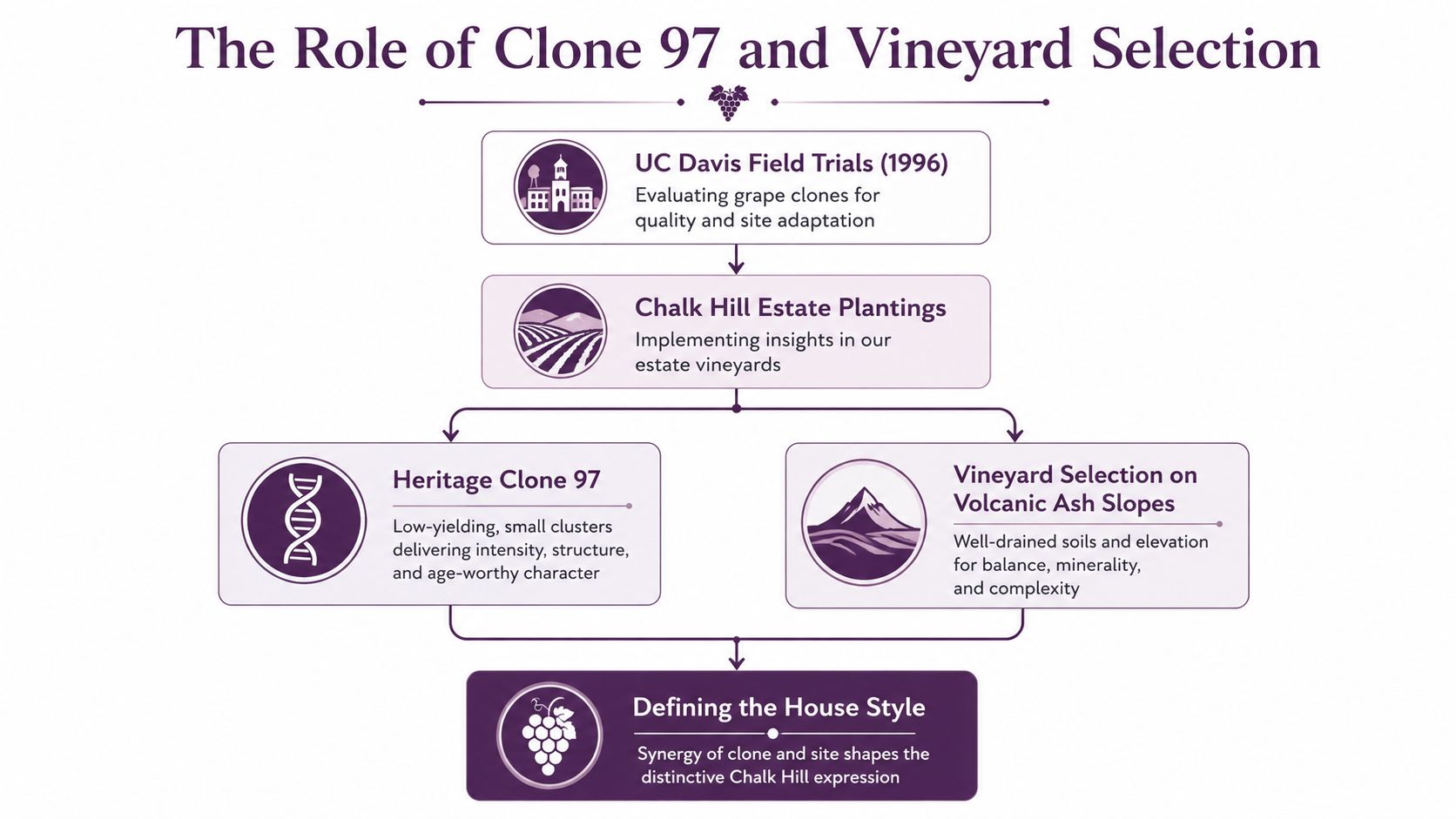
Chalk Hill's clonal program is a quiet source of portfolio differentiation. Rod Strong planted Chardonnay in 1965 in the area that later became the Chalk Hill AVA, giving the region an early foundation. Chalk Hill Estate began a major Chardonnay research program with UC Davis in 1996, evaluating 17 clones over five vintages from 1999 to 2003 before selecting the top 6 clones for replanting, according to the estate's historical account.
A separate Wine Enthusiast profile of Chalk Hill Estate reports that more than one-third of the estate's vines are planted to Chardonnay and that 23 separate Chardonnay clones grow there. The profile connects clonal studies in the 1970s with the discovery of the proprietary Chalk Hill Chardonnay Clone 97. A separate verified account places the formal Clone 97 development partnership with UC Davis between 1996 and 2001.
<a id="why-clone-selection-matters-to-the-portfolio"></a>
Why clone selection matters to the portfolio
Clone 97 helps explain how one estate can maintain a recognizable house identity while separating wines by tier. Clonal material affects ripening behavior, berry composition, crop balance, and the concentration available to the winemaker. Vineyard position then modifies those traits through exposure, drainage, wind, and harvest timing.
Clone 97 does not independently determine tropical fruit or a dense mid-palate. Those results come from the interaction of plant material, site selection, ripeness, fermentation, and oak. The research program gives Chalk Hill greater control over that combination than a winery working only with purchased fruit from unrelated vineyards.
The retail lineup therefore reflects internal vineyard and cellar choices. Sonoma Coast sourcing can support a fresher, more accessible bottling, while estate blocks and selected clones can support richer or more concentrated wines. Buyers may see three labels, but the producer is managing distinct growing conditions and winemaking objectives, not merely changing the packaging. That distinction helps explain why price tiers can diverge from flavor preference: higher placement signals selection and ambition, while the most suitable bottle still depends on the buyer's preferred balance of freshness, texture, oak, and concentration.
<a id="how-vintage-and-climate-are-reshaping-the-style"></a>
How Vintage and Climate Are Reshaping the Style
The strongest verified evidence for Chalk Hill's stylistic movement comes from the contrast between technical sheets, not from an unsupported claim about a single linear trend. The 2020 Estate example shows 25.2° Brix, pH 3.7, and 15.1% alcohol, a combination consistent with a ripe, broad, oak-built wine. The 2023 sheet reports pH 3.18 and acidity equivalent to 0.64 g/100 mL, pointing toward greater freshness and structural tension. Those figures are not interchangeable because they come from different vintages and technical documents, but the contrast makes the buyer's task clear.
The producer's own description of the 2022 vintage calls it “warm and fast-paced” while still reporting fresh acidity and balanced fruit on the Estate Chardonnay vintage page. That combination challenges the lazy assumption that warmth must produce an overtly heavy wine. Vineyard picking decisions and cellar choices can preserve freshness even when growing conditions accelerate ripening.
<a id="climate-pressure-versus-cellar-intent"></a>
Climate pressure versus cellar intent
Climate affects the raw material. Warmer conditions can push sugar accumulation and shorten the window between flavor maturity and excessive alcohol. Drought pressure and warmer nights can also alter vine water status and ripening rhythm. Winemaking determines how the producer responds, through harvest selection, pressing, lees handling, malolactic management, and oak proportion.
The recent style tension is therefore best read as a portfolio signal. Some descriptions still emphasize vanilla, toasted hazelnut, butterscotch, and creamy texture, while newer technical evidence supports citrus lift and firmer acidity. That doesn't prove that every newer bottle is less oaky. It does show that Chalk Hill Chardonnay now needs vintage-specific interpretation.
A lower-pH release can feel fresher without abandoning the Estate house style. Brightness and creaminess aren't mutually exclusive when the producer manages both.
Buyers should resist replacing one cliché with another. Chalk Hill Chardonnay hasn't necessarily moved from “rich” to “lean.” Instead, the range now appears capable of holding richer oak architecture alongside more precise acid structure. A broader discussion of California wine conditions and changing production priorities is available in this market digest on California wine tourism and organic shifts.
<a id="pricing-pairing-and-cellaring-expectations"></a>
Pricing, Pairing, and Cellaring Expectations
Price works best as a portfolio map, not as a quality ranking. The verified retail listing places a 2023 Chalk Hill Chardonnay at $25, while Little Patch is identified at $90. The available verified data doesn't establish defensible universal price bands for every tier, so buyers should treat shelf price as vintage- and channel-dependent rather than assuming fixed ranges.
The practical pairing logic follows the wine's structure. A fresher Sonoma Coast expression should work well as an aperitif or with shellfish because its brightness won't overwhelm delicate flavors. The Estate style, especially the 2020 example with full malolactic fermentation, extended French-oak aging, and substantial ripeness, has the breadth for roasted poultry, lobster with butter, and mushroom preparations.
Little Patch belongs to a different buying occasion. Its $90 positioning makes it a premium gift or centerpiece bottle, and the most sensible food matches are correspondingly substantial, such as lobster or aged hard cheese. That doesn't mean every vintage will show identical weight. It means the label's market position tells you to expect a more ambitious presentation than the core bottling.
| Bottling | Retail Range (USD) | Typical Oak Profile | Recommended Pairing | Cellaring Window |
|---|---|---|---|---|
| Sonoma Coast Chardonnay | Verified listing at $25 for the 2023 bottle | Bright, balanced, and approachable; verify vintage sheet | Aperitif, shellfish, roast chicken | Earlier drinking is the safer assumption |
| Estate Chardonnay | Varies by vintage and retailer | Creamy, rich, French-oak influenced | Lobster with butter, roasted poultry, mushrooms | More suitable for structured cellaring |
| Little Patch Chardonnay | $90 listed price | Premium treatment should be checked by vintage | Lobster, aged hard cheeses, premium gifting | Collector-oriented, vintage-specific evaluation required |
Cellaring requires more than a premium label. Acidity, alcohol, oak integration, closure, storage, and vintage condition all influence how Chardonnay develops. The 2023 pH of 3.18 suggests a firmer acid foundation than the 2020 Estate example, but pH alone can't promise a particular drinking window. For buyers building a cellar, purchase documentation and tasting the wine across time are more reliable than a generic claim that every Estate or reserve bottle will improve for a set number of years.
For a broader view of how white-wine portfolios are positioned and repriced, consult this Wine Labs market digest on white-wine market dominance.
<a id="buyer-takeaways-and-common-misconceptions"></a>
Buyer Takeaways and Common Misconceptions
Three trade-offs define the Chalk Hill Chardonnay decision:
- Oak weight versus acidity: Choose richer Estate-style architecture for creamy sauces, buttered lobster, and roast poultry. Choose a brighter bottling when freshness matters more than volume.
- Value versus collectibility: The verified $25 2023 listing makes the core bottle the clear value reference, while Little Patch's $90 price signals a premium purchase rather than an everyday default.
- Accessibility versus ageability: Approachable wines reward immediate use. More structured, oak-integrated releases deserve closer attention to vintage, acidity, and storage before they enter a cellar.
Two misconceptions deserve correction. Chalk Hill isn't one flavor profile. The lineup spans fresher coastal Chardonnay and richer estate expressions, so the label alone can't predict the glass. The chalky-ash soil story is also geological before it's sensory. Soil contributes to drainage and vine behavior, but aroma and texture emerge from site selection, clones, ripeness, fermentation, malolactic conversion, lees handling, and oak.
The best buyer matches bottle to occasion, not bottle to mythology. Read the sub-label, check the vintage-specific technical sheet, and use price as a clue to intended positioning rather than proof of superiority.
Wine Labs helps buyers and merchants compare fine-wine prices across retail, auction, exchange, and restaurant channels while keeping vintages and bottle identities aligned. Visit Wine Labs to research Chalk Hill Chardonnay pricing, track comparable listings, and make a more informed sourcing or cellar decision.