Wine Labs · Market intelligence
Brunello Wine Price: A Practical Market Guide
Brunello wine price explained by vintage, producer, and channel. Compare retail, auction, and bulk benchmarks to value bottles with confidence.
A typical Brunello di Montalcino sits in a US$50 to US$150 working band at retail, but the true answer lies in the channel split, not the label. Bulk, wholesale, and auction references pull that same wine in very different directions, which is why brunello wine price needs to be read as a market range, not a single number.
Brunello is a rare case where the vineyard asset, the bottle, and the collectible lot all tell different stories. Vineyard land has re-rated sharply over time, bulk wine sits on a separate wholesale ladder, and trophy bottles can clear far above everyday shelf pricing. The result is a fine-wine market where the same appellation can look cheap, fair, or expensive depending on producer, vintage, format, and venue.
Table of Contents
- Brunello Wine Price at a Glance
- What Drives Brunello Di Montalcino Pricing
- Retail Price Bands and What They Mean
- Bulk and Wholesale Benchmarks in 2026
- Auction Records Versus Retail Listings
- Vintage Dispersion Across Recent and Older Bottles
- How To Value Any Brunello Bottle Step by Step
- The Long Run Story Behind The Headlines
- Case Size, Format, and Provenance Premiums
- Quick Reference Brunello Price Table
<a id="brunello-wine-price-at-a-glance"></a>
Brunello Wine Price at a Glance
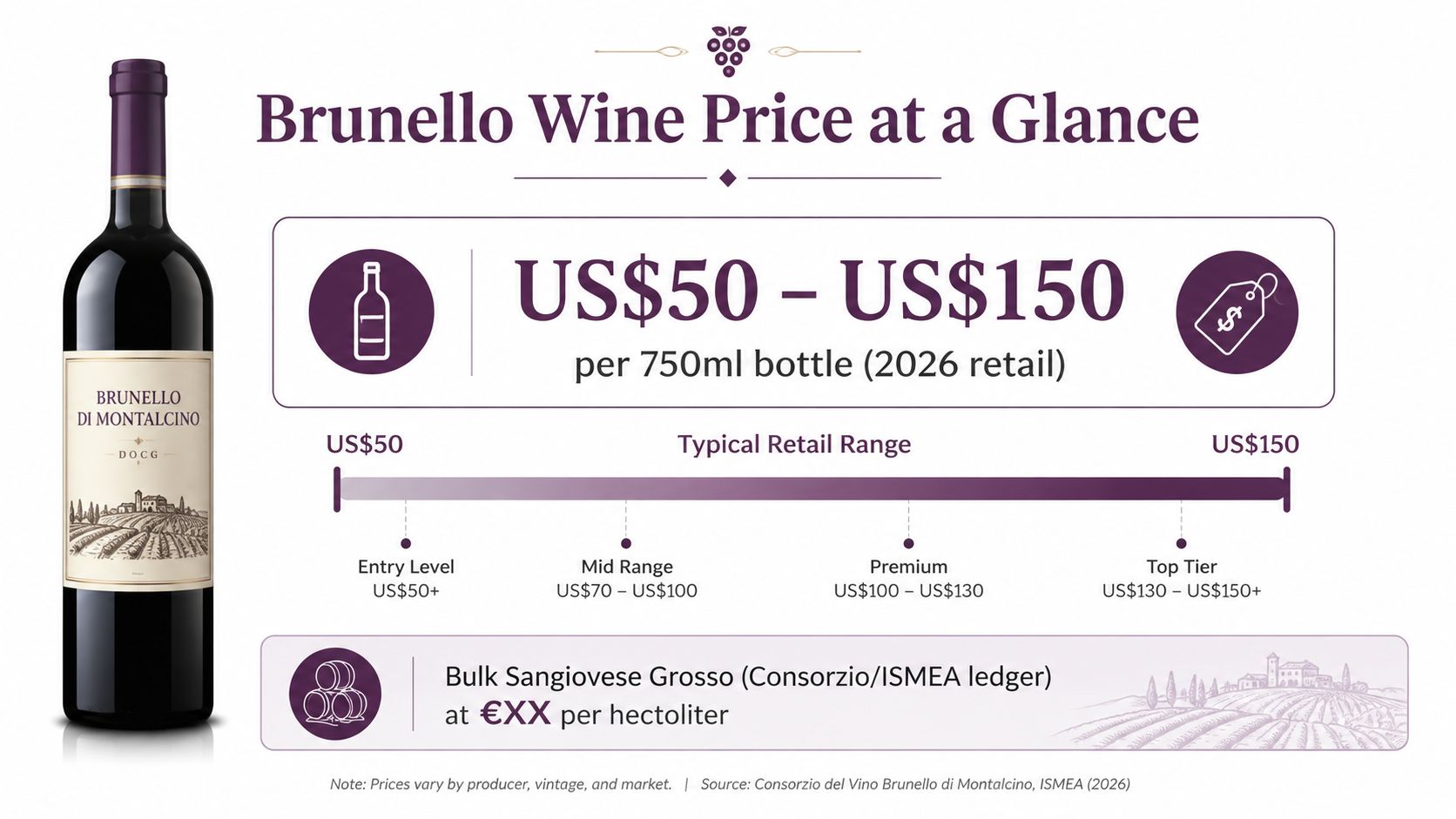
Retail, bulk, and auction figures describe different markets. For brunello wine price, Wine-Searcher lists bottles under US$40, while its value screen places most critic-score-adjusted opportunities in the US$50 to US$150 range Wine-Searcher Brunello region pricing. That range is a useful retail reference, not a universal valuation.
Auction pricing occupies another tier. A 2016 Poggio di Sotto lot was estimated at US$1,600 to US$2,400 for 12 bottles at Sotheby's Sotheby's 2016 Poggio di Sotto lot. The figure reflects a specific producer, vintage, lot size, and auction venue. It should not be compared directly with a single bottle on a retail shelf.
Bulk pricing supplies a third benchmark. A Brunello bulk reference in Italy stood at 925 euros per hectoliter in June 2026, down 5.6% year on year Sotheby's Riserva Madonna del Piano lot page. Older land and bulk evidence also indicates that the appellation's scarcity premium has developed beyond immediate production costs WineNews analysis on Brunello land values. Bulk, retail, and auction numbers therefore answer different valuation questions.
<a id="three-working-bands-matter-more-than-one-headline-number"></a>
Three working bands matter more than one headline number
For retail comparison, divide bottles into entry, mid, and icon bands. Entry wines generally sit around US$45 to US$75, mid-tier releases around US$75 to US$150, and icon bottles from US$150 to US$600+. These bands describe shelf pricing. They exclude auction hammer prices and bulk quotations.
Use the bands as a first filter, then adjust for producer, vintage, format, and venue. A standard release from a larger house and a Riserva from a sought-after estate may share the appellation, yet occupy different economic tiers. The practical question is therefore which market number applies to the bottle in front of you, and what the channel excludes.
<a id="what-drives-brunello-di-montalcino-pricing"></a>
What Drives Brunello Di Montalcino Pricing
Brunello pricing begins with controlled supply. The appellation uses 100% Sangiovese Grosso, and its production rules require substantial ageing before release. A harvest therefore becomes market inventory slowly, while storage, financing, and cellar time accumulate in the cost base. Retail, auction, and bulk prices measure different points in that process.
<a id="scarcity-is-structural-not-promotional"></a>
Scarcity is structural, not promotional
Long-run land values show how the appellation's scarcity premium developed. One report placed a hectare of Brunello vineyard land at 1.8 million Italian lire in 1967, equivalent to about €15,537 in the source's inflation-adjusted calculation. The figure reached €350,000 per hectare by 2007 and later €750,000 per hectare, described as a 20-fold rise and a +1,962% increase over roughly three decades WineNews analysis on Brunello land values. The same report recorded a rise in Brunello value per hectoliter from 250,000 lire in 1992, about €227, to €900, a +296% increase over 30 years.
Land is therefore part of the bottle's economic foundation, not a background detail. Higher vineyard costs raise the structural production floor, while ageing requirements delay revenue and tie up inventory. Reputation then adds another layer: buyers pay for scarce sites, patient maturation, and a producer whose track record supports resale.
<a id="reputation-and-format-change-the-curve"></a>
Reputation and format change the curve
Secondary-market evidence shows why an appellation-wide average can mislead. Idealwine lists a 2000 Brunello di Montalcino DOCG at an estimated €73 per 75cl bottle, with auction records of €50 in 2020 and 2023, plus a +4.76% year-over-year indicator for the 2025-to-2024 comparison Idealwine 2000 Brunello reference. A Biondi-Santi Brunello di Montalcino 1999 reached $197 in both 2023 and 2024, with an average auction price of $213 across three lots. An older 1974 bottle recorded $101 in 2012 and $209 in 2021.
Brunello functions as a hybrid asset, part consumable luxury good and part land-backed collectible. Producer reputation, vintage condition, bottle format, and venue determine which side dominates. A standard release may track retail demand, while a scarce older bottle can attract collector pricing, making vintage, producer, and channel necessary inputs for any credible valuation.
<a id="retail-price-bands-and-what-they-mean"></a>
Retail Price Bands and What They Mean
Retail Brunello splits cleanly into tiers because buyers aren't just paying for appellation, they're paying for vineyard sourcing, ageing depth, and label trust. A standard bottle from a broad-production house can look accessible, while a Riserva from a sought-after estate can feel like a different category altogether.
<a id="entry-tier"></a>
Entry tier
At the entry level, the market is still recognizably Brunello, but the bottle usually aims at day-to-day buying rather than trophy collecting. Examples from major retail channels include Castello Banfi, Caparzo, and Donatella Cinelli Colombini, which commonly sit in the high €40s to mid €50s in retail listings referenced in the brief. These are the bottles most likely to be discounted during promotional periods, and they're the easiest way to see how the appellation reaches a broader audience.
<a id="mid-tier"></a>
Mid tier
The middle band is where Brunello starts to feel like a serious fine-wine purchase rather than a luxury dinner bottle. Il Poggione, Lisini, and La Poderina are cited around US$90 to US$110, while Uccelliera and Canalicchio di Sopra sit closer to US$120 to US$145. This is the price zone where buyers usually expect a clear step up in vineyard identity, ageing confidence, and consistency.
<a id="icon-tier"></a>
Icon tier
The top tier is where Brunello behaves like a collector's asset. Biondi-Santi Riserva routinely clears US$350 to US$500, and Soldera Case Basse can cross US$600 on release. The market is paying for scarcity, prestige, and long ageing potential, not just for the liquid in the bottle.
| Tier | Price Band (USD) | Representative Producers | Typical Vintages on Shelf |
|---|---|---|---|
| Entry | US$45 to US$75 | Castello Banfi, Caparzo, Donatella Cinelli Colombini | Recent standard releases |
| Mid | US$75 to US$150 | Il Poggione, Lisini, La Poderina, Uccelliera, Canalicchio di Sopra | 2019, 2020 |
| Icon | US$150 to US$600+ | Biondi-Santi Riserva, Soldera Case Basse | Reserve bottlings and selected back vintages |
The most useful way to read those bands is not as fixed prices, but as shorthand for what the bottle is trying to do. Lower-tier Brunello is usually built for accessibility, mid-tier bottles aim for balance between prestige and value, and icon labels are priced as scarce assets with strong brand gravity. For buyers who want a wider pricing lens, the same logic is easier to apply when you compare across channels using a market-data view like Wine Labs' fine-wine market data feature.
<a id="bulk-and-wholesale-benchmarks-in-2026"></a>
Bulk and Wholesale Benchmarks in 2026
Bulk Brunello operates on a different price basis from retail. ISMEA reported 980 €/hl in September 2025, while the Consorzio later cited 1,085 €/hl and described Brunello as the highest-quoted wine in Italy ISMEA market page. A separate reference placed Brunello at 925 euros per hectoliter in June 2026, with a 5.6% year-on-year decline. That figure belongs to a bulk benchmark, not a shelf price, so it should not be compared directly with a branded bottle or an auction lot.
<a id="turn-hectoliters-into-bottle-economics"></a>
Turn hectoliters into bottle economics
Dividing a bulk quotation by the volume of a standard 750ml bottle gives a rough starting point, not a finished valuation. Ageing, bottling, storage, certification, distribution, retailer margin, and producer reputation all widen the distance between the vineyard-level benchmark and the consumer price. The wholesale figure therefore marks the lower economic base from which later costs and premiums accumulate.
The quoted €/hl range also shows why Brunello cannot be assessed like undifferentiated Sangiovese. Slow maturation ties up capital, while land, cellar work, and time must be recovered through the eventual bottle price. A producer with a recognized vineyard or a strong record may also hold above the broad bulk reference, even before the wine enters a branded retail channel.
Bulk data answer a narrower question than retail listings or auction estimates. They indicate where the wine begins economically, while retail reflects packaging and distribution and auctions reflect scarcity, provenance, and buyer competition. Comparing all three prevents a wholesale number from being mistaken for the value of a finished bottle.
| Tier | €/Litre (Bulk) | Ex-Cellar €/Bottle | Retail Band |
|---|---|---|---|
| Base Sangiovese-led bulk | Low single digits to mid single digits | Low single-digit bottle economics | Entry retail cluster |
| Established Brunello producer | Mid to high single digits | Meaningfully higher than base bulk | Mid retail cluster |
| Top Brunello benchmark | Around the low teens per litre in quoted references | Higher ex-cellar floor before margins | Icon retail cluster |
For valuation, compare a producer's internal transfer price with an open-market quotation when both are available. A narrow gap may indicate market-aligned trading, while a wider one can reflect a relationship transaction, contract terms, or different quality specifications. The Wine Labs market data API can help assemble comparable observations across retail, auction, and bulk channels. The practical result is a triangulated estimate based on vintage, producer, and venue, rather than a single headline number.
<a id="auction-records-versus-retail-listings"></a>
Auction Records Versus Retail Listings
Auction and retail prices measure different forms of value. Retail pricing reflects availability, packaging, distribution, and immediate purchase convenience. Auction pricing adds scarcity, provenance, lot size, and competition among buyers. The same appellation can therefore produce sharply different numbers across channels.
<a id="same-appellation-different-market-logic"></a>
Same appellation, different market logic
The 2016 Poggio di Sotto illustrates the auction premium clearly. A 12-bottle lot carried an estimate of US$1,600 to US$2,400, far above broad consumer-market retail for Brunello. That comparison does not make ordinary retail stock mispriced. It shows that producer, vintage, format, and venue must be matched before a price becomes meaningful.
Collectible bottles show a second pattern. The Biondi-Santi 1999 and 1974 examples retained auction liquidity across several years, indicating demand for established names with credible ageing potential. Buyers were paying for more than a young wine's current drinking window. Producer reputation, storage history, and the possibility of future resale also entered the bid.
| Producer | Vintage | Format | Retail Median (€) | Auction Hammer (€) | Channel Delta % |
|---|---|---|---|---|---|
| Biondi-Santi | 1999 | 750ml | Not stated in verified data | $197 to $246 recorded sales | Higher at auction for collectible provenance |
| Biondi-Santi | 1974 | 750ml | Not stated in verified data | $101 to $209 recorded sales | Auction liquidity stayed intact over time |
| Brunello di Montalcino DOCG | 2000 | 750ml | €73 estimated | €50 recorded in 2020 and 2023 | Auction can sit below reference retail |
| Poggio di Sotto | 2016 | 12 bottles | Not stated in verified data | US$1,600 to US$2,400 estimate | Strong auction premium for top-end lot |
The table also shows why an auction record is not a retail replacement. The 2000 Brunello reference was estimated at €73, while recorded auction results were €50 in 2020 and 2023. Auctions can fall below retail when bidding is thin, fees differ, or provenance is less persuasive. They can also rise well above retail for scarce, well-documented stock.
Provenance determines where a bottle sits within that range. Ex-cellar lots with original wooden cases generally give buyers more confidence than reconditioned stock. Descriptions that specify storage, ownership history, or case integrity identify the evidence behind a premium. To estimate a real bottle price, compare the same vintage and producer across retail listings and auction outcomes, then adjust for format and provenance rather than relying on a single headline figure.
<a id="vintage-dispersion-across-recent-and-older-bottles"></a>
Vintage Dispersion Across Recent and Older Bottles
Vintage dispersion shows why Brunello should be valued as a multi-channel asset, not as one regional average. Age, producer reputation, format, and selling venue can shift the reference point sharply. A 1999 bottle and a 2015 bottle therefore belong to different pricing conversations before label tier is considered.
<a id="the-market-treats-old-bottles-differently-from-young-ones"></a>
The market treats old bottles differently from young ones
The collectible end of the market provides the clearest comparison. 1974 and 1999 Biondi-Santi bottles show how established producers can retain buyer interest across long holding periods, provided storage and provenance support the condition. The 2000 Brunello reference, estimated at €73, offers a more accessible benchmark for mature wine rather than a direct proxy for rare collector stock, as noted earlier.
Recent-vintage pricing follows a different pattern. The 2021 Brunello vintage market update illustrates why a release should be assessed in context rather than by age alone. The brief notes that 2015 lots often trade below comparable 2010 and 2016 bottles. That gap reflects more than drinking readiness. Supply, critic attention, producer standing, and buyer expectations can all move a vintage's position within the market.
Younger wines may have wider availability while still carrying a firm retail quote. Better-known back vintages can command stronger interest because buyers place value on maturity and reduced uncertainty. Retail, auction, and bulk channels may assign different prices to the same vintage, so a listing from one venue cannot establish a universal value.
<a id="older-bottles-need-more-diligence"></a>
Older bottles need more diligence
Pre-1990 bottles require especially careful review. A well-stored older Brunello may offer maturity and scarcity, while weak storage records can make the bottle difficult to resell. The price gap often reflects fill level, label condition, closure integrity, and documented custody more than vineyard location.
Practical rule: age alone is not a value signal. Age plus producer plus storage history is.
Vintage dispersion is therefore a pricing mechanism, not market noise. Trusted producers and favorable vintages can support demand, while uncertainty reduces liquidity. Older bottles may attract collectors, yet they also expose casual buyers to greater condition risk. Triangulate the likely price through the same vintage, producer tier, format, and venue before treating any quoted figure as fair value.
<a id="how-to-value-any-brunello-bottle-step-by-step"></a>
How To Value Any Brunello Bottle Step by Step
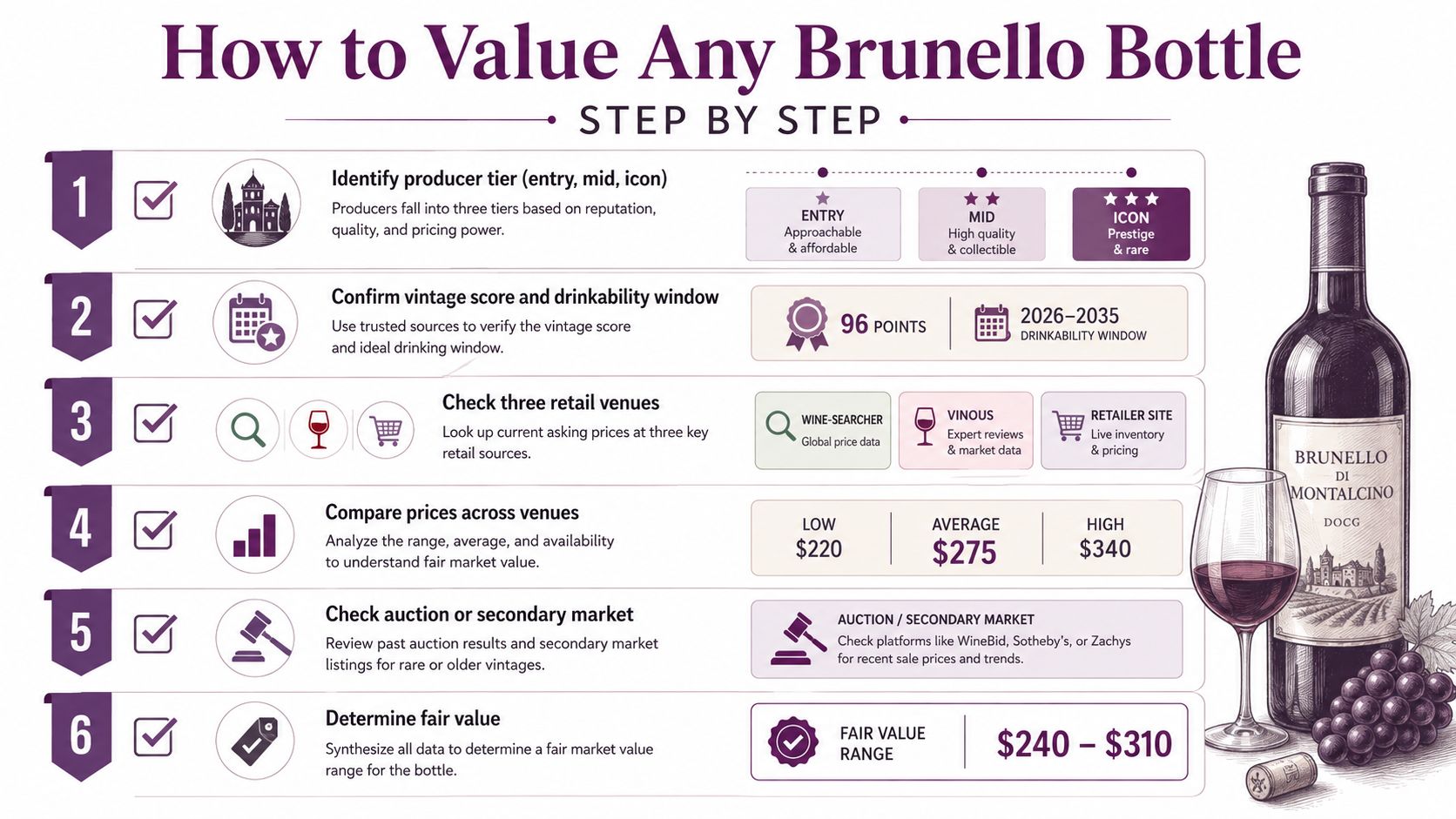
A fair Brunello valuation starts by identifying the bottle's place in the market, not just its appellation. The same label can sit in retail, auction, or bulk logic, and each one implies a different fair value range.
<a id="step-1-identify-the-producer-tier"></a>
Step 1, identify the producer tier
Start with entry, mid, or icon. A Castello Banfi 2019 Annata belongs in a very different mental bucket from a Biondi-Santi Riserva. That first classification keeps you from comparing bottles that should never have been placed next to each other.
<a id="step-2-check-the-vintage-and-drinking-window"></a>
Step 2, check the vintage and drinking window
Vintage matters because the market prices maturity and patience differently. A bottle that is ready now can trade differently from one that still needs cellar time. If the vintage sits in a respected window, you can usually justify more confidence in the quote.
<a id="step-3-compare-retail-venues"></a>
Step 3, compare retail venues
Use multiple retail listings, not just one shop. A bottle priced at US$40 to US$55 on one site may look very different once you compare across specialist merchants and broader marketplaces. A platform like Wine Labs can sit alongside retail checks, because it consolidates comparable pricing and market context in one view.
<a id="step-4-pull-auction-comparables"></a>
Step 4, pull auction comparables
Auction records show what buyers paid, not just what a merchant hoped to charge. If the retail number is stable but the auction prints are thin, the bottle probably belongs in a lower-liquidity bracket. If the auction prints are strong and repeated, the bottle has real secondary-market support.
<a id="step-5-apply-a-channel-haircut"></a>
Step 5, apply a channel haircut
A useful working assumption is that auction-to-retail pricing often needs a haircut for fees, venue costs, and buyer behavior. That does not mean auction is always cheaper or always dearer, it means the venue is part of the price.
<a id="step-6-adjust-for-format-and-provenance"></a>
Step 6, adjust for format and provenance
A Biondi-Santi 2016 Riserva will not price the same way as a standard bottle, and clean provenance can push the number higher still. A US$90 retail Brunello can become a US$220 to US$250 750ml auction reference or a US$480 to US$600 1.5L lot when the format and provenance are strong.
The decision checklist is straightforward. Trust retail when the bottle is common and current. Trust auction prints when the label is collectible and the history is clear. Trust bulk references when you want to understand the floor rather than the shelf.
<a id="the-long-run-story-behind-the-headlines"></a>
The Long Run Story Behind The Headlines
Brunello's current shelf price reflects decades of asset repricing, not only recent demand. Vineyard land in the Brunello DOCG has become more valuable over time, while the wine has built a stronger global reputation. The result is a market where scarcity and brand equity sit alongside production cost.
The land-value analysis noted earlier shows the scale of that change. One hectare rose from €15,537 in the source's 1967 inflation-adjusted calculation to €350,000 per hectare by 2007, then to €750,000 per hectare later on. The same analysis recorded a hectoliter moving from 250,000 lire in 1992 to €900. These figures matter because they connect Brunello's bottle price with the economics of the appellation, rather than treating retail as an isolated number.
That history also helps explain the gap between channels. Retail reflects current release costs, ageing, distribution, and producer positioning. Auction prices add scarcity, provenance, and collector demand, while bulk benchmarks indicate a lower reference point for the wine before packaging, maturation, and brand presentation.
Brunello therefore behaves like a multi-channel asset. To estimate a bottle's real value, triangulate its vintage and producer tier against the venue, then ask whether the price reflects drinkability, cellar potential, or secondary-market scarcity.
Affordable Brunello can still feel expensive because land, ageing, and reputation remain embedded in the price. That premium is accumulated, not incidental.
<a id="case-size-format-and-provenance-premiums"></a>
Case Size, Format, and Provenance Premiums
Two bottles of the same wine can trade at very different prices once format enters the picture. Brunello is especially sensitive to that because collectors buy both to drink and to cellar, and the market charges more when the bottle is easier to store as a trophy.
<a id="size-changes-the-apparent-price"></a>
Size changes the apparent price
A magnum can carry a strong premium versus a standard 750ml bottle, and larger formats price even higher when the producer is collectible. The brief's format guidance points to 2.0 to 2.5x for magnum lots relative to 750ml equivalents, with larger formats rising further. That is not just a volume effect, it reflects collector preference and the scarcity of well-kept large-format stock.
<a id="provenance-changes-buyer-confidence"></a>
Provenance changes buyer confidence
Clean provenance matters too. Ex-cellared, single-owner lots often draw a higher price than re-offered stock because buyers trust them more. Original wooden cases, intact labels, and consistent storage history can all support that confidence. Mixed or re-conditioned cases tend to lose some of that value because the buyer has to absorb more uncertainty.
Provenance is not decoration in the catalogue. It is part of the asset.
A simple example shows the jump. A US$90 retail Biondi-Santi Riserva can move to US$220 to US$250 at 750ml auction levels, and to US$480 to US$600 in 1.5L format when provenance is clean. That spread is why serious buyers read lot notes as carefully as they read the label.
| Format / Condition | Multiple vs 750ml Retail | Typical Use | Notes |
|---|---|---|---|
| 750ml, standard condition | 1.0x | Drinking and baseline valuation | Most common reference point |
| 750ml, clean provenance | Higher than baseline | Secondary market comparison | Better storage history supports price |
| Magnum 1.5L | 2.0x to 2.5x | Cellaring and gifting | Collector preference drives premium |
| Larger formats | 3x to 6x | Trophy lots and long-term holding | Scarcer and more sensitive to provenance |
<a id="quick-reference-brunello-price-table"></a>
Quick Reference Brunello Price Table
A fast Brunello valuation starts with tier, then checks channel, then adjusts for vintage and format. That order keeps you from confusing a retail shelf number with a collectible lot or a bulk reference.
| Producer Tier | Retail Band (USD) | Auction Hammer (USD) | Bulk €/hl Reference | Vintage Note |
|---|---|---|---|---|
| Entry | US$45 to US$75 | Usually lower-liquidity and bottle-specific | Lower bulk benchmark | Recent standard releases |
| Mid | US$75 to US$150 | Active but producer-sensitive | Middle bulk benchmark | 2019, 2020 |
| Icon | US$150 to US$600+ | Strong collectible demand | Highest quoted benchmark | 2010, 2015, 2016 |
| Mature collectible | Varies by condition | Supported by recorded auction history | Not the main reference | 1999, 1974 |
| Market anchor | Not a retail line | Not a retail line | 925 euros per hectoliter in June 2026 | Wholesale reference only |
For a quick sanity check, compare the lot against current market references before committing. If the bottle is out of line with a trusted benchmark, the issue is usually producer, format, or provenance, not the appellation itself.
Wine Labs gives buyers and sellers a way to compare Brunello across retail, auction, exchange, and other channels in one place, which is exactly what this market needs when one bottle can mean three different prices. If you're pricing, sourcing, or auditing a Brunello position, visit Wine Labs and use the market context to narrow the spread before you buy or sell.