Wine Labs · Market intelligence
Barbera D Alba
Barbera d alba. Explore Barbera d'Alba — grape character, top producers, vintage quality signals, and the retail price ranges buyers and sellers should track
A denomination producing approximately 906,000 cases from 1,296 hectares deserves more than the usual “easy-drinking Piedmont red” description. Industry data on Barbera d'Alba DOC points to a category with meaningful scale, geographic breadth, and enough producer variation to support very different commercial outcomes.
That scale creates a pricing problem. The same appellation can represent a fresh, inexpensive restaurant pour, a vineyard-designated bottle with serious cellaring potential, or an auction-tracked wine whose value depends on producer, vintage, provenance, and channel. The grape explains the wine's acidity. It doesn't explain the whole market.
Table of Contents
- Why Barbera d'Alba Earns a Market Look
- What Barbera d'Alba Actually Is
- Grape Character in Plain Numbers
- DOC, Superiore, and Producer Style
- How Long Barbera d'Alba Really Ages
- Notable Producers and Where They Sit in the Market
- Yields, Channel Pricing, and What a Bottle Should Cost
- Buying and Selling Barbera d'Alba With Confidence
<a id="why-barbera-dalba-earns-a-market-look"></a>
Why Barbera d'Alba Earns a Market Look
A single 2021 Barbera d'Alba from a mid-tier producer can appear at $18 in retail, $26 on a restaurant list, or $14 to $16 per bottle in a six-bottle auction lot. The wine has not changed. The channel has, along with its margin, inventory pressure, and buyer expectations.
That spread gives Barbera d'Alba a stronger commercial case than its “everyday red” reputation suggests. The denomination covers 1,296 hectares and roughly 906,000 cases, a scale large enough to produce several market tiers rather than one uniform value category. The denomination's area and production profile places it in the commercial heart of the Langhe and Roero, where commune, estate, and vineyard identity can materially affect how a bottle is priced.
<a id="the-market-is-larger-than-the-stereotype"></a>
The market is larger than the stereotype
Consumers often meet Barbera d'Alba as a bright, inexpensive red for pizza or pasta. That role remains valid, but it represents the entry point, not the full category. Producers can vary farming, extraction, maturation, and packaging, creating offers with different levels of concentration, polish, scarcity, and intended drinking horizon.
Producer identity consequently carries more information than the grape name alone. A generic bottling establishes a broad style expectation. A named estate, Superiore designation, vineyard indication, and favorable vintage each add signals that merchants can use to distinguish a more ambitious bottle from a straightforward release.
Market rule: Treat Barbera d'Alba as a category with tiers, not as one uniform bottle.
Regional demand also influences those tiers. Shifts in Piedmont's wine market, trade coverage, and consumer preferences can change how merchants position wines that once sat below the collector radar. Wine Labs' Piedmont market digest provides context for that wider discussion. The practical conclusion is clear: price Barbera d'Alba by producer, vintage, and channel, rather than by appellation name alone.
<a id="what-barbera-dalba-actually-is"></a>
What Barbera d'Alba Actually Is
Barbera d'Alba DOC is a controlled-origin denomination in Piemonte. It was officially recognized on 27 May 1970, placing it among the classic controlled-origin appellations of the region rather than a recent marketing construction. Its regulatory history has been actively maintained, with documented amendments in 1977, 1987, 2001, 2010, 2011, 2013, 2014, and 2015. The denomination's historical and regulatory record shows an appellation that has been refined over time.
The production zone sits in and around Alba in Cuneo province. It includes all or part of numerous communes, among them Alba, Barbaresco, Barolo, Diano d'Alba, Grinzane Cavour, Neive, Serralunga d'Alba, Treiso, and Verduno. Other market references describe a territory extending across about 50,000 hectares and more than 40 towns, a reminder that the commercial identity of Barbera d'Alba is regional rather than tied to one estate.
<a id="geography-changes-the-merchants-reading"></a>
Geography changes the merchant's reading
A generic commune blend and a bottle identifying a more specific vineyard source shouldn't be evaluated as interchangeable. Fruit from a recognized hillside or a commune associated with fine-wine production may receive more attention from merchants, even when the front label still carries the same DOC name.
That distinction matters because the denomination overlaps with the geographic world of Barolo and Barbaresco. A buyer isn't only purchasing acidity and red fruit. They're also buying the producer's interpretation of a region already familiar to collectors.
| Field | Value |
|---|---|
| Denomination | Barbera d'Alba DOC |
| Recognition | 27 May 1970 |
| Core region | Alba and surrounding areas in Cuneo province |
| Vineyard area | 1,296 hectares in 2021 |
| Average production | 81,550 hectoliters over five years |
| Approximate cases | Roughly 906,000 |
| Historical grape record | Barbera recorded in the area from the second half of the 1600s |
Barbera's roots in the Alba area reach much further back than the DOC. Historical records place the variety in the region from the second half of the 1600s, while Lorenzo Fantini documented particularly strong expansion in the Province of Cuneo around 1860 to 1870. Phylloxera-era replanting helped the productive, resilient variety gain ground, which helps explain why Barbera became both an agricultural workhorse and a durable part of Piedmont's wine economy.
<a id="grape-character-in-plain-numbers"></a>
Grape Character in Plain Numbers
Barbera's commercial identity begins with chemistry. Technical data place Barbera d'Alba around 5.8 to 6.6 g/L total acidity and a pH near 3.35 to 3.60, with the profile linked to the grape's natural retention of malic acid. The technical sheet for Barbera d'Alba connects that low-pH, high-acid structure to freshness even when ripeness and alcohol rise.
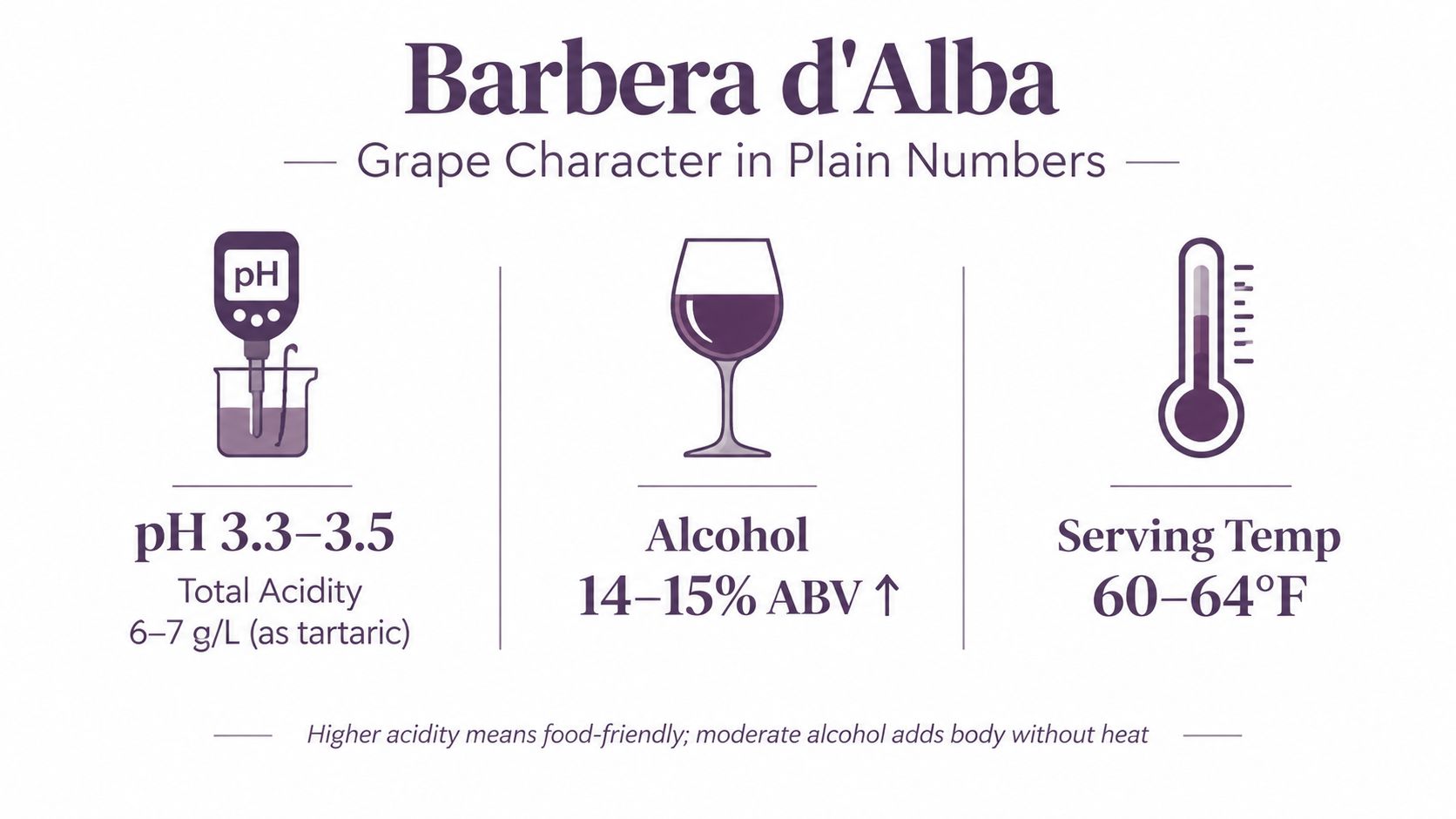
The tasting consequence is straightforward. High acidity makes cherry and plum flavors feel vivid rather than heavy, while the relatively low pH supports a firm, energetic finish. Barbera generally offers less tannic grip than Nebbiolo, so its structure comes more from acidity than from drying phenolics.
<a id="why-acidity-matters-at-the-table"></a>
Why acidity matters at the table
That structure explains Barbera's unusual versatility with food. Acid can cut through rich sauces, cured meats, cheese, and roasted dishes, while the fruit supplies enough weight for grilled or braised preparations. The wine can feel refreshing without becoming thin, provided the producer has managed extraction and alcohol sensibly.
Alcohol changes the balance. The technical reference places many wines in a 13% to 15% range, although the exact level depends on ripeness, site, vintage, and producer choices. Higher alcohol adds body, but Barbera's acidity can keep that body from feeling soft or hot.
For pricing, this balance creates two advantages. Entry-level wines can remain immediately useful at the table, while better vineyard material and careful élevage can turn the same acid backbone into a foundation for medium-term ageing. The grape's acidity isn't merely a tasting note. It's the reason the category can serve both volume-driven restaurants and buyers looking for a serious, cellar-friendly red.
<a id="doc-superiore-and-producer-style"></a>
DOC, Superiore, and Producer Style
The label's legal tier establishes a floor, not a complete description. Barbera d'Alba includes a standard expression and a Superiore tier, and the latter requires at least 12.5% alcohol and at least 12 months of ageing, including four months in barrel. A summary of the denomination's regulatory distinctions also identifies 12% minimum alcohol for the standard version.
The regulatory framework should be read alongside yield rules. The EU product specification allows a maximum of 10,000 kilograms of grapes per hectare for Barbera d'Alba and Barbera d'Alba Superiore, 9,500 kilograms in the Castellinaldo subarea, and 9,000 kilograms where the label carries a vigna indication. The published product specification gives those limits, which make the vigna designation economically meaningful even before a buyer tastes the bottle.
| Tier / Style | Min. Alcohol | Min. Aging | Subzone Rule | Typical Container | Style Signature |
|---|---|---|---|---|---|
| Standard DOC | 12% | Regulatory floor applies | Broad DOC zone | Steel, concrete, or wood | Bright, direct, early-drinking |
| Superiore | 12.5% | 12 months, including 4 months in barrel | Defined production requirements | Barrel, large cask, or mixed élevage | Fuller, deeper, more cellar-oriented |
| Vigna indication | Depends on tier | Depends on tier | Lower yield ceiling | Producer choice | More specific site signal |
| Contemporary low-oak style | Depends on tier | Depends on tier | Producer-dependent | Concrete egg, amphora, or large cask | Fresh, transparent, less marked by wood |
<a id="the-container-often-explains-the-price-gap"></a>
The container often explains the price gap
Traditional large casks can preserve fruit and acidity while adding savory depth. French barriques, especially when new, can make the wine feel broader, sweeter, and more internationally styled. Seasoned barriques are less obvious, while concrete or amphora can emphasize texture and site without adding wood flavor.
That's why two wines carrying the same DOC name can sit at very different prices. A higher-priced bottle may reflect lower yields, a specific vineyard, longer élevage, expensive cellar work, or a producer whose name has stronger demand. The price doesn't automatically prove quality, but it does tell you which production choices the market considers scarce.
Recent trade coverage has also described a move toward restrained oak, large casks, concrete eggs, and amphora, alongside broader interest in organic and biodynamic farming. The local consortium's framing of Barbera as capable of both ready-to-drink and medium-longevity styles supports a more useful conclusion: producer technique now drives premium positioning as much as appellation identity.
<a id="how-long-barbera-dalba-really-ages"></a>
How Long Barbera d'Alba Really Ages
The legal ageing requirement is not the same as a recommended drinking window. The DOC establishes a minimum, while the bottle's actual life depends on acidity, tannin management, alcohol, fruit concentration, wood treatment, and storage.
Independent guides disagree on the details. Some place most Barbera d'Alba in a three-to-six-year best-drinking period, while Superiore and oak-aged examples can reach eight to ten years. An independent guide to Barbera d'Alba ageing and style makes the important distinction between the category's minimum regulatory floor and the longer life available to better-made examples.
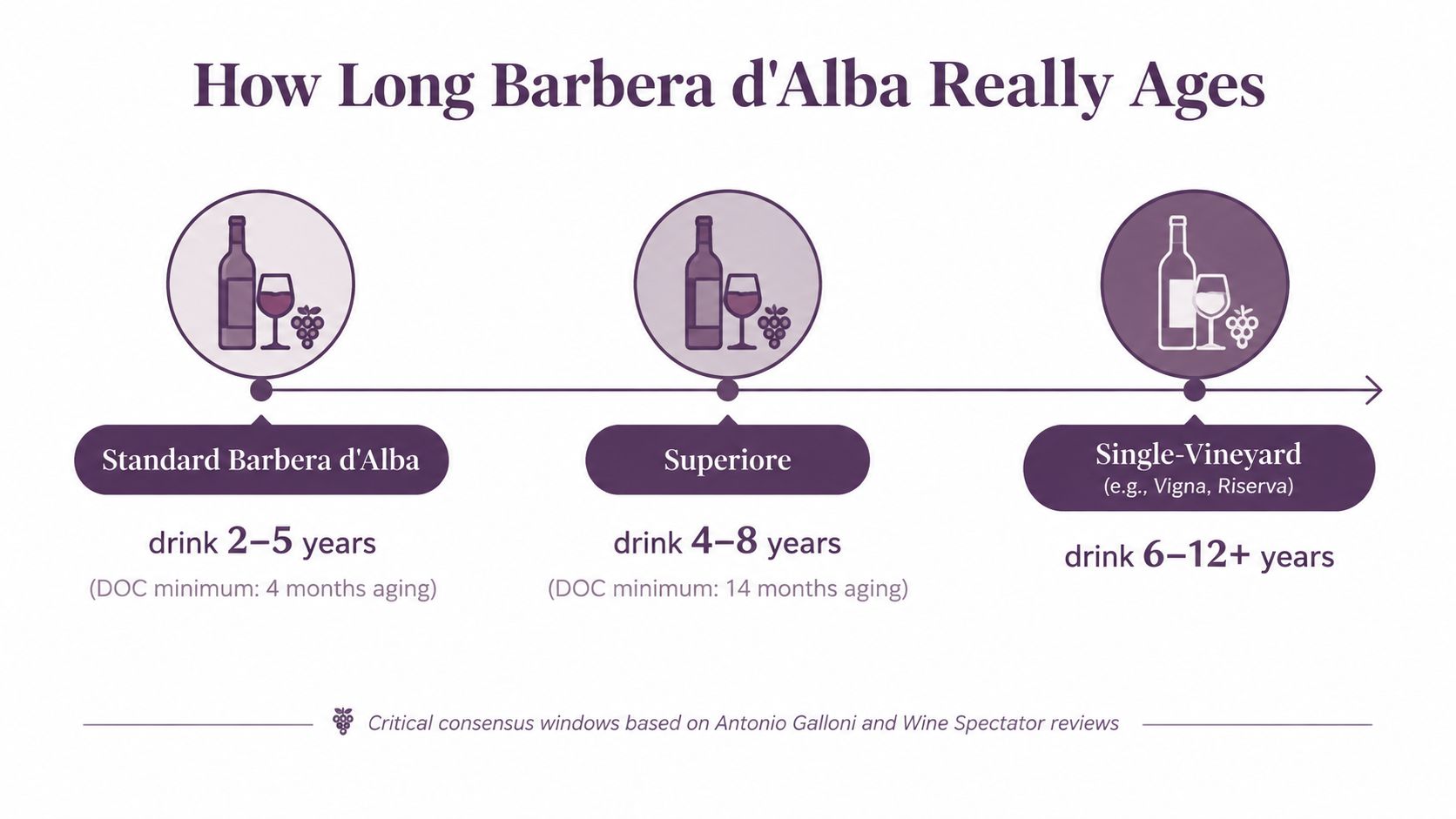
A casual drinker usually has the simplest decision. Buy a current release of standard Barbera d'Alba when the aim is bright fruit and immediate food compatibility. Holding that style for too long may soften the fruit without adding enough complexity to justify the wait.
<a id="match-the-window-to-the-buyer"></a>
Match the window to the buyer
Merchants need a different framework. A Superiore bottling can benefit from controlled inventory holding when the producer, vintage, and provenance justify it. Collectors should be more selective still, focusing on wines with clear site identity, restrained oak, and a producer record that supports longer development.
The underlying mechanism is also easy to misread. Fruit doesn't age a wine by itself. Acidity is the principal structural asset, while tannin and alcohol can contribute depending on the style. A heavily oaked wine may seem substantial in youth, but wood flavor alone doesn't guarantee graceful evolution.
A retailer should therefore avoid a single “drink young” label for the whole appellation. The better question is whether the bottle's structure and élevage support a near-term sale, a medium hold, or a collector allocation.
<iframe width="100%" style="aspect-ratio: 16 / 9;" src="https://www.youtube.com/embed/dcM8jMFLY40" frameborder="0" allow="autoplay; encrypted-media" allowfullscreen></iframe><a id="notable-producers-and-where-they-sit-in-the-market"></a>
Notable Producers and Where They Sit in the Market
“Notable” should mean more than a memorable score. For pricing purposes, a notable producer has an identifiable market position, recurring buyer demand, and enough channel presence for merchants to compare offers. That can include a reliable entry bottling, a vineyard-designated wine, or a top estate label that appears in auctions.
The working set below is best viewed as a positioning map, not a universal ranking. Producer portfolios can span tiers, and a basic estate Barbera may behave very differently from the same producer's vineyard-designated release.
| Market Tier | Producer Examples | Typical Retail (USD) | Ageing Horizon | Channel Notes |
|---|---|---|---|---|
| Accessible | Vietti, Prunotto, Fontanafredda, Cordero di Montezemolo basic Barbera | $16 to $24 | Near-term | Broad retail and restaurant availability |
| Mid-premium | Vietti Scarrone, Elio Grasso, Giacomo Conterno Cerretta, Prunotto Bricco bottlings, Cascina delle Rose | $30 to $55 | Medium term | Single-vineyard identity and stronger collector interest |
| Top estate | Giacomo Conterno, Bruno Giacosa Casa Vinicola bottlings, Sandrone, La Spinetta Ca' di Pian | $60 to $180 or more | Beyond a decade for suitable examples | Auction-tracked and provenance-sensitive |
<a id="what-buyers-are-actually-paying-for"></a>
What buyers are actually paying for
The accessible tier wins on consistency and liquidity. These bottles are easier for a retailer to explain and easier for a restaurant to sell by the glass or with a broad menu. Their value depends less on scarcity than on dependable style and availability.
The mid-premium tier is where the category becomes most interesting. A named vineyard gives the buyer a stronger geographic story, while Superiore status and more deliberate élevage can support a higher shelf price. This is often the point at which a merchant can justify a premium without asking the customer to enter trophy-wine territory.
Top-estate bottles operate under different rules. Their price depends on estate reputation, vintage, bottle condition, and the confidence that the wine will remain recognizable in a secondary-market listing. A broader discussion of Barolo and Piedmont market dynamics helps place that producer-led hierarchy in the wider regional context.
<a id="yields-channel-pricing-and-what-a-bottle-should-cost"></a>
Yields, Channel Pricing, and What a Bottle Should Cost
Yield limits help explain why a denomination with everyday associations can still generate premium bottlings. The published specification sets the maximum at 10,000 kilograms per hectare for Barbera d'Alba and Superiore, 9,500 kilograms for Castellinaldo, and 9,000 kilograms for a vigna indication. Those ceilings don't determine retail price on their own, but they establish a framework in which more specific vineyard claims can carry an economic signal.
The category's total scale remains substantial, with 1,296 hectares and approximately 906,000 cases. That combination creates a market with both liquidity and segmentation. Buyers can find broad commercial bottlings, while stronger estates can use site, élevage, and allocation to separate their offers.
| Tier | Retail (USD) | Restaurant (USD) | Auction (USD) |
|---|---|---|---|
| Standard DOC | $14 to $22 | $38 to $55 | Channel and lot dependent |
| Superiore | $24 to $45 | $60 to $95 | Producer and vintage dependent |
| Single-vineyard or top estate | $24 to $45 and higher | $60 to $95 and higher | $50 to $150 for selected lots |
<a id="channel-is-part-of-the-product"></a>
Channel is part of the product
Retail pricing usually gives the buyer the clearest reference point, but it isn't always the cheapest route. A restaurant list includes service, storage, glassware, labor, and the risk of unsold inventory. An auction lot can reduce the per-bottle price, yet the buyer assumes provenance, condition, buyer's premium, and transport risk.
The same label can therefore show a twofold or threefold spread without any change in liquid. Direct winery allocations may raise the floor because supply is controlled. Enotecas can offer better discovery but may price around service and curation. Negotiants and importers add logistics and tax friction, which can make cross-border comparisons misleading.
Pricing discipline: Compare like with like. Match producer, vintage, bottle format, condition, and channel before deciding that one listing is expensive.
Merchants and collectors who need that comparison can use Wine Labs' fine-wine market data tools to examine retail, auction, exchange, and restaurant references in one market view. The practical benefit is not a magic price. It's a cleaner comparison before quoting, buying, or releasing stock.
<a id="buying-and-selling-barbera-dalba-with-confidence"></a>
Buying and Selling Barbera d'Alba With Confidence
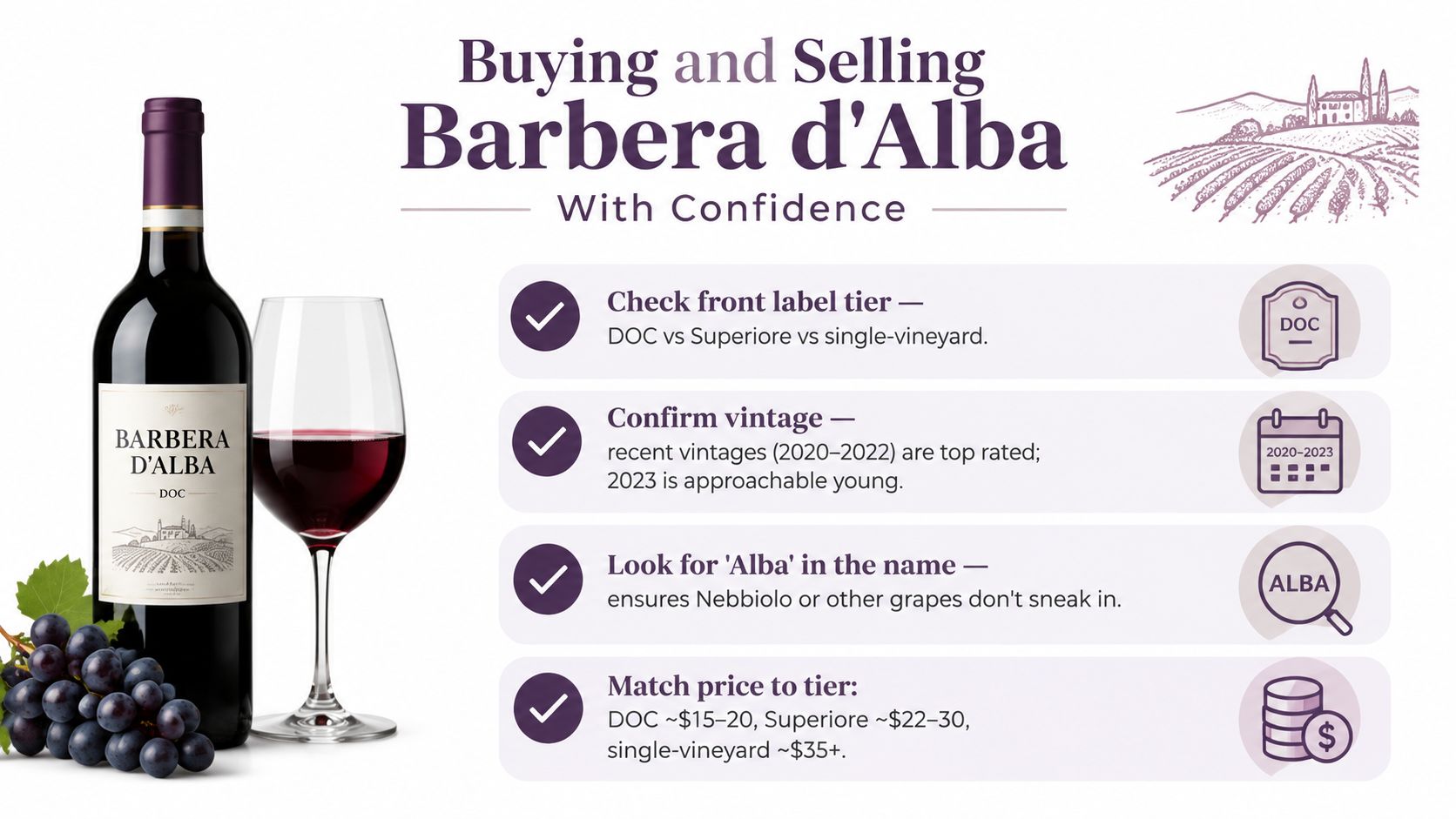
A buyer should start with the front label, not the back-label tasting language. Confirm whether the bottle is standard DOC, Superiore, or a vigna-designated wine, then identify the producer and vintage. Those details establish the first useful comparison set.
<a id="a-buyers-checklist"></a>
A buyer's checklist
- Verify the tier: A standard DOC and a Superiore shouldn't share the same assumed drinking horizon or valuation.
- Check the vintage: Compare the release with current regional quality commentary rather than treating every year as interchangeable.
- Confirm provenance: Once a bottle enters auction territory, storage history, fill level, capsule condition, and label condition can materially affect confidence.
- Compare channels: A retailer, restaurant list, and auction lot reflect different cost structures, so don't use one as a direct substitute for another.
- Question the premium: Above the accessible category, ask what the price buys. It may be a vineyard indication, lower yield, longer élevage, producer reputation, or a costly channel.
Sellers should anchor on current comparable listings rather than critic scores alone. Standard DOC wines generally make more sense as earlier-release inventory, while Superiore and strong single-vineyard examples deserve a closer look before being released immediately. A bottle's condition and storage record become increasingly important as the market moves from casual consumption toward collecting.
<a id="the-three-signals-that-move-price"></a>
The three signals that move price
Producer reputation tells the market whether a bottle deserves attention beyond the grape name. Vintage quality changes how buyers assess freshness, balance, and ageing potential. Release channel determines the final comparison because retail, restaurants, auctions, and direct allocations carry different margins and risks.
Cross-border trades add another complication. Import duties, taxes, freight, and compliance costs can compress the seller's margin even when the headline price looks attractive. The disciplined approach is to calculate the net outcome after those frictions, then compare it with a realistic local sale.
Wine Labs helps merchants, collectors, and producers compare Barbera d'Alba pricing across retail, auction, exchange, and restaurant channels, with historical tracking and market alerts for specific wines. Visit Wine Labs to check comparable listings, monitor producer and vintage movement, and price your next Barbera d'Alba purchase or sale with a clearer market reference.