Wine Labs · Market intelligence
Wine List Pricing That Actually Works in 2026
Wine list pricing decoded for restaurants and merchants. Cost models, tier strategies, and benchmarking tactics to set profitable, market-aligned menus.
A restaurant bottle can carry a threefold markup over retail, while auction buyers may pay a separate premium to acquire the bottle. Andy Hayler's analysis of hundreds of British wine lists found an average markup of 3.03 times retail, compared with 2.47 times retail abroad, including fine-dining venues with three Michelin stars. A CBC report on restaurant wine pricing also summarized research showing an average restaurant bottle price roughly 300% above retail.
That spread makes one conclusion unavoidable: wine list pricing isn't a single markup decision. It's a cross-channel benchmarking problem involving retail replacement value, restaurant service, scarcity, prestige, auction premiums, inventory risk, and the occasion in which the bottle is sold. A list that relies only on wholesale cost can protect a spreadsheet while damaging perceived value, turnover, or both.
Table of Contents
- Why Wine List Pricing Is a Cross-Channel Problem
- Calculating Cost of Goods and Pour Economics
- Choosing Markup Strategies That Fit Your List
- Positioning Wine List Pricing by Segment and Occasion
- Benchmarking Against Retail, Auction, and Exchange Channels
- Monitoring and Adjusting With Alerts and Analytics
- A 90-Day Wine List Pricing Rollout and Common Traps
<a id="why-wine-list-pricing-is-a-cross-channel-problem"></a>
Why Wine List Pricing Is a Cross-Channel Problem
A bottle has different economic meanings in different channels. Retail establishes what an informed guest might pay for possession. A restaurant sells convenience, preparation, glassware, service, curation, and the opportunity to consume the wine immediately. An auction can reveal how far collectors will stretch for scarcity, provenance, or a sought-after vintage, but its price also includes transaction mechanics that don't translate directly to a dining room.
The practical error is treating those signals as interchangeable. Retail is usually the reference floor, restaurant pricing is the service-adjusted offer, and auction results can help define the prestige ceiling. None of them should dictate the list price alone.
Hayler's British restaurant analysis is especially useful because it exposes the gap between a neat pricing rule and actual lists. The average British restaurant markup was 3.03 times retail, while the average “abroad” markup was 2.47 times retail, even among prestigious restaurants, as documented in his analysis of restaurant wine lists. Those figures don't establish a universal rule. They show that venue, geography, and positioning change the acceptable spread.
| Channel | Typical Markup Multiple | Price Floor Role | Price Ceiling Role |
|---|---|---|---|
| Retail | Market-dependent | Establishes a guest-facing comparison point | Limited, unless scarcity is visible |
| Restaurant | Commonly about 2 to 3 times wholesale, with UK restaurant commentary often describing roughly 2.5x to 4x retail-equivalent pricing | Covers service and operating costs | Reflects occasion, curation, and venue prestige |
| Auction | Buyer's premium commonly applies to the hammer price | Indicates collectible-market willingness to pay | Helps calibrate scarcity and prestige |
A working model should therefore collect three observations for every meaningful SKU: a comparable retail reference, a restaurant context reference, and, where relevant, an auction or exchange signal. The resulting price isn't mechanically averaged. Instead, the operator decides which channel deserves the greatest weight.
For an everyday house wine, retail and replacement cost matter most because guests compare it easily and turnover drives the economics. For an investment-grade bottle, auction and exchange evidence may matter more than the original acquisition cost. The list becomes defensible when its premium reflects the bottle's role, not merely the operator's preferred multiple.
<a id="calculating-cost-of-goods-and-pour-economics"></a>
Calculating Cost of Goods and Pour Economics
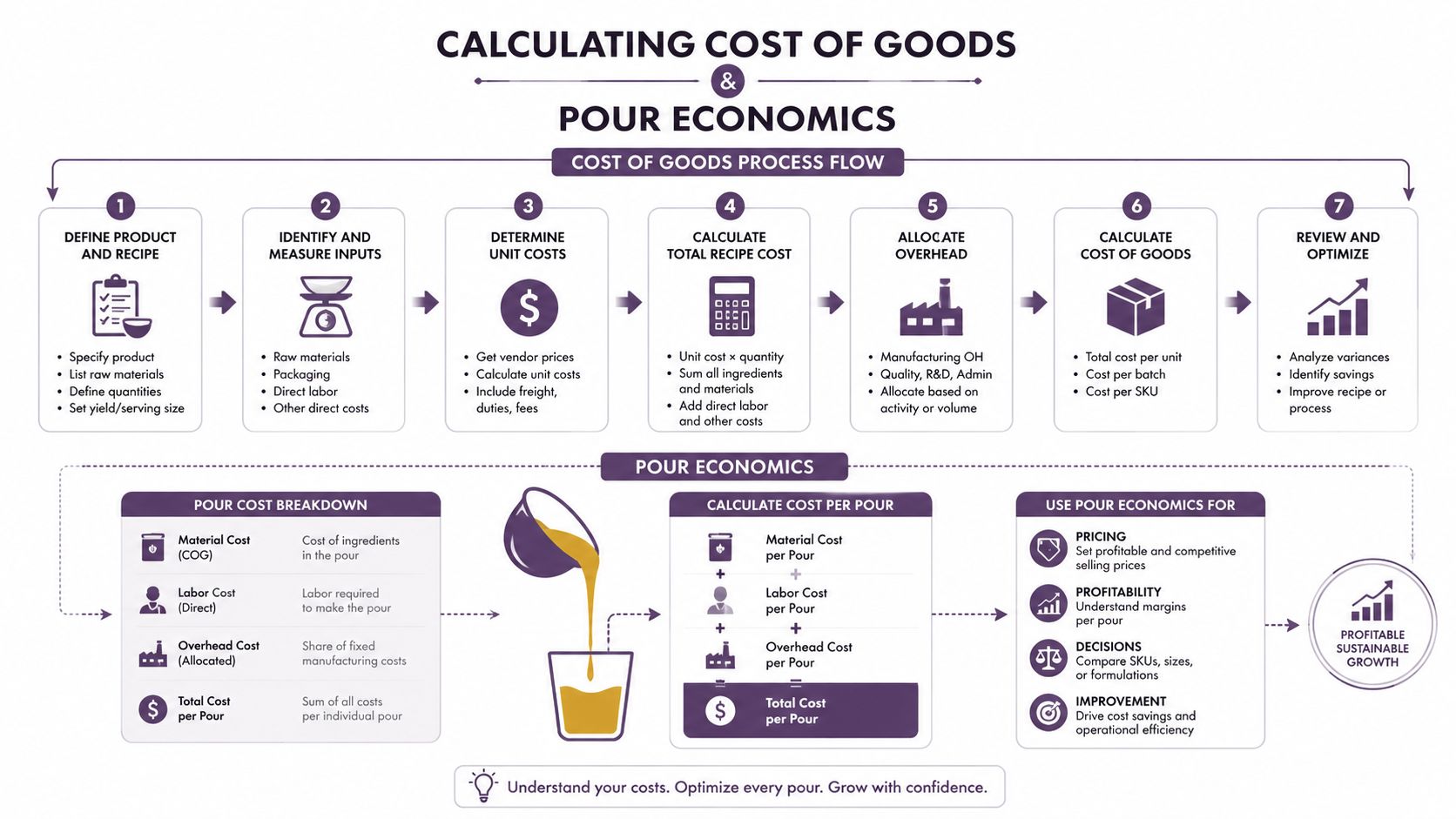
Cost of goods should begin with the landed cost, not the invoice line. For each bottle SKU, add wholesale purchase price, freight, storage allocation, expected breakage, and other directly attributable handling costs. This gives slow-moving or specially stored wines a more realistic cost base. It also makes cross-channel comparisons more useful, because retail or auction references should be tested against the cost of replacing the bottle, not an incomplete acquisition figure.
By-the-glass pricing requires a separate yield model. A standard 750 ml bottle produces roughly five 5 oz pours. At a 25% pour cost, a bottle costing $20 implies a glass price of $80, before accounting for service constraints and losses. The formula and related operating considerations appear in restaurant wine list pricing guidance from Alstig. Spillage, unsold open bottles, inconsistent pours, and demand volatility can move actual economics away from the theoretical target.
<a id="build-the-bottle-model-first"></a>
Build the bottle model first
For a $14 wholesale house red, record landed cost after freight, storage, and breakage. Set a target pour-cost band that fits the restaurant's positioning, then test the resulting glass price against food prices, nearby list references, and competing BTG options. Bottle pricing should support the same economics, though it does not need to be a direct multiple of the glass price.
A $120 wholesale reserve Cabernet presents a different problem. Applying the same pour-cost formula may produce a glass price that limits demand, while setting the glass price too low increases exposure to slow turnover and spoilage. A selective BTG role, a smaller service window, or bottle-only placement may preserve more value than forcing the wine into every service format.
<a id="model-corkage-as-portfolio-revenue"></a>
Model corkage as portfolio revenue
Corkage adds service revenue without consuming restaurant inventory, but it can divert guests from list bottles. The comparison should include corkage revenue, lost bottle contribution, and the strategic value of accommodating celebratory or hard-to-source wines. A close substitute for a high-margin selection deserves particular scrutiny.
Practical rule: Price the bottle and the glass together. A deliberately managed BTG program can support higher bottle prices, while weak assumptions about spoilage and demand will surface quickly in actual results.
Empirical research supports treating BTG as part of the portfolio. A study of restaurant wine pricing found that moving from bottle-only to bottle-plus-the-glass increased bottle price by 5.0% and bottle margin by 12.2%, as reported in the Wine Economics Association paper on bottle margins and the by-the-glass option. The finding supports modeling BTG availability as a pricing variable, not applying a blanket increase to every bottle.
For spreadsheet-based cellar valuation and price comparison, Cellar Pricer can sit alongside the cost model. The operator still needs realistic landed costs, expected yields, spoilage assumptions, and service constraints.
<a id="choosing-markup-strategies-that-fit-your-list"></a>
Choosing Markup Strategies That Fit Your List
Three strategies dominate practical wine list pricing: keystone, flat gross-margin pricing, and tiered variable markup. Each solves a different problem, and each creates a predictable weakness.
Keystone pricing doubles cost. It's fast, transparent, and easy for staff to understand, but it treats a house bottle and a prestige bottle as if guests evaluate value in the same way. That usually makes the cheapest wines look comparatively attractive while leaving expensive bottles underpriced relative to their scarcity and service burden.
A flat gross-margin model protects contribution more consistently. If an operator targets a 65% to 75% gross margin, the list price rises in direct relation to wholesale cost. The weakness is psychological. Every bottle remains visibly anchored to acquisition cost, so the list can lose the prestige ladder that helps guests understand why one bottle belongs above another.
Tiered pricing assigns different multiples to different roles. Entry wines can carry a lower multiple to preserve accessibility, core wines can carry the main margin load, and reserve or scarce bottles can use a carefully calibrated premium. The approach aligns price with perceived value, but it requires cleaner segmentation and more frequent review.
| Strategy | Multiplier | List Price for an $80 Wholesale Bottle | Trade-Off |
|---|---|---|---|
| Keystone | 2x | $160 | Predictable, but weak for prestige signaling |
| Flat 65% gross margin | About 2.86x cost | About $229 | Protects margin, but can feel cost-anchored |
| Flat 75% gross margin | 4x cost | $320 | Strong contribution, but greater value scrutiny |
| Tiered model | Depends on segment | Set by list role | Balances access, prestige, and turnover |
The table shows why a single “correct” number is misleading. An $80 wholesale bottle can reasonably occupy very different positions depending on whether it's a recognizable core selection, a scarce reserve, or a competitive value anchor.
For lists with more than 40 SKUs, tiered markup is usually the stronger operating choice because it lets the operator manage the portfolio rather than forcing every bottle through identical math. The key is documenting the bands, then checking them against retail and restaurant comparables.
Operators looking for a broader treatment of differentiated pricing can review Tagada pricing insights, especially when designing rules that vary by product role instead of applying one margin target everywhere.
<a id="positioning-wine-list-pricing-by-segment-and-occasion"></a>
Positioning Wine List Pricing by Segment and Occasion
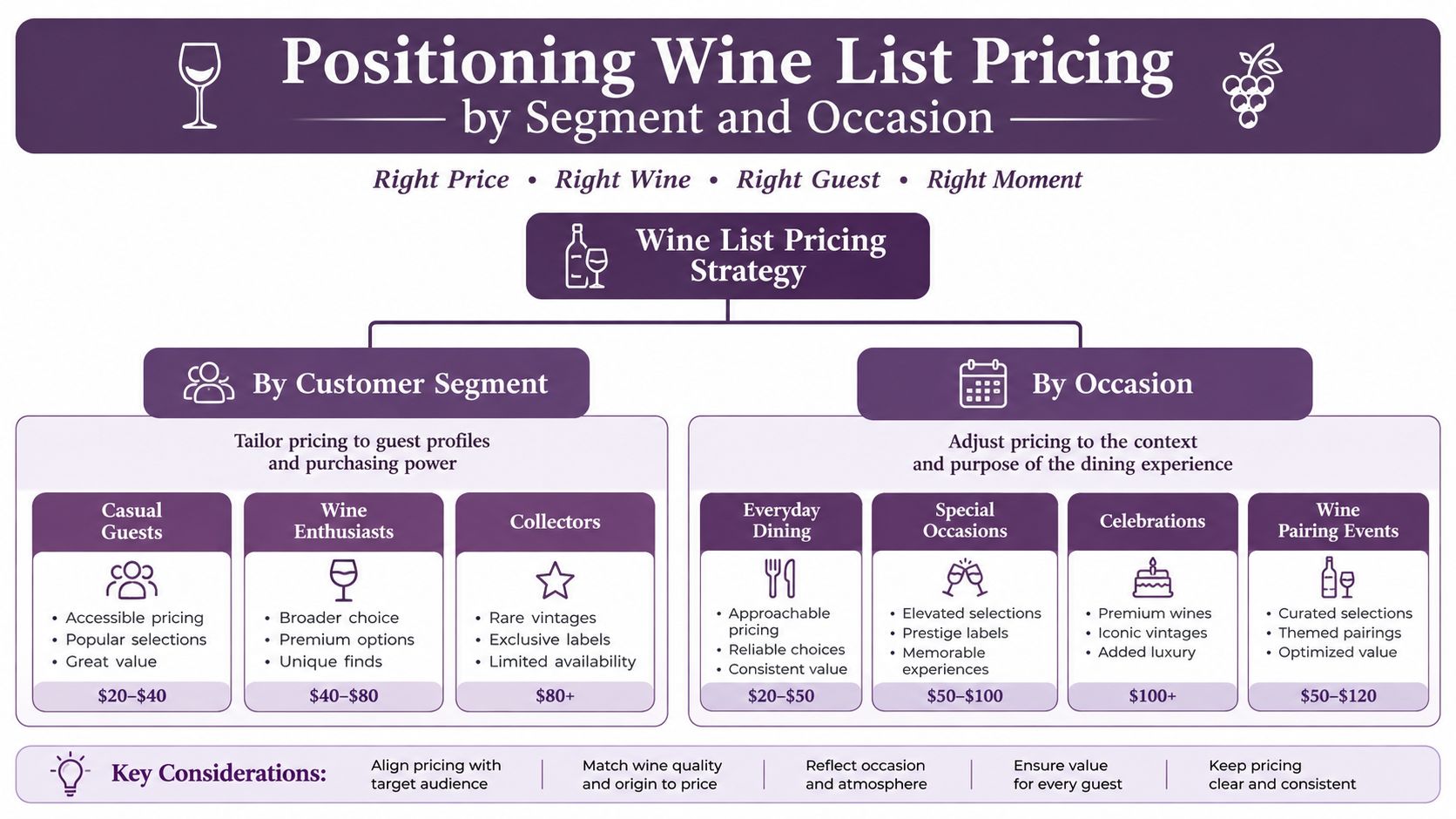
A profitable list doesn't present prices as a random staircase. It gives each bottle a job. Everyday drinking should offer a credible entry point, celebration bottles should make trade-up feel natural, and investment-grade selections should communicate scarcity without making the entire list feel expensive.
Anchoring works through contrast. A high-priced bottle at the top of the list can make a $60 to $80 mid-tier selection appear more approachable, provided the upper anchor is credible and clearly described. The anchor shouldn't be decorative. It needs a recognizable producer, a compelling vintage, a rare format, or another reason a knowledgeable guest accepts its position.
<a id="build-the-ladder-around-occasions"></a>
Build the ladder around occasions
A weeknight regular may prioritize familiarity, moderate commitment, and a quick decision. A wedding party may value a bottle that signals generosity and works across a table. A collector celebrating a milestone may care more about provenance, vintage, and scarcity than about the restaurant's relationship to wholesale cost.
Map those occasions before assigning prices:
- Everyday drinking: Use approachable wines with clear descriptors and a price that doesn't require a long explanation.
- Celebration: Place recognizable regions, larger formats, or food-friendly styles where servers can recommend them as a confident upgrade.
- Investment-grade: Use detailed provenance and vintage information, then price against current market context rather than historical acquisition cost.
By-the-glass wines need a separate portfolio logic. The restaurant carries open-bottle risk, so a BTG selection should earn its space through demand, versatility, and manageable spoilage. A prestigious glass can create excitement, but it shouldn't be included solely because the bottle looks impressive on paper.
<a id="make-self-selection-easy"></a>
Make self-selection easy
Guests should be able to identify a safe choice, an upgrade, and a special occasion bottle without asking for a lecture. Servers need the same map. Give each segment a short reason to buy, a food pairing direction, and a clear next step up.
A digital merchant workflow such as Wine Labs solutions for wine merchants can provide market context for sourcing and comparison, but the restaurant must translate that information into language guests can use. The best list is not the one with the most technical detail. It's the one that reduces uncertainty while preserving discovery.
<a id="benchmarking-against-retail-auction-and-exchange-channels"></a>
Benchmarking Against Retail, Auction, and Exchange Channels
A restaurant wine list is a cross-channel pricing problem. Retail establishes the comparison floor, auction reveals collectible-market behavior, and exchange data helps interpret liquidity and direction for investment-grade wines. Each channel measures a different form of value, so a simple average can hide more than it clarifies.
Retail provides the first reference point. Compare the same producer, cuvée, vintage, format, and region wherever possible. Service, storage, glassware, and immediate availability can support a restaurant premium. A wide gap without an evident reason, however, gives guests an easy phone-based comparison and weakens perceived value.
Auction results require a cost adjustment. The hammer price isn't the buyer's total cost. Major wine auction houses commonly charge buyer's premiums of about 18% to 23.5% in the United States, while some global sales have used a flat 24% premium and Christie's has charged 25% in Hong Kong and Shanghai, according to Wine Spectator's explanation of auction buyer's premiums. A prior Christie's fee schedule listed 22.5% in New York and Hong Kong and 17.5% in London, Paris, and Geneva, as reported by Antiques and the Arts on Christie's buyer's premium changes.
| Channel | Typical Spread vs. Cost | Best For | Data Source |
|---|---|---|---|
| Retail | Comparable market reference | Replacement value and guest comparison | Current retail listings |
| Auction | Hammer price plus buyer's premium | Scarcity, provenance, and collectible value | Auction results and fee schedules |
| Exchange | Market trend and liquidity context | Investment-grade bottles and price direction | Exchange indices and listings |
| Restaurant | Service-adjusted premium | Final list positioning and contribution | Comparable restaurant lists |
<a id="normalize-before-comparing"></a>
Normalize before comparing
Regional spreads reflect import structures, taxes, distribution rules, and availability. Those variables can change replacement value even when the bottle itself is identical. Exchange activity adds a liquidity test: repeated transactions provide stronger evidence than an aspirational listing with little turnover.
A fine wine market data platform from Wine Labs can place retail, auction, exchange, and restaurant references in one research workflow. The operator still has to judge service value, inventory risk, and the role of each bottle on the list. Consolidated references reduce the chance of pricing from a stale invoice after the market has moved.
The price spread observed in restaurant lists, including the reported 3.03 versus 2.47 markup figures, shows why channel selection matters. A restaurant may accept a different multiple for a scarce bottle than for a readily replaceable one, provided the market evidence and guest-facing value support that position.
A defensible list price accounts for what each channel reveals, retail replacement value, auction willingness to pay, and exchange direction, rather than simply extending a wholesale invoice by a fixed multiple.
<a id="monitoring-and-adjusting-with-alerts-and-analytics"></a>
Monitoring and Adjusting With Alerts and Analytics
Wine list pricing becomes inaccurate when the list is treated as a printed artifact. Distributor costs change, comparable retail offers move, auction results reset expectations, and a once-popular vintage can become difficult to replace. The operator needs a feedback loop that catches those changes without turning every short-term fluctuation into an emergency repricing.
Start with alerts tied to decisions, not noise. A distributor cost alert matters when it changes the contribution of a high-turnover SKU. An auction alert matters when a scarce bottle's realized value moves enough to affect its prestige position. A retail alert matters when a comparable bottle becomes visibly cheaper or disappears from the market.
<a id="create-a-practical-review-system"></a>
Create a practical review system
Track each bottle by role, not just by item number. A dashboard should show pour cost, bottle margin, sales velocity, stock remaining, and the gap between the current list price and relevant market references. Segment reporting matters because a weak margin on a prestige bottle may be acceptable if it drives trade-up, while the same weakness on a house wine can damage the program.
Use a review cadence that matches the bottle's behavior:
- High-turnover wines: Review monthly, especially when distributor pricing or inventory changes.
- Core list wines: Review when comparable retail or restaurant prices move materially.
- Prestige bottles: Review quarterly, with attention to auction, exchange, provenance, and replacement cost.
The cadence should be disciplined, but interpretation should remain cautious. A single auction result can be informative without being representative. A temporary retail promotion can distort a comparison. Record the reason for every adjustment so the team can distinguish a structural repricing from a tactical response.
<a id="turn-signals-into-operating-actions"></a>
Turn signals into operating actions
Assign an owner to each alert category. Purchasing can validate replacement cost, the beverage director can assess positioning, and finance can check contribution by cover or by segment. Staff training then closes the loop, because a new price won't deliver its intended result if servers still recommend the old value story.
A simple exception log helps. Record the bottle, old price, new price, trigger, expected effect, and review date. That creates institutional memory and makes later analysis more useful than an unexplained sequence of menu edits.
<a id="a-90-day-wine-list-pricing-rollout-and-common-traps"></a>
A 90-Day Wine List Pricing Rollout and Common Traps
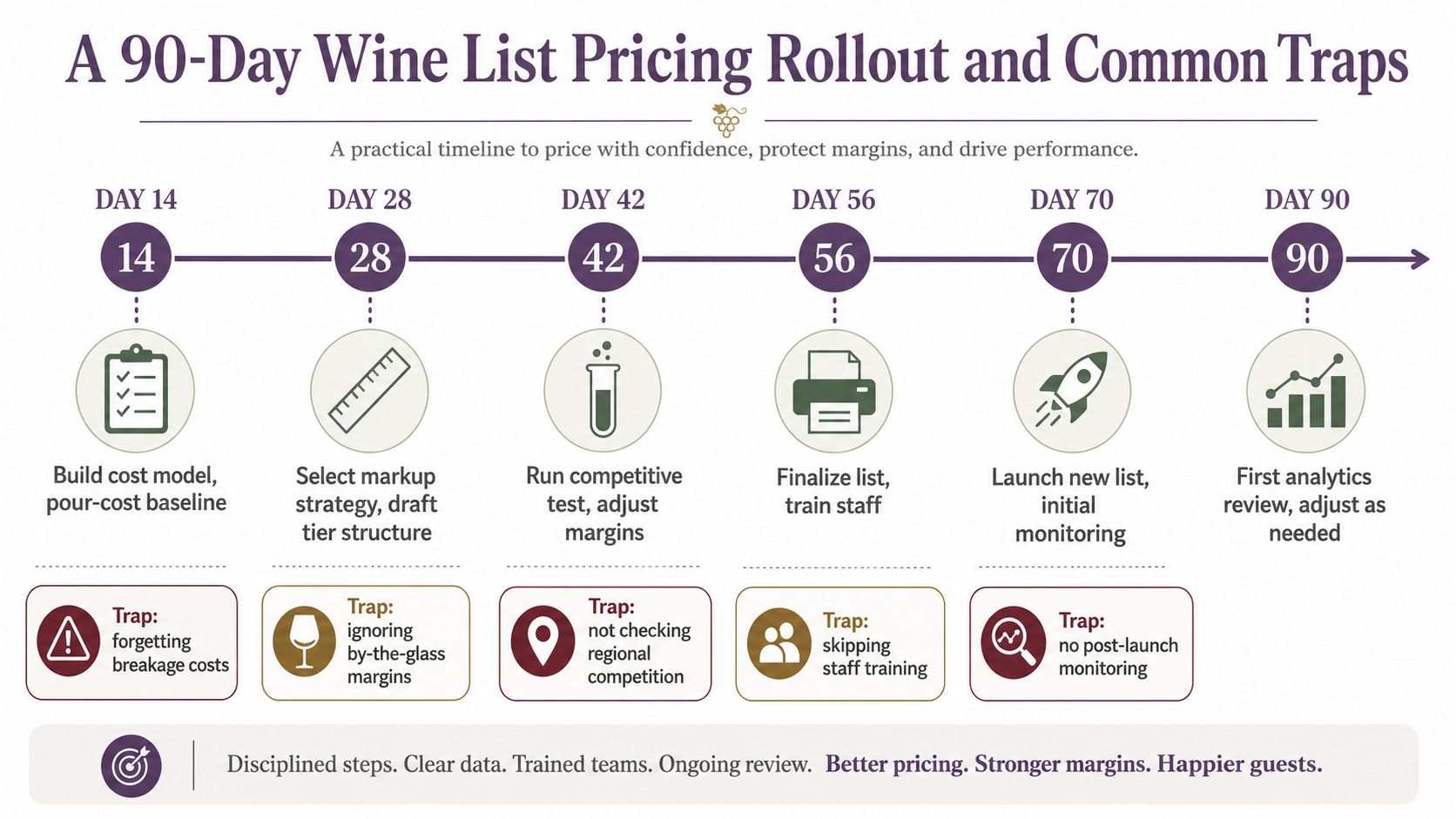
A workable rollout turns wine list pricing into a repeating decision loop. The first phase is diagnostic. Build the landed-cost model, establish pour-cost baselines, and identify bottles whose current prices depend on outdated wholesale assumptions. The deliverable is a clean SKU file, with a role assigned to every bottle and a clear measure of contribution.
During the next phase, select the markup architecture and draft the tier structure. Decide which wines protect accessibility, which carry core margin, and which provide prestige or occasion signaling. Watch pour cost and gross margin by segment, not only the total beverage result.
The middle of the rollout is where cross-channel benchmarking changes the list. Compare retail references, auction outcomes where relevant, and exchange context for investment-grade bottles. Test whether the proposed anchors make sense beside local restaurant offers, then adjust prices or descriptions when the comparison is difficult to defend.
<a id="the-90-day-checklist"></a>
The 90-day checklist
- Weeks one and two: Build landed-cost records and pour-cost baselines. Watch cost accuracy and open-bottle losses.
- Weeks three and four: Select the markup model and draft price tiers. Watch margin consistency across entry, core, and reserve segments.
- Weeks five and six: Run cross-channel benchmarks and refine anchors. Watch the gap between comparable market prices and proposed list prices.
- Weeks seven and eight: Pilot BTG placements and promotions. Watch attachment rate, spoilage, and bottle substitution.
- Weeks nine through twelve: Launch, document exceptions, and begin recurring reviews. Watch gross margin per cover and changes in turnover.
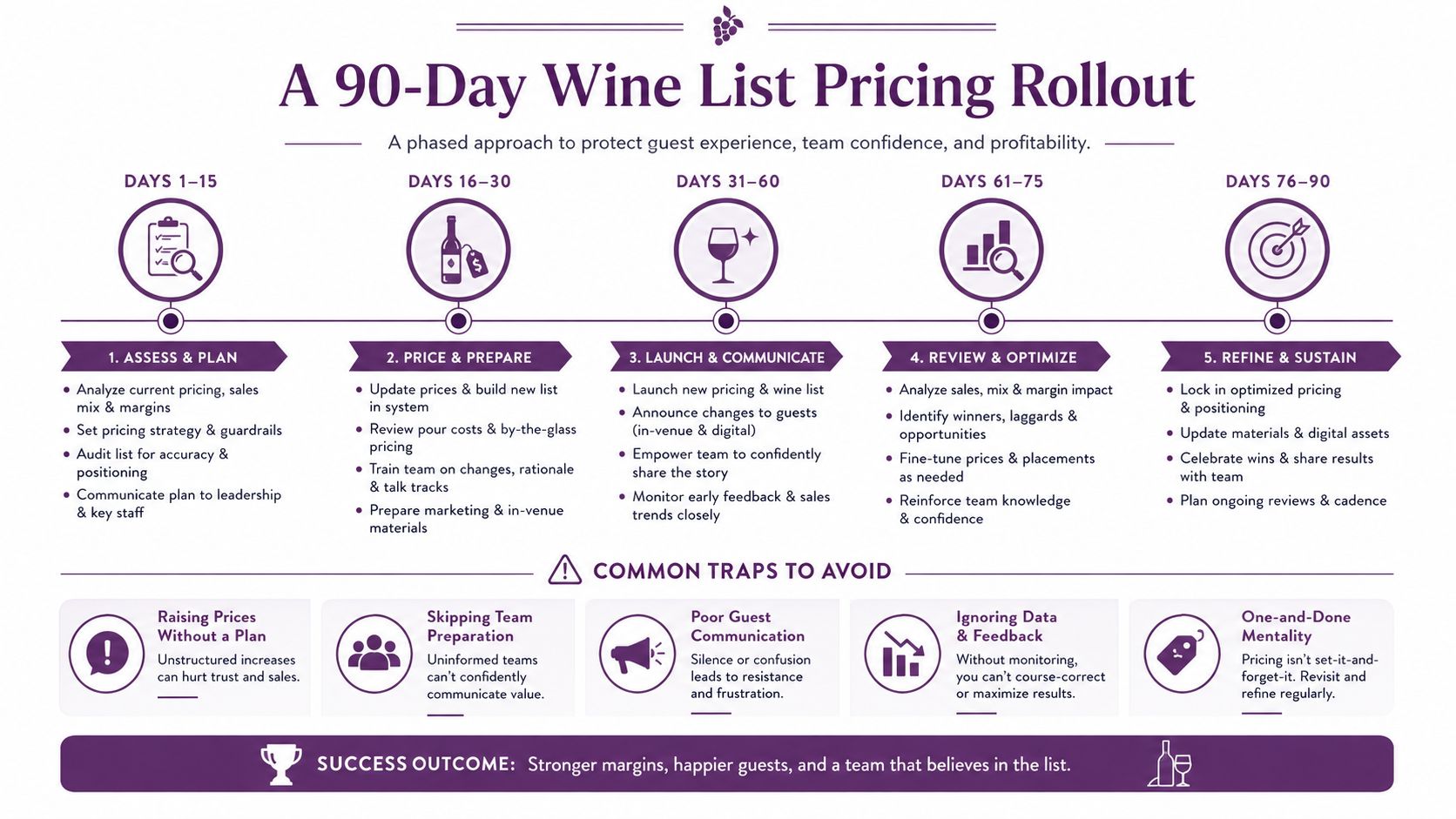
The recurring traps are predictable. Keystone everywhere ignores occasion premiums and can understate the value of scarce bottles. Ignoring auction buyer premiums makes collectible comparisons look cheaper than the buyer's actual acquisition cost. Treating wholesale cost as fixed leaves the list exposed when replacement economics change. Failing to reprice after a vintage release can make an old list look detached from current availability.
The strongest operators don't “finish” pricing after the new list is printed. They review the evidence, record the exception, test the guest response, and revise the next decision. That is how margin, prestige, and turnover stay aligned.
Wine Labs consolidates retail, auction, exchange, and restaurant pricing into a comparable market-data workflow, with historical tracking and alerts that support cellar valuation and repricing decisions. Visit Wine Labs to benchmark your list against current market context and build a more defensible pricing process.