Wine Labs · Market intelligence
Wine Investment Platform Guide: Data, Fees, and Risk
Evaluate any wine investment platform with confidence. Learn how pricing data, fees, liquidity, and identity matching shape real returns and risk.
Fine wine delivered an average real return of 4.1% a year after inflation from 1900 to 2012, according to academic work cited in an industry analysis of wine investment performance (Wine Investment). That long record explains the appeal, but it also creates a dangerous shortcut: investors can mistake a resilient asset class for a simple one.
A wine investment platform exists because the market is neither simple nor uniform. Producers, vintages, bottle formats, storage histories, auction venues, merchant offers, and exchange prices create a fragmented information environment. The platform that merely displays a price is offering convenience. The platform that verifies what the price refers to, where it came from, and whether it can be realized is addressing the core investment problem.
Table of Contents
- Why Wine Investment Platforms Exist
- How Different Wine Investment Platform Models Work
- The Data Layer Behind Serious Wine Investing
- Hidden Costs and Liquidity Frictions in Wine Markets
- A Practical Checklist for Evaluating Wine Investment Platforms
- How Wine Labs Differentiates Its Product Offerings
- Matching Platform Choice to Investor Profile
<a id="why-wine-investment-platforms-exist"></a>
Why Wine Investment Platforms Exist
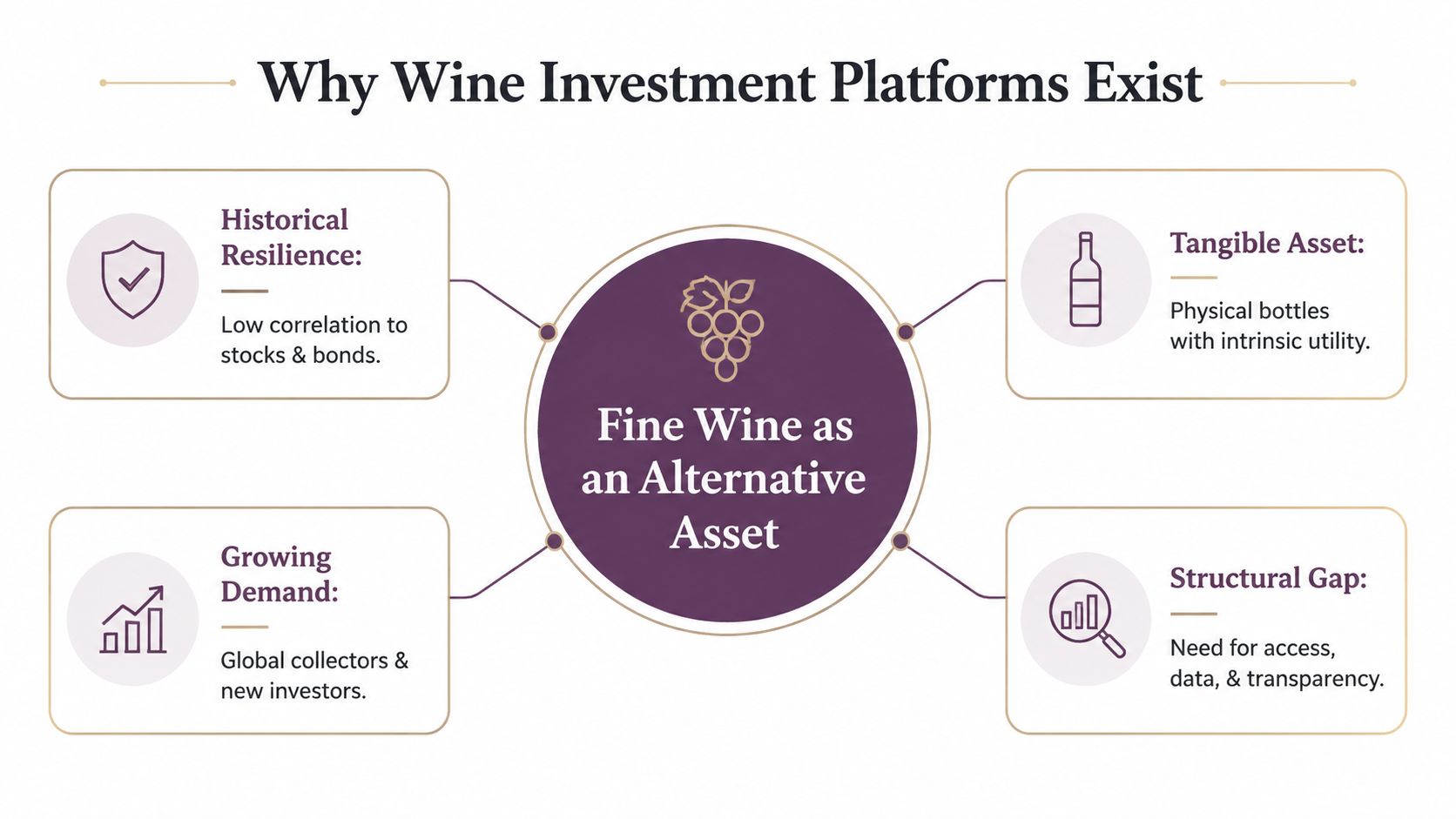
Fine wine occupies a narrow part of the wider wine economy. One industry analysis estimates that it represents around 1% to 2% of the $450 billion global wine market, implying an annual market value of roughly $4.5 billion to $9 billion (Wine Investment). That's small enough to remain specialized, but large enough to support merchants, auction houses, exchanges, storage providers, analysts, and technology companies.
The historical case is also more durable than a short market rally. The same analysis cites The Price of Wine, published in the Journal of Financial Economics in 2015, which found a 4.1% average real annual return after inflation between 1900 and 2012, outperforming collectible alternatives such as art and stamps (Wine Investment). That result doesn't promise future gains. It does show why investors have treated fine wine as a serious alternative asset rather than only an expensive hobby.
<a id="fragmentation-creates-the-technology-problem"></a>
Fragmentation creates the technology problem
A single wine may appear under different producer names, abbreviations, vintage formats, bottle sizes, and pack descriptions. A merchant may list a six-bottle case, an auction house may list individual bottles, and another source may use a different spelling for the same estate. Without identity matching, a portfolio can count one product as several products, or compare unlike products as if they were identical.
Price discovery has the same weakness. A retail listing is an offer, not proof that a buyer completed a transaction at that level. Auction hammer prices provide a stronger basis for benchmark construction because they represent completed trades, while retail prices may remain unchanged even when the market has moved (Wine Economics).
Practical rule: A platform's value isn't its chart. It's the chain of evidence connecting a specific bottle to a comparable, executable market signal.
That need becomes more important when performance is cyclical. The Liv-ex Fine Wine 100 has been reported at roughly 8% to 10% annual returns over the past decade, while the broader Liv-ex 1000 was up 288.3% since January 2004 as of July 2024 (Modern Alts). Yet another market summary reported that the Liv-ex 1000 fell 17.7% over the 2023 to 2024 period, leaving most indices 25% to 30% below their 2022 peak (Modern Alts). A serious platform therefore needs long-range history and current market monitoring. Without both, investors see either an attractive historical curve or a volatile present, but not the relationship between them.
<a id="how-different-wine-investment-platform-models-work"></a>
How Different Wine Investment Platform Models Work
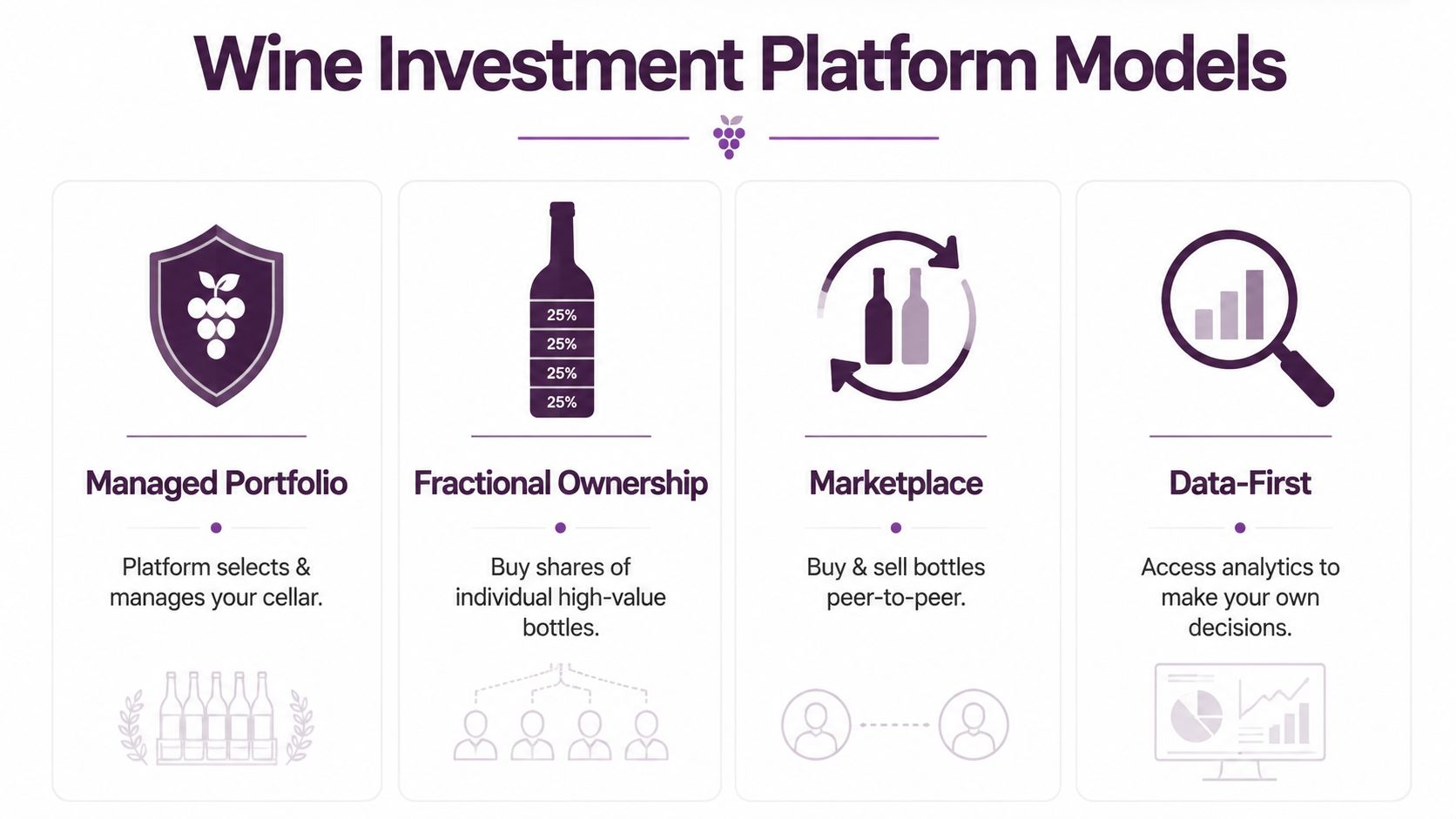
The phrase wine investment platform covers several different businesses. Two services may both let a user view a portfolio, yet one may hold physical bottles for the user, another may sell fractional exposure, and a third may provide data without handling ownership at all.
<a id="managed-portfolios"></a>
Managed portfolios
A managed model selects wines, purchases them, arranges custody, and may coordinate storage, insurance, valuation, and eventual sale. The convenience is obvious, especially for someone who wants exposure without building merchant relationships or operating a cellar.
The trade-off is control. You need to know whether you own identified bottles, a contractual claim against a portfolio, or an interest in a pooled structure. Ask who holds title, where the wine is stored, how provenance is recorded, and whether the platform can sell through more than one channel. Management fees may be only one part of the cost, with storage, insurance, acquisition, and exit charges potentially affecting the final result.
<a id="fractional-ownership"></a>
Fractional ownership
Fractional schemes divide an asset or collection into interests. This can make high-value wine accessible without requiring one participant to buy the entire holding, but it introduces questions that don't arise in the same way with direct bottle ownership.
The key issue is exit authority. Can you sell your interest independently, or must the operator sell the underlying wine? What happens if other participants disagree about timing? The legal form also matters. A fractional interest may resemble direct co-ownership, a contractual right, or a pooled investment. Those distinctions affect custody, transferability, and investor protection.
<a id="marketplaces"></a>
Marketplaces
A marketplace connects buyers and sellers, usually leaving participants to make their own decisions. It can offer more choice and potentially more exit routes, but the user carries more responsibility for authenticity, condition, provenance, shipping, and price comparison.
A marketplace is only as transparent as its listing data. If sellers display asking prices without completed-trade context, the screen may show optimism rather than realizable value. Strong marketplaces make the transaction history, seller terms, condition information, and total cost easier to inspect.
<a id="data-first-intelligence"></a>
Data-first intelligence
A data-first platform doesn't need to own the wine or manage a cellar. It provides the analytical layer for collectors, merchants, investors, and marketplaces that want to source, price, monitor, or value assets independently.
This model offers the most operational control, but it demands more judgment from the user. It's suited to people who need auditable data, portfolio exports, alerts, and identity consistency rather than a packaged investment product. Before choosing, classify the service by asking one question: is it selling exposure, intermediating a transaction, or supplying evidence for your decision?
<a id="the-data-layer-behind-serious-wine-investing"></a>
The Data Layer Behind Serious Wine Investing
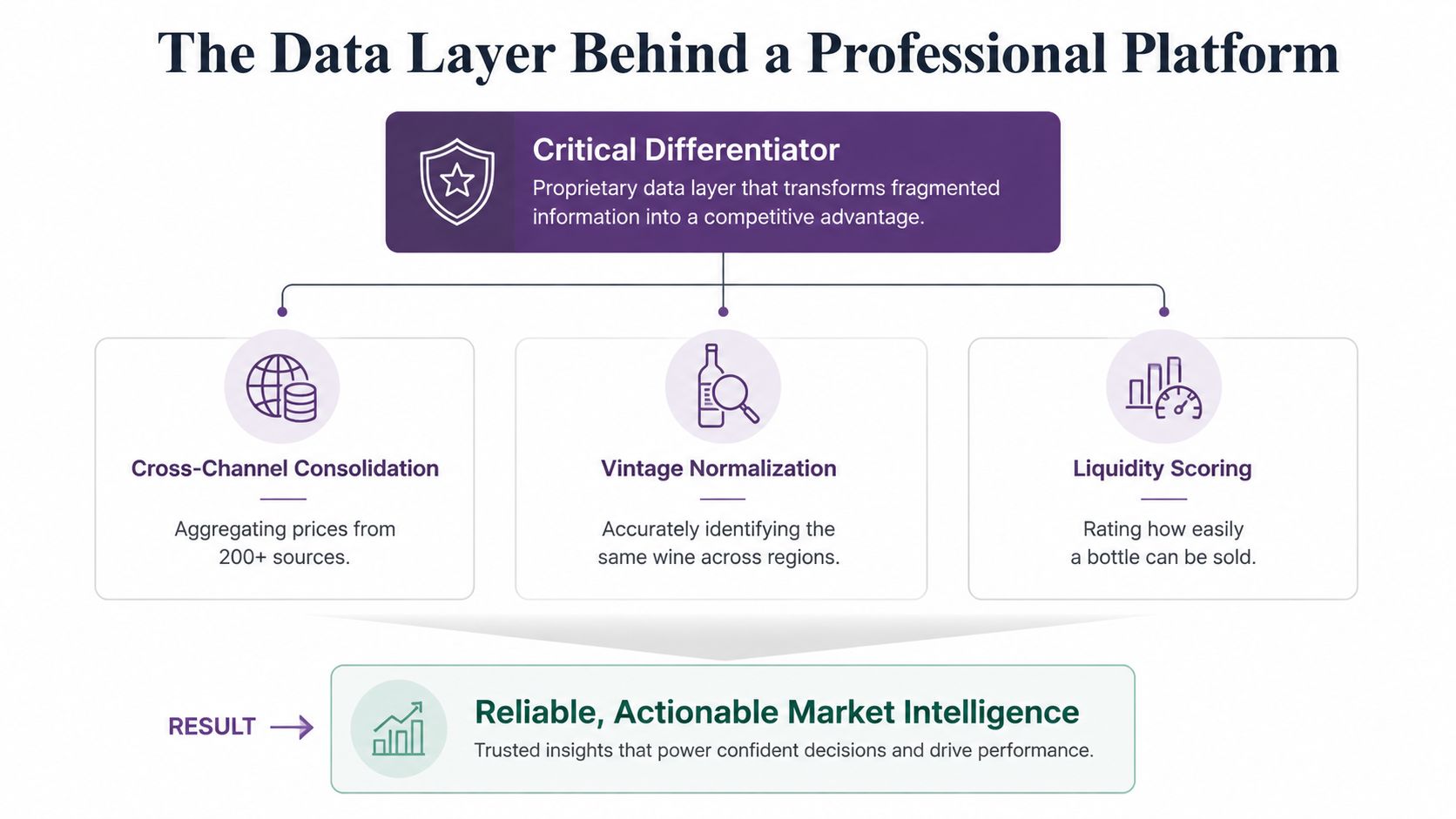
A dashboard becomes useful only when it knows what each record represents. Fine wine data often arrives as inconsistent text, with producer names, vintages, bottle sizes, packaging, and identifiers varying between sources. A platform that fails to resolve those differences can produce a valuation that looks precise while combining non-comparable inventory.
Consider two listings for the same estate. One uses the full producer name, the other an abbreviation. One describes a standard bottle, the other a case. A basic text search may create duplicate records, while a weak matching process may attach the wrong vintage. The resulting portfolio value can be distorted before any market calculation begins.
<a id="identity-comes-before-valuation"></a>
Identity comes before valuation
LWIN provides a standardized identification system introduced in 2011, using a seven-digit code. The first six digits identify the wine and the seventh is a check digit intended to reduce input errors. Vintage, pack size, and bottle size can be appended in a standard format (Liv-ex).
That standard is useful, but interoperability still requires a platform to retain context from different systems. Wine Labs' matching workflow stores a canonical wine_id while retaining LWIN context, enabling consistent identity resolution across heterogeneous sources (Wine Labs Matching API). The important design principle is separation: one stable internal identity, with external identifiers preserved for exchange and reconciliation.
<a id="prices-need-context-not-just-aggregation"></a>
Prices need context, not just aggregation
Cross-channel consolidation helps only when the system distinguishes retail offers, auction outcomes, exchange activity, restaurant placements, and other forms of market evidence. A retail ask can indicate availability and seller expectations. A completed auction transaction indicates that a buyer accepted a price under defined conditions. Those signals answer different questions.
Academic work on wine indices prefers auction hammer prices for benchmark construction because they record completed transactions, whereas retail prices are offers (Wine Economics). That distinction should appear in the interface and in the valuation logic. Otherwise, a portfolio owner may mistake the highest visible listing for fair value.
For teams tracking portfolios across changing markets, drift detection tools for investors offer a useful adjacent concept. Monitoring isn't limited to price movement. It can also identify changes in the composition, assumptions, or reference data behind a reported valuation.
A robust data layer should expose source, timestamp, product identity, channel, condition context, and transaction status. Readers evaluating market-data coverage can review Wine Labs fine wine market data as an example of a workflow built around comparable pricing and market context.
<iframe width="100%" style="aspect-ratio: 16 / 9;" src="https://www.youtube.com/embed/HyoEVLumSf0" frameborder="0" allow="autoplay; encrypted-media" allowfullscreen></iframe><a id="hidden-costs-and-liquidity-frictions-in-wine-markets"></a>
Hidden Costs and Liquidity Frictions in Wine Markets
Headline returns describe the asset, not the investor's cash outcome. A wine bought near a market peak can remain difficult to sell while storage, insurance, and custody costs continue. Even when the eventual hammer price is higher than the purchase price, commissions and premiums can convert gross appreciation into a weak or negative net result.
Auction economics make the gap visible. One industry guide states that sellers typically pay around 10% commission, while buyers pay a 21% to 23% premium, meaning the buyer's all-in cost can be roughly a quarter above the final sale price (Luxury Lifestyle Magazine).
| Role | Typical Commission or Premium | Impact on Realized Price |
|---|---|---|
| Seller | Around 10% commission | Reduces proceeds below the hammer price |
| Buyer | 21% to 23% premium | Raises the buyer's all-in acquisition cost |
| Platform or intermediary | Varies by agreement | Can add another layer between market price and net result |
The rates aren't uniform. Christie's reported a United States buyer premium of 15% up to a $100,000 hammer price and 10% above that, while the UK rate was 10% (Wine Spectator). Academic research on Bordeaux auctions at Berry Bros. & Rudd described seller schedules that could be a flat 14% plus VAT for managed lots, or step down from 8.5% to 5.5% across hammer-price bands for seller-managed lots (Wine Economics).
<a id="liquidity-is-a-process"></a>
Liquidity is a process
A quoted price doesn't guarantee an immediate exit. The seller may need to prove title, document provenance, confirm condition, arrange transport, wait for a sale cycle, and accept a spread between the bid and the offer. Market corrections can widen that gap precisely when more holders want to sell.
Independent reporting described the market as still correcting through the first half of 2025. The Liv-ex Fine Wine 100 was down about 4.4% in the first half, while liquidity and spreads improved only gradually later in the year (Vinovest). The decision implication is straightforward: model the exit before buying the asset.
A credible platform should show gross value, estimated selling costs, storage and insurance obligations, and the likely channel for disposal. Wine Labs pricing can be assessed in that context, as a reference point for comparing the cost of an intelligence layer with the broader expenses attached to physical ownership and transactions.
<a id="a-practical-checklist-for-evaluating-wine-investment-platforms"></a>
A Practical Checklist for Evaluating Wine Investment Platforms
A platform deserves scrutiny before it receives capital, inventory, or pricing authority. The interface matters less than the records behind it and the legal relationship it creates with the user.
<a id="start-with-the-data"></a>
Start with the data
Ask where prices come from, how frequently they're refreshed, and whether the system separates offers from completed transactions. A platform that can't identify the channel and timestamp behind a valuation gives you a number without an audit trail.
Then test identity resolution. Can the platform distinguish producer, cuvée, vintage, format, and pack size? Does it retain external identifiers while maintaining one canonical record? Duplicate listings aren't a cosmetic nuisance. They can affect sourcing decisions, portfolio weights, benchmark selection, and reported value.
<a id="review-the-ownership-and-cost-model"></a>
Review the ownership and cost model
Use these questions as a minimum diligence screen:
- Fee disclosure: Are acquisition, management, storage, insurance, valuation, withdrawal, sale, and transfer charges listed before commitment?
- Custody evidence: Who owns the wine, who stores it, and what documentation proves title and provenance?
- Exit mechanics: Can you sell independently, or does the operator control the sale? Which channels are available, and how are spreads calculated?
- Regulatory status: Does the platform clearly explain whether the arrangement is regulated or unregulated and whether values can fall?
- Data portability: Can you export holdings, transaction history, identifiers, valuations, and source records?
- Operational resilience: What happens to the bottles, contracts, data, and customer claims if the platform stops operating?
Regulatory language deserves special attention. UK enforcement and legal commentary in 2025 emphasized that advertising for wine and gold investments must explicitly state that such products are unregulated and that values can go down as well as up (Taylor Wessing). That scrutiny reflects a practical concern: consumers can confuse a polished digital experience with investor protection.
Due-diligence test: If a provider can explain expected returns more easily than it can explain custody, title, fees, and exit timing, treat the imbalance as a risk signal.
Merchants and analysts should also check API access, bulk imports, alert configuration, and historical exports. Retail-facing apps may optimize for simplicity. A professional workflow needs reproducibility, especially when several people rely on the same valuation.
<a id="how-wine-labs-differentiates-its-product-offerings"></a>
How Wine Labs Differentiates Its Product Offerings
Wine Labs approaches the market as a data and workflow problem rather than as a packaged ownership product. Its system consolidates real-time pricing from retail, auction, exchange, and restaurant channels into a comparable view with analytics, portfolio tooling, and programmatic access.
A merchant can use that structure to compare an incoming offer with observed prices across channels before quoting a customer. A collector can import a stock file, resolve product identities, and assess whether the reported value reflects a current market signal or a stale listing. A digital marketplace can use an API to connect catalog records with normalized pricing rather than maintaining separate manual mappings.
<a id="from-messy-stock-to-usable-valuation"></a>
From messy stock to usable valuation
Portfolio work often starts with spreadsheets, vendor feeds, or exported cellar records. The operational challenge isn't only calculating a total. It's identifying each item correctly, separating bottle and case formats, retaining provenance context, and applying a defensible reference price.
The Cellar Pricer supports file-based valuation workflows. That matters for merchants and collectors with existing inventory because they can begin with operational data instead of rebuilding a cellar manually inside a new application.
<a id="alerts-turn-monitoring-into-action"></a>
Alerts turn monitoring into action
Real-time ingestion becomes more valuable when it triggers a decision. A price movement alert can prompt a merchant to review a quote, a collector to revisit a watchlist, or an operator to investigate a discrepancy between channels. Programmatic access also allows teams to connect market data with catalog systems, internal portfolios, and AI agents.
The differentiation is therefore architectural. Canonical identity matching prevents the same wine from becoming several records, while cross-channel comparison prevents a single asking price from standing in for the whole market. That combination supports sourcing, quoting, valuation, and monitoring without requiring the platform to take custody of the bottles.
<a id="matching-platform-choice-to-investor-profile"></a>
Matching Platform Choice to Investor Profile
A casual collector usually benefits from simple inventory control and transparent market references. A serious investor needs stronger provenance records, net-return modeling, historical benchmarks, and a clear exit process. A merchant or importer will prioritize bulk valuation, identity matching, alerts, and data that can feed pricing operations. A marketplace operator needs APIs, catalog normalization, and controls that prevent duplicate or incomparable listings.
The time horizon changes the answer. If you want a managed product, focus on title, custody, fees, and the operator's authority to sell. If you want to trade directly, prioritize marketplace transparency and cross-channel price evidence. If you already understand ownership and storage, a data-first wine investment platform may provide more control than a packaged portfolio.
Tokenization can add another layer of legal and operational complexity. Readers assessing digital ownership structures may find a complete guide to tokenized equity useful for understanding how digital representation differs from direct ownership.
The right choice is the one that makes your weakest control visible. For some users, that's custody. For others, it's identity, valuation, or liquidity.
Wine Labs provides cross-channel fine wine price intelligence, canonical identity matching, portfolio valuation, alerts, and programmatic access for collectors, merchants, investors, and marketplaces. Visit Wine Labs to evaluate how a structured data layer can improve your pricing, sourcing, and portfolio decisions.