Wine Labs · Market intelligence
8 Sweet Red Wine Types to Know
Explore 8 sweet red wine types by region and method, with tasting notes, food pairings, price pointers, and practical buying guidance.
Sweetness is only the starting point. The popular advice, “choose a sweet red and expect a fruity, easy-drinking wine,” collapses very different products into one shelf label. Port, Lambrusco, Brachetto d'Acqui, Banyuls, dried-grape wines, and botrytis-influenced wines can differ sharply in residual sugar, acidity, tannin, sparkle, alcohol, serving context, and market visibility. Sweet red wine is a market shorthand, not a single grape or legally unified style. The category can include Lambrusco, Brachetto d'Acqui, Port, Beaujolais Nouveau, and sweet red blends, with published charts placing very sweet reds around 20% residual sugar while some reds sit close to 1% (sweetness chart and category overview).
This guide compares eight sweet red wine types by the production decisions and regional identities that create sweetness. It also separates consumption value, meaning freshness, pairing flexibility, and immediate enjoyment, from collectible potential, meaning vintage structure, provenance, condition, and secondary-market visibility. Adjacent styles, including rosé-toned and technically white sparkling wines, appear because shoppers and wine lists commonly place them near sweet red searches. Use the comparison table after the list to see the practical differences in one view, then apply the buying signals to retail, restaurant, auction, and portfolio research.
For a broader starting point, explore these types of sweet red wine.
Table of Contents
- 1. Port Wine
- 2. Brachetto d'Acqui
- 3. Moscato d'Asti
- 4. Lambrusco
- 5. Demi-Sec Champagne
- 6. Recioto della Valpolicella
- 7. Tokaji Aszú
- 8. Banyuls
- 8 Sweet Red Wine Types Comparison
- Choose by Method, Then Check the Market
<a id="1-port-wine"></a>
1. Port Wine
Port is the clearest example of sweetness created through fortification. In the Douro Valley of Portugal, producers add grape spirit during fermentation, stopping yeast activity before all the grape sugar converts to alcohol. The result is a rich, full-bodied wine with retained residual sugar and an alcohol range of 19% to 22%, as described in the style notes supplied for this category.
That production method gives Port a very different role from lightly sparkling or naturally sweet table wines. A Vintage Port can bring dark fruit, density, tannin, and long cellar potential, while an age-statement Tawny emphasizes oxidative development and ready-to-drink complexity. Late Bottled Vintage occupies another position, often offering mature character without the same purchase logic as a declared Vintage Port.
<a id="how-to-read-port-market-signals"></a>
How to read Port market signals
Port has unusually useful market structure because producer identity, vintage designation, age category, bottle condition, and provenance all influence comparability. A bottle of Graham's Vintage Port can serve as a benchmark reference, while Taylor Fladgate age-statement Tawnies provide a different signal because buyers compare release age and channel availability rather than only vintage scarcity. Quinta do Noval Nacional belongs to an ultra-premium tier, whereas Warre's and Dow's Vintage expressions can provide broader secondary-market activity.
For research teams, the important distinction is between a declared and non-declared vintage announcement, auction-to-retail spreads, and condition. A damaged capsule, label, or cork can change how buyers value an otherwise identical bottle.
Practical rule: Match Port by producer, designation, vintage, format, and condition before comparing prices. “Port” alone is too broad a record.
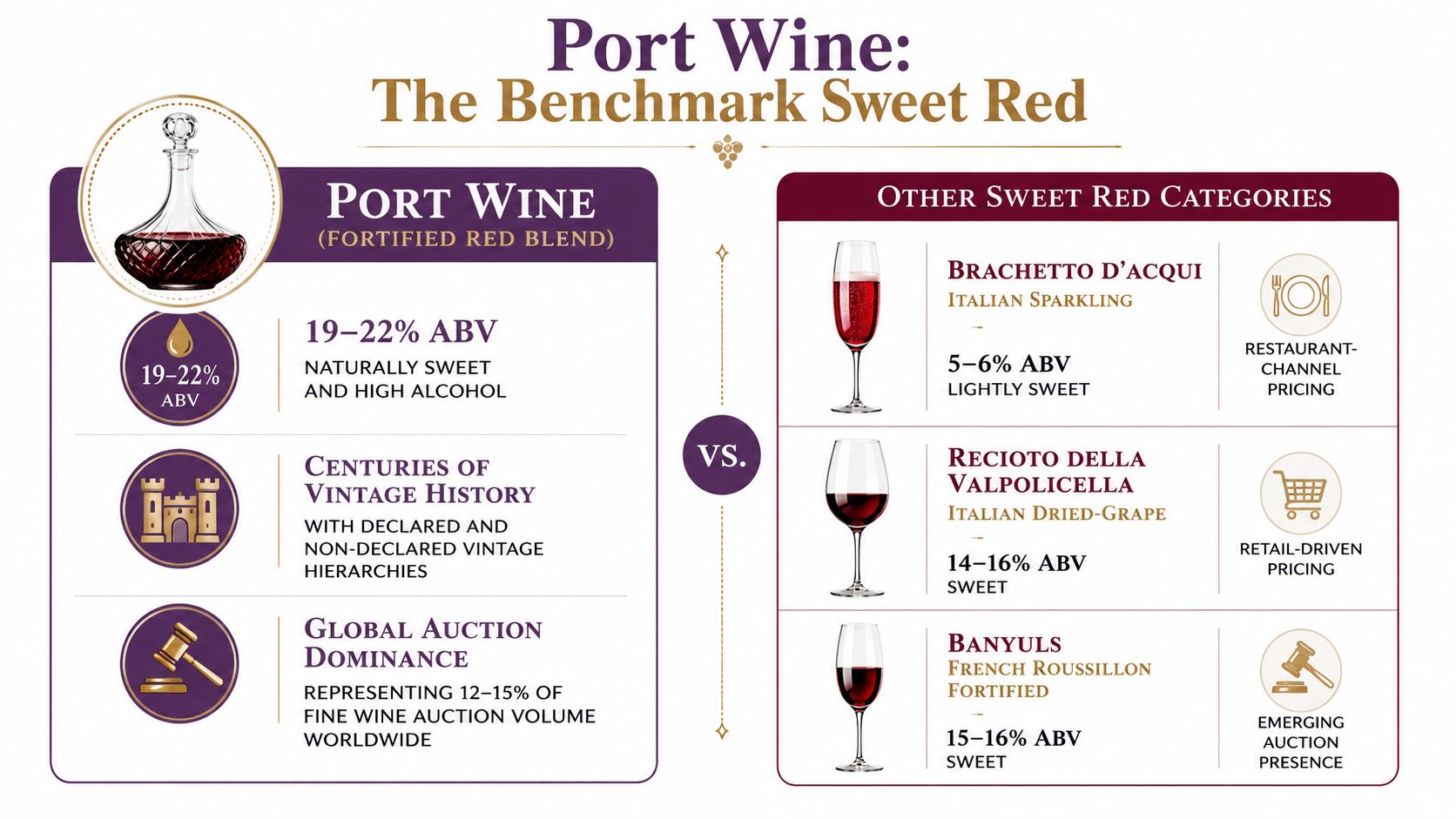
Port suits blue cheese, chocolate desserts, and slow after-dinner service, but its intensity can overwhelm delicate dishes. It also rewards cellar context more than most approachable sweet reds. For current market context, compare the category with Wine Labs' Port market coverage, then use an Effortlessly Porto itinerary to connect the style with its regional setting.
<a id="2-brachetto-dacqui"></a>
2. Brachetto d'Acqui
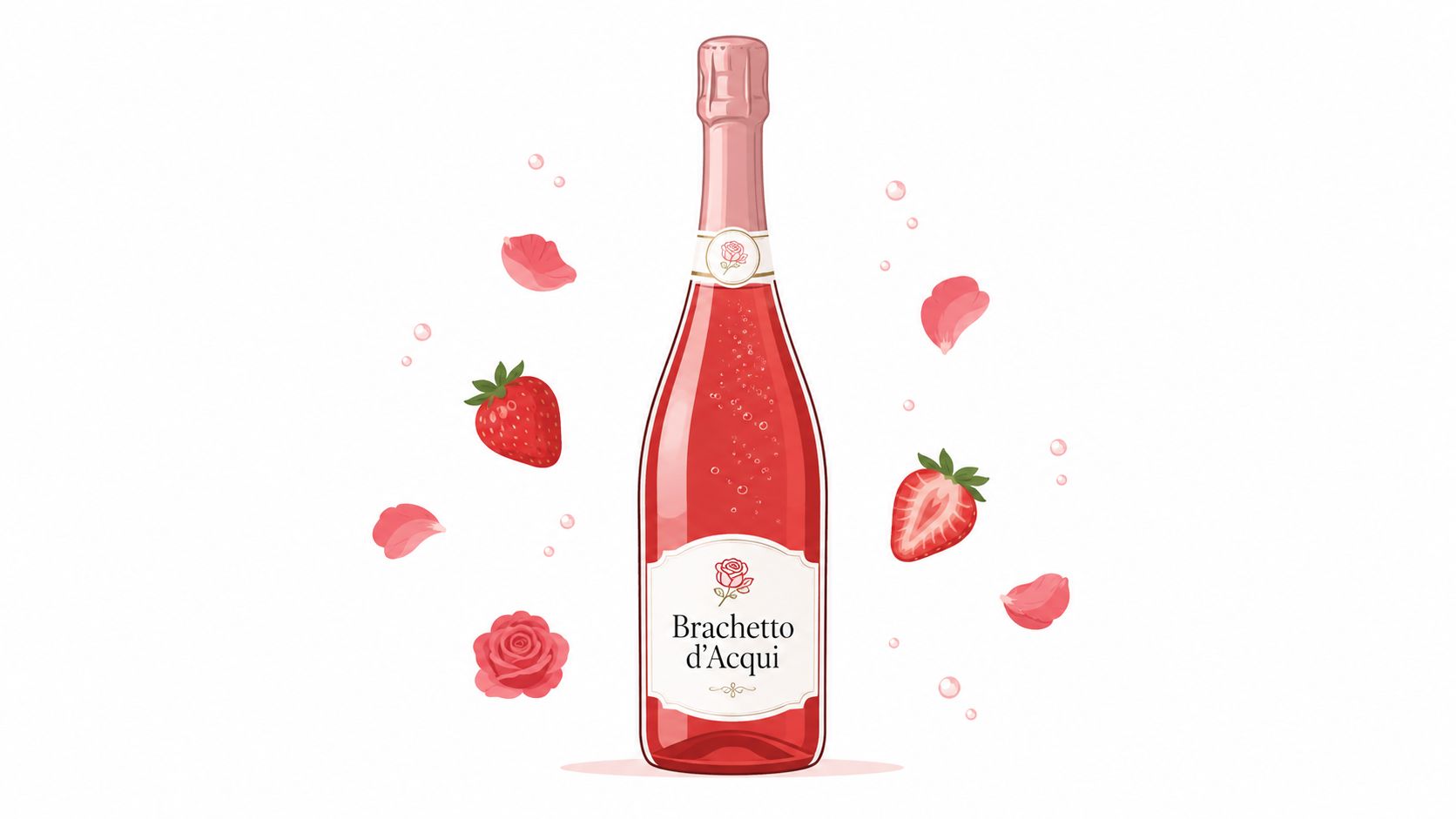
Brachetto d'Acqui creates sweetness without fortification. This lightly sparkling red from Piedmont is made from the Brachetto grape, combining residual sugar, aromatic red fruit, floral character, and gentle effervescence. Its low alcohol profile, 5% to 6% ABV, makes it a different purchase from Port, even when both appear under sweet red wine types.
The wine's practical appeal comes from its balance of softness and lift. Strawberry, raspberry, rose, and other bright aromatic notes make it suitable for celebrations, fruit desserts, and lighter end-of-meal service. The bubbles also matter. Sweetness and sparkle are separate variables, and a wine can be sweet without being sparkling, sparkling without being sweet, or both.
<a id="why-channel-matters-more-than-auction-history"></a>
Why channel matters more than auction history
Brachetto d'Acqui is more likely to reveal useful commercial signals through restaurant programs, fine-dining lists, specialty retailers, and e-commerce than through mature auction markets. Ceretto provides a recognizable producer reference, while Michele Chiarlo and Paolo Saracco help researchers track how established regional identity travels into modern retail and hospitality channels.
A real-world buying scenario makes the distinction clear. A restaurant planning a strawberry dessert pairing may value freshness, serving speed, and low alcohol more than bottle age. A retailer, by contrast, needs to know whether a listing is current, whether the vintage has changed, and whether a previous release is being discounted.
- Monitor restaurant lists: On-premise placements can reveal demand before retail descriptions change.
- Normalize producer names: Brachetto and dialect or spelling variants can create duplicate records.
- Watch release transitions: A product moving into a new vintage can make old stock look weaker, even when the wine remains sound.
The most useful Brachetto signal is often not an auction hammer price. It's the relationship between list placement, release timing, and retail availability.
Serve it chilled with berry desserts, soft cakes, or as an aperitif. It's a consumption-led style, so freshness and correct identification usually matter more than collectible narratives.
<a id="3-moscato-dasti"></a>
3. Moscato d'Asti
Moscato d'Asti belongs on this list as an adjacent style, not as a conventional red wine. It's a lightly sparkling sweet wine from Piedmont made from Moscato Bianco. Rose-tinted variants and blended expressions can appear in fine-wine inventories and sweet red searches, especially when hospitality buyers organize products by sweetness, aroma, or occasion rather than strict color.
Its defining choices are gentle carbonation, aromatic grape character, and low alcohol. The supplied category notes identify 5.5% ABV, placing it alongside Brachetto as a freshness-oriented option rather than an intense fortified wine. The palate tends toward floral and grapey aromas, soft sweetness, and a lively finish.
<a id="a-useful-test-for-inventory-classification"></a>
A useful test for inventory classification
Moscato d'Asti shows why color alone produces poor comparability. A rose-toned bottle may sit beside sweet reds in a search result, but its pairing role and consumer expectation can be closer to an aromatic celebration wine. That difference affects product descriptions, restaurant placement, and recommendation engines.
Consider an airline premium-cabin program or a cruise line selecting a sweet wine for broad appeal. The buyer may prioritize low alcohol, recognizable sweetness, and easy service. A natural wine shop may position the same regional identity through alternative retail language, making channel context essential when interpreting availability or price movement.
- Consolidate hospitality records: Airline, cruise, and restaurant listings can expose placements that ordinary retail data misses.
- Match batch and release information: Similar labels may represent different production runs or release points.
- Pair velocity with price: Faster online movement can provide an early demand signal, but it shouldn't be mistaken for collectible appreciation.
Moscato d'Asti works with fresh fruit, light pastries, brunch service, and informal celebrations. It's generally a buy-to-drink style. The right comparison is another current bottle in the same format, not an aged fortified wine with a completely different production and storage profile.
<a id="4-lambrusco"></a>
4. Lambrusco
Lambrusco is the category's most important reminder that sparkle and sweetness are independent. This traditional sparkling red from Emilia-Romagna can range from dry to sweet, so the grape family or regional name doesn't tell a buyer enough. A dry Lambrusco may function as a food-friendly red, while a sweeter version can move toward fruit-led aperitif or dessert service.
That range creates both opportunity and analytical risk. A retail search that groups every Lambrusco together may compare products with different residual sugar, acidity, body, and pairing roles. Industry-style guides place off-dry reds around 10 to 30 g/L residual sugar and sweet reds around 30 to 80 g/L, with Lambrusco Dolce commonly cited in the sweet tier (sweet red wine guide). The same grape family can therefore occupy different commercial positions.
<a id="the-premiumization-question"></a>
The premiumization question
Modern producers have helped move Lambrusco beyond an everyday table-wine image into specialty retail and upscale restaurant programs. Paltrinieri, Cleto Chiarli, Cavicchioli, and Giacobazzi offer useful identity points, but they shouldn't be treated as interchangeable. Producer reputation, sweetness designation, vintage or release, and restaurant context all influence how buyers interpret value.
A wine shop specializing in Emilia-Romagna can signal regional momentum before broad retail listings respond. A fine-dining placement can also matter, but only if the bottle's sweetness level and producer are recorded accurately.
Lambrusco isn't one product with one price curve. It's a family of styles whose sugar and sparkle combinations determine where each bottle belongs.
Pair sweeter Lambrusco with cured meats, spicy dishes, pizza, or fruit-forward desserts, depending on its balance. For a merchant, the buying signal is clear: classify the exact style first, then compare like-for-like listings. Otherwise, a dry bottle can distort the apparent market position of a Dolce expression.
<a id="5-demi-sec-champagne"></a>
5. Demi-Sec Champagne
Demi-Sec Champagne demonstrates how dosage changes the role of a prestige sparkling wine. The style uses higher residual sugar, with supplied plan notes placing Demi-Sec expressions around 32 to 50 g/L. That figure should be checked against the bottle's exact designation and producer record, because sweetness category, rosé status, cuvée identity, and format all affect comparison.
Although Champagne is technically a white wine category, Demi-Sec and rosé expressions appear in sweet-wine searches because they combine sweetness, sparkle, prestige, and celebratory service. The production identity remains Champagne, but the consumption decision changes. A sweeter dosage can work with fruit desserts, pastries, and dishes that would make a very dry sparkling wine seem austere.
<a id="prestige-names-need-exact-matching"></a>
Prestige names need exact matching
Producer reputation is unusually important here. Names such as Dom Pérignon, Krug, Bollinger, and Cristal can carry strong recognition, but the specific cuvée, bottle size, release, packaging, and condition still determine whether two listings are comparable. A standard bottle, magnum, gift set, and special presentation should not collapse into one product record.
For collectors, auction authentication and provenance deserve more attention than a simple retail quote. Limited allocations and release announcements can influence availability, while media associations may affect attention without proving lasting value.
- Identify the dosage and cuvée: “Demi-Sec” is not enough for a complete record.
- Separate formats: Magnums and gift presentations require their own comparison set.
- Review provenance: Auction evidence is more useful when bottle history and condition are documented.
Demi-Sec Champagne is usually consumption-first unless the bottle belongs to a recognized prestige structure with clear provenance. Use Wine Labs' Champagne market and trend coverage as one contextual input, then compare current restaurant, retail, and auction listings without mixing unlike formats.
<a id="6-recioto-della-valpolicella"></a>
6. Recioto della Valpolicella
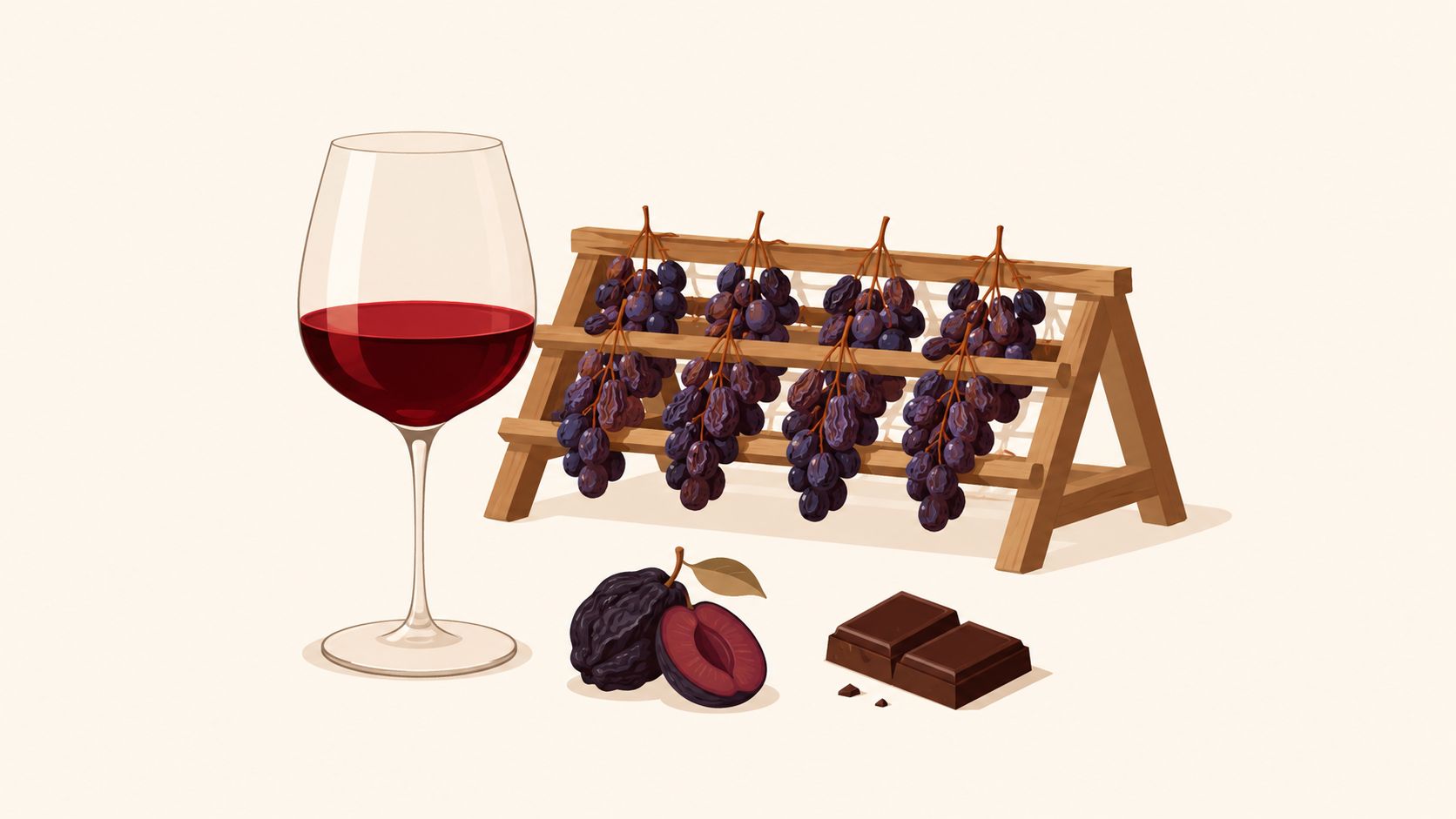
Recioto della Valpolicella gets its sweetness from appassimento, the partial drying of grapes before fermentation. Producers traditionally use Corvina, Rondinella, and Molinara, concentrating grape sugars and flavors before making the wine. The supplied category notes place its residual sugar typically around 12% to 14% and alcohol around 14% to 16% ABV.
This is a concentrated, fruit-rich style, but its structure differs from Port. Drying produces density and raisined character, while acidity and tannin help prevent the wine from becoming one-dimensional. The result can suit chocolate, dried fruit, aged cheese, and other rich pairings where a lighter sparkling red would lose authority.
<a id="dried-grapes-create-a-different-value-proposition"></a>
Dried grapes create a different value proposition
Recioto occupies a premium position in upscale retail and fine dining, but its market may be less visibly auction-driven than highly collectible fortified categories. Masi, Bussola, Quintarelli, and Tommasi provide different producer anchors. Quintarelli can represent an ultra-premium reference, while established producers with more reliable inventory help merchants understand current replacement cost.
A restaurant adding Recioto to a dessert list may create a useful demand signal before general retail prices respond. A retailer should also watch harvest communication and vintage transitions because dried-grape production links the finished wine closely to grape condition and regional supply.
Appassimento changes the raw material before fermentation. Compare Recioto with other dried-grape wines only after checking grape blend, producer, vintage, and sweetness.
Recioto makes sense for buyers who want concentrated fruit without fortified intensity. It can be served as dessert, but it also works with savory dishes that combine salt, richness, and gentle sweetness. For cellar decisions, assess storage history and bottle format before treating a premium label as collectible.
<a id="7-tokaji-aszu"></a>
7. Tokaji Aszú
Tokaji Aszú is an adjacent style with a powerful claim on the sweet-wine market, even though it's golden to amber rather than red. Producers in northeastern Hungary use grapes affected by botrytis, or noble rot, primarily Furmint and Hárslevelű. The fungus reduces water in the berries and concentrates sugar, acidity, and aromatic complexity.
That combination creates a layered wine with honeyed, dried-fruit, citrus, spice, and apricot-like dimensions. It's not a substitute for a red, but it belongs in a serious comparison of sweet red wine types because shoppers, collectors, restaurants, and fine-wine databases frequently organize sweet wines by intensity and prestige rather than strict color.
Tokaji's market logic is more hierarchical than a casual supermarket sweet red. Producers such as Disznókő, Royal Tokaji Company, Oremus, and Château Pajzos provide recognizable reference points, while vintage, classification, provenance, and production style shape the comparison. Puttonyos classifications and the distinction between Szamorodni and Aszú can change how a bottle is positioned and valued.
<a id="why-provenance-carries-weight"></a>
Why provenance carries weight
A collector researching Tokaji shouldn't rely on the producer name alone. Historical bottle documentation, storage conditions, label integrity, and exact classification can matter substantially. A merchant, meanwhile, may care more about current restaurant placement, specialty retail demand, and whether an older release has become difficult to replace.
The wine's acidity makes it effective with foie gras, blue cheese, fruit desserts, and dishes with sweet-sour tension. It's also a strong example of why sweetness isn't only sugar intensity. Acidity and botrytis-derived complexity can make a very sweet wine feel precise rather than heavy.
For background on regional risk and wine-market context, see Wine Labs' Hungarian vineyard coverage.
<iframe width="100%" style="aspect-ratio: 16 / 9;" src="https://www.youtube.com/embed/YzXVU6Jrt4Q" frameborder="0" allow="autoplay; encrypted-media" allowfullscreen></iframe><a id="8-banyuls"></a>
8. Banyuls
Banyuls shows how fortification can create sweetness without erasing regional identity. From Roussillon in southern France, it is made primarily from Grenache noir. Producers use mutage, adding grape spirit during fermentation to preserve residual sugar. The method resembles Port, but the grape base, climate, and French origin produce a distinct profile. Supplied category notes place its alcohol around 15% to 16% ABV.
The name alone does not establish sweetness. Banyuls includes dry expressions as well as lush sweet wines, so the bottle's designation matters before pairing or pricing. Sweet versions may offer dark berry, dried fruit, cocoa, spice, and oxidative complexity. Drier styles can fit savory dishes more naturally and may serve as table wines rather than dessert pours.
<a id="a-specialist-category-with-practical-signals"></a>
A specialist category with practical signals
Banyuls is concentrated in French specialty retail, sommelier programs, and focused wine shops. Domaine du Mas Blanc, L'Étoile Banyuls, Cellier des Templiers, and Clos de Paulilles provide useful producer reference points. Availability can remain uneven because production is small-batch and distribution is regional.
For cross-channel research, compare a specialist merchant's inventory with restaurant listings rather than treating broad retail visibility as a demand signal. A new restaurant placement may indicate practical adoption, while repeated regional listings can clarify whether a bottle is consistently available or merely difficult to source.
Collector interest requires a separate test. Provenance, producer reputation, vintage, and condition matter, but limited distribution does not automatically create investment-grade potential. Ask whether scarcity reflects durable demand or a narrow supply route.
- Check sweetness designation: Do not assume every Banyuls bottle is dessert-sweet.
- Compare French specialty channels: Regional listings can establish a reference value before wider distribution.
- Separate consumption from collection: Buy for chocolate, blue cheese, or dessert service unless the bottle has clear scarcity and provenance.
Banyuls suits buyers seeking fortified intensity with a French regional identity. Its most useful comparison is another Grenache-based fortified wine with a similar format, age, and condition, not every sweet red on a retail shelf.
<a id="8-sweet-red-wine-types-comparison"></a>
8 Sweet Red Wine Types Comparison
| Category | 🔄 Complexity | ⚡ Resources | ⭐ Expected outcomes | 📊 Ideal use cases | 💡 Key advantages |
|---|---|---|---|---|---|
| Port Wine (Fortified Red Blend) | High, fortified process + vintage/age classes; authentication critical | High, auction ingestion, provenance & condition checks | High, benchmark, investment-grade pricing signals | Auction/collector analytics, portfolio tracking, vintage arbitrage | Centuries of vintage data; strong auction volume (12–15%); long cellaring |
| Brachetto d'Acqui (Italian Sparkling Sweet Red) | Medium, frizzante production; short consumption window | Medium, restaurant/listing monitoring; limited auction data | Moderate, emerging, dining-driven price signals | Restaurant program trend detection, premium retail introductions | Low ABV & food-friendly; rapid restaurant adoption for early signals |
| Moscato d'Asti (Lightly Sparkling Sweet) | Low, simple production; high retail churn | Medium, e‑commerce & hospitality channel consolidation | Moderate, high retail velocity; stable cross-channel pricing | Retail/e‑commerce benchmarking, hospitality pricing intelligence | Highest retail volume; consistent multi-channel pricing; frequent repricing |
| Lambrusco (Italian Sparkling Red) | Medium, varied styles (frizzante–spumante); fragmented producers | Medium, indie retailer & fine-dining monitoring; editorial analysis | Moderate, trend-driven with volatility | Fine-dining adoption tracking, niche retailer expansion monitoring | Rapid premiumization; natural-production appeal in specialty channels |
| Demi-Sec Champagne (French Sparkling Sweet) | High, dosage variants, prestige cuvée complexity | High, producer release tracking, auction & authentication resources | High, stable premium benchmarks; predictable appreciation | Prestige cuvée portfolio benchmarks, auction analytics | Brand-driven pricing, strong auction presence, reliable vintage hierarchies |
| Recioto della Valpolicella (Dried-Grape Sweet Red) | Medium, appassimento method; vintage variability | Medium, retail & restaurant data; limited auctions | Moderate, stable retail pricing; limited secondary liquidity | High-end retail and dessert wine program pricing | Premium positioning; strong restaurant adoption; DOCG provenance |
| Tokaji Aszú (Botrytis Sweet) | High, botrytis-dependent vintages; puttonyos system | High, auction-focused provenance, vintage matching | High, investment-grade auction performance; scarcity premiums | Collector portfolios, auction-driven valuation & scarcity analysis | Well-established vintage hierarchy; strong collector demand; limited production |
| Banyuls (French Sweet Red from Roussillon) | Medium, mutage fortification; small-batch variability | Medium, specialty retailer & sommelier channel tracking | Moderate, emerging pricing with limited liquidity | Specialty/sommelier channel insights, artisanal pricing discovery | French artisanal appeal; arbitrage opportunities vs. larger fortified categories |
<a id="choose-by-method-then-check-the-market"></a>
Choose by Method, Then Check the Market
The most reliable way to choose among sweet red wine types is to start with production method, then refine the decision with acidity, alcohol, sparkle, serving temperature, and food. Method predicts the broad experience. Fortification brings intensity and a cellar-oriented frame. Sparkling production brings freshness and movement. Appassimento concentrates fruit before fermentation. Botrytis adds layered sweetness and acidity. Fermentation control can create several distinct wines from the same grape base.
Residual sugar remains the technical starting point, but it isn't the whole tasting experience. It's measured in grams per liter, and published wine references describe styles ranging from 0 to 220 g/L, while also emphasizing that acidity, tannin, and alcohol change how sweetness feels (residual sugar and perception overview). A common industry rule of thumb places dry wines around 0 to 4 g/L, off-dry wines around 4 to 12 g/L, medium-sweet wines around 12 to 45 g/L, and sweet wines above 45 g/L (wine sweetness classification guide). Use those bands as orientation, not as a substitute for the bottle's exact technical information.
A practical decision framework looks like this:
- Choose sparkling, lower-alcohol styles for freshness: Brachetto d'Acqui, Moscato d'Asti, and sweeter Lambrusco expressions suit aperitif service, fruit desserts, celebrations, and drinkers who want lift rather than weight.
- Choose dried-grape wines for concentrated fruit: Recioto della Valpolicella offers density, ripe fruit, and a dessert-ready profile without the same fortified structure as Port or Banyuls.
- Choose fortified wines for intensity and cellar context: Port and Banyuls bring spirit, depth, and a stronger relationship between producer, age, condition, and storage history.
- Choose botrytis-influenced examples for layered sweetness: Tokaji Aszú offers concentrated fruit and honeyed complexity supported by acidity, although it sits outside a strict red-wine definition.
- Choose dosage-led prestige sparkling for brand structure: Demi-Sec Champagne is best evaluated through exact cuvée, producer, format, dosage, and provenance.
Pairing should follow balance rather than a simple “sweet with dessert” rule. Sweetness can temper spicy food, complement salty cheese, and echo fruit or chocolate, but the wine's acidity and body determine whether it refreshes or feels heavy. Sparkling wines can reset the palate, while Port, Banyuls, and Recioto can match richer dishes and extended after-dinner service. Serve delicate sparkling styles chilled, and give fuller wines enough time and temperature to show their aroma without allowing alcohol to dominate.
Retail buyers should prioritize current release, exact format, producer identity, sweetness designation, and replacement availability. A supermarket shopper usually gains more from a fresh, correctly classified bottle than from a prestigious name that has been stored poorly. Restaurant buyers should monitor list placement, menu pairing, and by-the-glass practicality. These signals reveal consumption value, not necessarily collectible potential.
Collectors and investors need a stricter comparison set. Match like for like across vintage, bottle size, condition, provenance, label, capsule, cork, and channel. A declared Vintage Port, an age-statement Tawny, a current Brachetto release, and a botrytis wine shouldn't share one undifferentiated price benchmark. A price difference may reflect age, scarcity, packaging, storage, or a different market channel.
The U.S. market history also explains why this category deserves structured analysis. An FTC-recorded industry finding reported that domestic and imported dessert wines, including vermouth and other special natural still wines above 14% ABV, represented 47.9% of commercially produced wine entering U.S. distribution channels in 1968. Shipments later fell from 102,377,600 gallons in 1968 to 94,566,000 gallons in 1976, documenting a long decline in that traditional segment (FTC industry decision). The federal labeling framework also defines “dessert wine” as grape wine containing over 14% but not more than 24% ABV, making alcohol a formal regulatory boundary for some fortified styles (TTB labeling framework).
More recent commercial coverage shows why sweet reds have returned to strategic attention. One industry summary reported U.S. sweet red sales of about $534 million in the 52 weeks ending April 25, with sales up about 20% year over year, while another Nielsen-style estimate placed the category at $116 million with 5.2% growth. The same coverage discussed sweet reds as the fifth-largest U.S. wine category behind Chardonnay, Cabernet Sauvignon, Pinot Noir, and Merlot (market summary and sweetness context). Those figures come from different estimates and shouldn't be blended into one market total. Their analytical value is directional: sweet reds have enough demand and category ambiguity to justify precise identity matching.
The production case for structured data is equally strong. A Tempranillo-based sweet red study engineered wines at 25, 50, and 75 g/L sugar targets by stopping fermentation with sulfur dioxide and low temperature. Lower-stop wines preserved more acidity and firmer structure, while higher-stop wines moved toward dessert-like sweetness (Tempranillo sweet-wine production study). That result shows why residual sugar isn't a decorative tasting note. It changes pairing utility, menu language, consumer expectations, SKU comparability, and potentially channel placement.
Wine Labs is useful when the research problem extends beyond a single shelf. Its platform consolidates retail, auction, exchange, and restaurant data into a comparable view, with historical tracking, trend indicators, watchlists, portfolio tools, alerts, and programmatic access. Canonical identity matching can connect producer aliases, regional designations, label variants, and inconsistent listing names, while the Wine Matching API and Wine Label API support workflows that need normalized records rather than manual spreadsheet cleanup.
Use those tools differently by audience. A retailer can compare current listings and replacement costs. A restaurant group can monitor wine-list placement across locations. A producer or distributor can identify channel gaps and release transitions. A collector can use Cellar Pricer, portfolio tracking, provenance notes, and alerts to separate a bottle's drinking value from its resale evidence. Auction digests and news coverage can surface catalysts, but no alert replaces condition review and like-for-like matching.
The final rule is simple. Choose by method, verify sweetness and format, then check the market through comparable identities and channels. That sequence prevents the most common error in sweet red wine research, treating a broad consumer label as if it described one product, one occasion, or one price behavior.
Wine Labs brings retail, auction, exchange, restaurant, airline, and cruise pricing into one comparable platform for researching sweet red wine types. Use canonical matching, alerts, portfolio tools, and market history to compare bottles accurately, then visit Wine Labs to turn fragmented wine research into a faster buying or valuation workflow.