Wine Labs · Market intelligence
South African Wine Explained: Regions, Prices, and Trends
A guide to South African wine — key regions, Chenin Blanc and other varieties, export trends, notable producers, and what to expect at each price band.
South Africa ranked seventh in the world by wine production volume in 2025, accounting for 4.5% of global output. Its annual harvest reached 1,024.1 million litres, making South African wine a major supply market rather than a niche curiosity.
That scale changes how the category should be understood. Behind the Cape's dramatic mountains, coastal vineyards, dry inland parcels, and celebrated old vines sits an export industry that supplies both branded bottles and bulk wine. In 2024, South African wine exports reached 306.1 million litres and generated R10.3 billion, about US$562 million, according to Wines of South Africa's global industry statistics.
The more interesting story, however, is what happens beneath those headline figures. Vineyard area has contracted, temperatures have risen across Western Cape wine regions, and older vines now represent a larger part of the remaining vineyard base. That combination could make future availability less predictable, while increasing the gap between ordinary volume wines and scarce, site-specific releases.
This guide approaches South African wine through a buyer's lens. It connects regions and grape varieties to supply, vintage conditions, provenance, and price logic, so you can read a bottle as both a drink and a market signal. For a wider view of current developments around climate, hospitality, and the South African wine trade, the Wine Labs news digest on South Africa offers useful context.
Table of Contents
- Why South African Wine Deserves Your Attention
- A Short History of the Cape Winelands
- How the Wine of Origin System Works
- The Key Regions and What Makes Each Distinct
- Chenin Blanc and the Grape Varieties That Define the Country
- Export Trends and What the Numbers Signal for Buyers
- The Shrinking Vineyard Story and Why It Matters for Price
- How to Buy South African Wine with Confidence
<a id="why-south-african-wine-deserves-your-attention"></a>
Why South African Wine Deserves Your Attention
The Cape winelands can look almost deceptively tranquil. Vineyards spread beneath rugged mountains, roads wind through dry valleys, and the Atlantic sits close enough in many coastal areas to shape the air moving through the vines. Yet this beautiful region supports a market with global weight.
South Africa's 1,024.1 million-litre harvest in 2025 placed it seventh worldwide by production volume and gave it 4.5% of global wine output. Wines of South Africa reports that 85.3% of the harvest went into wine production, while exports in 2024 reached 306.1 million litres and generated R10.3 billion, about US$562 million. Those figures place the country among the material sources that merchants, importers, and retailers must monitor, not merely a regional supplier for specialist shops.
The commercial significance becomes clearer when the supply is split by style and route to market. South Africa can provide large-volume wine for price-sensitive channels, but it also offers distinctive, provenance-led bottles from old vineyards, specific wards, and cooler or warmer sites. A buyer comparing only country-level averages risks missing the point. The market contains several different South Africas, each with its own availability and pricing logic.
The central contradiction: South Africa is large enough to matter globally, yet parts of its most compelling supply are becoming harder to reproduce.
That contradiction runs through every bottle. Climate separates coastal and inland parcels. Soil changes the shape of Chenin Blanc. Vineyard contraction may reduce future flexibility even when harvest conditions improve. A low-priced blend and a single-ward old-vine wine may carry the same national identity, but they don't occupy the same supply market.
The sections ahead decode the Cape's history, appellation rules, major regions, key varieties, export figures, and shrinking vineyard base. Read it less like a tourist itinerary and more like a purchasing map.
<a id="a-short-history-of-the-cape-winelands"></a>
A Short History of the Cape Winelands
South Africa's wine story begins in the mid-17th century, when Dutch settlement established the Cape wine tradition. European settlers planted vines beneath African mountains, building an agricultural culture that would eventually connect the Cape to international wine trade. The terrain wasn't a blank canvas. Its mountains, coastal influences, and varied soils gave growers a complex set of sites to work with from the beginning.
Stellenbosch later became one of the country's most important viticultural centres. Its name now carries historical and commercial meaning, but the deeper importance is geographical. The area helped establish the Cape as a place where wine could be produced with enough consistency and identity to support both estates and broader regional trade.
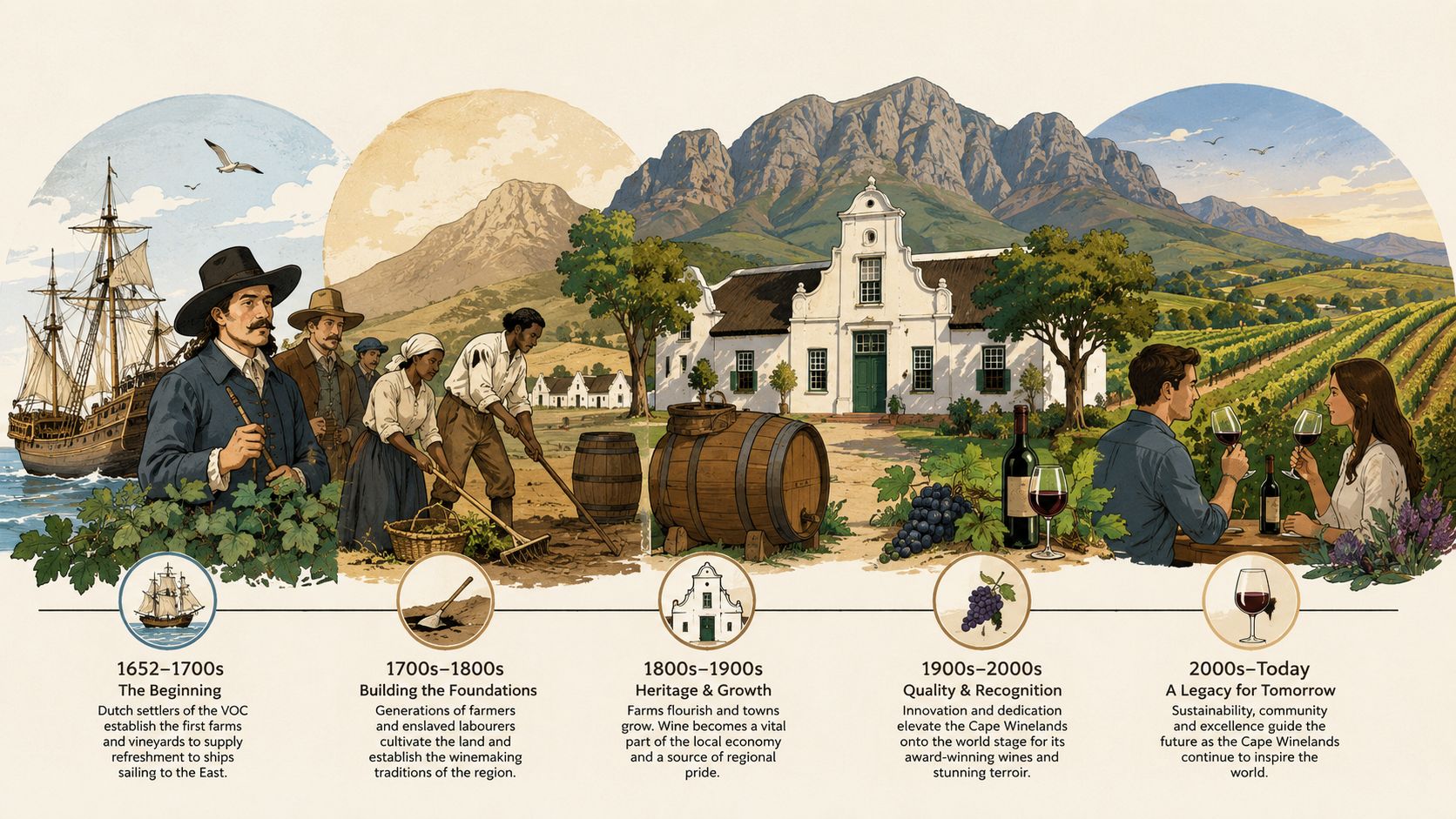
The modern industry grew from that old foundation but doesn't operate like a historical relic. South Africa's vineyard area has been reported at roughly 86,544 hectares, a scale that supports a diversified production and export structure rather than a small collection of heritage estates. The country now serves markets that demand both branded packaged wine and dependable volume supply.
That dual identity explains why South African wine can confuse new buyers. A historic appellation, a modern export brand, and an old-vine boutique release may all come from the same national industry while targeting completely different customers. History supplies the depth, but trade structure determines what appears on shelves and what remains scarce.
The Cape therefore belongs to two categories at once. It is one of the oldest New World wine traditions, rooted in Dutch settlement and Stellenbosch, and it is a contemporary export business competing across international channels. Buyers who understand both sides can recognize why provenance matters, why regional names carry different weight, and why the most limited wines shouldn't be evaluated against bulk-market benchmarks.
<a id="how-the-wine-of-origin-system-works"></a>
How the Wine of Origin System Works
South Africa's Wine of Origin system works like a set of nested postal codes. The broadest designation identifies a large geographic unit, while the most precise points to a smaller area with a more specific environmental and production identity.
The four levels are:
- Geographical Unit: The broadest geographic category in the system.
- Region: A defined wine area within the larger unit.
- District: A narrower designation that helps identify a more specific production zone.
- Ward: The most local level, often used to communicate a highly specific site identity.
The hierarchy matters because a label isn't only describing where the grapes were processed or where the producer is based. It communicates the declared origin of the fruit under a legally defined appellation framework.
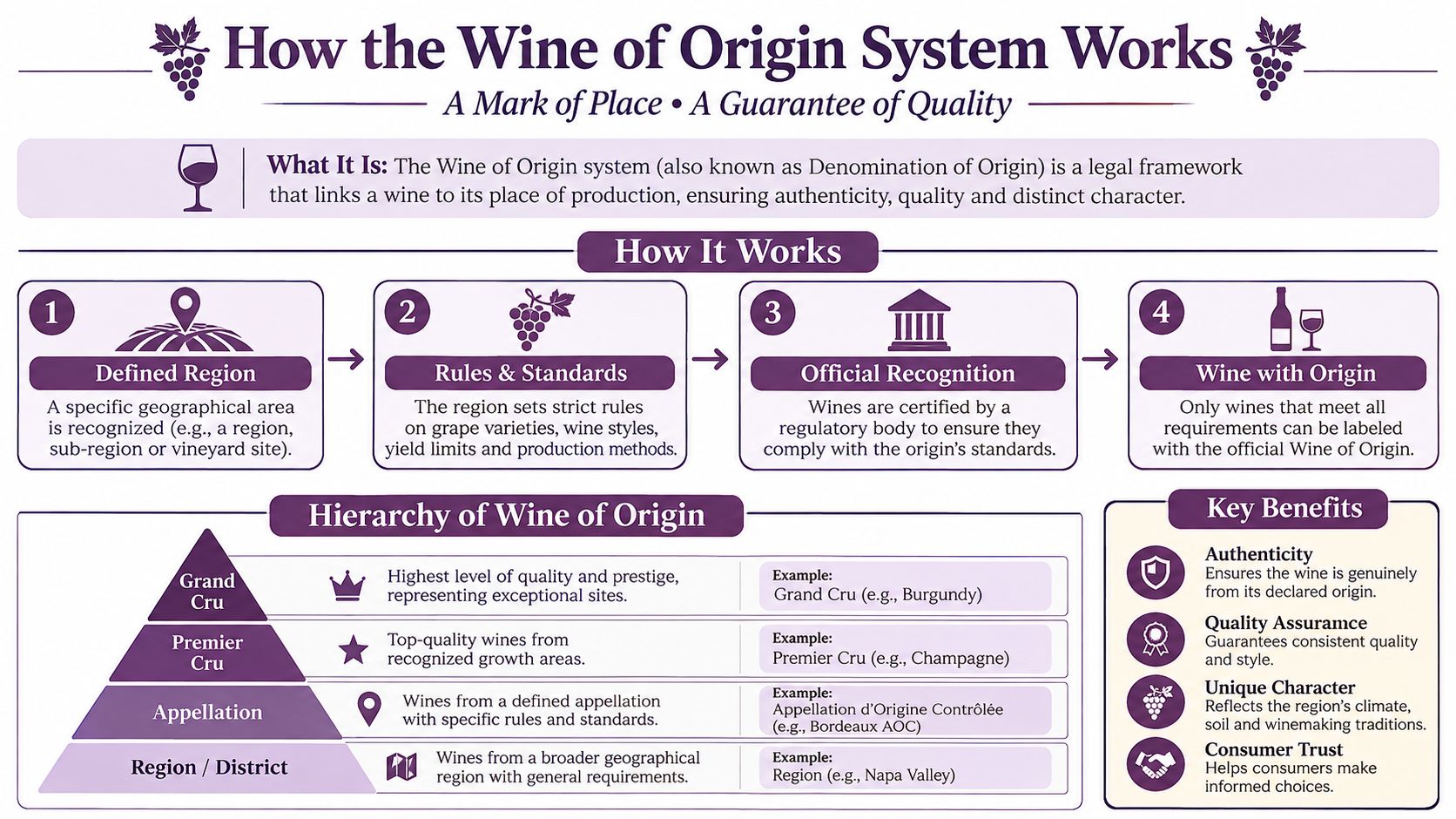
The rules become especially useful when comparing bottles. 100% of the grapes must come from the declared origin, and at least 85% must come from the stated vintage or variety for those claims to appear on the label, according to the South African Wine Industry Information and Systems Wine of Origin regulations.
That doesn't mean every bottle with a regional name will taste identical. A district can contain different slopes, soils, elevations, and exposures. The system establishes provenance, not a single flavor profile. It gives the buyer a reliable starting point, then leaves the producer, site, grape, vintage, and cellar decisions to explain the wine's final character.
For merchants, this structure supports cleaner comparisons. A ward-level wine should be assessed as a specific site expression, not as an average example of the wider region. A broader regional blend may offer more flexibility and availability, but it won't make the same provenance promise.
Read the label from broad to narrow. The smaller the declared origin, the more carefully you should ask what the site contributes and how consistently the producer can supply it.
<a id="the-key-regions-and-what-makes-each-distinct"></a>
The Key Regions and What Makes Each Distinct
Regional names help, but climate is often the sharper purchasing clue. Western Cape wine regions have recorded annual temperature increases of roughly 0.5°C to 1.7°C, depending on region and record period, while broader assessments report average warming of about 1.0°C over the last 50 years in wine-grape production areas, as documented in observed climatic trends in Western Cape vineyards.
The commercial effect is uneven. Warmer conditions can accelerate vine development, bring harvest earlier, increase heat-stress risk, and make acid retention harder during ripening. Buyers should therefore treat a regional name as a starting point, then check the site, grape, vintage, and producer. Those details increasingly shape both style and availability.
<iframe width="100%" style="aspect-ratio: 16 / 9;" src="https://www.youtube.com/embed/MbpumsH-6ac" frameborder="0" allow="autoplay; encrypted-media" allowfullscreen></iframe>| Region | Climate Character | Signature Styles |
|---|---|---|
| Stellenbosch | A historically important area with varied vineyard conditions shaped by mountain and inland influences | Structured reds, Cabernet Sauvignon-led wines, and serious estate bottlings |
| Swartland | Warm and dry, with conditions suited to drought-tolerant farming and old-vine parcels | Textural Chenin Blanc, Rhône-inspired reds, and expressive dry-farmed wines |
| Paarl | Warm and dry, with riper profiles than cooler coastal sites | Fuller Chenin Blanc and structured red wines |
| Elgin | Cooler coastal and mountain conditions | Fresh, acid-driven white wines and elegant cool-climate expressions |
| Cape South Coast | Coastal and mountain influence with cooler growing conditions | Brighter Chenin Blanc and other wines that emphasize freshness |
<a id="stellenbosch"></a>
Stellenbosch
Stellenbosch remains the historic heartland for many buyers, supported by a mature estate and tourism market. Its mountains, valleys, and inland exposures create meaningful variation within the district, so Cabernet Sauvignon-led wines can differ in ripeness, tannin, and freshness. Estate bottlings may command more attention and price, while broader regional wines can offer a more accessible entry to the area's red-wine identity.
<a id="swartland-and-paarl"></a>
Swartland and Paarl
Swartland and Paarl occupy the warmer, drier side of the comparison, but warmth alone does not determine value. Farming method, vine age, soil, canopy management, and harvest timing separate concentrated, balanced wines from merely ripe ones. Swartland is especially important for old-vine Chenin Blanc and dry-farmed wines, while Paarl often gives Chenin and red varieties a fuller profile. For buyers, producer choices matter as much as the regional label.
<a id="elgin-and-the-cape-south-coast"></a>
Elgin and the Cape South Coast
Elgin and the Cape South Coast provide cooler alternatives to inland sites. Slower ripening can preserve freshness and support lighter, more precise expressions, particularly in white wines and varieties that lose acidity in warmer conditions. These regions may also become more commercially relevant as warming reshapes buyer demand. Their supply is less interchangeable with warmer inland wine, making vintage and producer consistency important when comparing prices.
The practical rule is simple: assess the climate character, declared origin, grape, and vintage together. A familiar region can signal a style, but the smaller site and the year often explain what the bottle will deliver.
<a id="chenin-blanc-and-the-grape-varieties-that-define-the-country"></a>
Chenin Blanc and the Grape Varieties That Define the Country
Chenin Blanc is South Africa's global anchor variety, but its importance comes from flexibility rather than uniformity. It grows from warm, dry Swartland and Paarl to cooler coastal and mountain areas such as Elgin and the Cape South Coast. The Atlantic's moderating influence can help preserve natural acidity in warm vintages, while soil and vine age reshape texture, weight, and aromatic direction.
A broad regional average therefore tells buyers less than they might expect. Granite and dry-farmed old vines tend toward mineral, textural wines. Iron-rich sites can give fuller structure, while schist may produce riper, spicier profiles, according to this technical overview of South African Chenin Blanc.
<a id="how-to-read-the-variety"></a>
How to read the variety
A useful Chenin comparison starts with four questions:
- Where are the vines planted? Warm inland sites and cooler coastal parcels can produce markedly different balances.
- What is the soil? Granite, iron-rich soils, and schist can each push the wine toward a different texture or flavor profile.
- How old are the vines? Old-vine fruit can be associated with more concentrated, textural expressions, but the label and producer still need to establish the claim.
- What is the origin level? A ward designation offers a more specific provenance signal than a broad regional name.
Other varieties reinforce the same principle. Cabernet Sauvignon is strongly associated with Stellenbosch's structured red-wine identity. Pinotage gives South Africa a distinctive local red variety, while Syrah, Cinsault, Grenache, Chardonnay, and Sauvignon Blanc appear across different climate and site contexts. The buyer shouldn't treat these as interchangeable national styles. Their character depends on where they are grown and how the producer handles them.
Chenin remains the clearest example because it can span the country's major climate and soil contrasts. A warm Paarl bottling, a dry-farmed Swartland wine, and a cooler Cape South Coast release may all be labeled Chenin Blanc, yet they can occupy different quality tiers and attract different demand. Segmentation by terroir and vine age is more informative than a simple appellation average.
<a id="export-trends-and-what-the-numbers-signal-for-buyers"></a>
Export Trends and What the Numbers Signal for Buyers
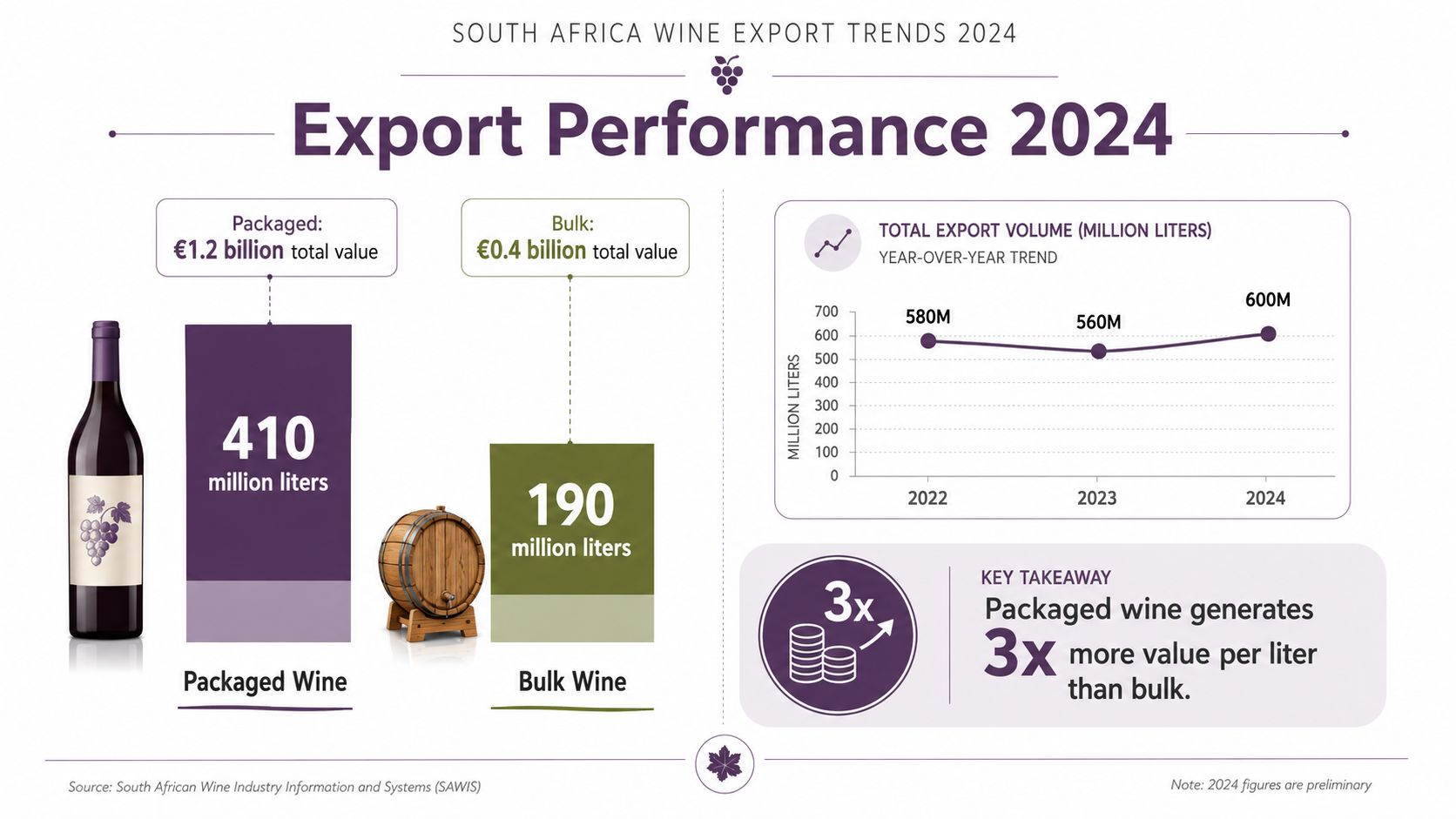
South Africa's export structure reveals two businesses operating inside one industry. In 2024, packaged exports reached 123.4 million litres and were worth R7.9 billion, about US$430 million, while bulk exports reached 182.8 million litres and were worth R2.4 billion, about US$132 million, according to South African wine industry data.
Packaged wine represented the branded and premium-facing side of the trade. Bulk wine represented a larger-volume supply role, where buyers may value flexibility, blending capacity, cost control, and dependable logistics. The split matters because export litres alone can obscure where commercial value is being created.
South Africa's 2023 figures make the point more sharply. The country produced 933.8 million litres of annual harvest, with 83.9% used for wine, while total exports reached 306 million litres. Export value reached US$540 million despite a 17% volume decline, as reported in Wines of South Africa's 2024 industry background material.
Buyer insight: Falling litres don't automatically signal a collapsing market. If export value holds while volume declines, the composition of sales may be shifting toward higher-value packaged or more differentiated wine.
That interpretation should shape sourcing decisions. Merchants buying bulk need to watch production conditions and vineyard contraction closely, because available volume may become less forgiving. Buyers sourcing premium bottles should track producer, ward, vine age, vintage, and channel availability rather than relying on country-level supply headlines.
Packaging also becomes part of the operational picture for anyone moving wine at scale. A practical strapping buyer's guide can help procurement teams evaluate how heavy cases and pallets are secured during handling and transit.
For current market context around fine wine and harvest developments, the Wine Labs South Africa news digest provides another useful monitoring point. The essential habit is to compare value per litre, packaging format, and provenance, not just headline export volume.
<a id="the-shrinking-vineyard-story-and-why-it-matters-for-price"></a>
The Shrinking Vineyard Story and Why It Matters for Price
South Africa's vineyard area fell from 99,472 hectares in 2014 to 87,848 hectares in 2023, while the share of vines older than 20 years rose. Wines of South Africa placed the national vineyard at about 86,525 hectares in 2026. The 2026 harvest outlook nevertheless improved, despite the smaller base, according to industry reporting on the sector's squeeze.
That combination changes the price question. Yield recovery in suitable regions can allow less land to produce a stronger harvest than expected, but it cannot restore the flexibility lost through vineyard removal. Producers have fewer options when climate stress, weak returns, or shifting demand require replanting and variety changes. An analysis of pressure on South African wine real estate and distribution helps frame why those land and channel decisions matter beyond the farm gate.
Older vines add a second layer to supply. They may provide fruit for distinctive wines, yet their value becomes more strategic as the overall vineyard base contracts. The market could separate more clearly between widely available commercial wine and scarce bottles linked to old-vine parcels, particular wards, or less common varieties.
<a id="what-buyers-should-watch"></a>
What buyers should watch
The useful questions concern the composition and timing of supply:
- Which cultivars are being replanted? New plantings can change future availability by variety, even if total vineyard area appears stable.
- Which regions are retaining vines? Coastal, mountain, and inland sites face different climate and commercial pressures.
- How quickly is the vineyard base changing? A gradual decline may tighten supply slowly, while removals concentrated in a few vintages can create abrupt gaps.
- Is premiumization replacing volume? As land and farming costs become harder to justify, producers may pursue greater value per bottle instead of more litres.
South Africa may become more relevant to scarcity-driven pricing than to mass-market volume, even while it remains a major exporter.
This does not imply universal price increases. It means country-level abundance will become a weaker guide. Bottles with defensible provenance, old-vine identity, and few substitutes face the greatest risk of price dispersion across vintages and channels.
<a id="how-to-buy-south-african-wine-with-confidence"></a>
How to Buy South African Wine with Confidence
Start with the label, then test the market context.
- Entry-level bottles: Look for clear variety and region information, reliable producer identity, and a style suited to everyday drinking. These wines are generally the most replaceable when supply is broad.
- Mid-tier district wines: Compare the district, vintage, and grape together. A district designation can narrow the provenance conversation and help distinguish a more site-focused bottle from a generic regional blend.
- Premium releases: Look for ward-level designations, old-vine references, and a producer with a consistent record of site-specific bottling. These wines deserve comparison across several listings before you decide what they're worth.
For any bottle, use this checklist:
- Origin level: Is it a Geographical Unit, Region, District, or Ward?
- Vintage and variety: Does the label make both claims, and does the Wine of Origin framework support them?
- Vine age: Is an old-vine reference specific enough to evaluate?
- Channel price: How does the listing compare across retail, auction, exchange, and restaurant channels?
Wine Labs can help with that last step by consolidating comparable wine pricing across retail, auction, exchange, and restaurant channels, while its canonical identity matching links different listings to the same wine record. For a South African reference point, its price tracker includes Meerlust Rubicon from Stellenbosch.
South African wine rewards buyers who separate abundance from scarcity. Start with the origin, identify the supply story, and then judge the bottle on its own terms.
Wine Labs brings South African wine pricing into a comparable market view, helping merchants, collectors, and buyers compare listings across retail, auction, exchange, and restaurant channels. Visit Wine Labs to track bottles, research price history, and make sourcing decisions with the vineyard and vintage context in view.