Wine Labs · Market intelligence
Russian River Valley Wine Guide: Pinot Noir, Chardonnay
A practical Russian River Valley wine guide covering terroir, Pinot Noir and Chardonnay styles, leading producers, market signals, and sourcing tips for buyers.
A Russian River Valley wine region that once produced more than 500,000 gallons of wine from about 7,000 acres in 1876 now carries roughly 15,000 to 16,000 acres of premium wine grape vineyards, according to the Russian River Valley Winegrowers' history. That shift isn't just a story of expansion. It explains why buyers today must separate appellation reputation from the variables that support a bottle's price, including fog exposure, vineyard location, producer scarcity, variety, and vintage conditions.
The Russian River Valley AVA was established on November 21, 1983, at roughly 96,000 to 96,400 acres, and its modern market identity rests on cool-climate Pinot Noir and Chardonnay. Yet the region is more commercially complex than the familiar two-variety shorthand suggests. Pinot plantings rose from about 4,000 acres in the late 1990s to more than 12,000 acres by 2003, while recent releases show that Chardonnay and Sauvignon Blanc also operate at meaningful scale. The buyer who treats every Russian River Valley label as interchangeable will miss both value and risk.
Table of Contents
- Why Russian River Valley Commands a Premium Today
- How Fog and Diurnal Swings Shape the AVA
- The Rise of Pinot Noir as the Signature Variety
- Chardonnay and the Beyond-Pinot Story
- Leading Producers and Sub-Zones Worth Tracking
- Climate Variability and Vintage Risk in 2025–2026
- Sourcing, Pricing, and Using Market Signals
- Key Decisions for Buyers and Collectors
<a id="why-russian-river-valley-commands-a-premium-today"></a>
Why Russian River Valley Commands a Premium Today
A buyer can find a $40 to $60 retail gap between two Russian River Valley Pinot Noir bottles despite seeing the same AVA on both labels. One may be an appellation blend, while the other comes from a scarce estate block with a tightly controlled release. The price difference reflects how much of the region's limited supply, site specificity, and producer control each bottle captures. For merchants, the AVA is a starting point for pricing, not a sufficient explanation.
<a id="the-premium-has-a-physical-foundation"></a>
The premium has a physical foundation
Marine air enters through the Petaluma Gap, producing cool nights and mornings while daytime temperatures still support ripening. The resulting diurnal pattern slows fruit development and helps preserve acidity, a combination described in technical Pinot Noir notes on the Russian River Valley climate. This climate supports a recognizable commercial profile, particularly for Pinot Noir and Chardonnay, but it does not establish a premium by itself.
Vineyard concentration supplies the next signal. The region's approximately 15,000 to 16,000 premium vineyard acres are strongly associated with Pinot Noir and Chardonnay rather than broad commodity production, according to the Russian River Valley Winegrowers. That specialization gives merchants a clear style position and helps buyers distinguish regional identity from generic California volume. The acreage figure should therefore be read as a measure of concentrated supply, not proof that every bottle has equal scarcity.
Release structure determines how that supply reaches the market. Boutique estate bottlings restrict volume by design, while négociant labels may assemble fruit across broader lots. A vineyard-designate Pinot can command more even when its grapes come from the same general climatic corridor as a lower-priced appellation blend. Buyers should compare site, producer allocation, and release scale before treating a price gap as evidence of superior quality.
<a id="compare-the-label-not-only-the-appellation"></a>
Compare the label, not only the appellation
Sonoma Mountain and Sonoma Valley also contain cool-climate sites, yet similar growing conditions do not produce identical market pricing. Russian River Valley has built a particularly strong association with premium Pinot Noir and Chardonnay through its history, producer network, and recognizable fog-influenced style, as noted in the earlier history summary. That reputation lowers the explanation burden for merchants, but it can also make undifferentiated labels easier to overprice.
The available regional summaries establish scale and commercial importance. They do not provide verified median prices, Pinot acreage by neighboring AVA, or Chardonnay shares for the comparison below. Those fields remain data gaps, so a buyer should request producer-level evidence rather than infer precision from the appellation alone.
| AVA | Median Pinot Bottle Price (USD) | Pinot Acreage | Chardonnay Share |
|---|---|---|---|
| Russian River Valley | Not provided in verified data | Not separately provided in verified data | Not provided in verified data |
| Sonoma Mountain | Not provided in verified data | Not provided in verified data | Not provided in verified data |
| Sonoma Valley | Not provided in verified data | Not provided in verified data | Not provided in verified data |
Practical rule: Pay the premium only when the bottle offers a scarce producer, a specific site, a strong vintage rationale, or a demonstrable secondary-market signal.
<a id="how-fog-and-diurnal-swings-shape-the-ava"></a>
How Fog and Diurnal Swings Shape the AVA
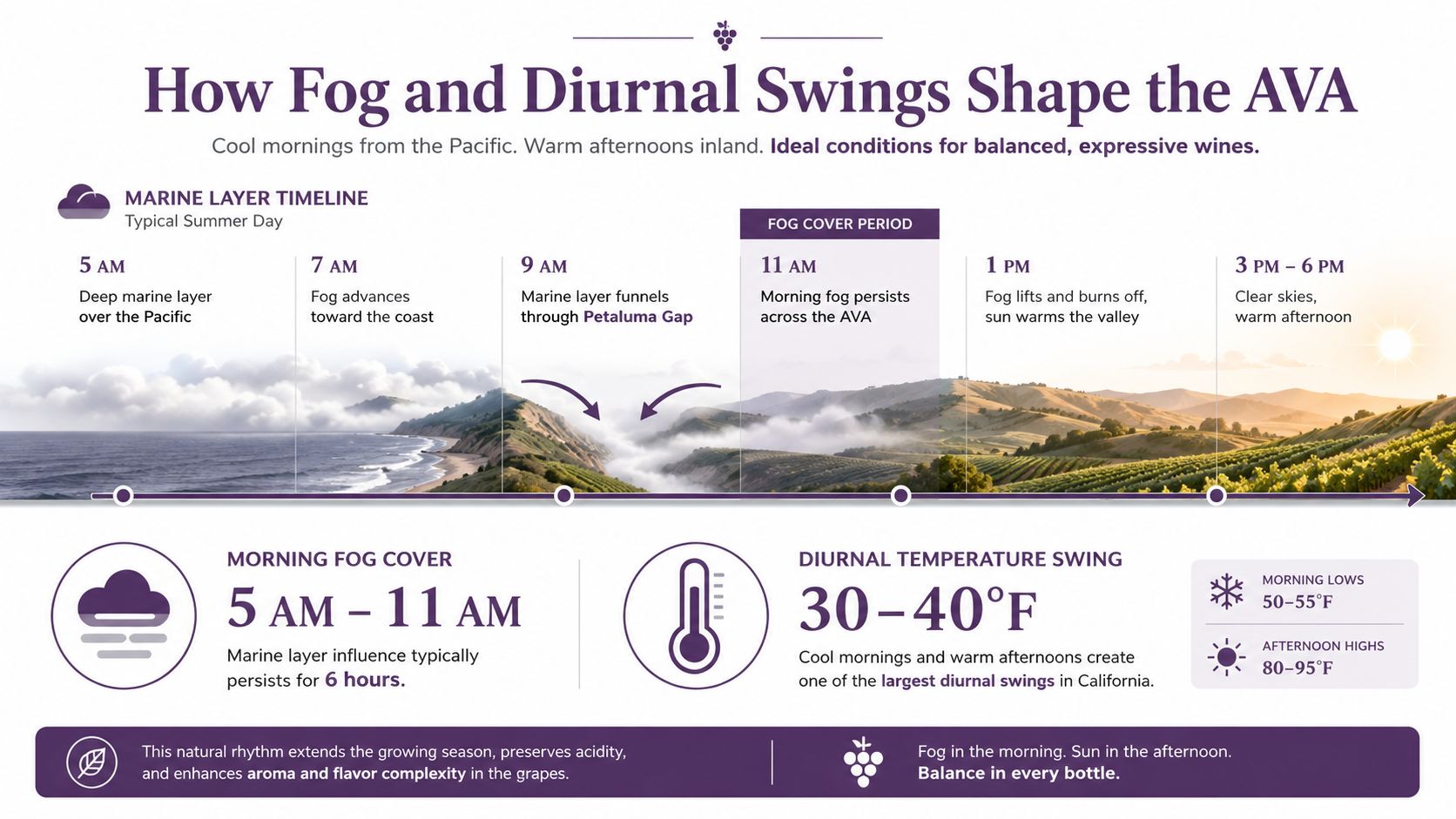
Russian River Valley's production profile begins with marine fog. Air moving inland through the Petaluma Gap keeps parts of the valley cool overnight and into the morning, before daytime heating accelerates ripening. An industry climate analysis describes a long, cool growing season in which fog may persist into mid-morning. The commercial consequence is a pronounced diurnal swing, with ripening conditions changing sharply within the same day.
<a id="why-the-climate-favors-pinot-noir-and-chardonnay"></a>
Why the climate favors Pinot Noir and Chardonnay
The relevant advantage is the combination of maritime cooling and adequate daytime warmth. Cooler mornings can slow sugar accumulation, while warmer afternoons support physiological ripeness over an extended season. Growers can therefore pursue ripe fruit without depending entirely on intense daytime heat, and acidity remains an important component of the wine's structure.
That pattern fits Pinot Noir and Chardonnay. Extended hang time can build aromatic complexity and texture, while both varieties already command attention from buyers seeking freshness, site expression, and vintage variation. The same climate analysis supports the connection among fog, cool nights, long growing seasons, and the varieties most associated with the AVA.
Later-ripening varieties involve a different sourcing decision. A parcel that ripens Pinot Noir consistently may provide less certainty for Cabernet Sauvignon or Mourvèdre when morning fog delays active ripening. Such plantings remain possible, but the added vintage and fruit-source risk should be reflected in purchasing terms and final pricing.
<a id="fog-creates-internal-price-differences"></a>
Fog creates internal price differences
Maritime influence also produces variation within the AVA. Elevation, exposure, wind, soil depth, and the time fog clears can alter sugar accumulation and vine hang time. The broad appellation label consequently combines sites with materially different ripening profiles.
For merchants, sub-zone and vineyard information should sit beside producer reputation in the comparison process. A Pinot Noir from a clearly identified cool site may warrant a different price architecture from wine made with fruit from a warmer, earlier-ripening parcel, even when both carry the Russian River Valley designation. Wine Labs-style market intelligence should treat fog exposure and diurnal range as pricing variables, not merely tasting-note language.
<a id="the-rise-of-pinot-noir-as-the-signature-variety"></a>
The Rise of Pinot Noir as the Signature Variety
Pinot Noir plantings grew from about 4,000 acres in the late 1990s to more than 12,000 acres by 2003, according to the Russian River Valley AVA overview. That increase shifted Pinot Noir from an important variety to the region's primary commercial identifier. For buyers, the acreage change is more than historical context. It explains why Russian River Valley Pinot Noir now supports a deeper producer ladder and clearer price segmentation than many other varieties grown in the AVA.
<a id="follow-the-acreage-shift"></a>
Follow the acreage shift
Vineyard owners expanded Pinot plantings as the region gained recognition for cool-climate fruit. Producers then built brands around site-specific bottlings, rather than relying only on broad regional blends. The market reinforced that decision: recognized Pinot producers created benchmark wines, and those benchmarks gave retailers and collectors a familiar reference point for Russian River Valley.
The verified record supports the acreage increase. It does not establish commonly repeated explanations involving a precise role for Sancerre comparisons, Burgundy-trained investment, or a separate 1998 formal recognition date. The defensible conclusion is narrower: climate suitability, producer investment, and rising reputation redirected vineyard land toward Pinot Noir.
| Year | Pinot Noir Acres | Share of AVA Plantings |
|---|---|---|
| Late 1990s | About 4,000 | Not provided in verified data |
| 2003 | More than 12,000 | Not provided in verified data |
<a id="why-pinot-drives-scarcity"></a>
Why Pinot drives scarcity
Pinot Noir's pricing strength comes from two reinforcing assets: a recognizable regional style and limited estate supply. A producer with a loyal mailing list can separate an appellation release from a vineyard-designate or reserve bottling, creating distinct price tiers while retaining the Russian River Valley identity.
That tiering changes how merchants should compare offers. An appellation Pinot can introduce the region to new customers. A single-vineyard release can target collectors who value scarcity and provenance. Treating both wines as interchangeable obscures the value of site detail, allocation access, and release volume.
The available data does not establish a verified current percentage share of Russian River Valley production, nor does it identify which sub-zones command the highest per-ton fruit prices. Buyers should track those variables through supplier offers, release sheets, and transaction records instead of relying on unsupported market folklore.
Pinot Noir leads the region's market identity because acreage, climate, and release scarcity reinforce one another. None of those factors alone explains the premium.
<a id="chardonnay-and-the-beyond-pinot-story"></a>
Chardonnay and the Beyond-Pinot Story
Chardonnay is Russian River Valley's second commercial pillar, and its scale changes how buyers should evaluate the AVA. Foggy mornings slow development, while daytime warmth supports concentration. The resulting wines can retain freshness while building orchard-fruit weight and a mineral-edged finish. That combination gives Chardonnay a distinct premium route rather than making it a secondary version of the region's Pinot Noir story.
A recent release offers a concrete volume signal. The Bravium Russian River Chardonnay release lists 18,798 cases for a 2024 Russian River Valley Chardonnay. A separate 2025 Sauvignon Blanc bottling is listed at 3,400 cases. These figures do not establish that Chardonnay tonnage exceeds Pinot Noir across the AVA, but they show that buyers should price Russian River Valley as a broader white-wine market, not a Pinot-only category.
<a id="two-chardonnay-production-lanes"></a>
Two Chardonnay production lanes
One lane centers on older vineyard material and traditional selections, including Wente-style plantings. Barrel work, lees contact, or malolactic fermentation can add texture. Another lane uses newer clonal programs and more deliberate cellar intervention to produce a polished, consistent house style. Buyers should identify the production lane before comparing two Russian River Chardonnays on price alone.
Release format also changes the commercial calculation. Single-vineyard wines can command more because they offer a specific site story and limited production. Appellation-tier bottles usually provide a more practical entry point for restaurants and retailers seeking a dependable house pour. Vineyard designates offer provenance and scarcity. Broader blends offer consistency and easier replenishment.
| Tier | Approx. % of RRV Chardonnay Volume | Avg. Release Price (USD) | Typical Style Markers |
|---|---|---|---|
| Appellation tier | Not provided in verified data | Not provided in verified data | Freshness, regional consistency |
| Vineyard designate | Not provided in verified data | Not provided in verified data | Site detail, greater scarcity |
| Estate or reserve | Not provided in verified data | Not provided in verified data | More texture, oak or lees complexity |
<a id="the-value-question-for-buyers"></a>
The value question for buyers
Chardonnay's opportunity lies in comparing release scale with pricing position. A large-production regional bottling may offer stronger availability than scarce Pinot Noir, while a low-volume vineyard release can reach collector territory through provenance as much as variety.
Russian River Valley also supports Sauvignon Blanc and other plantings, as noted in the Sonoma appellation overview. That breadth gives merchants more ways to position the AVA, from high-acid whites to richer cellar selections. It also lets buyers compare volume, replenishment, and site specificity across varieties instead of treating regional value as a Pinot Noir question alone.
<a id="leading-producers-and-sub-zones-worth-tracking"></a>
Leading Producers and Sub-Zones Worth Tracking
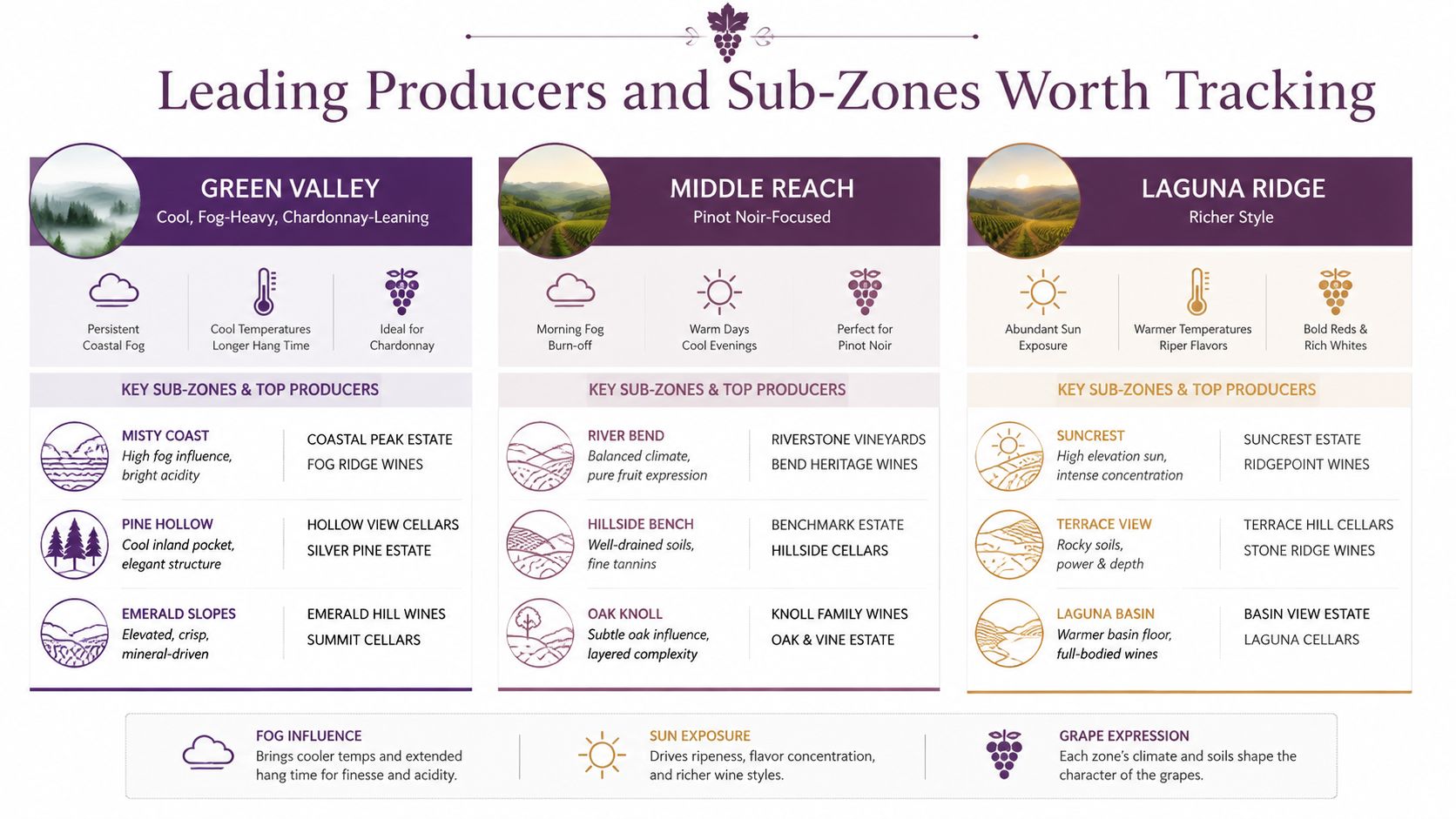
Russian River Valley works better as a sourcing matrix than as a producer ranking. Green Valley, the Middle Reach around Sebastopol, the Santa Rosa Plain, and Laguna Ridge don't present the same balance of fog, warmth, exposure, and ripening pace. Producers then amplify those differences through clonal choices, barrel programs, blending decisions, and release discipline.
<a id="read-the-sub-zones-as-sourcing-signals"></a>
Read the sub-zones as sourcing signals
Green Valley is typically associated with heavier fog influence and a Chardonnay-leaning profile. It suits buyers seeking freshness, tension, and a clear maritime identity, but the cooler conditions can also make vintage and site selection more consequential.
The Middle Reach around Sebastopol is often used as a reference point for rounded Pinot styles. That makes it useful for retailers who want a recognizable regional expression with enough texture to appeal to customers moving beyond lighter-bodied examples.
The Santa Rosa Plain tends to offer earlier-ripening conditions than the coolest pockets. A merchant can use those wines when a broader, more immediately accessible style fits the shelf, though the label alone won't reveal every site-level distinction.
Laguna Ridge is commonly treated as a richer stylistic pocket. It can support bottles positioned for customers who want concentration and depth rather than the most austere expression of maritime freshness.
<a id="match-producers-to-the-job"></a>
Match producers to the job
Williams Selyem, Rochioli, Kistler, and Gary Farrell function as important reference names for buyers comparing style, scarcity, and release positioning. DuMOL brings a modern, structured approach, while Martinelli and Iron Horse provide additional commercial and stylistic breadth. These producers shouldn't be treated as interchangeable benchmarks. Their vineyard sourcing and cellar choices create different reasons for a bottle to earn attention.
A practical sourcing matrix might look like this:
- Value-tier pour: Use broader appellation releases from credible producers when availability and repeatability matter more than a single site.
- Cellar release: Reserve established names and tightly allocated bottlings for customers who value provenance and aging potential.
- Vineyard-designate focus: Prioritize specific sub-zone and estate details when scarcity, site comparison, or collector interest drives the sale.
The regional wine market digest can add distribution context, but it shouldn't replace bottle-level analysis. A producer's reputation opens the conversation. The site, vintage, format, and actual replacement cost close it.
<a id="climate-variability-and-vintage-risk-in-20252026"></a>
Climate Variability and Vintage Risk in 2025–2026
“Cool and foggy” is a baseline for Russian River Valley, not a complete vintage forecast. Recent harvest notes describe 2025 as unusually cool, with persistent cold fog through July and no major heat events through late summer. The resulting longer hang time and slower, even ripening are documented in River Road Vineyards' 2025 harvest notes.
The verified record does not support the hotter, earlier 2024 to 2025 scenario outlined in the market-analysis plan. It also does not verify early budbreak, record February rainfall, picks two weeks ahead of schedule, or specific 2024 sugar-accumulation outcomes. Buyers should exclude those details from a firm vintage narrative until bottle-level evidence supports them.
<a id="vintage-risk-is-local"></a>
Vintage risk is local
The 2025 account shows why an AVA label can conceal different commercial results. Longer hang time may preserve freshness and measured ripeness in one block, while exposure, soil depth, or fog duration creates different pressure elsewhere. Buyers therefore need producer and vineyard context alongside the regional vintage label.
That same source's terroir model also shows variation beyond Pinot Noir. Its Cabernet Sauvignon site scores are 78 for 2025, 82 for 2024, and 62 for 2021 (River Road Vineyards). These scores are not a universal valuation system. They do, however, show that site suitability can shift materially between harvests, which changes how merchants should compare non-Pinot wines within the AVA.
<a id="how-buyers-should-adjust"></a>
How buyers should adjust
Sample 2025 releases early and ask producers how persistent fog shaped picking decisions. For 2024, avoid assigning one ripeness profile to every bottle. The verified record does not justify calling the entire vintage riper than average, so pricing should reflect producer notes, alcohol balance, acidity, and release timing.
Broader California supply and luxury-market context appears in the California harvest and luxury wine market digest, but bottle-level evidence remains decisive. Fog-driven diurnal swings and sub-zone differences make volume signals less reliable than repeat performance across contrasting vintages. For buyers, that means paying for demonstrated site and producer consistency, not applying one AVA-wide premium to every release.
<a id="sourcing-pricing-and-using-market-signals"></a>
Sourcing, Pricing, and Using Market Signals
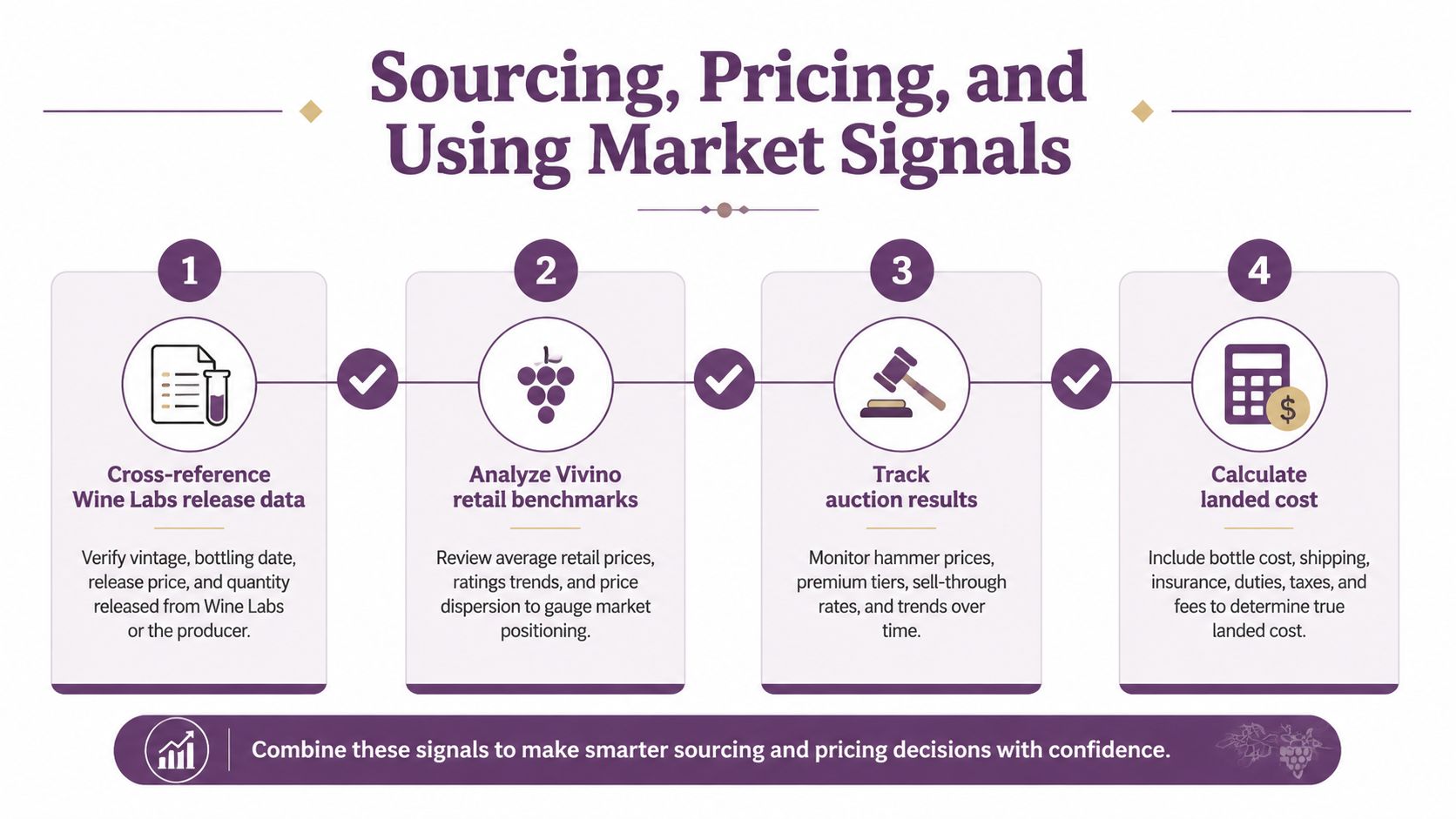
A Russian River Valley shelf should be built from triangulation, not a single score or retailer listing. Merchants need to compare release data, retail benchmarks, auction results, producer allocations, and landed cost before deciding whether a bottle is a value, a traffic driver, or a capital risk.
<a id="four-checks-before-you-buy"></a>
Four checks before you buy
- Cross-reference release data. Record producer, vineyard, vintage, format, and release timing. A regional label without a stable identity is difficult to compare across channels.
- Analyze retail benchmarks. Use Vivino-style listings as a directional reference, then separate current asking prices from completed transactions and account for shipping, tax, and availability.
- Track auction results. Established names such as Williams Selyem, Kistler, and Rochioli can show demand changes in secondary markets before retail pricing adjusts. Auction evidence is most useful when the wine, vintage, bottle condition, and format match.
- Calculate landed cost. Wholesale price isn't the final margin. Include freight, duties where applicable, storage, breakage exposure, and the cost of tying up inventory.
The Wine Labs fine wine market data platform is designed for this type of cross-channel comparison, but the analytical principle applies regardless of the system used. Normalize the product identity first. Then compare like with like.
<a id="build-breadth-before-depth"></a>
Build breadth before depth
A merchant shouldn't fill a Russian River program with only famous producers. Sub-zone diversity reduces dependence on one style and helps staff explain why two bottles from the same AVA taste and trade differently. Pair an accessible appellation wine with a Green Valley Chardonnay, a Middle Reach Pinot, and a scarce vineyard-designate release.
Monitor release cadence as carefully as price. A producer that releases consistently gives a merchant a replenishment path, while an irregular estate release may create excitement but complicate a standing program. The weekly review can stay focused:
- New releases: Identify changes in vineyard, vintage, format, and allocation.
- Critic score clusters: Look for repeated support across several wines, not one isolated score.
- Benchmark SKU movement: Track whether comparable bottles are rising, falling, or disappearing from supply.
Pricing discipline: Never treat scarcity alone as proof of value. Scarcity matters when buyers can verify identity, provenance, demand, and replacement cost.
<a id="key-decisions-for-buyers-and-collectors"></a>
Key Decisions for Buyers and Collectors
Russian River Valley competes with Burgundy, Oregon's Willamette Valley, and other Sonoma districts, but each comparison carries different risks. Burgundy offers historical signaling and established site hierarchy. Willamette Valley presents another cool-climate Pinot framework. Russian River Valley combines strong domestic identity with broad producer choice, while fog exposure and sub-zone selection materially change style, supply, and price.
The buying question is portfolio fit. A bottle earns its position through producer reliability, site clarity, vintage conditions, replacement cost, and customer demand.
<a id="decide-how-much-benchmark-prestige-you-need"></a>
Decide how much benchmark prestige you need
A Pinot program anchored by Williams Selyem, Kistler, or Rochioli gives customers recognizable reference points and can support cellar-oriented sales. The trade-off is allocation pressure and a greater need to verify current market pricing. Emerging labels may offer value below the benchmark tier, but buyers must conduct more producer-level research because reputation provides less initial guidance.
Avoid using a fixed price threshold as a substitute for analysis. The available evidence does not establish a universal under-$50 value band. Compare actual release terms, replacement bottles, vintage conditions, and customer demand instead.
<a id="treat-chardonnay-as-an-allocation-choice"></a>
Treat Chardonnay as an allocation choice
Chardonnay's meaningful release scale creates a different buying opportunity from scarce Pinot Noir. Broader appellation bottlings can provide dependable availability, while reserve and vineyard-designate wines suit customers willing to pay for site specificity. A larger supply base may reduce scarcity value even when quality remains high.
That supply profile makes Chardonnay useful for portfolio balance. It broadens the Russian River story without forcing customers into the region's most expensive Pinot tier, while still offering visible climate and site distinctions.
<a id="choose-specialization-or-breadth"></a>
Choose specialization or breadth
A Green Valley-focused program can establish a sharp maritime identity. A Sebastopol Hills or Middle Reach emphasis supports a more rounded Pinot discussion. A Santa Rosa Plain or broader AVA mix gives retailers greater flexibility across price points and styles.
For many buyers, the practical choice is a deliberate blend. Concentrate enough to teach customers how place changes the wine, then maintain enough breadth to manage vintage and supply risk. The earlier harvest-note analysis supports this approach: unusually cool conditions can favor some sites more than others.
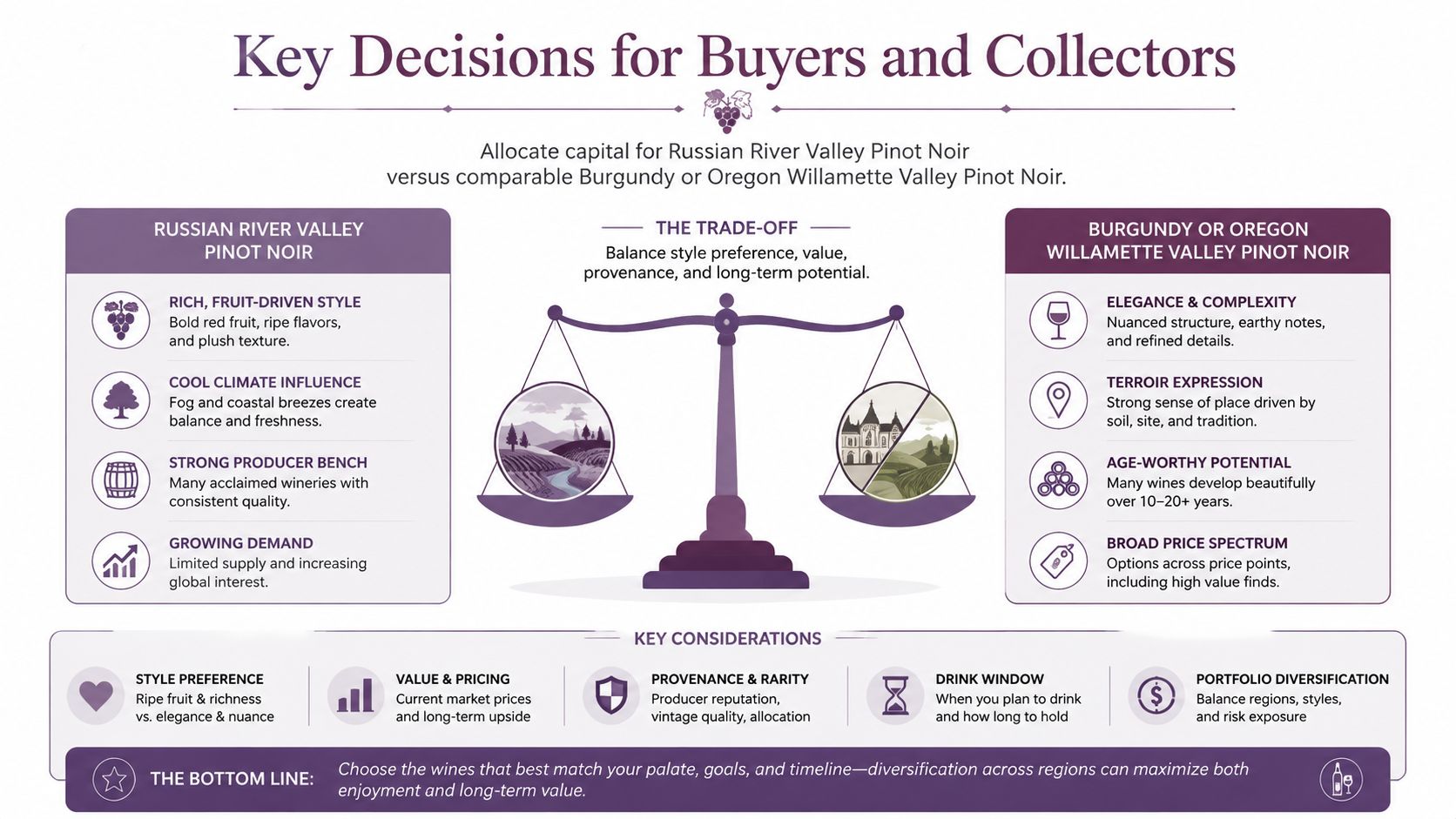
Collector decision: Underweight early vintage volume signals. Prioritize producers that demonstrate consistent balance across contrasting heat, fog, and ripening conditions.
Wine Labs lets merchants, collectors, and producers compare Russian River Valley bottles across retail, auction, exchange, and restaurant channels. Normalize identities first, then examine release pricing, benchmark producers, sub-zone differences, vintage conditions, and market history through Wine Labs. The result is a clearer basis for sourcing, pricing, and deciding which wines deserve depth in inventory.