Wine Labs · Market intelligence
Rosso Di Montalcino Guide: Style, Producers, and Price
A data-led guide to Rosso di Montalcino: how it differs from Brunello, which producers lead, where it sits in the fine wine market, and what it costs today.
Rosso di Montalcino is entering a new commercial phase. Trade reporting indicates that Rosso bottling surged 27% in 2025, while the denomination's vineyard base was authorized to expand from about 520 hectares to roughly 860 to 872 hectares. The resulting question isn't whether Rosso is a cheaper Brunello. It's whether the market is finally recognizing a separate Montalcino category with its own supply curve, release cadence, producer hierarchy, and price logic. (VinoNews24)
For merchants, collectors, and producers, that distinction matters. Rosso di Montalcino can function as an accessible, early-release Sangiovese for restaurants and premium retail, but ambitious estates also use the appellation to develop more structured, oak-influenced wines with serious cellar potential. The category's future will depend on how clearly those two identities are priced and presented.
Table of Contents
- Why Rosso di Montalcino Deserves Its Own Category
- The DOC Rules Behind the Wine
- Rosso di Montalcino Compared to Brunello
- The 2025 Supply Expansion in Numbers
- Two Market Styles Inside One Denomination
- Typical Prices and Channel Positioning
- How to Evaluate a Rosso di Montalcino Listing
- Where the Category Is Heading
<a id="why-rosso-di-montalcino-deserves-its-own-category"></a>
Why Rosso di Montalcino Deserves Its Own Category
Rosso di Montalcino has two market identities, and its supply expansion gives both greater commercial relevance. The wine shares Montalcino's territory and Sangiovese base with Brunello, but its earlier release creates a different role in a producer's portfolio. For merchants, that means faster stock rotation and a proposition suited to consumers who want the region without waiting through Brunello's longer timetable.
Rosso was formally recognized as a controlled-origin wine on 25 November 1983, and its first commercial vintage followed in 1984. The rules allowed release from 1 September of the year after harvest, establishing an early-release route from the same production zone. The official profile also identifies Rosso as entirely Sangiovese from the Montalcino area, with a maximum yield of 9 tonnes of grapes per hectare. (Consorzio del Vino Brunello di Montalcino)
Those rules indicate a deliberate product role. Rosso was created to convert vineyard output into revenue sooner while offering consumers a less time-intensive entry to Montalcino. Its commercial logic therefore rests on release timing and portfolio structure, not on a simple discount relationship with Brunello.
<a id="the-two-identities"></a>
The two identities
The denomination now supports two recurring propositions:
- Approachable Rosso emphasizes direct fruit, freshness, and immediate restaurant utility. It fits premium by-the-glass programs and competes with higher-quality everyday Tuscan reds.
- Ambitious Rosso applies more selective fruit, firmer extraction, extended maturation, or more visible oak. It can occupy the space below Brunello while maintaining a fine-wine identity.
Both approaches remain legitimate expressions of the denomination. Production choices and intended consumption separate them, rather than a legal hierarchy that makes one version authentic and the other inferior.
Commercial reading: Rosso di Montalcino sits between everyday Chianti and collector Brunello, yet it functions as a distinct category with its own price and usage logic.
The distinction also matters in wine tourism. Tour operators can present Rosso and Brunello as separate products, making tastings more informative for visitors and more useful for producers seeking to explain portfolio roles. Samba for tour operators provides a relevant framework for building food-and-wine itineraries around different audiences and experiences, rather than presenting every Tuscan tasting as one premium product story.
<a id="the-doc-rules-behind-the-wine"></a>
The DOC Rules Behind the Wine
Production rules define Rosso di Montalcino's category boundaries, while producer choices create its two market identities. The official technical profile specifies a dry, warm, slightly tannic red with a minimum alcohol level of 12.0% vol, minimum total acidity of 5 g/L, and minimum dry extract of 22 g/L. These thresholds establish a legal baseline, not a uniform tasting outcome. (Italian Ministry of Agriculture technical sheet)
<a id="what-the-rules-establish"></a>
What the rules establish
The denomination's grape requirement gives merchants a clear territorial proposition. Rosso di Montalcino is made entirely from Sangiovese grown in the Montalcino area. Vineyard selection, fermentation, extraction, and maturation can differ by estate, so the rule fixes the origin and variety without prescribing one commercial style.
The yield ceiling adds another boundary. Production cannot exceed 9 tonnes of grapes per hectare under the cited rules. That limit does not ensure identical concentration or aging capacity in every bottle, yet it prevents Rosso from operating as an unrestricted bulk category. For distributors, the distinction supports a controlled-origin position rather than generic Tuscan branding.
The technical thresholds also set minimum conditions for ripeness and material. 12.0% alcohol establishes a floor for maturity, while the acidity and dry-extract requirements preserve a structural frame associated with Montalcino Sangiovese. Those figures describe compliance. They do not determine whether a bottling is light, firm, fruit-led, or shaped by oak.
<a id="why-release-timing-changes-the-business"></a>
Why release timing changes the business
Release timing gives Rosso a separate economic function. The denomination cannot be released before 1 September of the year following harvest, allowing producers to enter commercial channels substantially sooner than Brunello. That schedule reduces the time between harvest investment and sales, supporting faster portfolio rotation and earlier restaurant or retail placement.
Producer technical material illustrates how that flexibility can be used. One technical sheet describes fermentation in temperature-controlled stainless steel at approximately 24 to 29°C, extended maceration, and maturation that can be as short as 6 months in wood plus bottle time. A commonly summarized denomination minimum is around 10 months, while individual producers may mature the wine longer for more texture, oak integration, or bottle development. (Camigliano Rosso technical sheet)
| Parameter | Rule | Commercial Implication |
|---|---|---|
| Grape identity | 100% Sangiovese from Montalcino | Creates a defined territorial product rather than a generic Tuscan red |
| Maximum yield | 9 tonnes of grapes per hectare | Limits unrestricted volume and supports controlled-origin positioning |
| Minimum alcohol | 12.0% vol | Sets a ripeness floor for the denomination |
| Minimum acidity | 5 g/L total acidity | Maintains structural freshness within a warm regional style |
| Minimum dry extract | 22 g/L | Establishes a baseline for body and material |
| Release timing | Not before 1 September of the year after harvest | Enables earlier cash conversion and quicker portfolio rotation |
| Wood and maturation | Producer programs may include at least 6 months in wood plus bottle time, with many exceeding the minimum | Separates immediate-drinking bottlings from more ambitious releases |
The commercial conclusion follows from the rules. Rosso is permitted to be young in market timing, but it isn't required to be simplistic in style. Its legal framework enables both an early-release restaurant wine and a more deliberate, fine-wine-oriented bottling.
<a id="rosso-di-montalcino-compared-to-brunello"></a>
Rosso di Montalcino Compared to Brunello
Rosso di Montalcino and Brunello share Montalcino and a Sangiovese foundation, yet their market identities diverge. Rosso is designed for earlier circulation, while Brunello supports longer holding periods, cellar development, and more selective allocation. The shared grape therefore defines provenance, not interchangeable positioning.
Release timing creates the clearest operational difference. Rosso may enter the market from 1 September of the year following harvest. Brunello follows a substantially longer maturation schedule, with release typically closer to five years after harvest. For producers, that distinction affects working capital, inventory exposure, and the point at which a vintage begins generating revenue.
| Dimension | Rosso di Montalcino | Brunello di Montalcino |
|---|---|---|
| Grape identity | 100% Sangiovese from Montalcino | Sangiovese-based denomination from Montalcino |
| Geographic identity | Montalcino production zone | Montalcino production zone |
| Release timing | From 1 September of the year after harvest | Typically closer to five years after harvest |
| Minimum maturation | Shorter maturation category, with producer programs varying by ambition | Long maturation category, with Riserva receiving additional time |
| Commercial role | Earlier-drinking, restaurant, retail, and volume counterpart | Collector, cellar, prestige, and long-term allocation product |
| Labeling logic | Sold under the Rosso di Montalcino denomination | Sold under the Brunello di Montalcino denomination |
| Portfolio function | Faster turnover and broader access | Slower release, higher aging expectation, and stronger scarcity logic |
Rosso is therefore a parallel DOC category, rather than a junior version of Brunello. A producer can position it as an earlier expression of Montalcino, using different fruit, a shorter élevage program, and broader channel access. Brunello can carry the longer maturation narrative and a more deliberate allocation model.
That separation gives the denomination two market identities. One is an accessible, faster-turning restaurant and retail wine. The other is a more ambitious bottling that uses Rosso's release flexibility while retaining a fine-wine orientation. The legal category permits both, so the producer's sourcing, maturation choices, and route to market determine the final position.
For context on how Brunello vintage conditions and market developments can affect portfolio decisions, merchants can consult the Wine Labs Brunello market digest.
<a id="release-cadence-drives-channel-strategy"></a>
Release cadence drives channel strategy
Brunello's longer holding period favors allocation, cellar sales, and established collector relationships. Rosso can reach restaurants, specialist retailers, and export programs while the producer continues managing the wider vintage cycle. Its value to buyers lies in combining Montalcino identity with a shorter maturation window and faster portfolio rotation.
<a id="the-2025-supply-expansion-in-numbers"></a>
The 2025 Supply Expansion in Numbers
The 2025 figures point to a category-level supply expansion, with implications for Rosso di Montalcino's price positioning. Trade reporting recorded a 21% increase in bottling during the first five months of 2025 compared with the same period in 2024, while separate coverage reported a 27% surge in bottlings during 2025. The same reporting linked the growth to authorization for vineyard expansion from about 520 hectares to roughly 860 to 872 hectares. (VinoNews24)
A Wine Labs-aligned market estimate places projected 2025 Rosso production at roughly 7 million bottles, an estimated 20% increase. This is a projection for the 2025 production picture, not a claim that every estate or vintage will show the same growth.
| Metric | 2025 figure | Interpretation |
|---|---|---|
| Projected Rosso production | Roughly 7 million bottles | Confirms a scalable category rather than a micro-label segment |
| Bottling increase in the first five months | 21% versus the same period in 2024 | Signals faster supply entering the market during the year |
| Reported bottling surge | 27% during 2025 | Indicates a substantial expansion in released volume |
| Existing reported production average | 32,375 hectoliters, about 359,700 cases | Shows that Rosso already had meaningful commercial scale |
| Potential vineyard expansion | About 520 hectares to roughly 860 to 872 hectares | Creates a larger production base for future supply |
For importers and distributors, expanded appellation supply can improve listing continuity. A larger pool of wine may support wider geographic distribution, steadier restaurant placements, and fewer allocation gaps. Consumers may encounter established Rosso labels more consistently, especially in markets where the category was previously handled as a narrow seasonal selection.
Category growth does not automatically mean lower prices. Appellation totals can conceal estate-level scarcity. A substantial increase across Rosso may coexist with limited production from a recognized producer, a specific vineyard site, or a deliberately restricted oak-aged cuvée. The pricing effect therefore depends on which segment gains volume, not only on the denomination total.
<a id="what-buyers-should-monitor"></a>
What buyers should monitor
The next two to three vintages require attention to producer-level signals rather than the denomination total alone.
- New release allocations: Additional supply may first appear through expanded distributor lists instead of immediate shelf discounts.
- Carryover stock: Persistent availability can indicate slower sell-through, or a producer's deliberate release schedule.
- Vintage consistency: A stable style across vintages can support pricing, while uneven execution may create temporary pressure.
- Estate-level output: Compare an individual producer's declared bottlings with its historical market presence before applying appellation-wide growth to that label.
Pricing signal: Separate category expansion from producer scarcity. Category growth affects broad availability. Producer scarcity determines whether a specific bottle can retain premium positioning.
The 2025 data supports Rosso di Montalcino as a scalable category with two commercial identities, not just a lower-priced Brunello substitute. Greater volume may improve access to entry-level listings, while reputation, vineyard selection, élevage, and release discipline continue to support premium positioning for selected estates.
<a id="two-market-styles-inside-one-denomination"></a>
Two Market Styles Inside One Denomination
A producer's portfolio shows the commercial split more clearly than the denomination's legal label. Caparzo, Conti Costanti, and Canalicchio di Sopra each demonstrate how a winery can place Rosso in different roles while also producing Brunello. The relevant question for merchants is therefore not whether Rosso is a cheaper Brunello, but which customer, occasion, and price position the bottling is designed to serve.
The legal framework remains the same across these examples. Vineyard selection, extraction, fermentation, wood format, maturation length, and bottle time determine how a producer presents the wine and where it fits within a portfolio. Those choices create two practical routes to market, with different channel requirements.
<a id="the-approachable-lane"></a>
The approachable lane
An approachable Rosso suits a merchant seeking a premium Tuscan red that can sell with limited explanation. Its value rests on regional recognition, current-drinking utility, and accessible positioning within fine-wine retail. Restaurants can place it where Brunello would make the list too formal, too slow-moving, or too expensive for the intended customer.
Producer decisions commonly support that role through stainless-steel fermentation, restrained oak, vivid fruit, and earlier release. The commercial objective is direct regional identification. Customers receive a Montalcino red for current consumption, while the producer avoids presenting every Rosso as a cellar project.
<a id="the-ambitious-lane"></a>
The ambitious lane
A more ambitious bottling addresses buyers who want greater differentiation and development potential. Selective vineyard sourcing, longer maceration, more substantial wood, or additional bottle maturation can support that position. Communication shifts toward structure, site, and development rather than freshness alone.
This lane depends more heavily on estate reputation and execution. A specialist retailer may use the producer's broader portfolio to explain why one Rosso is suited to hospitality and another merits cellar attention. The wine remains a separate category, yet its pricing and sales argument can move closer to Brunello-adjacent fine wine without becoming a Brunello substitute.
| Dimension | Approachable style | Ambitious style |
|---|---|---|
| Primary buyer | Restaurant, casual collector, premium retail customer | Fine-wine buyer, gift purchaser, cellar builder |
| Drinking proposition | Earlier access and immediate utility | Greater structure and development potential |
| Oak influence | Subtle or integrated | More deliberate and visible |
| Merchandising language | Fresh, regional, versatile | Site-driven, ageworthy, prestige-oriented |
| Competitive set | Premium Tuscan reds and everyday fine wine | Brunello-adjacent fine wine and selective collector bottles |
| Margin logic | Faster rotation and broader audience | Higher attention per bottle and stronger producer dependence |
The two routes solve different commercial problems. The approachable style supports distribution and turnover, while the ambitious style supports differentiation and producer-led pricing. A clear portfolio can use both without forcing every Rosso into one maturity expectation or one retail role.
<a id="typical-prices-and-channel-positioning"></a>
Typical Prices and Channel Positioning
A single average price would obscure more than it clarifies. Rosso di Montalcino pricing varies according to producer reputation, fruit source, vintage, bottle age, oak program, importer economics, and sales channel. The same label can occupy different positions in a supermarket, specialist shop, restaurant list, or secondary-market inventory.
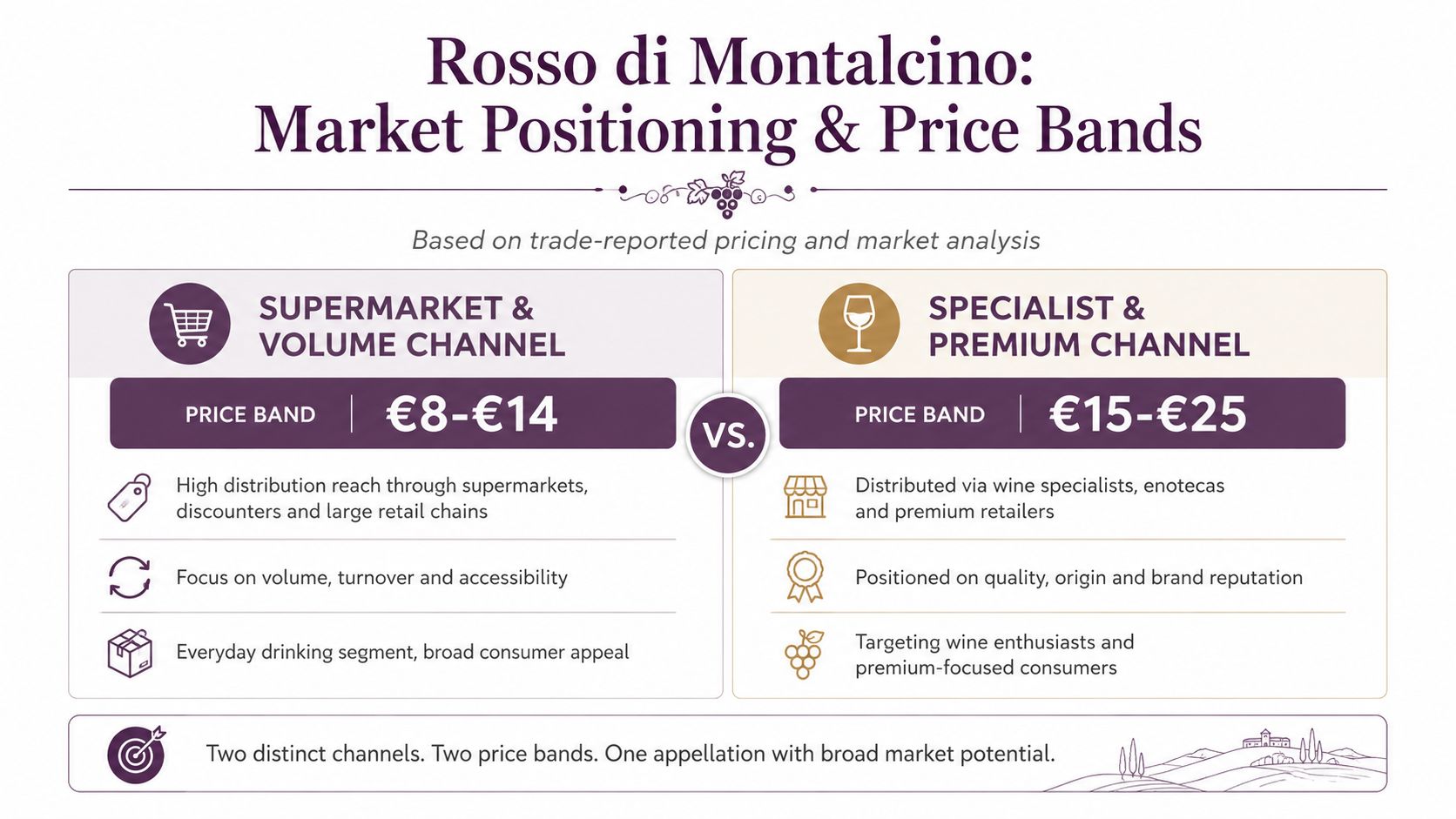
Trade-reported market analysis places the volume channel around €8 to €14 and the specialist or premium channel around €15 to €25. These should be used as positioning bands, not universal valuations. (Wine Labs fine wine market data)
<a id="what-each-band-communicates"></a>
What each band communicates
The lower band places Rosso in the accessible premium Tuscan-red segment. Retailers can use it for customers who recognize Montalcino but don't want to commit to Brunello pricing or extended cellaring. Volume availability and faster turnover matter more here than scarcity.
The specialist band supports a different sales conversation. A respected producer, a stronger vineyard source, a more ambitious oak program, or a mature bottle can justify a higher position. The wine is still generally below Brunello in market hierarchy, but that doesn't mean every Rosso should be treated as interchangeable.
Discounting requires diagnosis. A lower shelf price may reflect release pressure, an expanded allocation, older inventory, a case-format adjustment, or weak distribution. It may also indicate that a producer has repositioned the wine toward higher velocity. Without comparing the same producer, vintage, provenance, and channel, the discount tells the buyer very little.
<a id="a-practical-offer-comparison"></a>
A practical offer comparison
Before accepting a price as attractive, compare:
- Bottle basis: Check the price per bottle rather than relying on a case headline.
- Provenance: Establish whether the bottle comes through a reliable retail, restaurant, or secondary-market channel.
- Release timing: A current release and a mature bottle shouldn't be judged by the same benchmark.
- Producer tier: Compare like with like within the same estate, rather than using a denomination-wide average.
- Availability: A broad listing and a scarce allocation signal different market conditions.
Rosso's strongest commercial advantage is earlier access to Montalcino identity. Its strongest bottles can still behave like collectible fine wine, particularly when the producer has created a clear distinction from its volume release.
<a id="how-to-evaluate-a-rosso-di-montalcino-listing"></a>
How to Evaluate a Rosso di Montalcino Listing
A defensible purchase begins with identity verification, not the apparent bargain. Rosso di Montalcino has less secondary-market depth than Brunello, so provenance and label accuracy carry greater weight when a bottle is old, unusually cheap, or listed outside a specialist channel.
<a id="five-checks-before-purchase"></a>
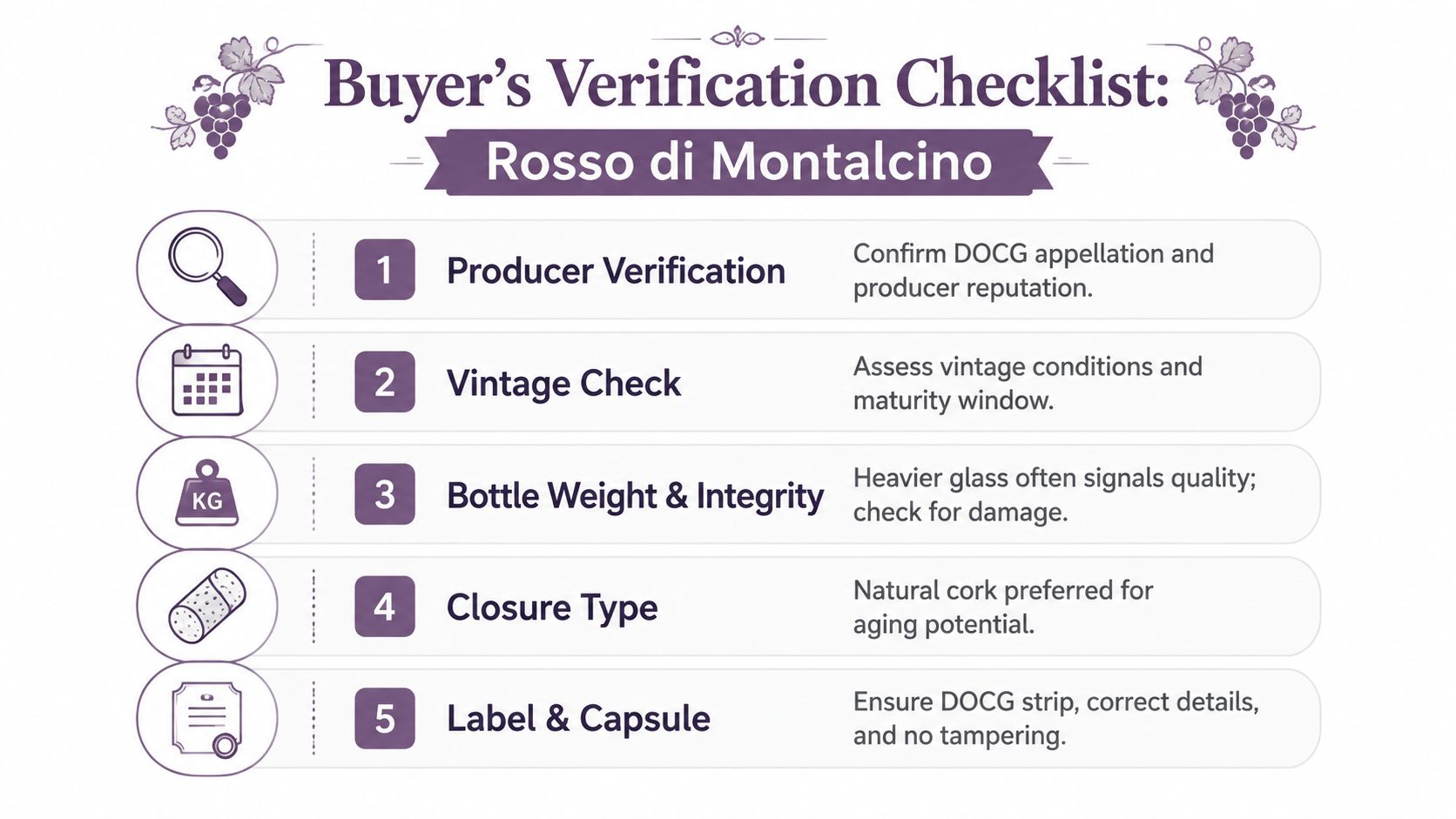
Five checks before purchase
-
Confirm the producer. Identify the estate, importer, and stated denomination. A recognized producer with a coherent Rosso portfolio offers a stronger starting point than an anonymous listing with vague Montalcino language.
-
Separate vintage from release year. The vintage identifies the harvest. The release year reflects when the producer made the wine available. Confusing the two can lead buyers to misjudge maturity and inventory age.
-
Inspect bottle weight and condition. Glass weight can offer a contextual quality signal, but it isn't proof of wine quality. Look for leakage, damaged capsules, label staining, and storage marks before assigning a premium.
-
Check the closure. Closure choice affects how a bottle should be assessed for aging potential and storage risk. Don't assume that a particular closure guarantees longevity.
-
Verify the label and capsule. Look for the correct appellation details, the official strip where applicable, intact printing, and the absence of tampering. Generic Toscana IGT labels should not be presented as Rosso di Montalcino.
Bulk filler can enter the conversation when listings blur the difference between a genuine Rosso, a declassified Brunello, an appassimento-style product outside the denomination's intended profile, and a generic Tuscan red. The label must establish what the bottle is before the price can establish whether it's worth buying.
For merchants, producer-level output tracking can provide a useful cross-check against declared bottlings and market availability. A practical flow is: confirm the producer, verify the vintage, inspect label integrity, compare the listing with released volume, then benchmark the offer against its channel.
<a id="where-the-category-is-heading"></a>
Where the Category Is Heading
Rosso di Montalcino's next phase will be shaped by three forces: a strict territorial rulebook, a larger supply base, and a widening split between early-drinking and ambitious styles. Together, they point to a category moving beyond its traditional role as Brunello's younger sibling.
The supply increase creates a clear downside risk. If the expanded vineyard base produces more entry-tier wine than the market can absorb, producers and distributors may face pressure to discount or increase promotional activity. That pressure won't necessarily reach the strongest estate bottlings. Small-production wines from recognized sites can retain a different market position even when broad DOC availability rises.
Climate also affects the positioning conversation. Sangiovese needs reliable ripening, and Montalcino's elevation and site variation can support a stronger regional argument than lower-altitude Tuscan comparisons. This doesn't remove vintage risk or guarantee quality, but it gives producers a useful basis for explaining why Montalcino Rosso can remain distinctive within a crowded Tuscan-red field.
<a id="a-category-with-two-growth-paths"></a>
A category with two growth paths
The broad DOC can absorb volume at moderate price points, supporting restaurants, retail programs, and export distribution. At the same time, a smaller group of estates can use Rosso as a prestige platform, extending the producer's fine-wine ladder without forcing customers to buy Brunello first.
Recent coverage has described the market as dividing between an “always Rosso” identity and a “Baby Brunello” identity, a distinction that affects aging expectations, positioning, and margins. (The Drinks Business)
The analyst view is that segmentation will deepen rather than disappear. Buyers should track Rosso as a category index, monitoring supply, release behavior, producer reputation, and channel pricing independently from Brunello. That approach makes it easier to distinguish a genuine premium bottling from a label that benefits only from Montalcino association.
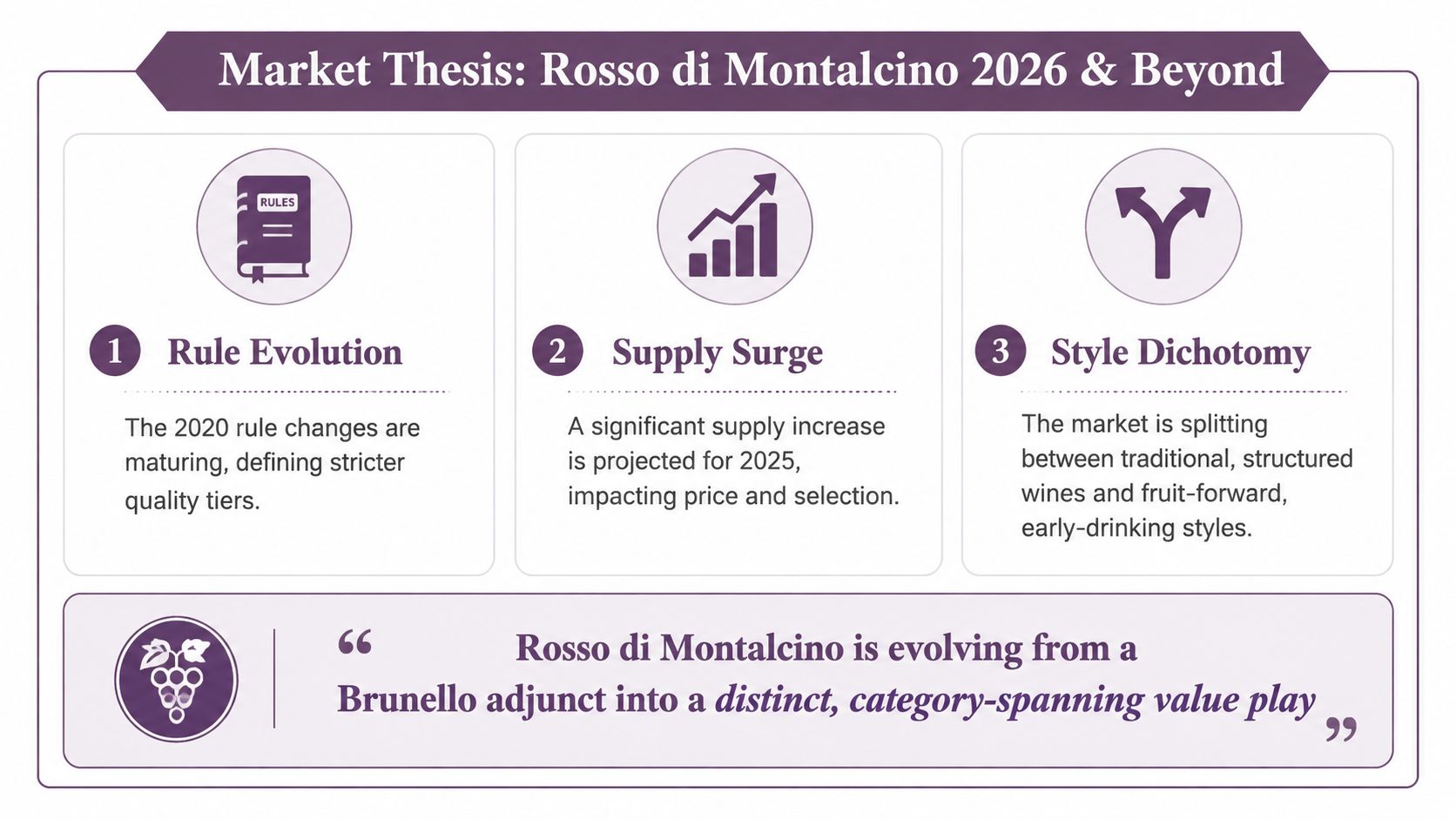
For broader portfolio analysis, Wine Labs' Tuscan sparkling and portfolio strategy digest offers a useful reminder that regional categories evolve through product architecture, not just production volume. Rosso di Montalcino is following the same path. It's becoming a distinct, category-spanning value play, with accessible bottles at one end and serious, age-oriented wines at the other.
Wine Labs consolidates retail, auction, exchange, restaurant, and other fine-wine pricing into comparable records, helping merchants, producers, collectors, and investors assess Rosso di Montalcino by producer, vintage, channel, and release context. Visit Wine Labs to compare listings, track price movement, and build a more defensible sourcing or portfolio strategy.