Wine Labs · Market intelligence
Tracking the Riesling Wine Price Across Markets
Explore current riesling wine price benchmarks, vintage histories, and cross-channel spreads. Learn how Wine Labs APIs track real-time market data.
A Riesling can occupy almost opposite positions in the market. Mass-market bottles may appear below $2 in some retail channels, while icon bottlings extend from roughly €150 to €5,000 or more, and auction-grade examples can reach five figures, as documented by VinoAlert's Riesling market overview. A single “average Riesling price” therefore conceals more than it reveals.
For merchants, collectors, and data teams, the useful question is not just what Riesling costs. It's which producer, vintage, style, region, bottle format, and sales channel are being compared. That distinction turns a shelf-price lookup into market intelligence. Canonical identity matching then provides the missing control, linking inconsistent listings to one comparable wine record before anyone calculates a benchmark, quotes a customer, or values a cellar.
Table of Contents
- Historical Context and Modern Price Dispersion
- The Global Riesling Pricing Ladder
- Identifying the Mid-Tier Value Sweet Spot
- Brand and Provenance in Price Formation
- Cross-Channel Spreads and Market Arbitrage
- Solving Identity Matching for Accurate Benchmarks
- Tracking Real-Time Pricing with Wine Labs APIs
- Strategic Applications for Industry Stakeholders
<a id="historical-context-and-modern-price-dispersion"></a>
Historical Context and Modern Price Dispersion
Riesling's current accessibility can obscure its former position. Historically, leading German Rieslings ranked among the world's most expensive white wines. During the nineteenth century, export-market prices sometimes exceeded those of the finest Bordeaux and Champagne, while elite bottles appeared above premium red Bordeaux on New York restaurant lists, according to Germany Rieslings' history of the category.
That premium later weakened after the world wars and the postwar move toward higher-yield varieties. The result is a striking market contrast: a grape associated with exceptional prestige in the 1800s now spans inexpensive supermarket wines, serious regional bottles, and scarce collector assets. The historical story matters because it shows that price is not a permanent property of the variety. Reputation, supply, production choices, and market context can rebuild or erode it.
U.S. pricing data also shows that Riesling's nominal value has not been static. A peer-reviewed Cornell study of 307 U.S. Riesling wines found that average nominal price rose from $11.20 in 2000 to $19.06 in 2016, a 70% increase over that period. The study also reported that the 2000 cohort averaged $16.48 in 2016 dollars, confirming that the climb remained substantial even after considering inflation through its real-price comparison (Cornell Dyson School study).
<a id="why-averages-fail"></a>
Why averages fail
A broad average combines products that buyers don't treat as substitutes. An entry-level off-dry bottle, a dry single-vineyard German Riesling, an Austrian Smaragd, and a mature sweet wine from a cult producer may all sit under the same varietal filter, but their economics differ sharply.
Practical rule: Treat the varietal name as a starting point for discovery, not as a valuation identity.
The modern Riesling market is best understood as a distribution with distinct tails. Supermarket inventory remains concentrated at accessible prices, while premium and icon wines behave more like scarce luxury goods. Historical prestige explains why the upper tail exists, but it doesn't tell a merchant whether a current listing is fairly priced. That requires producer, provenance, style, vintage, and channel-level comparison.
For readers following how premium Riesling competes with other luxury beverages, the Mosel Riesling and Hibiki 12 market discussion illustrates why category boundaries matter in contemporary product discovery. A collector searching only for “Riesling” will see a radically different market from one searching for a specific estate and vintage.
<a id="the-global-riesling-pricing-ladder"></a>
The Global Riesling Pricing Ladder
A practical Riesling valuation model starts with tiers rather than averages. Independent market coverage places entry-level German and Austrian Rieslings around €7–15, mid-range village and Kabinett or Federspiel wines around €15–35, premium Grosses Gewächs, Grand Cru, and Smaragd wines around €35–100, and icon bottlings such as Egon Müller, Keller, and Clos Sainte Hune from €150 to €5,000 or more. Auction-grade top wines can reach five figures, according to May Wines' Riesling pricing ladder.
These ranges should be read as market bands, not guaranteed transaction prices. They help a buyer test whether a quote belongs to the expected segment. They also separate wines whose pricing logic is entirely different. Entry-level bottles compete through accessibility and distribution, whereas icons depend on scarcity, producer reputation, provenance, and collector demand.
<a id="benchmark-table"></a>
Benchmark table
| Tier | Style / Classification | Typical Price Range (EUR/USD) | Market Behavior |
|---|---|---|---|
| Entry | German or Austrian regional Riesling, often accessible or off-dry styles | €7–15 | Broad distribution, high substitution, retail-led pricing |
| Mid-range | Village wines, Kabinett, Federspiel | €15–35 | Stronger regional identity, food-pairing demand, producer differences |
| Premium | Grosses Gewächs, Grand Cru, Smaragd | €35–100 | Site and producer reputation drive premiums; better cellar relevance |
| Icon | Egon Müller, Keller, Clos Sainte Hune and comparable bottlings | €150–€5,000+ | Scarcity-led pricing, allocation effects, collector and auction activity |
| Auction-grade | Exceptional mature or rare bottles | Five figures possible | Provenance, condition, vintage, and buyer competition dominate |
Dry premium Rieslings often command materially more than off-dry mass-market bottlings because the market attaches value to site specificity, lower production scale, and producer status. That doesn't mean sweetness determines price by itself. A sweet icon can be more valuable than a dry regional wine, while a dry entry-level bottle can remain inexpensive if its brand and origin carry little scarcity.
<a id="how-merchants-should-use-the-ladder"></a>
How merchants should use the ladder
The ladder becomes useful when attached to a specific commercial question:
- Sourcing: Compare a proposed cost with the correct tier, not with the entire Riesling category.
- Portfolio valuation: Separate current retail replacement value from auction potential and restaurant-list pricing.
- Catalog design: Give customers style and provenance filters so premium wines don't disappear inside a generic grape page.
- Data architecture: Store classification, region, producer, vintage, and channel as separate fields.
Teams building broader pricing systems can also compare this tiered logic with MCP server pricing tiers, provided they keep the product's own commercial structure separate from the wine's market classification. The important principle is consistent: a price tier only becomes meaningful when its definition is explicit.
<a id="identifying-the-mid-tier-value-sweet-spot"></a>
Identifying the Mid-Tier Value Sweet Spot
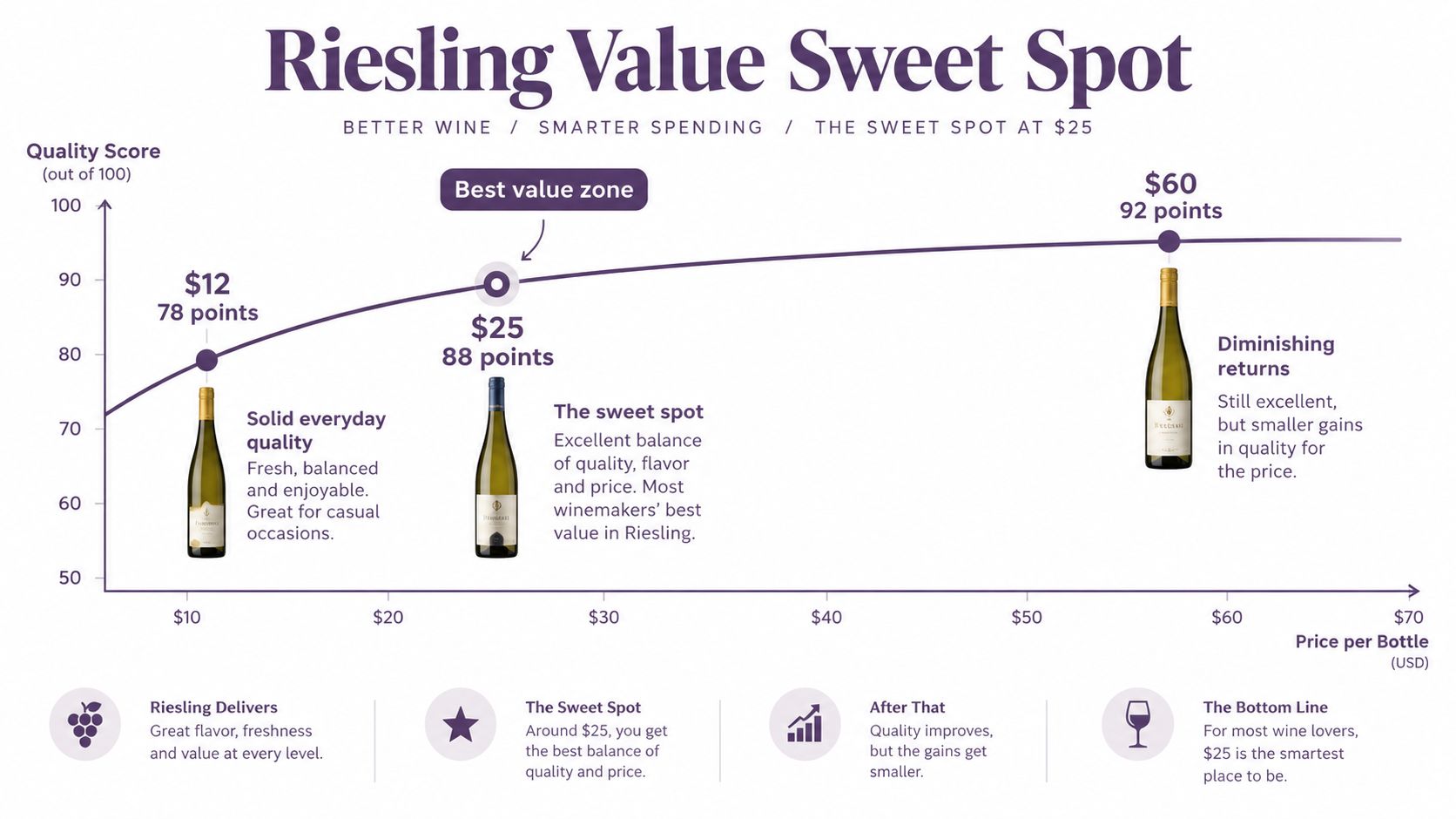
The cheapest Riesling isn't automatically the best value. A price-quality analysis identifies a sweet spot around €15–€25, where quality continues to improve before higher spending produces smaller incremental gains. The same coverage reports median quality rising from 87 points at €10–€15 to 89 points at €15–€20, as discussed by GrapeGuru's Riesling analysis.
That finding changes the buying question. A consumer focused only on the lowest shelf price may minimize the invoice while sacrificing regional definition, balance, or suitability for food. A restaurant buyer faces the same trade-off in a different form: a slightly higher acquisition cost may create a more convincing by-the-glass or pairing selection, while the most expensive bottle may add prestige without delivering proportional everyday utility.
<a id="the-curve-matters-more-than-the-floor"></a>
The curve matters more than the floor
The value curve has three practical zones:
- Entry: Low acquisition cost and broad availability, but quality can vary and the cheapest option may not represent the strongest value.
- Mid-tier: More pronounced quality gains, stronger regional signals, and a better balance between price and drinking performance.
- Premium: Greater site, producer, aging, or scarcity value, but diminishing utility for buyers seeking an everyday or food-service wine.
The distinction between value and cheapness is especially important for Riesling because the category includes multiple sweetness levels and production styles. A low-priced bottle might be perfectly appropriate for casual consumption, but it shouldn't be used as the benchmark for a dry Grosses Gewächs or a mature sweet wine.
A merchant who benchmarks every Riesling against the least expensive listing will systematically misread the category.
<a id="a-buying-framework-for-the-middle"></a>
A buying framework for the middle
For retail assortment, the mid-tier can serve as the category's interpretive center. It gives customers a step up from anonymous entry-level wine without forcing them into collector pricing. For restaurants, it can support a list that communicates origin and producer character while maintaining a workable cost structure.
The analysis also helps collectors avoid a false binary between inexpensive drinking wine and trophy bottles. Mid-tier Rieslings may provide the clearest combination of recognizable provenance, quality progression, and manageable replacement cost. Premium purchases still require separate evaluation, especially when scarcity and provenance become the main drivers.
The correct benchmark is therefore conditional. Ask whether the buyer wants refreshment, food compatibility, regional expression, cellar potential, or collectible scarcity. The mid-tier sweet spot is not a universal rule, but it's a strong default for buyers seeking quality gains without paying entirely for rarity.
<a id="brand-and-provenance-in-price-formation"></a>
Brand and Provenance in Price Formation
Riesling's grape designation explains only a limited share of its retail price. A peer-reviewed analysis of U.S. retail wines found that varietal identity accounted for 6.2% of price formation, while brand fixed effects accounted for 72% and geographic origin for 10.7% (Cambridge wine economics study). Riesling observations in that sample had an average retail price of $8.58. The wider implication is more useful than the average: brand and provenance often carry more pricing information than the grape name itself.
Producer reputation can reduce perceived purchase risk. Vineyard origin signals differentiation, while established labels may benefit from more consistent distribution and demand. At the upper end, scarcity and documented provenance can outweigh the contribution of the varietal designation. That helps explain why two bottles labelled “Riesling” may occupy very different price positions despite sharing a broad style.
A price record should therefore be read through an identity hierarchy:
- Variety: Riesling identifies the grape, but it predicts equilibrium price only weakly.
- Country and region: Germany, Austria, Alsace, and other origins establish the geographic frame.
- Producer: Brand effects can dominate the model, making the estate a central valuation field.
- Site and classification: Grand Cru, Grosses Gewächs, or a named vineyard can distinguish premium offers from regional bottlings.
- Vintage and condition: In collectible markets, age, storage, fill level, label condition, and provenance affect realizable value.
- Channel: Retail, exchange, auction, and restaurant prices answer different commercial questions.
The hierarchy matters particularly in digital marketplaces. A category page that applies one Riesling markup will miss producer premiums and inflate the apparent value of generic inventory. It can also create false anomalies when a rare producer appears beside a mass-market bottle under an unnormalized name.
Brand and origin belong in the pricing model, not only in descriptive metadata. A platform storing varietal, price, and bottle size can calculate an arithmetic average, yet that average may compare unlike products. Canonical matching, which connects inconsistent listing text to the same producer, wine, vintage, and format, makes cross-channel benchmarks more defensible.
Analyst's conclusion: The strongest Riesling benchmark is producer-specific before it is varietal-wide.
Merchants should compare like-for-like listings within the relevant channel. Collectors should separate replacement cost from liquidation value. Data teams should retain provenance fields instead of flattening them into one display name. Riesling price analysis fails less from a shortage of observations than from losing the attributes that explain why those observations differ.
<a id="cross-channel-spreads-and-market-arbitrage"></a>
Cross-Channel Spreads and Market Arbitrage
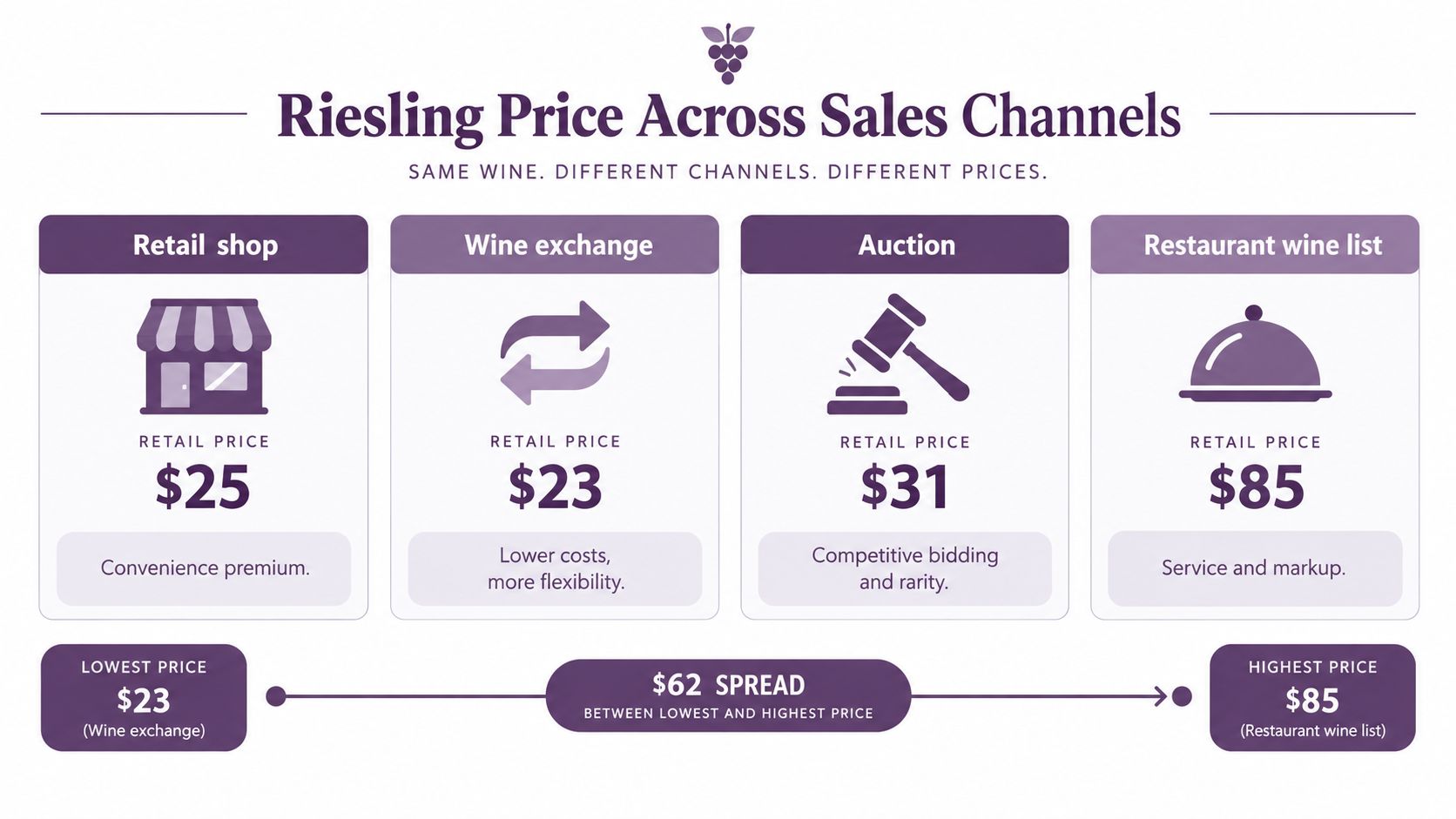
A Riesling price changes meaning when it moves between channels. A supermarket listing reflects shelf access and retailer economics. An exchange quote reflects a tradable market context. An auction result includes buyer competition and condition risk. A restaurant list incorporates service, storage, glassware, labor, and the venue's commercial model.
The same nominal wine can therefore show a wide spread without any seller making an error. The analytical mistake is comparing those figures as though they represented one market.
<a id="channel-roles-are-different"></a>
Channel roles are different
Retail provides the clearest reference for current consumer acquisition, but supermarket data can be heavily concentrated in accessible inventory. A Kroger category listing grouped 87 Riesling items from $0 to $12.49, 55 from $12.50 to $24.99, and only two above $25, showing that most supermarket Riesling sits below $25 (Kroger Riesling listings).
Specialty retail reveals a wider assortment. A WSJ Wine Riesling category includes bottles listed at $9.99, $13.99, $16.79, $18.99, $24.99, $28.99, $34.99, $39.99, and $49.99. The spread within one varietal category shows why supermarket medians can understate the role of origin and producer in specialist commerce.
The European Union's tax structure adds another useful control. Still and sparkling wine have a minimum excise-duty rate of EUR 0 per hectolitre, so EU Riesling differences aren't created by a uniform mandatory base excise floor. Origin, producer, distribution, and retailer margin remain central drivers, as described by the European Commission's alcohol excise-duty guidance.
<a id="arbitrage-requires-like-for-like-matching"></a>
Arbitrage requires like-for-like matching
A genuine arbitrage signal requires more than finding a lower number elsewhere. The wine must match on producer, cuvée, vintage, bottle size, condition, and availability. A lower restaurant price would be unusual in a direct acquisition comparison, but a restaurant listing can still offer a useful demand signal for merchants assessing how a wine is positioned in hospitality.
Use cross-channel data to ask:
- Is the retail quote for the same vintage?
- Does the auction lot include a different bottle condition or provenance history?
- Is the restaurant price a single-bottle menu price rather than a trade acquisition cost?
- Does the exchange listing represent an executable offer or an indicative quote?
- Are shipping, duty, storage, and buyer's premiums included?
Cross-channel spread is information, not automatically profit.
A merchant can exploit a mispriced listing only after adjusting for these differences. A collector can identify a replacement-cost gap, but shouldn't confuse it with guaranteed resale value. The discipline is simple: consolidate channels, normalize identities, then interpret the spread according to the transaction each channel supports.
<a id="solving-identity-matching-for-accurate-benchmarks"></a>
Solving Identity Matching for Accurate Benchmarks
Price analysis fails before the calculation begins if the system treats one wine as several products. Listings may abbreviate producer names, reorder appellation terms, omit accents, use different vintage formats, or attach inconsistent LWIN codes. Auction catalogs may describe a wine differently from a retailer, while restaurant lists may shorten the name for readability.
A scraper can collect all those records successfully and still produce a distorted benchmark. Duplicate listings inflate observation counts, mixed vintages blur price histories, and bottle-size differences make apparent discounts meaningless.
<a id="five-controls-for-canonical-records"></a>
Five controls for canonical records
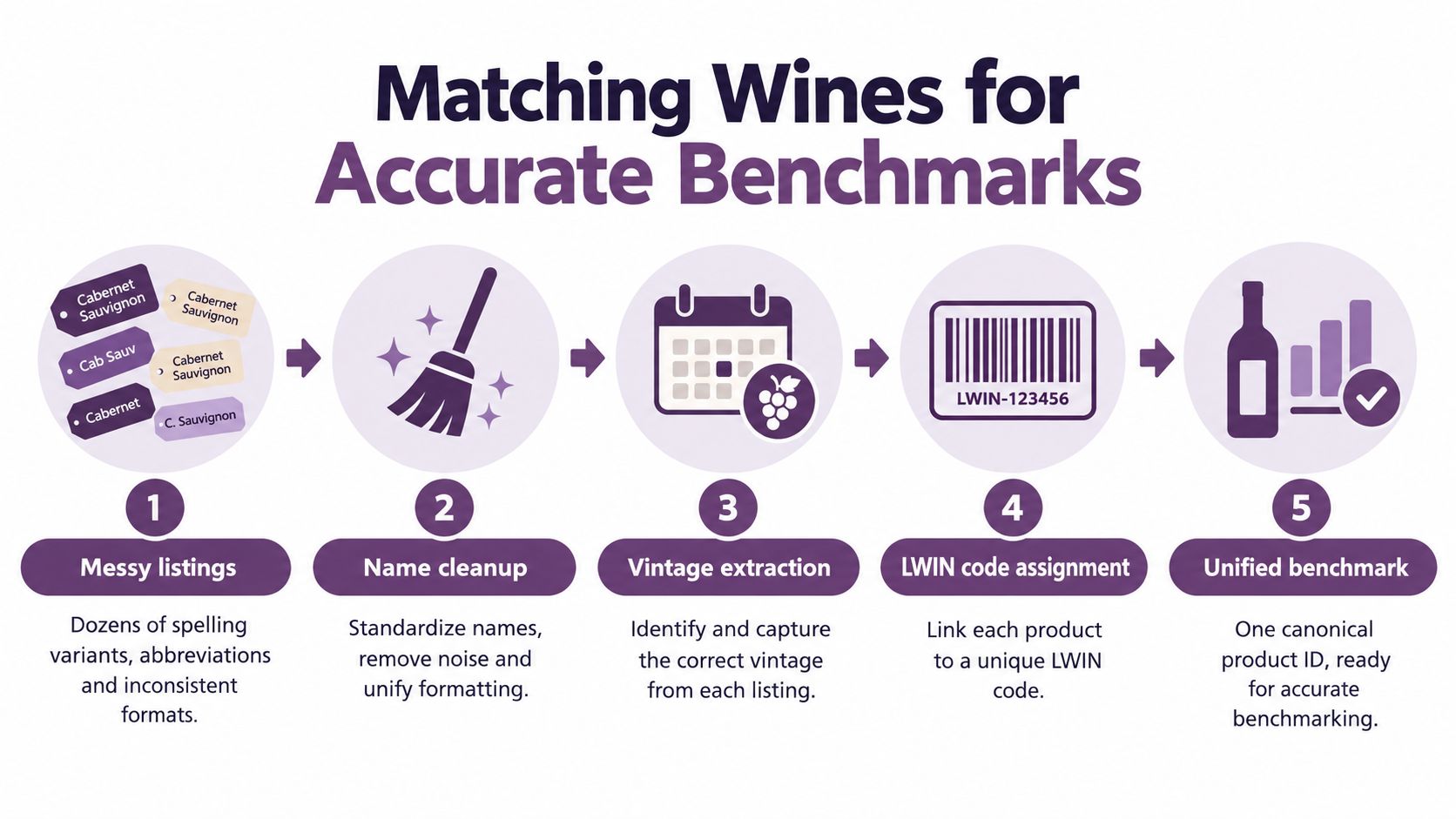
A well-built matching pipeline should separate cleanup from identification:
- Ingest the raw listing: Preserve the original title, source, timestamp, price, currency, bottle size, and channel.
- Clean the name: Standardize punctuation, accents, spacing, abbreviations, and common producer variants without destroying the raw text.
- Extract structured fields: Identify producer, cuvée, grape, region, classification, vintage, format, and condition where available.
- Assign or validate an identity code: Use LWIN or an equivalent canonical product identifier, with review rules for ambiguous matches.
- Build the benchmark: Aggregate only comparable records and retain channel and vintage dimensions for later analysis.
The fourth step is where many systems overstate confidence. A similar name doesn't prove that two listings describe the same wine. “Riesling Kabinett” may refer to different producers, sites, or vintages, and a generic label can't support a producer-level valuation.
<a id="why-normalization-changes-the-result"></a>
Why normalization changes the result
Canonical identities enable vintage-specific histories. They also let analysts compare retail replacement prices with auction outcomes without treating a restaurant's abbreviated listing as a new wine. The result is not merely cleaner data. It's a different analytical object, one where every observation has a defined relationship to the product being valued.
Teams can review a dedicated Wine Matching API workflow when they need programmatic normalization rather than manual catalog maintenance. The implementation should still retain uncertainty flags, because automated matching is most useful when it exposes ambiguous records for review instead of automatically forcing them into a benchmark.
A reliable matching system should report unmatched listings, confidence levels, and conflicting attributes. It should also prevent a vintage-less listing from being blended into a vintage-specific trend unless the analyst explicitly chooses that behavior. These controls protect merchants from false discounts and collectors from inflated portfolio values.
<a id="tracking-real-time-pricing-with-wine-labs-apis"></a>
Tracking Real-Time Pricing with Wine Labs APIs
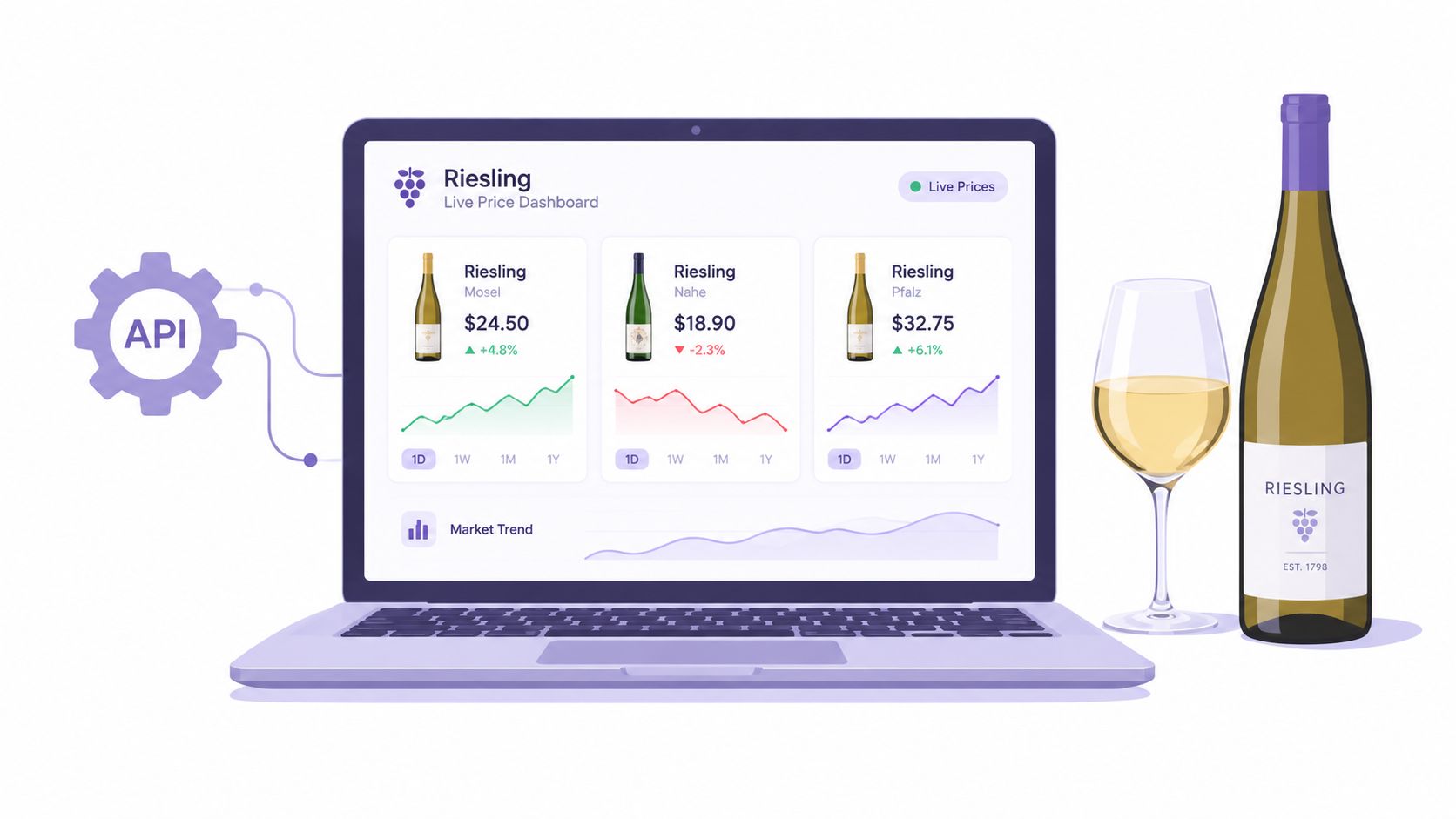
Once identities are stable, price monitoring becomes an operational workflow rather than a recurring research chore. A merchant can ingest retail and auction listings, attach them to canonical wine records, store timestamped observations, and trigger an alert when a target bottle changes position. A collector can upload a cellar file, match its contents, and compare estimated replacement value with current market evidence.
<a id="a-practical-monitoring-sequence"></a>
A practical monitoring sequence
Begin with the decision, not the endpoint. A distributor may need landed-cost comparison across markets, while a collector may care about a specific vintage and a merchant may want a replenishment alert for a defined producer tier.
A workable sequence looks like this:
- Define the universe: Select producers, regions, classifications, vintages, bottle formats, and channels relevant to the portfolio.
- Ingest observations: Use REST endpoints, custom feeds, or structured imports to capture prices and listing context.
- Resolve identities: Send raw names through matching logic before calculating medians, ranges, or trends.
- Apply market filters: Separate available retail offers from auction results, restaurant menus, and indicative exchange data.
- Set alerts: Monitor price movement, new listings, stock changes, or deviations from a chosen benchmark.
- Review exceptions: Inspect unusual prices for vintage, condition, currency, bottle size, or duplicate-record errors.
The Wine Labs market data API is one implementation option for teams that need programmatic access to consolidated market observations. Its relevance here is practical: a Riesling dashboard becomes useful only when it connects current prices to comparable identities and channel context.
<a id="from-monitoring-to-valuation"></a>
From monitoring to valuation
File-based portfolio tools can reduce manual spreadsheet work by matching cellar inventories to market records. A Cellar Pricer workflow, for example, can turn a stock file into a valuation view, while watchlists and configurable price-movement alerts help users focus on bottles that changed.
AI agents add another interface for questions such as which vintages have the widest retail-to-auction spread or which producer records lack sufficient comparable listings. Those outputs still need the same controls as a conventional report. The agent should show the matched wine, source channel, date, and assumptions behind the comparison.
For implementation teams, the core design principle is separation of layers. Store raw observations for auditability, canonical identities for comparability, calculated benchmarks for reporting, and alerts for action. That architecture lets a merchant change the valuation rule without losing the source data that supports it.
<a id="strategic-applications-for-industry-stakeholders"></a>
Strategic Applications for Industry Stakeholders
Riesling price intelligence creates different value for each participant because each participant faces a different form of uncertainty. A retailer needs to know whether a purchase quote fits its tier and local market. A collector needs a defensible estimate of replacement value. A producer needs to understand how the market positions its releases relative to comparable estates and sites.
<a id="merchants-and-retailers"></a>
Merchants and retailers
Merchants can use a tiered, canonical view to prevent two common errors. They can avoid overpaying for ordinary inventory that has been presented with premium language, and they can avoid underpricing scarce bottles because a generic category average makes them look expensive. Cross-channel comparison also helps separate a legitimate source opportunity from a listing whose low price reflects a different vintage or condition.
Assortment decisions improve when the buyer can see the category as a ladder. Entry-level bottles support accessibility, the mid-tier communicates quality progression, and premium labels create trade-up opportunities. The right mix depends on the store, but the underlying decision should use producer and provenance rather than “Riesling” alone.
<a id="distributors-and-importers"></a>
Distributors and importers
Importers face additional complexity because currency, duty, logistics, and channel margins affect the commercial offer. EU excise rules may remove a uniform base excise burden for still and sparkling wine, but that doesn't eliminate other cost differences. A distributor should therefore compare landed economics with market-facing prices rather than copying a foreign shelf price.
Canonical matching also supports portfolio rationalization. If several listings are duplicates of one product, demand may look larger than it is. If one producer is fragmented across spelling variants, the importer may miss the strength of its actual market presence.
<a id="producers-and-maisons"></a>
Producers and maisons
Producers can benchmark releases against the correct competitive set. That means comparing a dry premium Riesling with similar classifications, sites, and producers, rather than with inexpensive off-dry regional inventory. A release strategy built on varietal averages will usually miss the brand and provenance effects that shape actual price formation.
Producers can also monitor channel consistency. A large gap between retail positioning and restaurant placement may indicate a useful route to market, a margin issue, or a difference in service context. The data doesn't decide the commercial response, but it reveals where the question deserves investigation.
<a id="collectors-and-investors"></a>
Collectors and investors
Collectors should separate drinking value, replacement cost, and liquidation value. A bottle may be desirable because it delivers ageability or provenance without being easy to resell, while an icon may command a scarcity premium that makes condition and storage decisive. Auction evidence is informative, but it shouldn't be treated as interchangeable with retail availability.
The strongest portfolio process records the exact wine identity, vintage, format, acquisition context, and storage history. It then compares current evidence across appropriate channels. That discipline limits the temptation to value every bottle using the highest visible listing.
<a id="platforms-and-data-teams"></a>
Platforms and data teams
Digital marketplaces need identity resolution before they build ranking, pricing, or recommendation features. Without it, duplicate products split demand, mixed vintages distort trends, and category averages bury the wines that customers seek.
A unified data layer can support:
- Comparable search: Filter by producer, site, vintage, style, and channel.
- Transparent valuation: Show whether a figure reflects retail, auction, exchange, or restaurant evidence.
- Exception handling: Flag ambiguous matches and unusual prices for human review.
- Programmatic workflows: Deliver normalized records to catalogs, merchant systems, and portfolio tools.
- Faster decisions: Alert users when a relevant listing or benchmark changes.
Riesling is an unusually clear test case because its price dispersion is so wide. If a system can distinguish a supermarket bottle from an icon producer, preserve vintage identity, and explain channel spreads, it can support more credible pricing decisions across the broader fine-wine market.
Wine Labs consolidates retail, auction, exchange, and restaurant pricing into a comparable view, with canonical wine matching, historical tracking, portfolio valuation, alerts, and programmatic access for market-data workflows. Visit Wine Labs to evaluate how a structured Riesling benchmark could improve sourcing, quoting, and cellar valuation.