Wine Labs · Market intelligence
Price Rate of Change Indicator: Wine Investing Insights
Master the price rate of change indicator for fine wine investing. Learn calculation, interpretation, and momentum analysis with Wine Labs.
Why does the price rate of change indicator get treated like a universal momentum signal when wine prices don't move like equities, currencies, or futures? In fine wine, the question isn't whether ROC can be calculated, it's whether the same reading means anything across regions, vintages, and trading channels. That gap matters because broad market weakness can coexist with selective strength, and a single oscillator can blur that dispersion instead of clarifying it.
Table of Contents
- Why Standard ROC Explanations Fall Short in Fine Wine
- Understanding the Price Rate of Change Calculation
- The Lookback Window Problem in Wine Markets
- Choosing the Right Timeframe for Your Strategy
- Implementing ROC Analysis with Wine Labs
- Setting Up Alerts and Monitoring Workflows
- When ROC Adds Value Versus When It Doesn't
<a id="why-standard-roc-explanations-fall-short-in-fine-wine"></a>
Why Standard ROC Explanations Fall Short in Fine Wine
Most descriptions of price rate of change stop at the formula and a generic momentum interpretation. That's useful, but incomplete, because ROC only measures the percentage change from one price point to another, and the meaning of that change depends on the market behind it. In a fast market, a short lookback can be informative. In a slow, sparse market, the same lookback can turn into noise.
Fine wine makes that limitation impossible to ignore. Liquidity varies by region, producer, vintage, and channel, so the same ROC reading can reflect real demand in one segment and stale pricing in another. That is why a single indicator can look convincing on paper while failing in practice.
The bigger issue is predictive power. ROC is often introduced as if it were a clean momentum signal, but in thin markets it can be a lagging description of prior repricing rather than a reliable early warning. The practical question is not whether ROC works in general, but whether it adds information beyond trend context, spread behavior, and regime awareness.
A useful starting point for trend work is a broader framework like WebscrapingHQ's trend analysis guide, because ROC only becomes useful when it sits inside a larger view of market structure.
Practical rule: Treat ROC as a context-sensitive measure, not a standalone trigger. In wine, the same percentage change can mean momentum, illiquidity, or delayed repricing.
Liv-ex's own index dispersion shows why this matters. In 2024, the broad Fine Wine 100 was down 1.5%, while the Champagne 50 rose 0.5% and the Italy 100 gained 1.7% (Liv-ex 2024 retrospective). That kind of divergence means a single ROC reading can hide more than it reveals.
<a id="understanding-the-price-rate-of-change-calculation"></a>
Understanding the Price Rate of Change Calculation
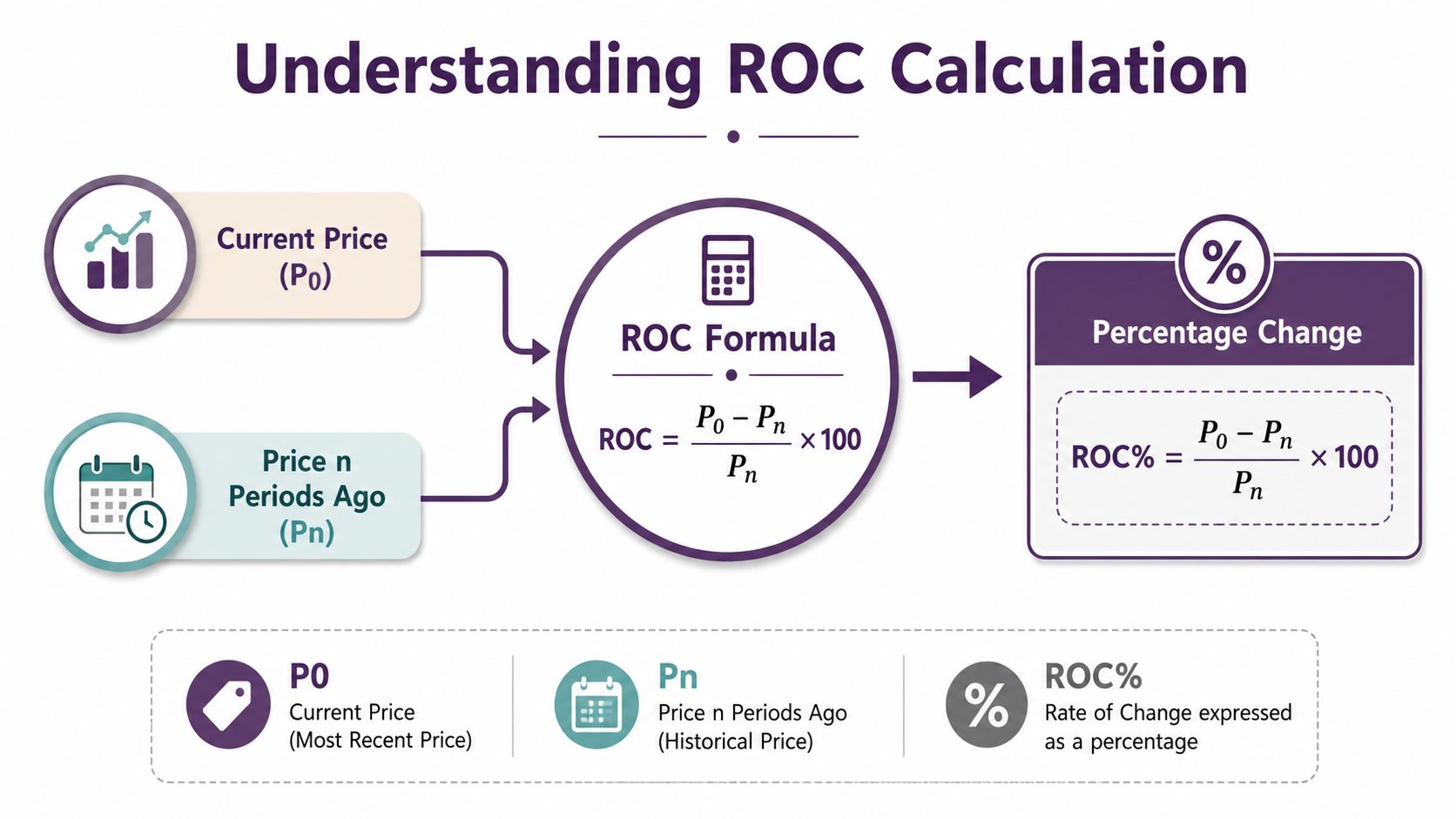
The calculation is straightforward. ROC = [(Current Price - Price n periods ago) / Price n periods ago] × 100. The current price is the latest observable value, and the earlier price is the reference point set by your lookback window. Because the result is expressed as a percentage, it is easier to compare wines that trade at very different price levels.
A positive ROC means the current price is above the earlier price. A negative ROC means it is below that reference point. The interpretation changes as soon as the lookback window changes. A shorter window captures nearer-term movement, while a longer one filters out some noise and places more weight on broader drift.
For example, a wine that moves from 100 to 105 over a short window produces a positive ROC of 5. The same wine can still appear modestly positive over a longer window, or it can look weaker if earlier prices were higher. The formula has not changed, only the reference point has, which is why the same asset can produce different readings at different horizons.
Useful check: If changing the lookback period changes the sign or strength of ROC, the signal is reflecting both the time horizon and the wine itself.
That distinction matters more in wine than in continuous, high-liquidity markets. A 14-period ROC on a frequently traded bottle can capture a real change in demand, while a longer lookback can smooth away a temporary gap. In a thin market, a short window can overreact to one auction print or a single channel adjustment, so analysts who analyze price movements need to treat ROC as one input rather than a standalone conclusion.
Liv-ex's own year-end review shows why the context matters. In its Liv-ex 2024 Year in Review report, published in December 2024, the broad Fine Wine 100 was down 1.5%, while the Champagne 50 rose 0.5% and the Italy 100 gained 1.7%. That kind of divergence means a single ROC reading can hide more than it reveals when regions and indices are moving on different regime paths.
<a id="the-lookback-window-problem-in-wine-markets"></a>
The Lookback Window Problem in Wine Markets
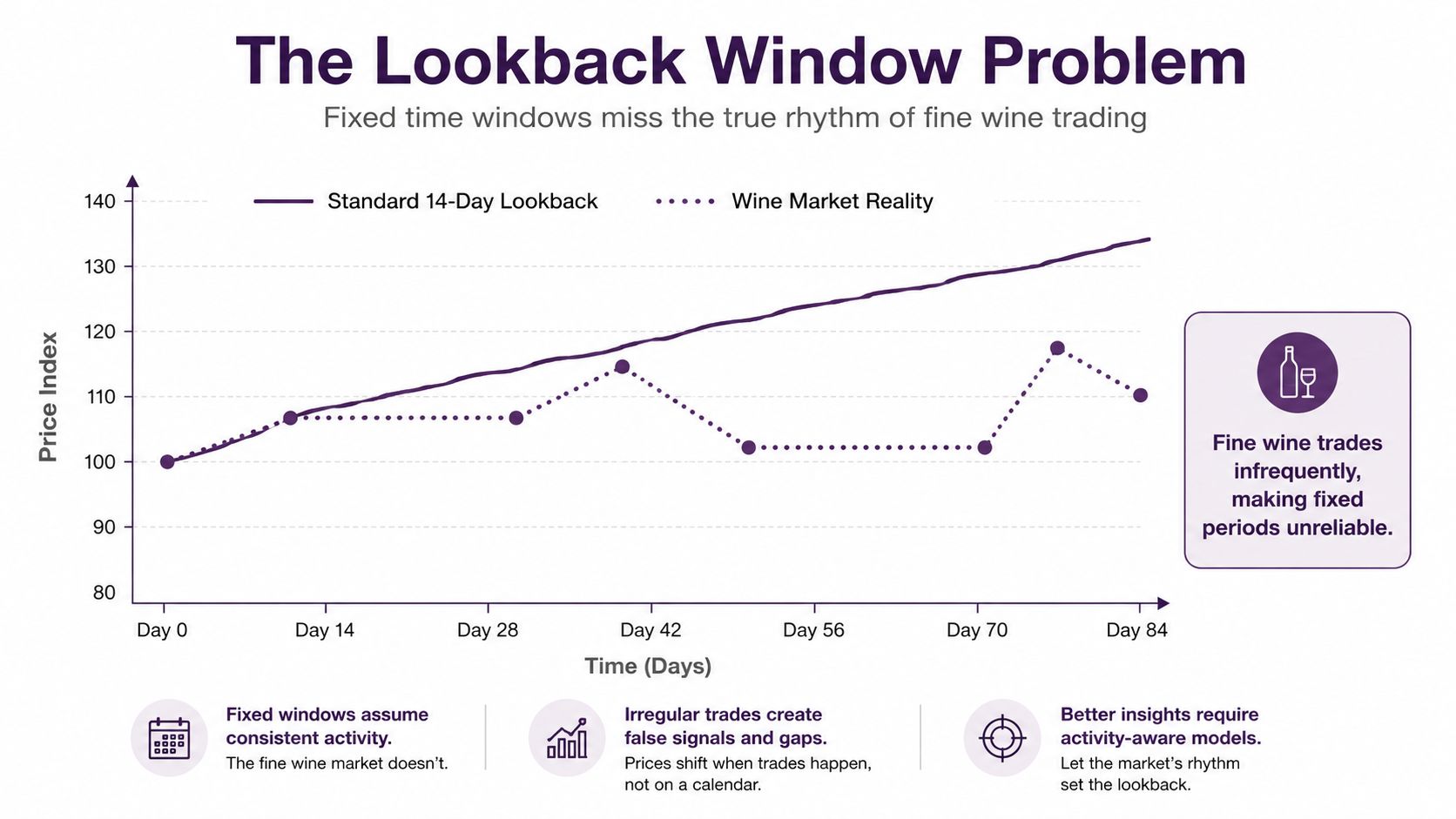
Fixed lookback defaults assume continuity that fine wine often doesn't have. A 14-period or 20-period setting can make sense in liquid instruments, but wine trading is uneven. Some names change hands often enough for short windows to be meaningful, while others print so irregularly that the same window mostly records gaps.
That is why regional dispersion matters. Liv-ex reported that the broad Fine Wine 100 fell 1.5% in 2024, while the Champagne 50 rose 0.5% and the Italy 100 gained 1.7% (Liv-ex 2024 retrospective). A single ROC setting cannot explain those differences well, because momentum is not behaving uniformly across segments.
<a id="why-the-same-window-misleads"></a>
Why the same window misleads
Short windows can work better where trading is frequent and repricing is quick. They tend to be noisier where transaction cadence is low, because one trade can dominate the reading. Long windows reduce that problem, but they can also lag real changes in sentiment, especially around auctions or campaign-driven price resets.
The internal tension is simple. The more liquid the sub-market, the more useful a shorter ROC becomes. The thinner the market, the more a longer window tends to be needed, though even then the indicator should be read alongside channel-specific context.
A practical way to think about it is to match the lookback to the repricing rhythm of the wine, not to a generic technical-analysis template. For a deeper market-specific example of how regional pricing can behave unevenly, the internal note at https://winelabs.ai/insights/news_digest/bordeaux-price-correction-global-rtd-growth-latin-american-wine-june-6-2026 is a useful reference point for comparing sub-markets.
<a id="choosing-the-right-timeframe-for-your-strategy"></a>
Choosing the Right Timeframe for Your Strategy
The right ROC horizon depends on the decision you're trying to make. A merchant reacting to inventory turnover doesn't need the same setup as a collector evaluating a cellar position. If the goal is to respond to near-term demand shifts, a shorter horizon is usually more relevant. If the goal is to understand structural drift, a longer one is better.
<a id="short-medium-and-long-horizons"></a>
Short, medium, and long horizons
Short horizons fit active trading behavior. They're most useful when prices can move around auction results, campaign releases, or concentrated buying interest. They can also help flag overbought conditions, but only if the wine trades often enough for the reading to represent real activity.
Medium horizons suit pricing and inventory decisions. They're better when you want to smooth out one-off prints without losing sight of a trend. For merchants, that often means reading momentum as part of a quoting or restocking process.
Long horizons are the least reactive and the most tolerant of sparse data. They're useful when the question is whether a wine has sustained a multi-period shift rather than whether it popped after a single event. That makes them more appropriate for strategic allocation than for tactical entry timing.
A shorter lookback is a timing tool. A longer lookback is a regime tool.
The mistake is using one setting for every task. A collector shouldn't expect a short ROC to behave like a durable valuation signal, and a merchant shouldn't rely on a long ROC to catch an immediate move. The right horizon is the one that matches the frequency of your decisions, not the one that sounds mathematically tidy.
<a id="implementing-roc-analysis-with-wine-labs"></a>
Implementing ROC Analysis with Wine Labs
Manual ROC calculation breaks down fast once you're following many wines across multiple channels. The harder problem isn't the formula, it's identity consistency. If the same wine appears under different labels, formats, or codes, the price series you're comparing may not be comparable at all. That turns a clean-looking ROC into a false signal.
Wine market data is fragmented across retail, auction, exchange, and restaurant channels, which makes cross-channel comparison difficult without normalization. Wine Labs' API documentation explains how programmatic access fits into that workflow, especially when you need structured price histories rather than isolated snapshots (Wine Labs API docs). The analytical value comes from treating the wine as one entity across different sources instead of as a set of disconnected listings.
<a id="what-normalization-changes"></a>
What normalization changes
Canonical identity matching is the prerequisite for ROC work in wine. Without it, the denominator and numerator in the ROC formula may come from different product records, which makes the percentage change meaningless. With it, you can compare like for like across markets and avoid mistaking catalog noise for momentum.
That matters for trend indicators and gainers or decliners lists. If the underlying identity layer is weak, the output will inherit that weakness. If the identity layer is strong, ROC becomes more useful because the price history reflects the same asset over time rather than a series of naming variants.
The practical insight is simple. ROC doesn't fail first because of math. It fails first because of data quality. In fine wine, the quality of the comparison matters more than the elegance of the formula.
<a id="setting-up-alerts-and-monitoring-workflows"></a>
Setting Up Alerts and Monitoring Workflows
A ROC reading only matters if someone sees it in time to act. That means the workflow has to be built around thresholds, watchlists, and portfolio review, not around occasional manual checks. In wine, the point isn't to watch every bottle equally. It's to watch the right bottles closely enough to catch change early.
Wine Labs' market data and alerting tools are designed for that kind of monitoring, with market snapshots and configurable signals that fit a price-driven workflow (Wine Labs market data features). The logic is straightforward. You define the wines you care about, set the movement you want to monitor, and then route the alert into a decision process.
<a id="three-practical-setups"></a>
Three practical setups
- Early momentum watchlists: Track high-priority wines that trade often enough to support a short ROC horizon. Use them for identifying a new trend before it becomes obvious in broader indices.
- Purchase discipline alerts: Flag wines that have moved too far, too fast, before you buy. That helps avoid entering after a short-lived spike.
- Portfolio review triggers: Monitor held wines for a break in trend so you can reassess valuation assumptions before the market forces the issue.
The Cellar Pricer workflow becomes useful here because it translates holdings into market-valued outputs that can be reviewed against momentum readings. That's especially helpful when a position looks stable in a spreadsheet but not in the live market data.
The strongest setup is one that separates signal from action. ROC should tell you where attention is needed, while the rest of the workflow decides whether that attention turns into a quote, a bid, or a hold.
<a id="when-roc-adds-value-versus-when-it-doesnt"></a>
When ROC Adds Value Versus When It Doesn't
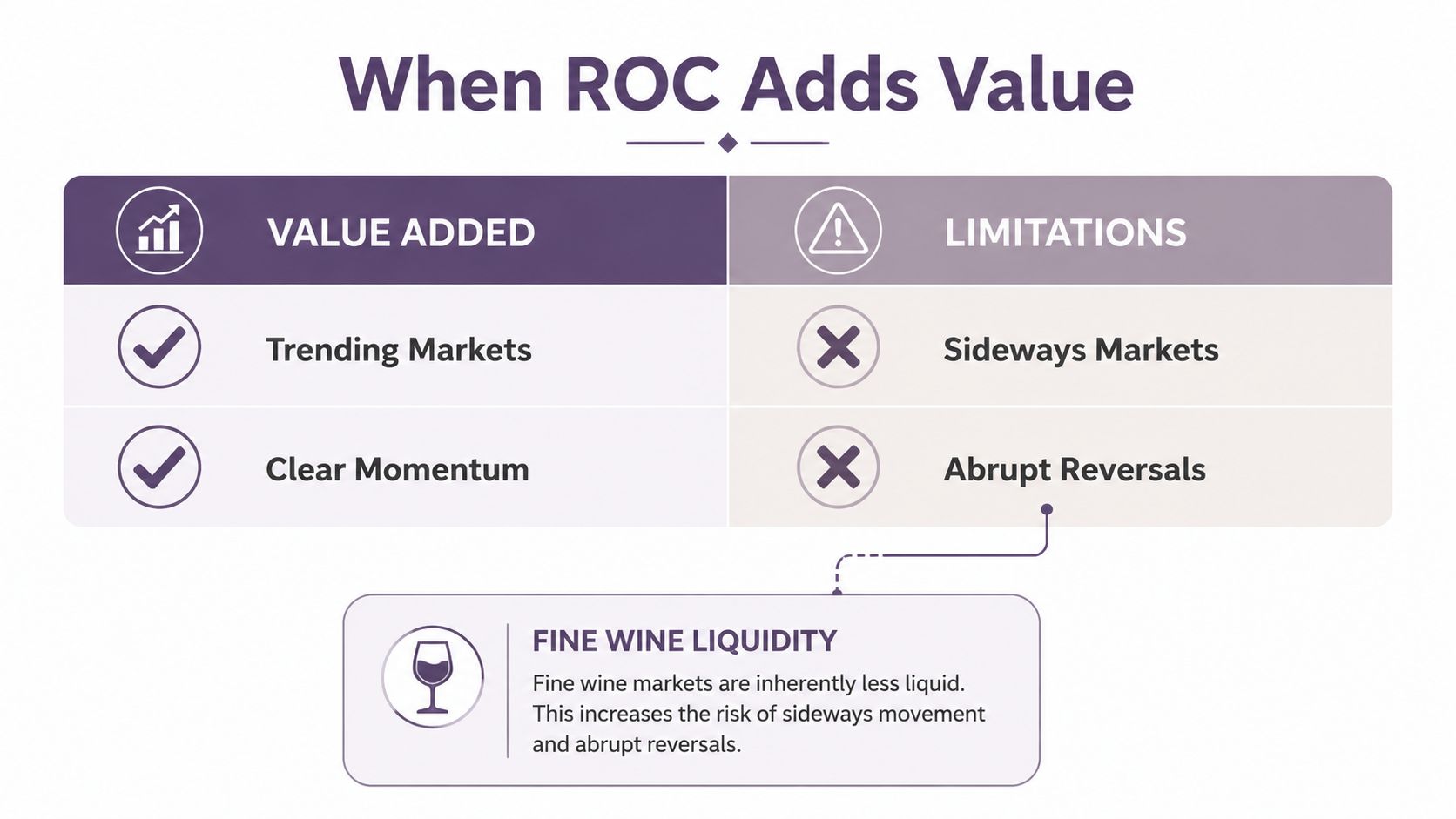
ROC adds the most value when price discovery is orderly enough for momentum to be measured rather than guessed. In those periods, it can separate a genuine bid from a short-lived bounce and show whether buying pressure is still broadening or starting to fade. That makes it useful for timing decisions in wines and indices that trade often enough for the signal to reflect actual repricing, not just noise.
Its value drops when the market is thin or trapped in a range. In those settings, ROC can cross above and below zero without telling you much about the next move, because the underlying market structure has not resolved. It also has clear blind spots during abrupt reversals, where the first change is often a loss of liquidity or a gap in quoting before any momentum reading becomes informative.
<a id="where-to-trust-it-and-where-not-to"></a>
Where to trust it, and where not to
| Value Added | Limitations |
|---|---|
| Trend continuation after a clean breakout | Range-bound trading with repeated whipsaws |
| Confirmation after volume improves | Abrupt reversals driven by a liquidity shock |
A useful wine-specific example is the kind of turn that can follow an auction-led repricing in a single vintage. A Bordeaux or Burgundy lot can stop clearing at prior levels after a weak result, then reprice lower across the secondary market before ROC has enough observations to confirm the shift. In that sequence, the indicator often reacts after the move is already visible in offers and成交 quality, so it works better as confirmation than as an early warning.
That limitation becomes sharper when region and market regime diverge. A broad index may still look orderly while individual segments are moving differently, as the 2024 split between the Fine Wine 100, Champagne 50, and Italy 100 showed (Liv-ex 2024 retrospective). In a setup like that, ROC can look clean at the aggregate level while masking the fact that one region is still holding up and another is already re-rating.
The best use of ROC in wine is to test whether a move is being confirmed by the market structure around it. If the indicator agrees with trend direction, trading activity, and cross-region context, it adds useful discipline. If those pieces do not line up, the safer read is that the signal is still incomplete, not that the move is tradable.