Wine Labs · Market intelligence
Portfolio Evaluation Tool: A Guide for Wine Investors
Discover how a portfolio evaluation tool simplifies fine wine investment tracking with key metrics and valuation methods.

What does your wine portfolio represent: the price shown on a screen, the amount you could realise at a particular venue, or a return measured against a benchmark that resembles your holdings? Most portfolio evaluation tools answer only the first question. That creates a dangerous illusion of precision in a market where retail offers, auction results, broker bids, exchange activity, provenance, and liquidity can point in different directions.
A useful portfolio evaluation tool must therefore do more than total bottles and assign prices. It should identify the asset correctly, compare like with like, separate allocation from selection effects, and explain whether a quoted value is achievable under a defined selling scenario. That distinction matters especially in fine wine, where the market remained in correction mode in 2025. The Liv-ex Fine Wine 100 fell about 4.4% in the first half of 2025, while trading volume rose 11.9% during the same period, a combination showing why price direction and market activity shouldn't be treated as interchangeable signals. Liv-ex market data and index resources
Table of Contents
- Why Most Portfolio Valuations Miss the Mark
- Core Metrics Every Wine Portfolio Needs
- Valuation Methods Compared
- The Benchmark Problem in Fine Wine
- Building a Reliable Portfolio Workflow
- Identity Matching and Data Quality
- Real Problems Solved by Modern Tooling
<a id="why-most-portfolio-valuations-miss-the-mark"></a>
Why Most Portfolio Valuations Miss the Mark
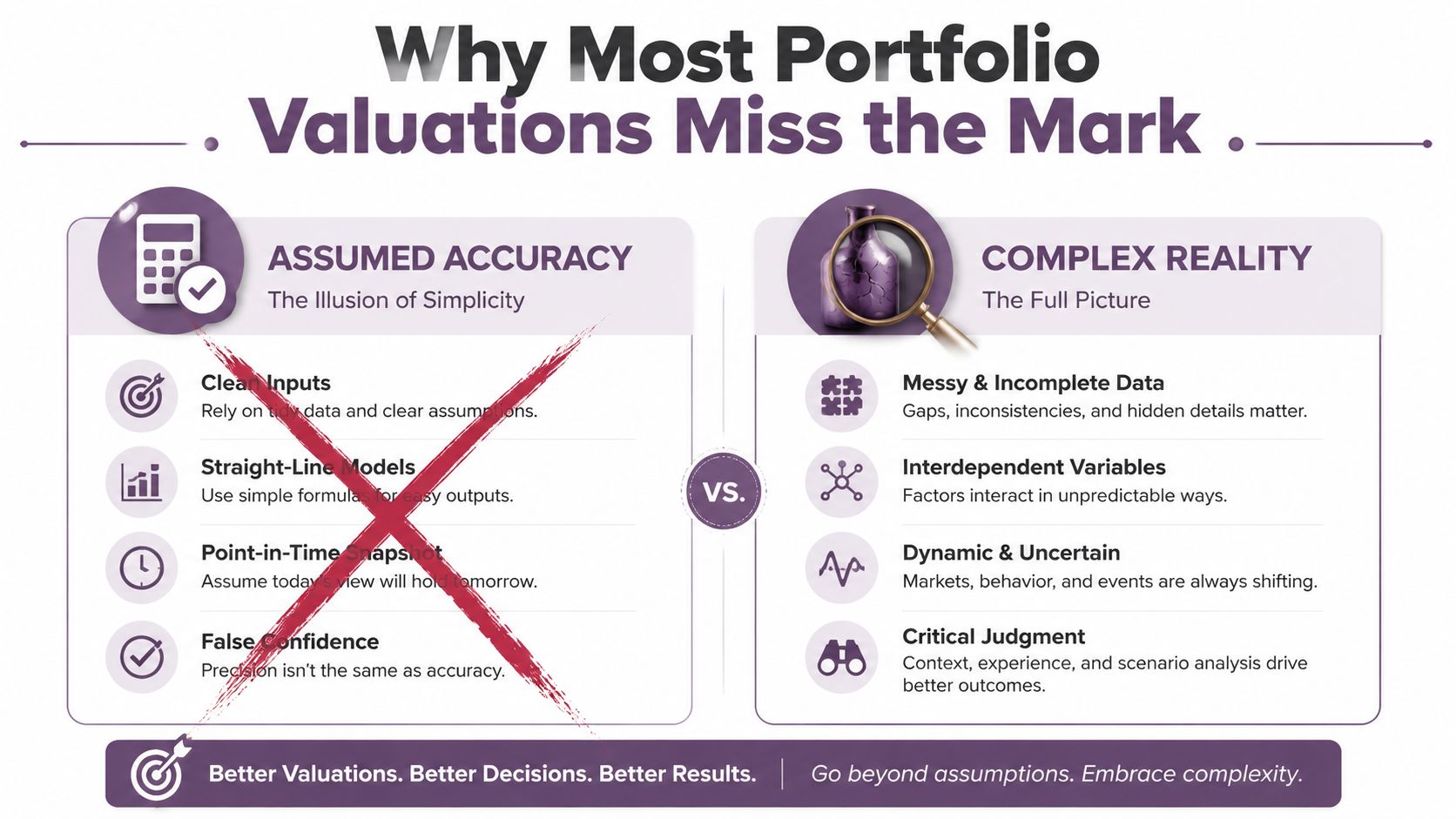
The common assumption is simple: upload a cellar, retrieve a price, and call the result portfolio value. That workflow is convenient, but it confuses price discovery with realisation value. A displayed number may describe an asking price, a historical auction result, or an indicative bid. Each answers a different investment question.
A valuation becomes meaningful only after you define the venue, timing, selling route, and costs. A collector preparing for an orderly sale over time needs a different mark from a merchant pricing replacement stock, and both differ from an investor assessing what could be exited quickly. Treating those figures as identical turns a conditional estimate into a misleading balance-sheet number.
<a id="three-prices-can-all-be-correct"></a>
Three prices can all be correct
Auction data records completed transactions, but it's tied to a particular house, sale date, lot condition, and buyer audience. Retail pricing shows what a merchant wants to receive, not necessarily what a buyer will pay. Broker or exchange bids indicate potential exit liquidity, yet they may sit below visible offers because the buyer is assuming inventory, financing, and execution risk.
The result is a market with several legitimate reference points rather than one universally correct price. Insurance replacement cost, orderly liquidation value, and immediate bid-side value should be kept separate in any serious report.
Practical rule: Never ask whether a bottle has a price. Ask which market participant would pay it, through which venue, and under what execution conditions.
Costs further weaken headline valuations. Buyer premiums, seller commissions, storage, shipping, duty treatment, and handling can all change the amount an owner ultimately receives. The exact effect depends on the transaction structure, so a tool that shows a gross mark without identifying deductions gives the user an incomplete decision signal.
The deeper failure is contextual, not technological. A database can contain extensive pricing and still produce a poor valuation if it cannot distinguish a current bid from an old retail offer, or a perfect bottle from stock with uncertain provenance. Data access is not the same as valuation discipline.
<a id="core-metrics-every-wine-portfolio-needs"></a>
Core Metrics Every Wine Portfolio Needs
A total portfolio value is an output, not an analysis. Investors need to know what drives that total, how sensitive it is to market conditions, and whether the stated value could be realised. Institutional performance systems provide a useful model here. The MSCI explanation of performance attribution describes platforms that decompose excess return into allocation, selection, and interaction effects, while connecting performance analysis with unified risk analytics and look-through reporting.
Wine portfolios need the same habit of decomposition, adapted to physical assets and fragmented venues.
| Metric | Definition | Why It Matters |
|---|---|---|
| Current market valuation | A mark built from relevant, comparable market observations | Establishes a reference value, but only becomes useful when venue and price type are visible |
| Unrealised profit and loss | Current mark compared with acquisition cost, including relevant provenance premiums | Separates apparent appreciation from the actual cost basis |
| Regional concentration | Exposure grouped by region, appellation, or market segment | Shows whether one regional cycle dominates portfolio behaviour |
| Producer concentration | Share of value linked to individual estates or brands | Identifies single-name exposure that a broad regional label can hide |
| Vintage distribution | Holdings mapped across vintages and maturity stages | Highlights drinking-window concentration and release-cycle risk |
| Liquidity score | An estimate of how readily a position could be sold near its stated mark | Tests whether valuation and exitability are aligned |
| Turnover and holding period | Trading frequency and length of ownership | Clarifies whether the strategy depends on active rotation or long-term maturation |
| Benchmark-relative return | Portfolio performance compared with a relevant index or custom comparator | Shows whether results reflect selection skill, market direction, or both |
<a id="concentration-reveals-the-portfolios-real-risk"></a>
Concentration reveals the portfolio's real risk
A collection heavily concentrated in Bordeaux behaves differently from one spread across Burgundy, Champagne, and other regions, even if both show the same current value. Vintage concentration adds another layer. Holdings clustered around one release period may mature together, reach a common selling window, or suffer simultaneously when buyers move toward younger or more liquid stock.
Liquidity deserves separate treatment because a high mark can coexist with a difficult exit. A wine may have an attractive replacement price while producing weak bids, sparse transactions, or substantial execution friction. That doesn't make the asset unattractive, but it changes the return an investor should require.
<a id="benchmark-choice-is-itself-an-analytical-decision"></a>
Benchmark choice is itself an analytical decision
The Liv-ex Fine Wine 100 is described as the industry's leading benchmark and tracks 100 sought-after fine wines with a strong secondary market. Its page lists a current value of 320.8, with 0.3% month-over-month, 0.4% year-to-date, and 3.3% over one year. Liv-ex Fine Wine 100 index details
The Liv-ex Fine Wine 50 is narrower. It tracks the ten most recent vintages, excluding en primeur, of Bordeaux First Growths and is updated daily. Its listed value is 289.8, with 0.7% month-over-month, -0.1% year-to-date, and 1.7% over one year. Liv-ex index information
Those indices aren't interchangeable. A portfolio dominated by mature Burgundy, Champagne, or less frequently traded wines shouldn't be judged as though it were a direct replica of either index. The right tool lets the investor test several reference frames rather than hiding the choice inside a single number.
<a id="valuation-methods-compared"></a>
Valuation Methods Compared
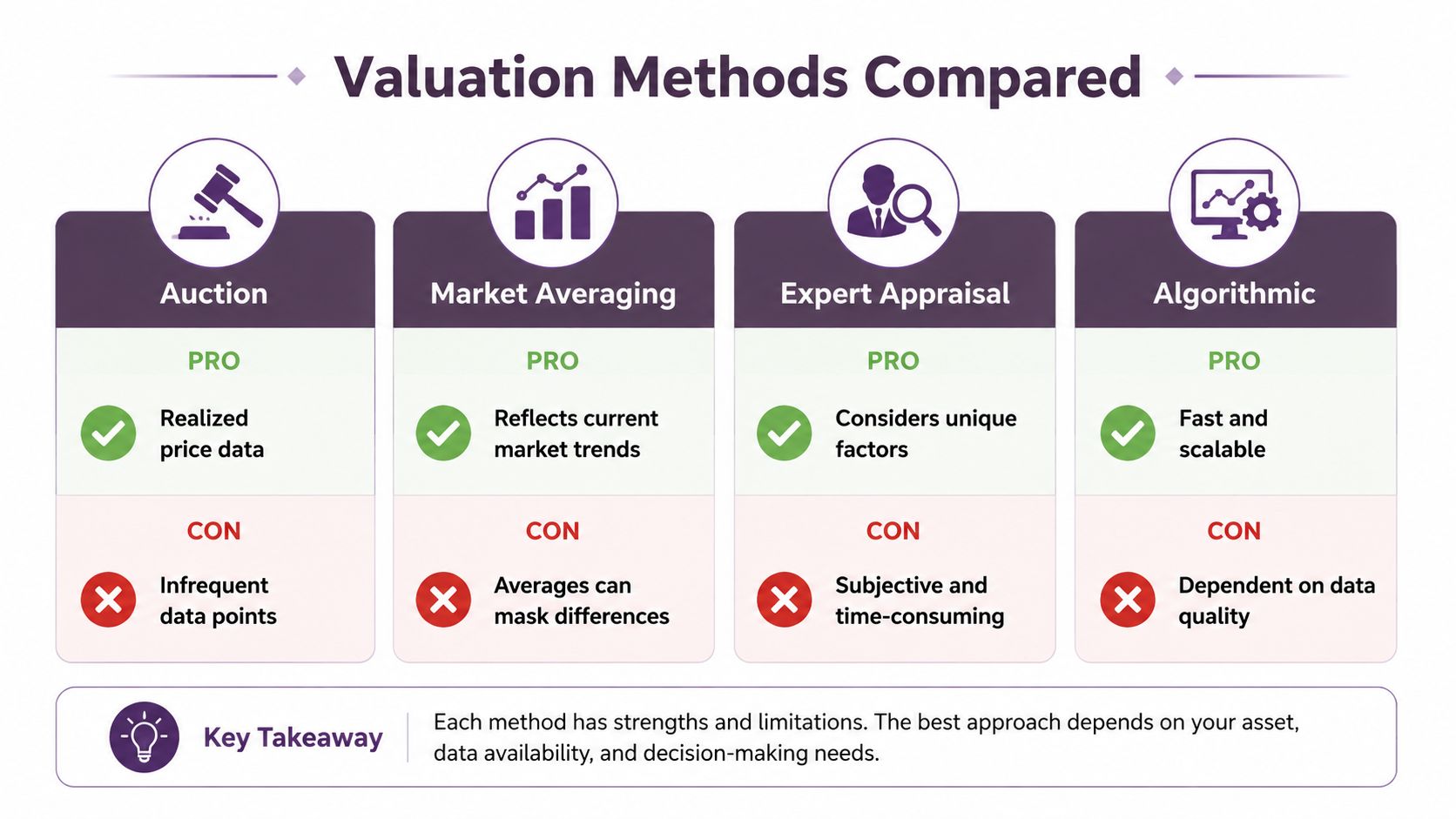
Every valuation method answers a different operational question. Auction hammer prices show what a buyer paid, but they can be episodic and venue-specific. Retail replacement cost is useful when estimating what it would take to replace stock, although an asking price can include merchant margin and may not represent an executable sale. Broker bids offer a more conservative view of immediate liquidity, while algorithmic fair value can make a large portfolio easier to monitor but may obscure abrupt micro-market changes.
A disciplined analyst doesn't search for one perfect method. The analyst assigns each method to the decision it can support.
| Method | Useful for | Main limitation |
|---|---|---|
| Auction hammer analysis | Reviewing realised transaction evidence and planning a sale through auction | Results depend on sale timing, house, lot quality, and audience |
| Retail replacement cost | Insurance, replacement planning, and stock pricing | An ask isn't the same as a completed transaction |
| Bid-side broker pricing | Assessing a quick-exit scenario | Bids may be conservative and unavailable for less liquid wines |
| Algorithmic fair value | Monitoring a broad portfolio consistently | Model assumptions can be opaque and slow to capture local shifts |
<a id="use-blended-marks-not-blended-confusion"></a>
Use blended marks, not blended confusion
A blended valuation is valuable only when the components remain visible. If an investor combines auction evidence, retail asks, and bid-side pricing into one figure without recording the source type, the resulting average can look objective while concealing incompatible observations.
For ongoing tracking, a fair-value model may provide consistency. For liquidation planning, realised auction evidence and current bids deserve greater weight. For insurance, replacement cost may be more relevant than a distressed exit price. The same bottle can therefore have several legitimate marks, provided the report explains their purpose.
The hidden risk lies in unexamined assumptions. Auction records can overrepresent wines that successfully reached market, retail listings can remain visible after stock has moved, and models can smooth volatility that an active buyer would notice immediately. A portfolio report should preserve the trail from bottle identity to source observation to final mark.
For a practical comparison of available approaches, investors can review fine wine pricing tools and their capabilities. The useful question isn't which method sounds most advanced. It's whether the method matches the decision, and whether the user can inspect the evidence behind the number.
<a id="the-benchmark-problem-in-fine-wine"></a>
The Benchmark Problem in Fine Wine
A portfolio valued at a large round figure tells you almost nothing about investment quality on its own. It doesn't reveal whether the holdings outperformed a relevant market, lagged comparable wines, or benefited from a broad repricing cycle. Benchmark relativity turns a static valuation into a performance question.
The Liv-ex Fine Wine 100 provides a broad reference for sought-after wines with a strong secondary market, while the Fine Wine 50 focuses on recent Bordeaux First Growth vintages. Neither automatically fits every cellar. A portfolio containing mature Burgundy, niche producers, or wines traded mainly through retail channels may have a different liquidity profile and a different price path from either index.
<a id="relative-performance-needs-a-defined-comparator"></a>
Relative performance needs a defined comparator
A strong portfolio evaluation tool should let the user state what “outperformance” means. That may involve a broad index, a regional comparison, a producer group, or a custom benchmark reflecting the portfolio's actual composition. It should also show whether the comparison uses bids, offers, auction results, or another price convention.
This is consistent with the broader discipline described by the CFA Institute's portfolio performance evaluation guidance, which treats manager-skill evaluation as requiring a broad range of analytical tools, each with limitations. The same principle applies to wine. A single benchmark can clarify one question while distorting another.
A portfolio can rise in value and still represent weak selection if comparable assets rose more. It can also lag a broad index while producing a sensible result if its holdings carry materially different liquidity or maturity characteristics.
<a id="venue-changes-the-meaning-of-performance"></a>
Venue changes the meaning of performance
Cross-channel visibility matters because a retail ask, auction outcome, exchange bid, and private transaction aren't identical observations. A portfolio marked only from one channel may appear stable just because the source updates slowly, or appear strong because it reports offers rather than executable bids.
The more useful report pairs each performance figure with its assumptions. It should show the benchmark, price basis, identity match, observation date, and liquidity interpretation. That structure answers the questions conventional tools leave open: worth relative to what, at which venue, and under which liquidity assumptions?
The analytical payoff is substantial. Once a manager separates market movement from asset selection, the portfolio becomes easier to rebalance. Weak performance may reflect an unsuitable benchmark, poor producer selection, stale inventory, or an exit assumption that was never realistic. Without that decomposition, those causes remain blended into one unexplained total.
<a id="building-a-reliable-portfolio-workflow"></a>
Building a Reliable Portfolio Workflow
Reliable evaluation starts with data handling, not dashboard design. A merchant or collector should build a repeatable path from inventory record to verified identity, selected valuation logic, and benchmark-relative output. Each step should leave enough information behind for another person to understand how the mark was produced.
<a id="start-with-clean-ingestion"></a>
Start with clean ingestion
Bring inventory into the system through a structured file, spreadsheet connection, or API integration. Preserve the original fields, including producer, wine name, vintage, format, quantity, purchase cost, storage status, and provenance notes. Don't overwrite uncertain values during import. Flag them for review.
The first matching pass should map each line to a canonical wine record. LWIN, the Liv-ex Wine Identification Number, provides a universal identifier across wine-industry systems. The system covers more than 200,000 wines and spirits, is free to download, and uses a seven-digit base code with optional suffixes for vintage, pack, and bottle size. LWIN identification standards
<a id="verify-the-commercial-context"></a>
Verify the commercial context
Mixed vintages, bottle formats, bonded stock, duty-paid stock, and case quantities can all change the appropriate comparison. A case shouldn't automatically be valued as separate bottles if the market trades it differently, and a duty status shouldn't disappear from the record just because the label matches.
For merchants, Cellar Pricer is designed for file-based portfolio valuation and mark-to-market workflows. Collectors can apply the same discipline by connecting cellar records to current market observations, selecting how often values refresh, and setting alerts for meaningful position changes.
<a id="choose-the-method-before-reviewing-the-result"></a>
Choose the method before reviewing the result
Set the valuation purpose first. Insurance replacement, routine reporting, acquisition analysis, and quick liquidation each call for different source priorities. Then configure the feed mix and retain the source labels in the output.
A useful operating model also separates data analysis from decision governance. Teams building repeatable reviews may find a data analysis framework for operators helpful for defining ownership, review cadence, and escalation paths around the numbers.
Implementation test: If a user can't explain why a bottle received its current mark, the workflow isn't finished.
Finally, compare the portfolio with a relevant benchmark and inspect concentration, liquidity, and unrealised P&L together. Refresh the workflow when a source changes, an identity conflict appears, or a market observation no longer reflects a tradable condition. A valuation should be reproducible, not merely plausible.
<a id="identity-matching-and-data-quality"></a>
Identity Matching and Data Quality
Canonical identity matching is the foundation beneath every portfolio metric. If “Château Margaux 2015 75cl” appears under several naming conventions and the system treats those records as different wines, the portfolio can show false concentration, incomplete price history, and distorted P&L. If it merges a different format or vintage into the same record, the error can be more serious because the valuation itself may be wrong.
LWIN's numbering mechanics illustrate why structured identifiers matter. The first six digits identify the wine, while the seventh digit acts as a check digit to reduce input errors. The standard also supports suffixes such as L-WIN-11 for vintage and L-WIN-16 or L-WIN-18 for bottle and case-size encoding in a standardised millilitre format. How LWIN works
<a id="common-failure-points"></a>
Common failure points
| Error Type | Example | Valuation Impact |
|---|---|---|
| Producer variation | Abbreviated estate name versus full registered name | Splits comparable observations and weakens the price history |
| Vintage mismatch | A current vintage assigned to a neighbouring release | Applies the wrong market evidence |
| Format ambiguity | Single bottle, half bottle, magnum, or case recorded without format | Compares non-equivalent assets |
| Packaging confusion | Original case treated as loose stock | Misstates marketability and expected exit route |
| Duty-status omission | Bonded and duty-paid inventory combined | Produces an unclear net realisation estimate |
| Duplicate listing | The same wine entered under multiple labels | Inflates quantity and can distort concentration |
Data-quality teams dealing with conflicting monthly recurring revenue records face a similar reconciliation problem. The discussion of conflicting MRR data solved offers a useful parallel: downstream reporting can't become reliable until the underlying records share consistent definitions and identifiers.
Automated matching should still expose uncertainty. High-confidence matches can flow through the valuation pipeline, while ambiguous records should enter a review queue with the competing candidates and supporting evidence. A black-box merge may reduce visible exceptions while increasing hidden errors.
The Wine Labs matching API represents the programmatic approach to this problem, linking heterogeneous wine records to standardised identities so downstream pricing and analytics operate on comparable assets. The central principle is simple: a valuation model cannot repair a wrongly identified bottle. Identity resolution must come first, and reconciliation must continue as new listings and transaction records arrive.
<a id="real-problems-solved-by-modern-tooling"></a>
Real Problems Solved by Modern Tooling
Merchants and collectors experience different symptoms of the same fragmented market. A merchant may have accurate inventory but stale marks across several sales channels. A collector may see an attractive portfolio total without knowing which holdings have credible bids. Both need a system that connects identity, price evidence, and market context.
For merchants, modern tooling reduces the gap between a market observation and an operational decision. A repricing review can draw on comparable listings, transaction evidence, and inventory records rather than relying on manually copied figures from separate tabs. That helps the operator identify stock that needs attention, but it doesn't remove the need to review provenance, format, and venue assumptions.
Collectors benefit from a different output. A portfolio report that places liquidity beside valuation can distinguish an active position from an asset supported mainly by visible asking prices. It can also reveal regional or producer concentration before the owner makes another purchase that reinforces the same exposure.
The strongest workflows use canonical records to connect fragmented listings, then show the evidence rather than hiding it behind a single score. They allow users to examine a bottle's price history, source type, benchmark relationship, and exit assumptions in one decision context.
Decision test: A portfolio tool earns its place when it changes what you buy, hold, reprice, or sell, not merely when it produces a polished total.
Wine Labs offers a market-data platform with portfolio tooling, cross-channel price views, canonical identity matching, alerts, and programmatic access. Visit Wine Labs to evaluate how a connected portfolio workflow can replace isolated marks with venue-aware, benchmark-relative decisions.