Wine Labs · Market intelligence
Greco Di Tufo Guide: Grape, Terroir, and Market Signals
Greco di Tufo explained for merchants and collectors: terroir, DOCG rules, tasting profile, vintage variation, and how cross-channel price signals inform
Greco di Tufo is a DOCG with production reported at 35,550 hectolitres in 2022, equivalent to about 395,000 cases, while the appellation's vineyard area is listed at 666 hectares in 2021 by one industry reference. That compact scale changes how buyers should read the wine. Greco di Tufo isn't a crisp Campanian white for seafood. It is a geographically restricted, structurally variable wine whose value can look very different on a retail shelf, a restaurant list, or an auction catalogue.
The central market question is not whether Greco di Tufo has quality. The DOCG designation, defined production zone, mineral soils, and acidity give it a credible premium foundation. The harder question is how much of that foundation is recognized by each channel, and whether the bottle in front of you is built for immediate freshness or for development in the cellar.
Table of Contents
- Why Greco di Tufo Matters Now
- Origins and the Road to DOCG
- Terroir of the Irpinian Hills
- Reading the DOCG Production Rules
- Tasting Profile and Vintage Variation
- Cross-Channel Price Signals
- Sourcing and Investment Considerations
- Common Misconceptions and the Road Ahead
<a id="why-greco-di-tufo-matters-now"></a>
Why Greco di Tufo Matters Now
Four signals separate a buyable Greco di Tufo from a generic Campanian white: producer concentration, vintage structure, channel divergence, and cellar potential.
The denomination is compact by Italian white-wine standards. Vineyard-area estimates range from 666 hectares to around 950 hectares, depending on the source and definition used (Italian Wine Central's denomination profile). The gap matters for market analysis. Buyers should distinguish regulated DOCG vineyard figures from broader planting estimates before comparing supply with other appellations.
Greco di Tufo also functions as a localized DOCG rather than a generic grape brand. It was promoted from DOC to DOCG in 2003, placing it among Italy's top quality-designated wines and one of only four DOCGs in Campania, as summarized by Wine with Seth's Greco di Tufo reference. The designation gives the name regulatory weight, although it does not guarantee broad resale liquidity.
<a id="four-signals-buyers-should-separate"></a>
Four signals buyers should separate
- Producer concentration: A small group of recognizable estates can exert more market influence than the appellation's total volume suggests.
- Vintage structure: Irpinia's conditions produce bottles ranging from sharply tense to more rounded and immediately accessible.
- Channel divergence: Retail pricing reflects shelf positioning, restaurants add service economics and scarcity, while auctions show whether older bottles attract specialist demand.
- Cellar potential: Strong examples can develop beyond simple freshness, but ageability depends on both producer and vintage.
For merchants, the right comparison extends beyond neighboring Italian whites. Evaluate the bottle's identity, provenance, vintage, and route to market. A widely distributed young release may behave like a restaurant-friendly white. An older Riserva from a respected estate may operate as a scarce collector item, provided provenance is credible.
Commercial rule: A limited appellation does not create automatic investment liquidity. Scarcity becomes commercially useful only when buyers can identify, find, and trust the bottle.
Cross-channel evidence therefore deserves priority. Retail can understate ageability when shelves favor current releases. Restaurant prices can overstate market value because service markups do not transfer to resale. Auction appearances remain infrequent, yet that thin record can indicate which producers and formats command recognition beyond ordinary consumption.
<a id="origins-and-the-road-to-docg"></a>
Origins and the Road to DOCG
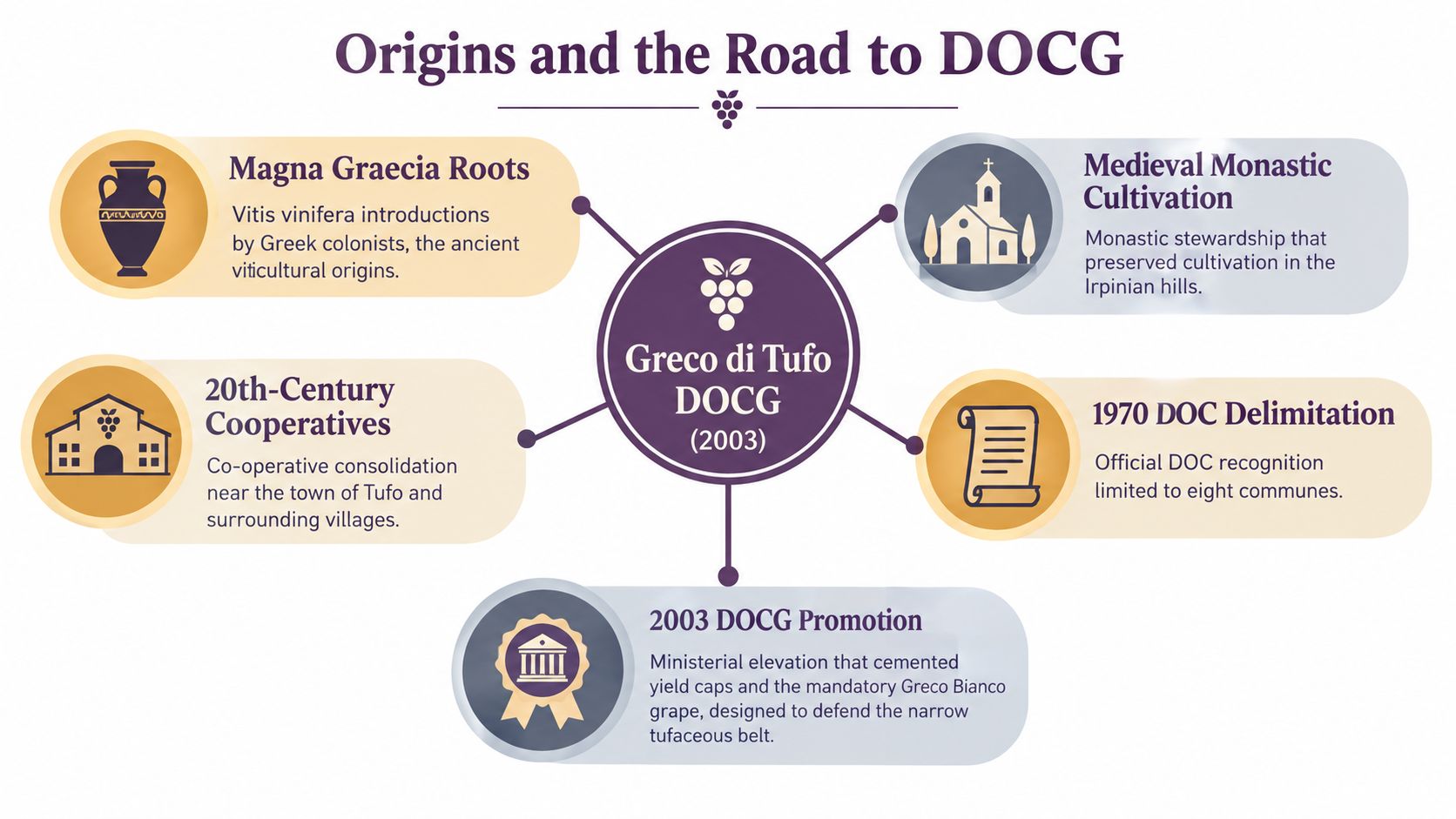
Greco di Tufo's story begins with a grape associated with ancient Greek settlers from Thessaly. Historical references connect its cultivation to Roman-era Campania, while later written records appear by the 12th century. Wine with Seth's historical overview For buyers, that continuity matters. The name reflects a long local identity tied to Campania and the Irpinian interior, rather than a recent label built around an international variety.
Tufo became the geographic reference point as the wine's identity narrowed around the town and nearby communities. That history helps explain why the appellation is treated as a specific place rather than a broad Campania category. It also gives commune, producer, and vintage information greater commercial relevance than a generic regional designation.
<a id="regulation-turned-history-into-a-market-boundary"></a>
Regulation turned history into a market boundary
Greco di Tufo first received DOC status in 1970 and advanced to DOCG in 2003. The promotion turned a historical name into a verifiable market boundary, distinguishing bottles made within a defined appellation from wines marketed through a looser regional or varietal identity.
That distinction affects how the wine trades across channels. Retail buyers can verify that the bottle belongs to a controlled origin, while restaurant and auction buyers still need to assess producer reputation, vintage, storage, and provenance. DOCG therefore provides an authentication starting point, not a guarantee of quality or future demand.
The appellation's narrow geography also helps explain price divergence. A current-release bottle with broad distribution may remain an accessible restaurant or retail wine, even when the DOCG name is tightly defined. An older bottle from a recognized estate can attract more specialist attention, but scarcity only becomes commercially useful when buyers can identify and trust its origin.
The rules and geographic limits are best read together in the dedicated production analysis. For this historical section, the key conclusion is simpler: DOCG converted place history into a market framework with boundaries that can be checked.
A bottle carrying the designation still requires scrutiny of label accuracy, storage, and chain of custody. Its value depends on what happens after the legal boundary is established, including the estate's standing, the vintage's structural profile, and the sales channel through which it reaches the buyer.
<a id="terroir-of-the-irpinian-hills"></a>
Terroir of the Irpinian Hills
Greco di Tufo's commercial identity starts with a fragmented terrain rather than a single soil formula. Regional descriptions identify combinations of clay, limestone or calcareous material, sand, and tuffaceous layers, while Tufo's name reflects compacted volcanic ash. Vineyards commonly occupy south- or southeast-facing slopes at roughly 300 to 650 metres, where exposure and altitude can restrain vigor, slow ripening, and retain acidity.
The eight-commune zone named earlier is therefore better read as a set of related sites than as one uniform source. Tufo remains the appellation's reference point, while Santa Paolina is one concrete example of how the surrounding communes extend production into distinct hillside settings. Commune information can refine a buyer's expectations, but it does not determine a fixed taste or guarantee superior quality.
<a id="soil-and-elevation-create-the-commercial-style"></a>
Soil and elevation create the commercial style
| Commune Cluster | Elevation (m) | Dominant Soil | Structural Influence |
|---|---|---|---|
| Tufo and nearby tufaceous sites | 300 to 650 | Tuffaceous, clay, calcareous layers | Saline tension, extract, persistent acidity |
| Calcareous-clay hillside communes | 300 to 650 | Chalky clay and limestone | Firm palate, slower-feeling maturity |
| Sandy and mixed-soil locations | 300 to 650 | Sand with mineral and clay components | More lifted texture, site-dependent breadth |
| Wider localized zone | 300 to 650 | Mixed volcanic and sedimentary layers | Vintage-sensitive balance and phenolic grip |
The table summarizes the producer's site descriptions and technical material. In the same producer's technical sheet, Greco di Tufo is presented at around 13% ABV, with total acidity approximately 5.5 to 7.8 g/L and pH around 3.4 to 3.5 (Villa Matilde's technical release). Those parameters help explain why the wine can move beyond a simple early-drinking white. Acidity supports freshness, while extract and site conditions can give the palate persistence.
The market implication is a divergence between structure and liquidity. More severe, well-drained slopes may produce firmer wines with greater persistence and a slower drinking curve. Broader or less demanding sites can yield a softer style that fits restaurant turnover more readily. Vintage can alter that balance, so commune, slope, soil, and harvest conditions should be recorded together.
A Wine Labs wine-industry digest on niche terroirs provides useful context for treating small-site distinctions as operational information rather than decorative geography. Retail buyers can use them to segment current releases, while auction and on-trade buyers should pair them with producer, vintage, and storage evidence. A DOCG name identifies origin, but it does not by itself establish the bottle's likely ageing path.
<a id="reading-the-docg-production-rules"></a>
Reading the DOCG Production Rules
The label answers three questions before you taste: grape, place, and format.
| Parameter | Requirement | Buyer Implication |
|---|---|---|
| Principal grape | At least 85% Greco Bianco | The wine must retain a strong Greco identity |
| Permitted blending | Up to 15% Coda di Volpe Bianca | Limited flexibility does not erase appellation character |
| Geographic origin | Eight communes in Avellino province | Commune and estate details can refine quality assessment |
| Still wine | Recognized DOCG style | Compare vintage, producer, and storage rather than name alone |
| Spumante | Bottle fermentation with at least 18 months on lees | Sparkling bottles require a different release and service evaluation |
| Riserva | A recognized aged category | Check release practice and provenance carefully |
The blend requirement defines the category, but it does not predict quality on its own. DOCG rules permit a dominant Greco Bianco component and a limited share of Coda di Volpe Bianca under the Italian agriculture ministry's production discipline. For buyers, that distinction matters because appellation compliance establishes identity, while producer choices and vintage determine how that identity performs in the glass.
Geography narrows the field further. Production is limited to the eight Avellino communes specified by the denomination's geographic definition. That boundary makes the designation more informative than a broad varietal label, yet commune alone remains an incomplete quality signal. It should be read with producer, slope, vintage, and bottle history.
<a id="what-the-label-can-and-cannot-tell-you"></a>
What the label can and cannot tell you
The still category is usually the easiest comparison point. Spumante requires bottle fermentation and at least 18 months on lees, while the Riserva format carries a longer ageing requirement identified in Wine-Searcher's Greco di Tufo regional reference. Those production differences affect pricing and service. A sparkling release should not be compared with a still entry-level bottle without allowing for cellar time, method, and on-trade context.
The label also has limits. DOCG status confirms category and origin, not freshness, storage, or future performance. For older bottles, inspect label condition, fill level, closure, provenance, and release information. Retail pricing may reflect immediate availability, while auction evidence depends heavily on condition and documentation. Restaurant pricing adds service and inventory costs, so these channels should not be treated as interchangeable measures of value.
Buyer discipline: Use the DOCG rules to verify identity. Use producer records and bottle condition to estimate value.
A compliant label therefore provides a starting filter, not a purchase verdict. The useful question is whether the format, vintage, producer, and provenance justify the bottle's position in its channel. That is where DOCG structure becomes actionable market information.
<a id="tasting-profile-and-vintage-variation"></a>
Tasting Profile and Vintage Variation
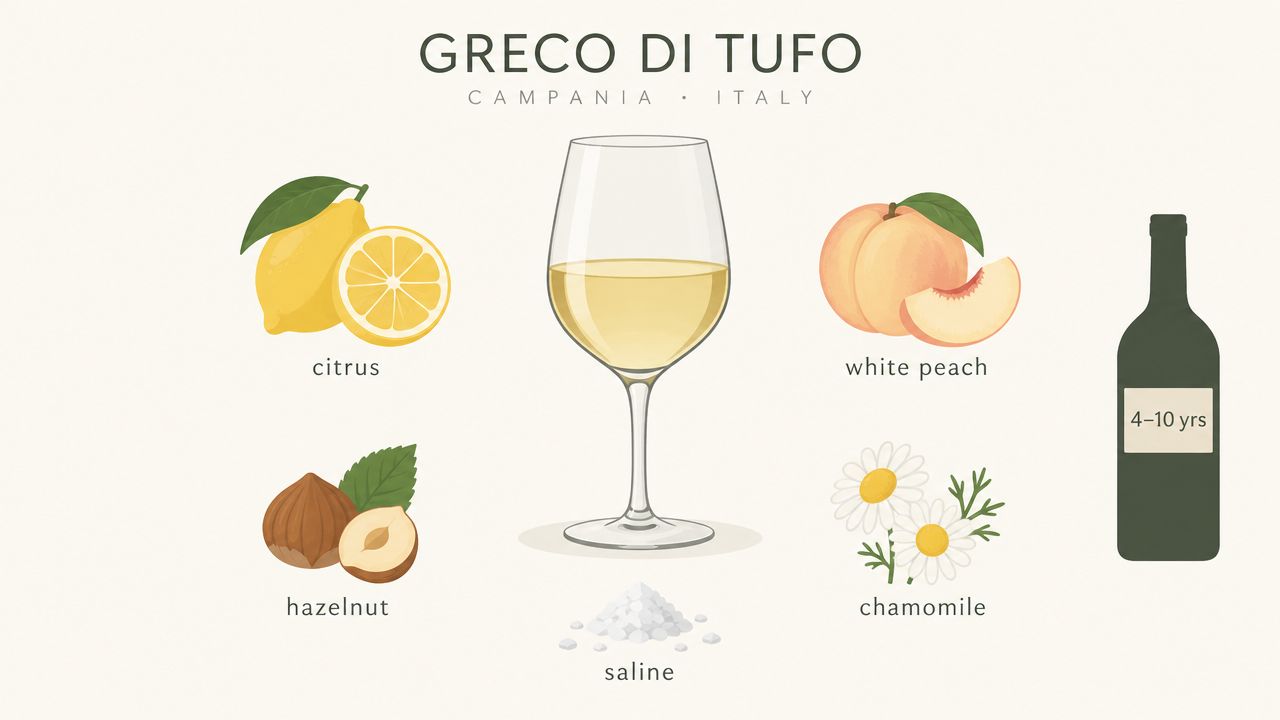
In the glass, Greco di Tufo can show citrus pith, white peach, hazelnut, chamomile, and a saline mineral lift. Young bottles often feel brisk and tightly wound. With bottle development, the texture can become waxier, while savory notes gain definition. The important analytical question is balance: acidity supplies length, but extract and phenolic grip determine whether the finish feels serious or merely sharp.
<a id="two-vintage-poles"></a>
Two vintage poles
Vintage conditions can alter the wine's market usefulness as much as its tasting profile. The World of Fine Wine's Greco di Tufo coverage notes that top producers have demonstrated ageability, while the warm 2024 vintage brought total acidity to around 7 g/L. The comparison shows why a generic description of Greco di Tufo can conceal meaningful variation.
| Attribute | Cool Vintage | Warm Vintage |
|---|---|---|
| Acidity | More pronounced and tightly defined | Softer, though still capable of freshness |
| Fruit expression | Citrus-led, restrained, linear | Riper peach and broader fruit |
| Texture | Taut, saline, phenolic | Fuller, rounder, earlier-feeling |
| Service logic | Suits mineral-focused tasting menus | Works sooner with richer dishes |
| Cellar question | May need time for integration | May offer earlier pleasure but requires balance checks |
The seafood-pairing shorthand is therefore incomplete. A young, high-acid bottle can suit shellfish, yet its phenolic structure may also support richer poultry dishes and aged cheese. A warmer vintage may perform better by the glass because it offers immediate texture. A taut vintage can make more sense for deliberate cellar allocation, provided the buyer accepts a longer integration period.
Greco di Tufo's ageability is conditional. Producer, vintage, bottle development, and service timing all shape the result, so buyers should avoid treating the denomination as a uniform ageing category.
For current-release purchasing, taste for freshness and tension first. Reserve more structured examples for customers or collectors willing to wait, and assess each vintage on its own balance rather than assuming every bottle improves indefinitely.
<a id="cross-channel-price-signals"></a>
Cross-Channel Price Signals
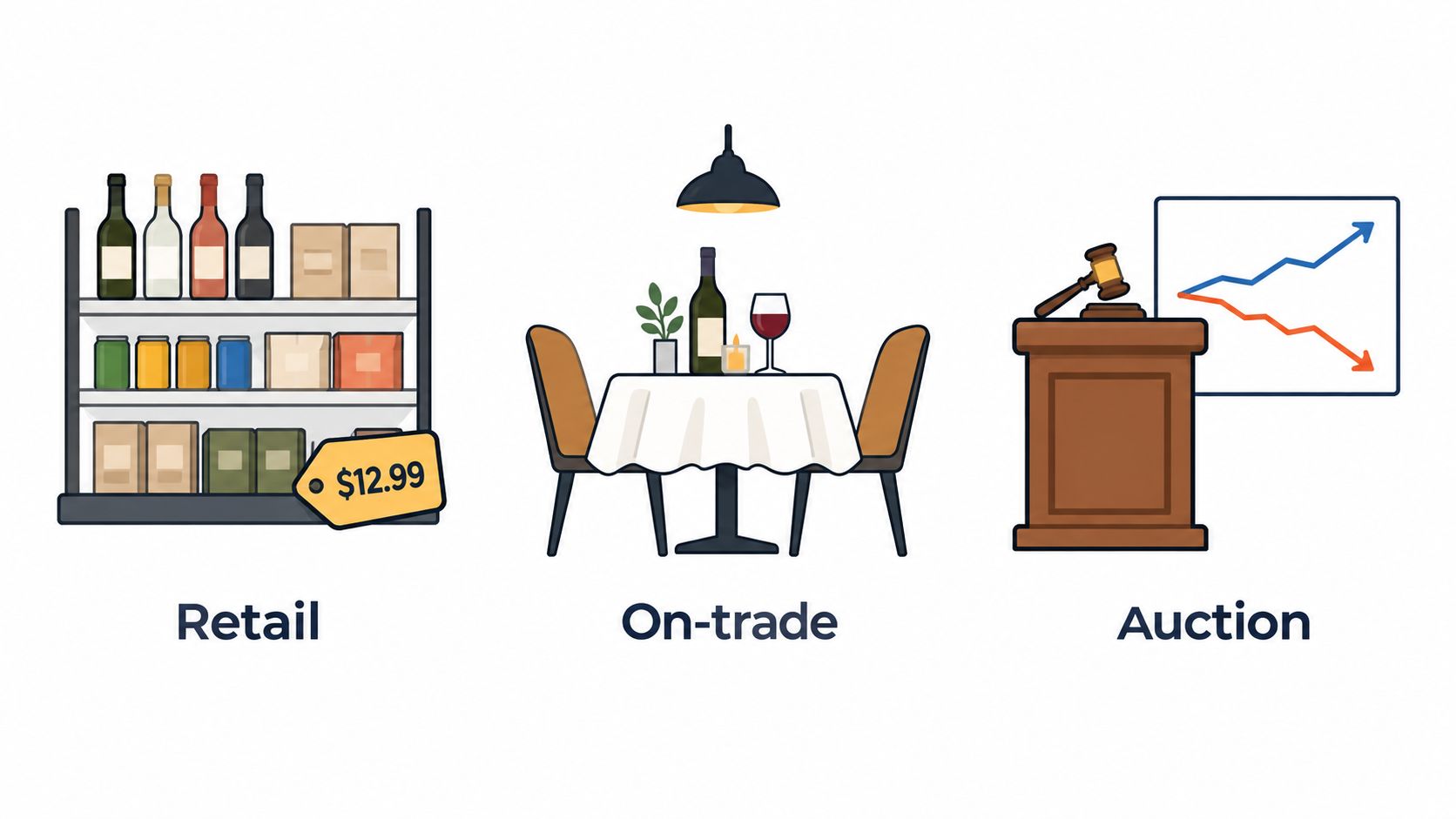
Greco di Tufo's price can diverge sharply by channel because each market measures a different form of demand. Retail, on-trade, and auction channels measure different kinds of demand, so their prices should not be treated as interchangeable. Retail reflects importer access, producer recognition, current-release competition, and shelf strategy. Restaurants add service, glassware, labor, spoilage risk, and the value of immediate access. Auctions test whether buyers will pursue older bottles once the restaurant experience is removed.
For an appellation with roughly 395,000 cases of annual output, secondary-market depth can still be uneven. A bottle may be easy to find at specialist retail yet appear only sporadically at auction, particularly when a producer or vintage has limited distribution. That gap is evidence about channel structure, not proof of weak demand.
<a id="how-to-read-the-divergence"></a>
How to read the divergence
| Producer / Category | UK Retail | US Retail | On-Trade | Auction |
|---|---|---|---|---|
| Recognizable estate, current still release | Brand-led shelf positioning | Importer availability and distribution | Bottle-list premium, sometimes by the glass | Usually limited evidence |
| Recognizable estate, older release | Scarcity may be reflected unevenly | Provenance becomes more important | Restaurant rarity can inflate access pricing | Stronger test of specialist demand |
| Riserva | Specialist retail positioning | Collector-oriented availability | Suits premium lists | Most informative when provenance is clear |
| Spumante | Compared with sparkling alternatives | Dependent on importer breadth | Service and celebration context matter | Thin, format-specific demand |
The table remains qualitative because dependable channel-specific price bands are not established here. Build comparisons from like-for-like bottles, matching producer, vintage, format, bottle size, condition, and market. A current-release retail offer should not be compared directly with an older auction lot or a restaurant bottle list.
Retail can misprice age in either direction. A shop may discount an older bottle to clear inventory, or maintain a premium because replacement supply is scarce. On-trade pricing includes hospitality economics that do not transfer to resale. Auction is often the clearest scarcity signal, but a thin record can also indicate limited supply rather than weak demand.
For a normalized view across retail, auction, exchange, and restaurant listings, use Wine Labs fine-wine market data alongside direct merchant and auction checks. The actionable measure is the spread between channels. An older, well-stored bottle priced near current-release retail may offer a collector value. A restaurant charging substantially more without stronger provenance is selling access and service, not necessarily investment potential.
<a id="sourcing-and-investment-considerations"></a>
Sourcing and Investment Considerations
Greco di Tufo should be sourced as a selective inventory wine, not as a broad speculative category. The first filter is producer transparency. Look for clear vintage information, technical details, vineyard origin, closure information where available, and a documented chain of custody for older bottles.
A second filter is channel fit. Current and preceding releases are more naturally suited to restaurant programs and specialist retail because buyers can understand their freshness and service role. Riserva and distinctive estate bottlings deserve a different route, especially when the producer has enough recognition for collectors to find comparable bottles.
<a id="build-the-inventory-around-use-not-mythology"></a>
Build the inventory around use, not mythology
- For restaurants: Prioritize current releases with enough acidity and texture to work by the glass or alongside richer food. The wine's structure gives it more range than a seafood-only positioning suggests.
- For specialist retail: Carry a mix of current bottles and a small number of older examples, but make the vintage and storage story visible.
- For collectors: Favor bottles with strong provenance, recognizable estates, and a clear reason to mature, such as a Riserva designation or a more structured vintage.
- For distributors: Treat lesser-known communes as discovery opportunities, but don't assign a discount or premium without verified local pricing.
The temptation is to borrow the investment language of Barolo or Brunello. That would be a mistake. Greco di Tufo has ageworthy examples, but the secondary market remains narrower and less continuous. Holding decisions should be based on expected drinking quality and buyer access, not on an assumption of automatic appreciation.
A cellar plan also needs an oxidation review. Closure, storage temperature, transport history, and bottle condition can matter as much as the vintage. The best question isn't “How old is this bottle?” but “What evidence supports its remaining freshness?”
Portfolio test: If you can't identify the next buyer, treat the bottle as a drinking allocation rather than a liquid investment.
For valuation work, compare specialist auction catalogues, current retail offers, restaurant listings, and market histories rather than relying on one channel. Wine Labs Cellar Pricer is one tool that can turn a cellar file into a market-oriented valuation workflow, but the output still needs human review for provenance and condition.
<iframe width="100%" style="aspect-ratio: 16 / 9;" src="https://www.youtube.com/embed/wF-2EfM0T6c" frameborder="0" allow="autoplay; encrypted-media" allowfullscreen></iframe>| Producer Tier | Retail Presence | Auction Liquidity | Recommended Holding Window |
|---|---|---|---|
| Widely recognized estate | More consistent | More likely to attract specialist attention | Hold selectively, based on structure and provenance |
| Established regional producer | Available but less uniform | Intermittent | Buy for drinking first, resale second |
| Small or under-distributed producer | Limited | Thin or unproven | Shorter commercial cycle unless the bottle has a clear niche |
| Riserva or distinctive estate lot | Specialist positioning | Most useful secondary-market test | Longer consideration, with storage evidence |
The producer names often discussed by serious buyers include Feudi di San Gregorio, Mastroberardino, and Terredora, but recognition alone isn't proof of auction liquidity. Check actual listings before allocating capital.
<a id="common-misconceptions-and-the-road-ahead"></a>
Common Misconceptions and the Road Ahead
Greco di Tufo is often treated as a single market product, yet still wine and Spumante address different buying occasions, production choices, and price comparisons. Combining them into one average obscures the signals that matter. A restaurant may use Spumante for aperitivo demand, while still Greco di Tufo competes through vintage structure, producer reputation, and cellar potential.
A second misconception is that the wine cannot age. Mature bottles from serious producers can show development, but ageability is not automatic. Producer, vintage, closure, storage, and bottle condition determine whether a mature example offers complexity or merely reflects decline. Buyers should therefore seek provenance and bottle evidence rather than treating age alone as a value signal.
A third misconception is that Greco di Tufo and Fiano di Avellino are interchangeable. Both come from Irpinia, but Greco di Tufo generally emphasizes mineral cut, saline tension, and phenolic structure. Fiano may occupy a different stylistic lane. Substituting one for the other on a wine list can change food performance, serving expectations, and the price a customer considers justified.
<a id="watchpoints-for-serious-buyers"></a>
Watchpoints for serious buyers
- Vintage variability: Warm conditions can soften the acidity profile. The reported 2024 experience, with total acidity around 7 g/L, shows why generic “high-acid white” language can conceal meaningful variation.
- Sub-zone clarity: More precise commune or site labeling could make producer and vineyard comparisons easier, particularly when retail offers do not separate bottling origin clearly.
- Transparency: Buyers should ask how producers managed ripeness, botrytis pressure, and oxidation risk. Overripe fruit can reduce the tension that distinguishes the category.
- Format separation: Still wine, Spumante, and Riserva should be tracked as separate products. Their retail placement, restaurant use, and secondary-market evidence do not mean the same thing.
- Secondary evidence: Auction appearances can confirm specialist interest, but a thin auction record may indicate limited supply rather than weak quality recognition.
The road ahead depends on legibility. Producers that communicate site, vintage, farming, closure, and release decisions give merchants a firmer basis for pricing. Merchants that separate immediate-drinking bottles from cellar candidates can avoid underpricing mature stock while also avoiding inflated investment claims.
Greco di Tufo occupies an unusual middle ground. It is not a mass-market white, and it does not yet trade as a universally liquid collector category. Its DOCG identity, structural variation, and limited supply can reward disciplined sourcing, but the buyer must compare channels rather than assume retail price, restaurant price, and auction value are interchangeable.
Use Wine Labs to compare Greco di Tufo across retail, restaurant, exchange, and auction signals, then assess producer, vintage, and provenance before buying. That context can improve an allocation, cellar review, or restaurant listing decision.