Wine Labs · Market intelligence
Fine Wine Valuation with Practical Market Data
Learn fine wine valuation across retail, auction, exchange, and restaurant channels using canonical matching, market methods, workflows, alerts, and tools.
The most popular advice on fine wine valuation is also the least reliable: find a headline price, then treat it as the bottle's worth. A listing is not a transaction, a hammer price is not the seller's proceeds, and a market index can't tell you whether one particular bottle will sell quickly. Usable value is always conditional, shaped by exact identity, condition, channel, timing, fees, liquidity, and the decision you're trying to make.
A merchant preparing a buy quote needs an executable acquisition value. An investor reviewing an exit needs an estimated liquidation value after costs. A collector preparing an insurance schedule may need a replacement-oriented figure instead. The bottle hasn't changed, but the correct valuation question has.
Table of Contents
- What Fine Wine Valuation Really Measures
- Building a Market-Based Valuation
- Reading Retail Auction Exchange and Restaurant Channels
- Core Valuation Methods and Their Limits
- A Reliable Fine Wine Valuation Workflow
- Valuation Decisions for Merchants and Investors
- Case Studies Mistakes and Monitoring Signals
- Building a Durable Valuation Standard
<a id="what-fine-wine-valuation-really-measures"></a>
What Fine Wine Valuation Really Measures
A fine wine does not carry one permanently defensible price. It carries several reference values, each tied to a different decision, buyer, channel, and execution condition.
Intrinsic value describes the attributes embedded in the bottle and its history. These include the producer, appellation, vintage, bottling, condition, provenance, scarcity, and quality signals such as expert scores or agronomic conditions. This analysis explains why two wines that appear similar may require different adjustments, but it does not establish what a buyer will pay.
Market value answers a narrower commercial question: what informed buyers may pay for that exact wine, in a defined condition, on a stated date, through a specified channel. A merchant comparing current offers can use retail evidence as an initial reference. An investor estimating an exit needs evidence closer to an actual sale, including the likely route to market, liquidity, fees, and the time required to find a buyer.
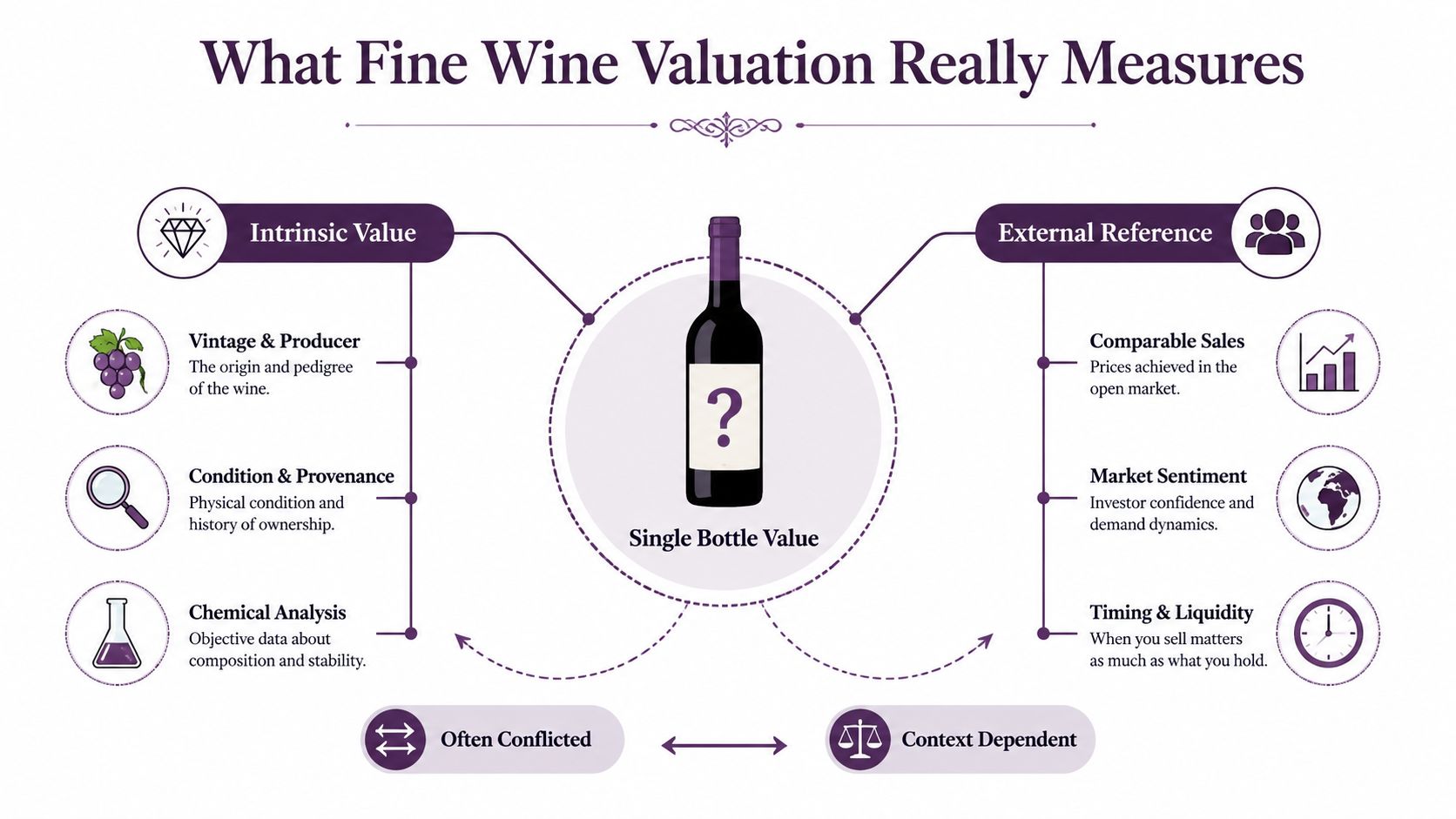
The same bottle can therefore support different usable values. A merchant's buy quote must allow for handling, inventory risk, and resale margin. An investor's exit estimate must reflect provenance, the selected selling route, transaction costs, and any discount or delay needed to secure a buyer. A high retail offer may answer the merchant's sourcing question while offering little evidence for the investor's liquidation decision.
| Dimension | Market Value | Intrinsic Value |
|---|---|---|
| Main question | What could this exact bottle trade for now? | What attributes support the bottle's desirability? |
| Evidence | Comparable offers, completed sales, channel conditions, timing | Producer, vintage, condition, provenance, scarcity, quality signals |
| Time sensitivity | High, because demand and costs change | More structural, although perception can change |
| Commercial use | Buying, selling, reporting, sourcing, liquidity analysis | Explaining price differences and setting adjustment factors |
| Main caveat | A quote may not be executable | Quality does not guarantee a sale at a particular price |
Practical rule: State the valuation's purpose, date, channel, currency, condition assumption, and confidence level.
Historical research can provide context for wine as an alternative asset, but it cannot substitute for bottle-level matching. A repeat-sales study covering 1900 to 2012 estimated a 5.3% geometric average real annual return, or 4.1% after storage and insurance costs, and reported that wine exceeded the long-run real returns of bonds, art, and stamps over that period (Cambridge academic benchmark). That historical baseline does not predict an executable price for a particular bottle. Fine wine valuation becomes useful only when the reference price matches the decision.
<a id="building-a-market-based-valuation"></a>
Building a Market-Based Valuation
A credible estimate starts with the narrowest reliable comparison, not the most impressive average. Record the producer, appellation, exact wine or cuvée, vintage, bottling, bottle size, pack format, condition, provenance, storage history, quantity, currency, channel, and observation date.
<a id="start-with-identity-then-condition"></a>
Start with identity, then condition
Suppose a merchant is assessing a case of a celebrated Bordeaux wine. A producer-level average is too broad. The analyst should first isolate the exact château, then the appellation, vintage, bottling, and format. A standard bottle in original packaging shouldn't be blended with a special format, a mixed case, or a listing with materially weaker provenance.
Condition then changes confidence. Fill level, label and capsule condition, seal integrity, storage history, and proof of ownership all help determine whether an observed price is relevant to the stock being valued. Subjective judgments about taste or prestige should remain separate from observed market evidence. The former can support an adjustment hypothesis, but the latter establishes the market reference.
<a id="narrow-the-evidence-progressively"></a>
Narrow the evidence progressively
A practical sequence looks like this:
- Identify the asset. Resolve producer, wine, vintage, bottling, format, and quantity.
- Build a peer set. Use the same wine and vintage first, then widen only when direct evidence is insufficient.
- Classify observations. Separate asking prices, reserves, hammer prices, and realized all-in prices.
- Check comparability. Remove or flag observations with unclear identity, damaged condition, stale dates, unusual lots, or unknown fees.
- State the output. Report a range, effective date, channel, currency, condition assumption, and confidence grade.
If direct evidence is sparse, the range should widen. If the observations are old, inconsistent, or based mainly on unsold listings, confidence should fall even when the arithmetic looks clean.
| Evidence Layer | Decision Question |
|---|---|
| Exact completed transactions | What did a comparable asset actually achieve? |
| Current executable offers | What price can a buyer access now? |
| Auction outcomes | What did demand support under that house's sale mechanics? |
| Broader benchmark | Is the segment moving with or against the wider market? |
| Intrinsic attributes | Why might this bottle differ from the peer set? |
| Condition and provenance | Can the asset qualify for the observed price? |
A merchant or portfolio team that needs to extract real-time pricing data should preserve the timestamp and channel context rather than copying a number into a spreadsheet without metadata. For a consolidated view of fine wine market data, the same principle applies: identity resolution must precede aggregation.
The final record might read: “Estimated secondary-market range, London auction channel, stated date, standard bottle, intact capsule, documented storage, medium confidence.” That description is more decision-ready than a single rounded figure because it shows what the estimate does and doesn't claim.
<a id="reading-retail-auction-exchange-and-restaurant-channels"></a>
Reading Retail Auction Exchange and Restaurant Channels
Cross-channel data is valuable only after each channel's economics are understood. Retail, auctions, exchanges, and restaurants don't measure the same thing, so combining their observations without normalization can create a false consensus.
| Channel | Most Useful Signal | Key Adjustment |
|---|---|---|
| Retail | Current available offer and replacement reference | Merchant margin, inventory strategy, taxes, delivery, and whether the offer is actually executable |
| Auction | Supply, bidding intensity, hammer and sale outcomes | Buyer or seller fees, lot size, location, reserve, taxes, and condition |
| Exchange | Recurring secondary-market observations | Contract or unit definition, settlement terms, currency, and timing |
| Restaurant | Positioning and end-demand context | Service markup, list strategy, vintage availability, geography, and non-transferability |
| Combined view | Relative spread across channels | Normalize identity, date, currency, fees, format, and condition first |
Retail listings are visible and useful, but an asking price can remain online without a sale. A merchant may also use a high offer to protect margin or signal scarcity, while a buyer can decline the price without creating a transaction. Retail evidence therefore works best as an availability and replacement reference unless the system can distinguish executed demand from inventory.
Exchanges can provide repeated observations and a clearer market rhythm, although the analyst still needs to confirm what unit is being priced and whether the quote is directly comparable to a physical bottle. Restaurant offers are even less interchangeable with secondary-market value. A restaurant wine list tells you how a venue positions the wine for consumption, not what a collector can necessarily realize on resale.
<a id="auction-outcomes-need-full-cost-translation"></a>
Auction outcomes need full-cost translation
The headline hammer price is incomplete. Sotheby's London terms state that Wine and Spirits lots carry a 24% buyer's premium on the hammer price, plus applicable VAT (Sotheby's London buyer conditions). Christie's New York wine conditions state a 25% buyer's premium, while Christie's London wine conditions also state 25% for wine, spirits, and cigars. These are channel-specific examples, not universal adjustments.
For a buyer, the all-in acquisition cost is above hammer. For a seller, the relevant proceeds may be below the headline result after seller charges, transport, insurance, and other deductions. The direction of adjustment depends on whose value you're estimating.
A retail offer can answer “what would replacement cost look like?” An auction result can answer “what did this sale mechanism clear at?” Neither answer automatically equals an exit price for your bottle.
Normalize the observation before using it. Match the exact identity and format, convert currency, record taxes and premiums, distinguish single bottles from cases, and attach the sale date. If those fields can't be resolved, the observation should be a cross-check or excluded, not blended into a precise average.
<a id="core-valuation-methods-and-their-limits"></a>
Core Valuation Methods and Their Limits
No single method works across every fine wine valuation problem. The right technique depends on the number of comparable observations, the quality of identity matching, the decision horizon, and whether the output concerns one bottle or a portfolio.
<a id="comparable-sales"></a>
Comparable sales
Comparable sales are usually the most intelligible starting point. Select observations for the same producer, wine, vintage, format, condition, and channel. If the peer group is small, show every observation and explain the differences rather than hiding uncertainty behind a mean.
An unusually high sale may reflect a bidding contest, exceptional provenance, or a rare lot structure. An unusually low sale may reflect weak condition, a forced sale, or a fee treatment that wasn't captured. Don't remove an outlier merely because it makes the estimate inconvenient. Flag it, investigate it, and decide whether the event is repeatable.
<a id="time-weighted-history"></a>
Time-weighted history
A time-weighted average helps when relevant observations occurred on different dates. Recent evidence receives more influence, while older results retain some value as context. The method should bring prices to a common valuation date using an appropriate market benchmark, then disclose the weighting rule.
For example, if three otherwise comparable observations point to different levels, the analyst shouldn't average them if the market regime changed between sales. A recent completed transaction may lead the estimate, while older transactions define the range and help show whether the current result is unusual.
<a id="hedonic-and-benchmarked-models"></a>
Hedonic and benchmarked models
Hedonic regression estimates price through observable characteristics. In fine wine, those can include region, vintage, expert barrel score, weather-related growing conditions, and a market benchmark. Academic analysis identified growing-season temperature, precipitation, appreciation in the Liv-ex 100 index, and expert barrel scores as primary determinants in one technical valuation model (academic fine wine pricing model).
That finding supports richer models, but it doesn't prove that a model can price every wine. Sparse observations, changing bottle condition, inconsistent identity, and non-random sales can all undermine apparent precision. A portfolio with enough clean records can benefit from regression. A single unusual bottle may need direct comps and specialist review instead.
A peer-reviewed study also found that short-term fine wine prices react more strongly to business cycles than to economic policy uncertainty (macrocycle analysis of fine wine prices). That means a model should separate structural attributes from cyclical demand. A rising benchmark can lift comparable wines even when the bottle's intrinsic attributes stay unchanged.
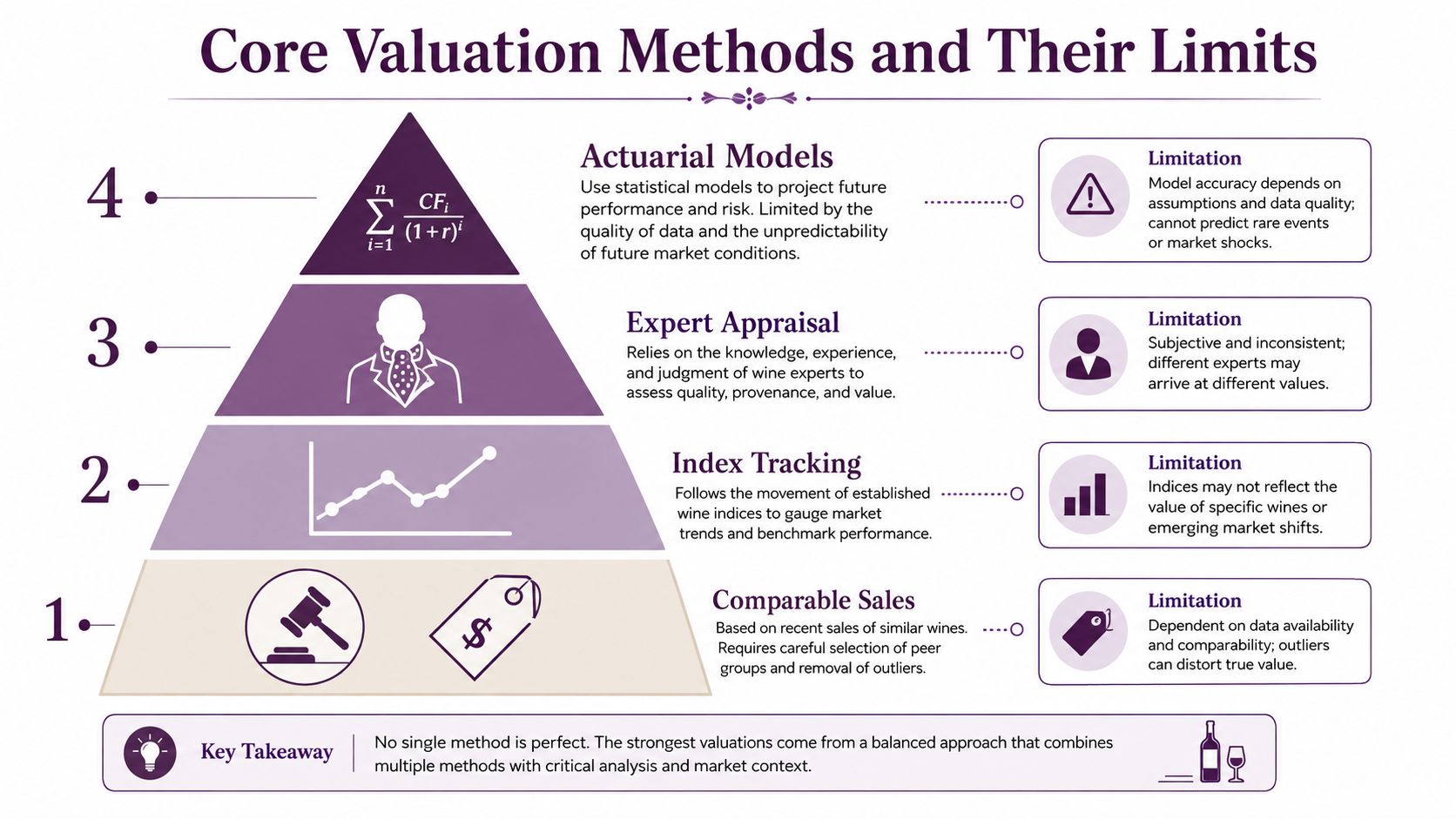
Repeat-sales thinking is useful for assets held over time because it focuses on price movement for the same item. It becomes less reliable when the bottle's condition changes, provenance is uncertain, or only successful sales are visible. Unsold inventory can make an asset look more liquid than it is.
| Method | Best Used For | Main Limitation |
|---|---|---|
| Comparable sales | A specific buying or selling decision | Thin or non-comparable evidence |
| Time-weighted history | Trend context across dated observations | Weighting can create false confidence |
| Hedonic model | Portfolios and sufficiently large datasets | Sensitive to missing variables and identity errors |
| Repeat-sales analysis | Tracking held assets through time | Unsold items and changing condition distort persistence |
A useful estimate might be a dated range supported by three coherent sales. A mathematically exact model output based on mismatched formats is commercially weaker, even if it displays more decimal places. Teams comparing tools should evaluate fine wine pricing tools by evidence quality and auditability, not by apparent complexity.
<a id="a-reliable-fine-wine-valuation-workflow"></a>
A Reliable Fine Wine Valuation Workflow
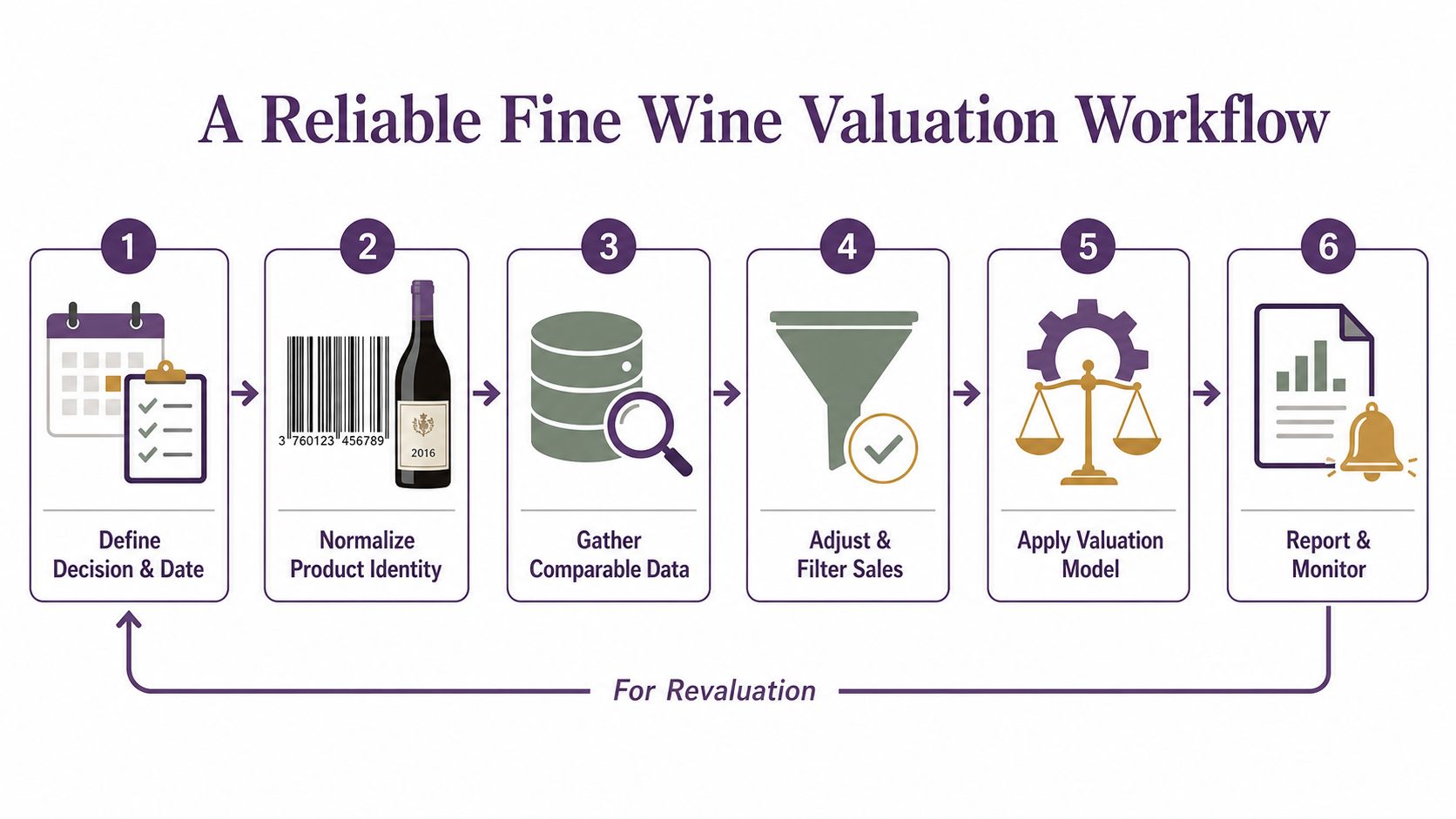
A reliable valuation starts with the decision it must support, not with the database. Define whether the output will guide a purchase, quote, replenishment decision, portfolio report, insurance context, or planned exit. Set the effective valuation date before gathering evidence. A price without a date cannot be tested against changing market conditions.
<a id="six-controls-keep-the-estimate-usable"></a>
Six controls keep the estimate usable
- Define the decision and date. Specify the audience, channel, currency, and holding or exit horizon.
- Normalize product identity. Resolve producer, exact wine, vintage, bottling, format, pack size, and benchmark universe.
- Gather comparable data. Collect retail, auction, exchange, and restaurant observations with source, timestamp, and status.
- Filter and adjust. Remove identity failures, stale listings, damaged lots, duplicates, and observations with unresolved fees.
- Apply the model. Calculate a central signal, a defensible range, and confidence grade.
- Report and monitor. Store assumptions, trigger review when signals change, and preserve the historical record.
Canonical matching controls the quality of every later calculation. Wine Labs reports documented 94.5% coverage in an investment platform case study, showing why heterogeneous listings must connect to a consistent product record (Wine Labs matching case study). Coverage does not establish certainty. Unresolved matches belong in an exception queue for human review, not in the comparable-sales set.
Automation can collect feeds, remove duplicate observations, retain historical prices, and flag missing fields. Human review remains necessary for unusual formats, unclear labels, mixed lots, questionable provenance, and abrupt price changes. These exceptions often determine whether a quoted value is tradable or merely indicative.
| Field | Entry |
|---|---|
| Decision | Merchant buy quote |
| Effective date | Stated valuation date |
| Canonical identity | Producer, wine, vintage, bottling, format |
| Base market signal | Best comparable evidence |
| Channel adjustment | Retail, auction, exchange, or restaurant context |
| Condition adjustment | Fill, label, capsule, provenance, storage |
| Liquidity adjustment | Expected speed and route to sale |
| Final range | Low, central, and high estimate |
| Confidence grade | High, medium, or low |
| Review trigger | Price movement, identity change, fee change, or stale evidence |
The range should widen when evidence is sparse, stale, or drawn from a materially different peer set. Channel and liquidity adjustments should reflect the route through which the bottle can be sold, rather than an average across incompatible observations. A central estimate without a confidence grade encourages users to treat model output as a guaranteed transaction. The final record should preserve the evidence and assumptions so a later reviewer can distinguish a market change from a matching or data-quality error.
<a id="valuation-decisions-for-merchants-and-investors"></a>
Valuation Decisions for Merchants and Investors
The same market observations support different decisions. A merchant needs an acquisition value tied to a credible resale route. An investor needs a marked range, then a separate estimate of what could remain after selling costs, delay, and execution risk. A collector or platform needs yet another output.
| Audience | Primary Decision | Required Output |
|---|---|---|
| Merchant | Buy, replenish, quote, or clear stock | Acquisition range, expected resale range, margin context, and sell-through risk |
| Investor | Report, hold, rebalance, or exit | Market value, cost basis, holding costs, unrealized change, and estimated liquidation value |
| Collector | Track or insure a cellar | Bottle-level identity, condition assumptions, and purpose-specific valuation |
| Platform | Match listings and publish prices | Canonical record, normalized observations, confidence, and exception status |
For a merchant, current listings show replacement pressure and competitive positioning. They do not automatically justify a buy price. The valuation should weight the likely exit channel, holding period, required margin, and whether the observed offer is executable. A bottle that appears attractive at retail may be uneconomic if the merchant must later sell through auction or accept a discount to clear stock.
An investor's portfolio report should separate at least two outputs: a marked market range and an estimated liquidation range. The latter should reflect channel-specific costs, weak demand, stale comparables, and bottles that may need discounting. A portfolio average can conceal one illiquid or condition-sensitive position, so identity and saleability must remain visible at bottle level.
<a id="regional-dispersion-changes-portfolio-interpretation"></a>
Regional dispersion changes portfolio interpretation
Prestige alone does not establish a valuation thesis. The Cult Wines index data as of June 2026 records reported gains since January 2014 of 129.01% for Burgundy, 84.65% for Champagne, 55.42% for Italy, 51.17% for the USA, 41.42% for Rest of World, 25.79% for Rhône, and 9.76% for Bordeaux (Cult Wines indices). Monthly June 2026 movements ranged from -0.53% for Burgundy to +0.58% for Champagne, so long-run regional performance does not remove short-term dispersion.
The broader Liv-ex Fine Wine 1000 stands at 350.7, with reported changes of -0.1% month on month, 0.3% year to date, 1.2% over one year, -9% over two years, and -7.9% over five years (Liv-ex indices). These benchmarks frame portfolio exposure, but they cannot identify the executable value of a specific bottle.
A rising index can improve the portfolio headline while an individual bottle remains hard to sell. Report both facts.
The long-run 4.1% to 5.3% real annual return range is useful for setting a holding-period assumption, whether storage and insurance costs are included or excluded. It cannot set an immediate exit quote. Merchants allocate inventory against operational resale conditions. Investors allocate capital against marked value, carrying costs, and liquidation risk. A useful valuation therefore preserves the bottle's canonical identity and keeps each channel's economics separate.
<a id="case-studies-mistakes-and-monitoring-signals"></a>
Case Studies Mistakes and Monitoring Signals
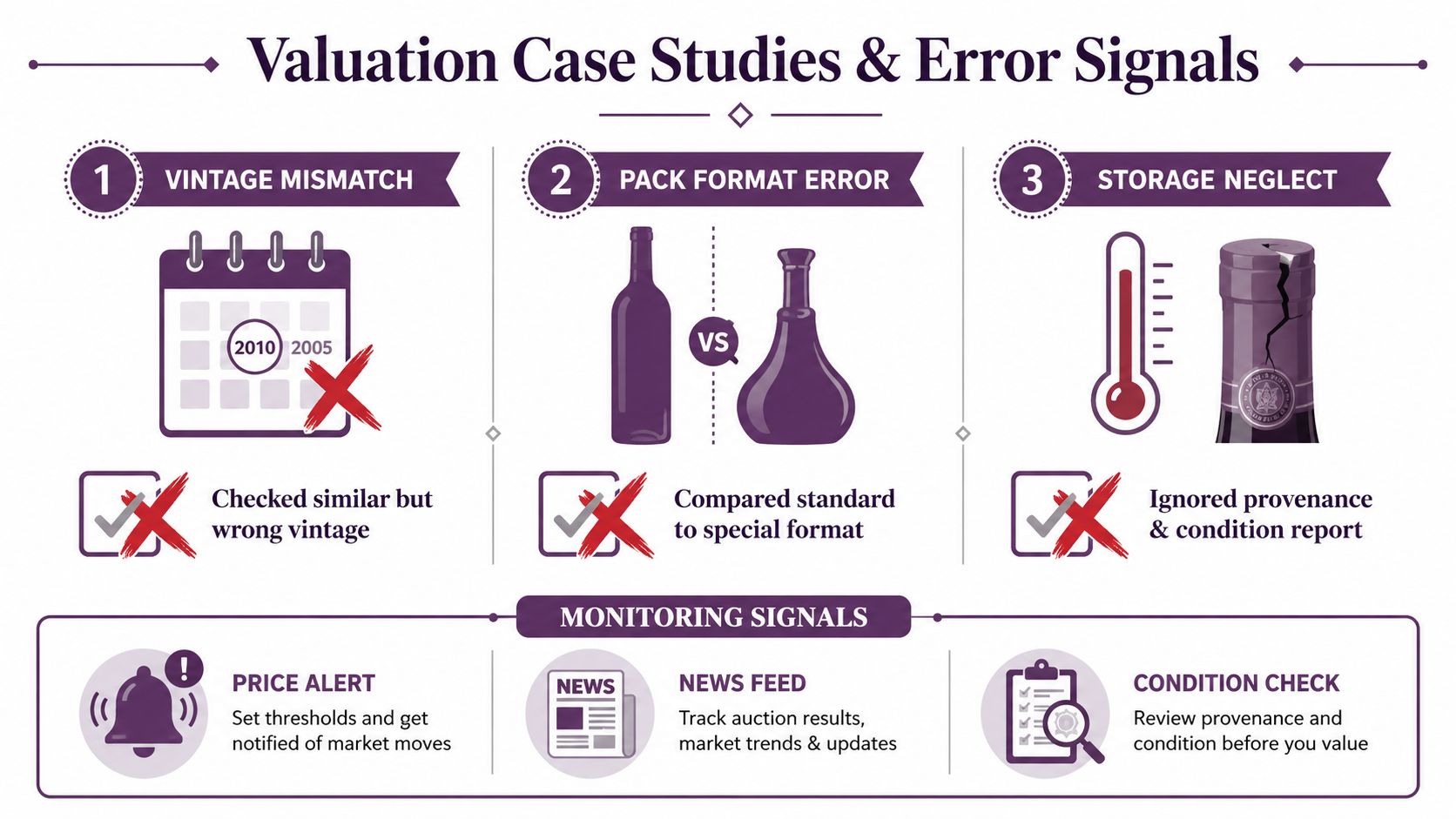
A valuation can look reasonable and still fail because the evidence answers a different question. Three recurring scenarios expose the problem.
<a id="the-similar-label-that-isnt-the-same-asset"></a>
The similar label that isn't the same asset
An analyst matches a producer and region but misses the vintage, bottling, or pack format. The resulting peer group may look full, yet it combines assets with different market behavior. Canonical identity matching catches the mismatch before the system calculates a false central price.
The control is simple: require exact identity fields and route unresolved records to review. Don't let a familiar producer name override a missing vintage or format.
<a id="the-attractive-asking-price-that-never-becomes-proceeds"></a>
The attractive asking price that never becomes proceeds
A seller sees a high retail listing and assumes it supports an equivalent auction exit. The listing reflects an offer, not necessarily a completed trade. Auction mechanics then alter the economics, and the seller may receive less than the visible headline after fees, timing, and sale conditions.
Use the listing as a reference, not proof. Compare it with completed outcomes and state whether the figure represents an asking price, hammer, buyer's all-in cost, or seller's proceeds.
<a id="the-strong-market-headline-beside-a-slow-bottle"></a>
The strong market headline beside a slow bottle
In 2025, iDealwine reported that auction volume rose 18.5% while average bottle prices fell 8% to 137 euros, with Burgundy representing 41.3% of value. The same report said Italian wines grew 33% in volume and 37% in value among non-French wines (iDealwine auction coverage). These figures describe one year and channel context, not a permanent rule. They do show why volume, average price, and category share can move in different directions.
Monitoring should focus on changes that challenge the current valuation:
- Identity exceptions: New listings fail to match the canonical record.
- Spread changes: Retail, auction, exchange, and restaurant prices diverge unusually.
- Realization weakness: Completed prices fall below the prevailing offer range.
- Liquidity deterioration: Lots remain unsold or require repeated repricing.
- Policy shocks: Tariff changes alter landed cost and cross-border demand.
- Regional momentum: A segment moves differently from the portfolio benchmark.
- Condition evidence: New inspection information changes provenance or bottle quality.
Wine Labs alerts, watchlists, REST endpoints, custom feeds, and agent-accessible analyses can surface these changes for review. They're monitoring tools, not automatic trade signals.
For auction-specific context, an analyst can review Berry Bros. & Rudd summer auction analysis, then preserve the relevant sale dates, formats, fees, and outcomes rather than relying on a summary headline.
| Check | Pass Condition |
|---|---|
| Identity | Producer, wine, vintage, bottling, and format match |
| Timestamp | Observation has a clear sale or listing date |
| Fees | Buyer, seller, tax, delivery, and premium treatment is recorded |
| Condition | Fill, label, capsule, seal, and provenance are documented |
| Liquidity | Expected exit route and selling speed are stated |
| Confidence | Range reflects evidence quality and comparability |
| Source ownership | The team knows whether evidence is first-party, listed, or completed |
<a id="building-a-durable-valuation-standard"></a>
Building a Durable Valuation Standard
A durable fine wine valuation standard is a dated, channel-specific range tied to a canonical identity, transparent adjustments, cost assumptions, liquidity, and confidence. Define the use, identify the exact asset, collect owned or first-party market evidence, normalize channel differences, select the method, document repricing risk, and set a review trigger. Business cycles can reprice fine wine even when quality is unchanged, while the 15% United States tariff on European wine and spirits from August 1, 2025, replacing a 10% rate then in place, showed how cross-border costs can change demand and arbitrage economics (Reuters tariff report). Teams building repeatable analyst capability can also use microlearning for developer products to improve how technical users interpret data workflows. Update when identity, fees, market regime, or liquidity changes, widen the range when evidence weakens, reject non-comparable sources, and obtain specialist review for exceptional lots.
Wine Labs consolidates retail, auction, exchange, and restaurant pricing into comparable records, with portfolio tools, canonical matching, historical tracking, alerts, APIs, and custom feeds for recurring valuation work. Visit Wine Labs to evaluate how its market data can support bottle-level pricing, merchant decisions, and investor portfolio monitoring.