Wine Labs · Market intelligence
Entre Deux Mers
Entre deux mers. Explore Entre-Deux-Mers, Bordeaux's hidden gem. Learn about wine styles, quality tiers, price bands and market trends
Entre-Deux-Mers is one of Bordeaux's largest named wine areas, covering roughly 47,000 hectares, yet only about 1,500 to 1,783 hectares carry the AOP designation. Historically, the appellation meant dry white wine only, but red wine was formally approved for the 2023 vintage, creating the first major structural shift in decades.
That opening fact should change how buyers read the name. The popular advice, that Entre-Deux-Mers is cheap Bordeaux white, is convenient but incomplete. It confuses a large geographic area with a much narrower appellation, overlooks the difference between AOP and generic Bordeaux AOC, and misses the commercial significance of the new red category.
For merchants, collectors, and investors, the important question is no longer only what Entre-Deux-Mers tastes like. It's how a historically white designation can add reds while preserving strict blending rules, and whether that regulatory evolution will create stronger identity or further blur the market.
Table of Contents
- Why Entre-Deux-Mers Is Not the Region You Think It Is
- Geography, History and the Appellation Gap
- Wine Styles, Blend Rules and the New Red Category
- Quality Tiers and Price Band Analysis
- Climate, Yield Constraints and Sourcing Resilience
- Sourcing Strategy for Merchants and Collectors
- Market Outlook and the Case for Attention
<a id="why-entre-deux-mers-is-not-the-region-you-think-it-is"></a>
Why Entre-Deux-Mers Is Not the Region You Think It Is
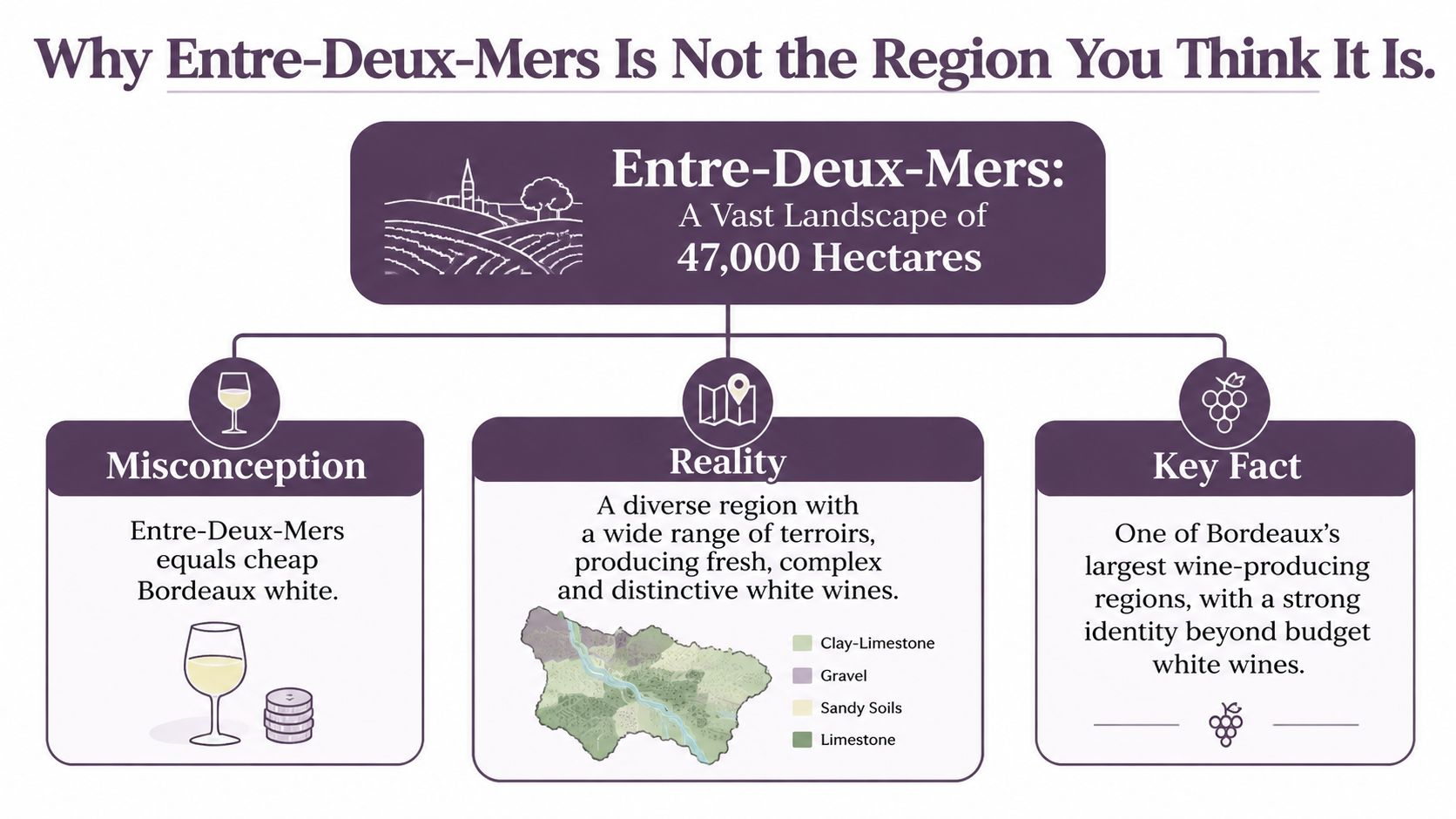
The phrase Entre-Deux-Mers describes two related but different things. As a geographic region, it covers a broad working vineyard area of about 47,000 hectares. As an appellation, it applies to a much smaller area, with sources identifying approximately 1,500 to 1,783 hectares dedicated to Entre-Deux-Mers wine. The Bordeaux appellation profile records 1,783 hectares, 133 communes, and 280 winegrowers, while broader industry figures distinguish that AOP footprint from the surrounding vineyard area.
That gap explains much of the category's confusion. A producer can operate within the Entre-Deux-Mers region while bottling red or rosé wine under generic Bordeaux AOC. Historically, the Entre-Deux-Mers AOC itself was reserved for still, dry whites, so the regional name became associated with a product category rather than with the full diversity of its vineyard economy.
<a id="the-red-wine-decision-changes-the-commercial-question"></a>
The red-wine decision changes the commercial question
The 2023 vintage marked the first time red wines could be labeled under Entre-Deux-Mers AOC. That decision ended a white-only convention and gave producers a new route to express the region's red-vineyard base through the appellation name. The first red wines were expected to reach consumers in January 2025, according to recent coverage of the appellation's evolution.
This doesn't turn Entre-Deux-Mers into a luxury red appellation overnight. It does create a new layer of differentiation for producers who previously had to use Bordeaux AOC for reds from the same broad area. The merchant's real task is to separate the established white category, the emerging red category, and the much larger pool of generic regional wine.
Commercial reading: Treat Entre-Deux-Mers as a designation with a narrow product identity inside a much larger agricultural zone.
The appellation's producer base is also split between independent growers and cooperative growers, making it a working production system rather than a boutique label built around a small group of prestige estates. That structure can support broad availability, but it also means buyers must assess producer identity, vineyard position, cellar practice, and channel positioning rather than relying on the regional name alone.
<a id="geography-history-and-the-appellation-gap"></a>
Geography, History and the Appellation Gap
Entre-Deux-Mers means “between two seas,” although the boundaries are rivers rather than open coast. The vineyard zone sits on a plateau between the Dordogne to the north and the Garonne to the south, a physical arrangement that gives the area a distinct geographic identity within Bordeaux. The INAO specification defines the AOP across 133 communes in Gironde and describes it as a zone for dry still white wines.
The plateau matters commercially because it prevents the regional name from functioning like a single, uniform vineyard. Elevation, drainage, exposure, and proximity to wetter low-lying ground can influence farming decisions and wine style. A label that says Entre-Deux-Mers therefore identifies a regulated origin, but it doesn't provide the same site-level information that a merchant might seek from a more narrowly recognized estate or lieu-dit.
<a id="a-long-history-with-a-modern-regulatory-layer"></a>
A long history with a modern regulatory layer
Viticulture in Entre-Deux-Mers is traced to Roman times, while monastic development accelerated vineyard activity from the 11th century. The appellation received formal status in 1937, connecting an old agricultural tradition to the modern French system of geographic regulation. Historical industry coverage records that long development and also documents the more recent authorization of red wines under the appellation.
The timeline reveals an important tension. Entre-Deux-Mers has deep historical continuity, but its commercial identity has never been frozen. Regulations define what can use the name, and those regulations now allow a category expansion that would have been unthinkable under the former white-only model.
<a id="why-the-geographic-name-misleads-buyers"></a>
Why the geographic name misleads buyers
Consumers often use “Entre-Deux-Mers” as shorthand for every wine produced between the two rivers. That assumption collapses the difference between where a producer farms and which appellation appears on the bottle. The result is a distorted view of both supply and quality.
A merchant evaluating the region should separate three questions:
- Geographic exposure: Is the wine made within the broader Entre-Deux-Mers region?
- Appellation qualification: Does it carry the Entre-Deux-Mers AOP designation?
- Commercial positioning: Is the producer using the appellation to build identity, or choosing generic Bordeaux AOC for flexibility?
That distinction is especially useful when assessing Bordeaux primeurs market mechanics, where geographic reputation, classification, and production identity can influence how buyers interpret a release. Entre-Deux-Mers is best understood as a large working agricultural area containing a focused appellation, not as a single homogeneous wine region.
<a id="wine-styles-blend-rules-and-the-new-red-category"></a>
Wine Styles, Blend Rules and the New Red Category
The traditional Entre-Deux-Mers bottle is a still, dry white wine. Its residual sugar must remain below 4 g/L, and its minimum alcoholic strength is 11.5%, according to the appellation rules summarized for Entre-Deux-Mers AOC. Those constraints create a defined style target rather than a broad permission to make any white wine from the region.
The principal white grapes are Sauvignon Blanc, Sauvignon Gris, Sémillon, and Muscadelle. Producers can also use accessory varieties including Colombard and Ugni Blanc. Under the current rules, the wine must contain at least two grape varieties, and no single variety may exceed 80% of the final blend, as specified in the official INAO production document.
<a id="blending-is-a-market-signal"></a>
Blending is a market signal
The blend cap does more than shape the technical profile. It limits the ability of a producer to market the wine as a near-monovarietal expression, making the appellation's identity depend more heavily on balance between varieties, harvest decisions, and cellar work. Sauvignon Blanc may provide freshness and aromatic lift, while Sémillon can add breadth and texture, but the final character depends on the proportion and condition of the grapes.
For buyers, that creates both an advantage and a complication. The advantage is a recognizable dry-white framework. The complication is that vintage variation can appear through the blend, especially when growers adjust proportions to manage ripeness, acidity, or disease pressure.
<a id="the-approved-red-framework"></a>
The approved red framework
The 2023 regulatory change opened the appellation to red wines. Approved red varieties include Merlot, Cabernet Sauvignon, Cabernet Franc, Malbec, and Petit Verdot. Carmenère is allowed only as an accessory variety and is limited to 30% of the blend, according to André Lurton's overview of the Entre-Deux-Mers appellation.
This gives producers a route to present Merlot-led or mixed Bordeaux red styles under a name previously associated almost entirely with white wine. It also introduces a branding challenge. Buyers who recognize Entre-Deux-Mers as a dry white designation may not immediately understand why a red carries the same name.
| Parameter | White Wine | Red Wine |
|---|---|---|
| Appellation role | Established dry-white category | Newly approved category from the 2023 vintage |
| Production format | Still and dry | Still red wine |
| Core varieties | Sauvignon Blanc, Sauvignon Gris, Sémillon, Muscadelle | Merlot, Cabernet Sauvignon, Cabernet Franc, Malbec, Petit Verdot |
| Accessory varieties | Colombard and Ugni Blanc | Carmenère, limited to 30% |
| Blend discipline | At least two varieties, with no single variety above 80% | Approved varieties governed by the new red framework |
| Commercial issue | Familiar identity and established demand | Emerging identity and developing market recognition |
The rules separate true Entre-Deux-Mers AOC from generic Bordeaux AOC. They give the name a more deliberate product architecture, but they also require merchants to educate customers. The technical framework is therefore part of the quality proposition and part of the sales challenge.
<a id="quality-tiers-and-price-band-analysis"></a>
Quality Tiers and Price Band Analysis
Entre-Deux-Mers doesn't have a single price story. Its commercial ladder reflects the difference between cooperative production, independent estate positioning, vineyard site, and the category chosen for the bottle. Because verified market pricing isn't provided here, the useful analysis is structural rather than a fabricated price list.
<a id="white-wine-offers-the-clearest-turnover-case"></a>
White wine offers the clearest turnover case
The entry tier is dominated by accessible cooperative and high-volume white wines. These bottles can work well for retailers seeking a recognizable dry Bordeaux white with straightforward customer appeal. The style rules help establish expectations around dryness, freshness, and blended grape composition, while the broader agricultural base supports a supply model that is more practical than scarcity-driven.
The mid-tier depends more heavily on producer and site. Independent growers working on slopes and plateaus can distinguish their wines through drainage, exposure, older vines, lower-intervention farming, or more ambitious cellar work. Those claims still need verification bottle by bottle, but the commercial principle is clear: the appellation name alone doesn't explain a premium.
A buyer should ask why a particular bottle sits above the entry tier. Is the justification a better site, a stronger producer reputation, a more selective distribution strategy, or just packaging? Without that answer, the buyer risks paying for a story that the label can't substantiate.
<a id="red-wines-begin-with-a-positioning-problem"></a>
Red wines begin with a positioning problem
The emerging red segment has a different economic profile. Producers can now use Entre-Deux-Mers AOC to give red wines from the area a more specific identity, but many comparable wines from the broader region remain eligible for generic Bordeaux AOC. That creates price compression risk. A producer choosing the appellation route is sacrificing some labeling flexibility in exchange for a chance to build long-term recognition.
This choice resembles a brand investment. In the short term, a generic Bordeaux label may be easier for customers to understand. In the longer term, a successful Entre-Deux-Mers red could give a producer a more distinctive narrative, especially if the estate can demonstrate consistent quality and a clear regional style.
The premium case rests less on scarcity than on credible differentiation.
<a id="where-value-is-most-defensible"></a>
Where value is most defensible
For immediate retail turnover, established dry whites remain the safer category because consumers already understand the basic proposition. For differentiated inventory, the new reds may offer more room to stand apart, but they also carry higher communication risk and less settled pricing behavior.
The strongest value is likely to appear where three elements align:
- Producer accountability: A clear independent or cooperative identity with transparent sourcing.
- Site credibility: Vineyard positions that support drainage and reliable ripening rather than undifferentiated volume.
- Appellation commitment: A decision to use Entre-Deux-Mers AOC as a durable identity, not merely as a temporary marketing experiment.
That framework helps merchants compare like with like. It also prevents the common mistake of treating every bottle from the geographic region as an equivalent substitute for an appellation wine.
<a id="climate-yield-constraints-and-sourcing-resilience"></a>
Climate, Yield Constraints and Sourcing Resilience
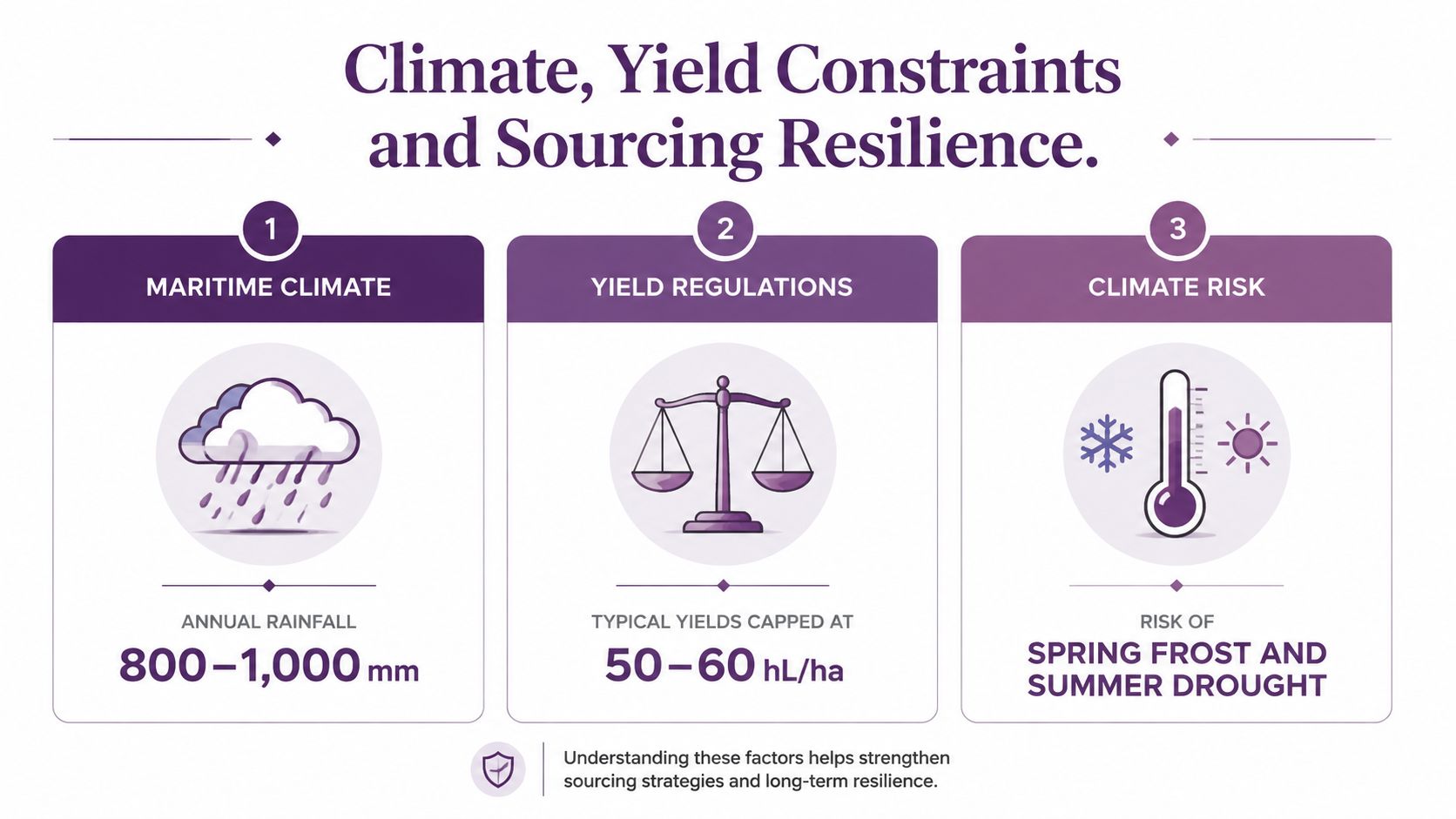
Entre-Deux-Mers has a maritime climate, with roughly 800 to 1,000 mm of rainfall and about 240 days of sunshine, according to regional coverage of the appellation's climate and production conditions. The same climate that supports vine growth also raises mildew and rot pressure in wet years. Vineyard sites on slopes and plateaus are therefore favored over lower, wetter ground because drainage becomes a commercial variable, not merely a viticultural preference.
<a id="yield-rules-limit-the-bulk-assumption"></a>
Yield rules limit the bulk assumption
Production rules sit at about 65 hectoliters per hectare, with a ceiling of 75 hectoliters per hectare, as reported in the same regional analysis. Historical production references show different outcomes depending on the source and period, including approximately 81,085 hectoliters in one industry account and about 92,147 hectoliters declared in 2023 in another.
Those figures shouldn't be read as a promise of stable annual availability. They show that the appellation is substantial, but exposed to the interaction between weather, disease management, yield limits, and producer decisions. A buyer who assumes that the geographic scale guarantees unlimited AOP supply may be confusing the broader vineyard with the regulated category.
The latest global wine supply coverage is relevant as market context, but it doesn't eliminate the need for appellation-level diligence. Supply risk is still assessed through producer commitments, vintage conditions, and the location of the vineyards in question.
<a id="blending-adds-resilience-but-not-immunity"></a>
Blending adds resilience, but not immunity
The 80% single-variety cap encourages producers to rely on blends rather than a single grape as the dominant commercial identity. That can help a winery adjust when one variety performs poorly, allowing other approved grapes to carry more of the final blend within the regulatory framework.
Blending doesn't remove climate risk. It can, however, give producers more tools to manage it. For merchants, the practical conclusion is to build relationships with estates that can explain their vineyard mix, harvest choices, and response to wet conditions, rather than relying on regional volume alone.
The video below offers useful visual context for the region and production environment.
<iframe width="100%" style="aspect-ratio: 16 / 9;" src="https://www.youtube.com/embed/rHUTiGZ_ooU" frameborder="0" allow="autoplay; encrypted-media" allowfullscreen></iframe>A resilient sourcing program should favor producers with access to well-drained sites, credible blending options, and enough operational discipline to protect quality when conditions become difficult. That approach may produce less predictable short-term uniformity, but it gives buyers a better basis for managing supply over successive vintages.
<a id="sourcing-strategy-for-merchants-and-collectors"></a>
Sourcing Strategy for Merchants and Collectors
The first decision is commercial purpose. A retailer buying for immediate turnover needs dependable customer recognition and a clear drinking proposition. A collector or investor can tolerate more category uncertainty if the bottle offers a credible route to future differentiation. Entre-Deux-Mers requires buyers to identify which job the inventory must perform before they judge the wine.
<a id="read-the-label-as-a-production-decision"></a>
Read the label as a production decision
Start with the appellation line, not the front-label imagery. The distinction between Entre-Deux-Mers AOC and Bordeaux AOC tells you whether the producer has chosen the narrower regulated identity. It doesn't prove quality, but it tells you how the wine is being positioned within the regional system.
Then examine the producer structure. The regional grower base includes both independent producers and cooperative growers, so buyers should understand whether a bottle reflects an estate-led identity, a cooperative sourcing model, or a broader commercial blend.
For white wines, the 80% cap means the blend can't be treated as a simple varietal statement. Ask for the actual composition where available, then compare it with the vintage conditions and the producer's stated style. A change in proportions can be a deliberate quality decision rather than inconsistency.
<a id="match-the-category-to-the-channel"></a>
Match the category to the channel
- Retail shelves: Prioritize established dry whites when customers need an easy-to-understand Bordeaux choice and dependable rotation.
- Restaurant lists: Use the appellation's dry profile and blended identity to support food-pairing placement, especially where a less obvious Bordeaux category can add breadth.
- Collector inventories: Approach the new reds selectively, focusing on producers with a convincing regional rationale rather than buying the label merely because it is newly permitted.
- Investment research: Compare retail, auction, and restaurant signals separately. A promotional retail listing doesn't automatically establish durable market value.
The emerging red category can create useful differentiation, but it shouldn't displace the white category's established commercial role. A disciplined portfolio can use whites for practical turnover and selected reds for controlled exposure to a developing identity.
Finally, verify the market before quoting, buying, or selling. Cross-channel comparisons help prevent a buyer from mistaking a temporary listing anomaly for a stable price signal. The most valuable Entre-Deux-Mers opportunities may not be the cheapest bottles, but the ones whose producer, site, appellation use, and channel behavior all point in the same direction.
<a id="market-outlook-and-the-case-for-attention"></a>
Market Outlook and the Case for Attention
Entre-Deux-Mers is changing through three connected forces. The first is the red-wine approval beginning with the 2023 vintage, which gives producers a new appellation route for wines that previously would commonly have carried generic Bordeaux AOC. The second is the 2025 blending-rule change, which caps any single grape variety at 80% and reinforces multi-varietal expression. The third is the continuing gap between the vast geographic region and the much narrower AOP footprint.
Together, these forces make the appellation more interesting than its low-cost white-wine reputation suggests. They don't make every bottle premium, and they don't erase the region's working agricultural character. They do create a more useful analytical distinction between volume, identity, and site-driven quality.
<a id="what-the-change-means-for-each-buyer"></a>
What the change means for each buyer
Merchants should treat the established white category as the operational core. It offers the clearest customer proposition, while carefully selected reds can provide differentiation where the retailer is willing to explain the regulatory change and the producer's style.
Investors should be cautious about assuming that a new appellation category will automatically generate appreciation. The red designation is still building market recognition, and its pricing logic remains less settled than that of the established white category. The opportunity lies in identifying producers that use the new identity with discipline, not in buying novelty alone.
Collectors may find value in building a foundation around distinctive producers rather than chasing scarcity. Entre-Deux-Mers remains a volume-oriented working region, not a luxury boutique appellation. Its potential rests on improving clarity, better site selection, and the possibility that consistent red and white identities will strengthen recognition over time.
<a id="a-measured-verdict"></a>
A measured verdict
The central trade-off is straightforward. Geographic scale can support production and distribution, but it can also obscure the difference between AOP wines and generic regional bottlings. Strict rules can strengthen identity, but they limit varietal simplicity and require producers to communicate blends more effectively. Climate exposure can interrupt supply, while well-drained sites and flexible blending can improve resilience.
Buyers should therefore give Entre-Deux-Mers active consideration in 2026 and beyond, but with a filter. Use everyday shelf space for reliable white wines with clear commercial logic. Reserve premium attention for producers whose site, blend, and appellation choices demonstrate a coherent long-term strategy. For market participants who need comparable evidence before making that judgment, fine wine market data and analytics can help separate isolated listings from broader channel behavior.
Entre-Deux-Mers isn't a surprise luxury discovery, and it shouldn't be sold as one. It is a structurally improving Bordeaux appellation whose regulatory evolution and site-driven quality discipline make it one of the region's most misunderstood value propositions.
Wine Labs consolidates retail, auction, exchange, and restaurant pricing into a comparable view, helping merchants and collectors assess Entre-Deux-Mers bottles without relying on a single channel or stale listing. Visit Wine Labs to compare market signals, track relevant wines, and make better-informed sourcing and portfolio decisions.