Wine Labs · Market intelligence
Cotes Du Rhone Wine Guide: Regions, Grapes, and Prices
Explore Cotes du Rhone with our data-backed guide to appellation zones, signature grape blends, quality tiers, and current retail pricing across major markets.
Côtes du Rhône sold 279,843 hectolitres in 2025, down 4.2%, while its average bottle price rose 1.4% to €3.93, according to Inter Rhône's reported market figures. That contradiction changes how the category should be read. Côtes du Rhône isn't a cheap, red regional blend under pressure. It's a large appellation trying to protect value while buyers show more interest in white wine, rosé, lighter reds, and occasion-led drinking.
The familiar Grenache, Syrah, and Mourvèdre formula still matters, but it no longer explains the whole commercial picture. Production remains overwhelmingly red, yet the most useful opportunities for merchants and restaurants may sit in the smaller white and rosé segments, especially when those wines fill seasonal and by-the-glass gaps that traditional red-heavy assortments leave open.
Table of Contents
- The State of Côtes du Rhône in 2026
- Appellation Map and Geographic Logic
- Quality Hierarchy From Regional to Cru
- Grape Blends That Define the Appellation
- Pricing Ranges and What Drives Them
- Sourcing and Assortment Strategy Across Channels
- Investment Case and Market Signals to Watch
<a id="the-state-of-cotes-du-rhone-in-2026"></a>
The State of Côtes du Rhône in 2026
Côtes du Rhône enters 2026 with record acreage but shrinking commercial volume. Rhône Valley figures show 26,777 hectares in production in 2025, alongside 917,549 hectolitres produced at an average yield of 34 hl/ha, according to official Rhône Valley appellation data. That scale supports broad availability, yet the commercial figures point to tighter demand or distribution in the channel, with volume falling while average bottle prices rise.
The central market signal is therefore a tension between volume and value. Commercial volume declined, while the average bottle price increased. Pricing power is likely concentrated among producers with recognizable brands, reliable distribution, clear provenance, or cuvées that give the regional name a more specific reason to command attention. Anonymous, bulk-oriented labels have less protection.
<a id="the-category-is-still-red-led"></a>
The category is still red led
The 2025 production mix was 83% red, 9% rosé, and 8% white, according to the reported 2025 Côtes du Rhône production breakdown. The INAO overview cited earlier describes a closely related composition of 87% red, 6% white, and 7% rosé, while characterizing the appellation as primarily dry red wine.
The numbers explain why the category's repositioning can be overlooked. White and rosé remain minority styles, but together they create a meaningful commercial lane within a red-dominated appellation. They can serve seasonal menus, by-the-glass programs, and lighter drinking occasions without requiring buyers to abandon Rhône identity.
The region's 2026 campaign targets consumers aged 21 to 40 and presents Côtes du Rhône through contemporary occasions. Trade reporting also identifies stronger interest in white wines, lighter reds, and sparkling styles in Asia (trade coverage of the Rhône and Alsace campaign in Asia). That positioning matters because the headline market evidence is not a simple growth story. The category is selling less commercial volume, yet selected wines are defending or raising price.
| Metric | Latest 2026 Reading |
|---|---|
| Production area | 26,777 ha in 2025 |
| Total production | 917,549 hl in 2025 |
| Average yield | 34 hl/ha in 2025 |
| Production mix | 83% red, 9% rosé, 8% white |
| Commercial volume | 279,843 hl, down 4.2% |
| Average bottle price | €3.93, up 1.4% |
The Wine Labs Rhône distribution digest provides an adjacent reference for changing Rhône distribution and market narratives. The practical conclusion is selective rather than broadly bullish: pricing power is strongest where regional identity is visible, while white, rosé, and lighter styles offer the clearest route to broaden the category beyond its traditional red profile.
<a id="appellation-map-and-geographic-logic"></a>
Appellation Map and Geographic Logic
Côtes du Rhône is a large regional designation, so its map matters more than a simple north-south label. The main analytical divide is climate and terrain. Northern Rhône vineyards occupy a narrower corridor with steep slopes, while the southern Rhône opens into broader plains and low hills that support a much larger production base.
<a id="north-and-south-follow-different-rules-of-place"></a>
North and south follow different rules of place
The Northern Rhône includes Côte-Rôtie, Condrieu, Saint-Joseph, Hermitage, Crozes-Hermitage, Cornas, and Saint-Péray. Syrah anchors the northern red-wine identity, with slope, exposure, and elevation shaping ripeness and structure. The cooler setting also favors wines built around freshness, savory spice, and aromatic definition rather than sheer weight.
South of the northern corridor, broader landforms allow vineyards to spread across alluvial plains, low hills, and varied soil complexes. Around Orange, alluvial deposits create a different growing environment from the narrow granite terraces farther north. In Châteauneuf-du-Pape, galets roulés, rounded stones deposited across the soil, store and radiate heat. Around Visan and Cairanne, limestone-clay slopes combine drainage with greater water retention, while exposure influences the pace of ripening.
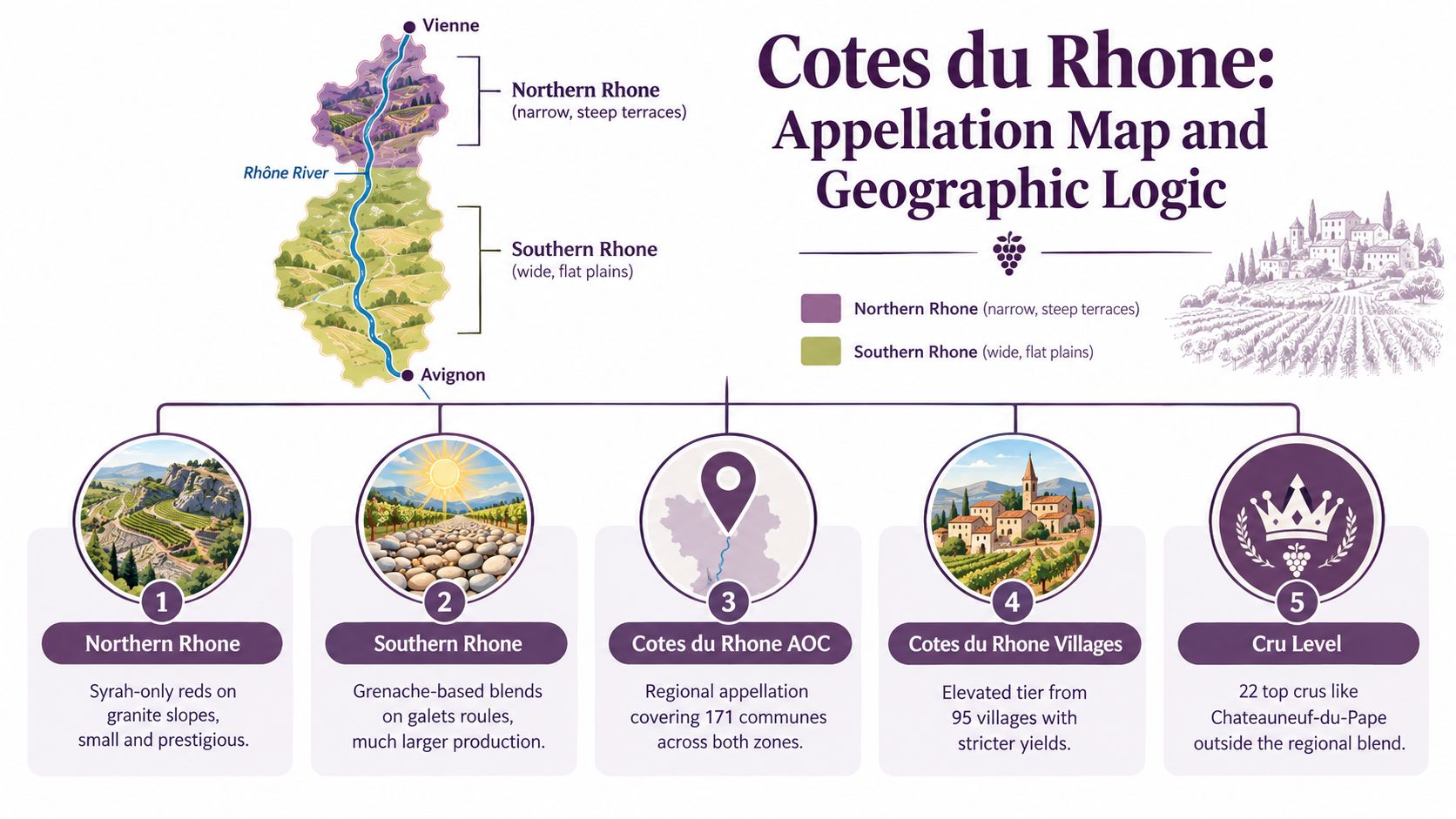
The video below helps visualize how northern slopes, southern plains, and soil differences shape the appellation's geographic logic.
<iframe width="100%" style="aspect-ratio: 16 / 9;" src="https://www.youtube.com/embed/leSVBry3XpI" frameborder="0" allow="autoplay; encrypted-media" allowfullscreen></iframe><a id="why-the-classification-needs-several-layers"></a>
Why the classification needs several layers
The regional Côtes du Rhône AOP spans 172 communes across six departments, Ardèche, Drôme, Gard, Loire, Rhône, and Vaucluse, as described in the INAO appellation description cited above. That scale explains why one regional label can contain substantially different soils, exposures, and ripening patterns.
Côtes du Rhône Villages and named village designations narrow that geographic claim. A warmer, stony site may support blends with more Grenache for body and ripe fruit. A cooler or higher site can preserve freshness and give Syrah a larger role in aromatic lift, spice, and structure. Mourvèdre becomes more practical where conditions allow longer maturation.
The classification does not remove local variation. It gives buyers a way to read how tightly origin and production rules constrain the final wine. Regional Côtes du Rhône offers the broadest sourcing canvas, while Villages and named communes make a more specific place-based promise.
That flexibility also supports the category's repositioning. The same broad appellation can produce generous southern red blends, fresher rosé, and increasingly relevant white wines. Its geographic breadth is therefore a commercial asset, especially as volume declines while average price rises. Côtes du Rhône can retain Rhône identity while reaching lighter drinking occasions and buyers less focused on traditional red styles.
<a id="quality-hierarchy-from-regional-to-cru"></a>
Quality Hierarchy From Regional to Cru
The Côtes du Rhône hierarchy is a progression of geographic precision and production restriction. Regional Côtes du Rhône permits the broadest sourcing and stylistic range. Côtes du Rhône Villages narrows the origin claim and applies tighter production expectations. Named village and Cru appellations attach the wine to a defined place, specification, and identity.
Commercial labels frequently diverge from the official yield and alcohol table, so buyers should verify the tier on the label rather than assume it. The regional maximum yield is 51 hl/ha, while the wider legal framework can allow annual adjustment up to 60 hl/ha by ministerial order, as summarized in this Côtes du Rhône appellation rule summary. Trade summaries place Villages yields around 45 hl/ha and indicate higher minimum alcohol requirements.
<a id="what-the-rules-change-in-the-bottle"></a>
What the rules change in the bottle
The regional AOC sets a natural minimum alcohol of 11% south of the Montélimar parallel and 10.5% north of it. Enrichment is capped at a total alcohol level of 13%, with no more than two degrees of enrichment, according to the Côtes du Rhône Villages rule reference.
These thresholds shape sourcing decisions. Cooler northern sites can qualify with slightly lower-sugar fruit, while warmer southern sites must meet a higher natural minimum. Yield limits add another control. Lower permitted yields reduce the volume produced per hectare and can give producers more room to manage concentration and consistency, although the commercial result still depends on site and vintage.
| Tier | Yield (hl/ha) | Min ABV | Aging Requirement |
|---|---|---|---|
| Côtes du Rhône AOC | 51 maximum | 10.5% north, 11% south | Not specified in the verified data |
| Côtes du Rhône Villages | Around 45 in trade summaries | Higher minimums than regional AOC | Not specified in the verified data |
| Named village and Cru appellations | Châteauneuf-du-Pape: 35 base yield | Châteauneuf-du-Pape: 12.5% minimum | Not specified in the verified data |
The table shows why the tiers matter commercially. Châteauneuf-du-Pape applies a tighter yield and higher alcohol floor than the regional AOC. Gigondas provides another concrete Cru example, with 38 hl/ha and 12.5% minimum ABV. These figures are appellation-specific, so buyers should not transfer one Cru's rules to another.
A Cru such as Châteauneuf-du-Pape, Gigondas, or Hermitage is a separate appellation, not just a more expensive Côtes du Rhône. Villages occupies the intermediate position. It offers a more specific regional story without requiring the scarcity or prestige pricing associated with Cru wines.
Buying implication: Treat Villages as a sourcing tier, not only a price tier. It can support a clearer origin proposition while preserving broader availability.
The Wine Labs appellation and AI sommelier digest is relevant to teams connecting appellation identity with market research. The hierarchy's commercial value is its ability to separate broad supply from increasingly constrained origin claims, including white, rosé, and lighter styles as the category adjusts beyond its traditional red focus.
<a id="grape-blends-that-define-the-appellation"></a>
Grape Blends That Define the Appellation
Grenache anchors many Côtes du Rhône reds, but the appellation's profile depends on how it is balanced with Syrah, Mourvèdre, and supporting varieties. Grenache brings ripe fruit, weight, and warmth. Syrah contributes darker fruit, pepper, color, and structural tension. Mourvèdre adds firmness, depth, and savory detail when it reaches full maturity.
In typical producer practice, Grenache often represents 40% to 70% of a red blend, while Syrah and Mourvèdre together commonly account for 15% to 30%. Cinsault, Carignan, and Counoise fill out the remaining balance. These are practical blending ranges rather than a single official percentage table covering every permitted variety, so producers can adjust emphasis by site and vintage.
<a id="red-wine-is-a-balancing-exercise"></a>
Red wine is a balancing exercise
A warm southern site can support a Grenache-led wine with generous fruit and a broad palate. Syrah keeps that profile from becoming heavy, while Mourvèdre supplies a firmer frame. In cooler conditions, Syrah's aromatic and structural role can increase, with Grenache retaining the regional signature.
Cinsault softens and lifts the blend. Carignan adds freshness and savory structure, while Counoise contributes perfume and brightness. The producer is managing ripeness, tannin, acidity, and texture rather than following a fixed recipe.
<a id="white-and-rose-offer-the-clearest-repositioning-opportunity"></a>
White and rosé offer the clearest repositioning opportunity
The appellation permits 21 white grape varieties. Viognier, Marsanne, Roussanne, and Grenache Blanc form principal combinations, while Bourboulenc and Clairette can add freshness and balance. White Côtes du Rhône consequently offers more internal variety than a red-dominated shelf implies.
Rosé can be made through pressing or saignée. Common blends use Grenache, Cinsault, and Syrah. Pressing emphasizes direct fruit and freshness, while saignée draws juice from a red-wine fermentation and can produce a different balance of color and texture. That distinction gives merchants two separate ways to position the style. Rosé serves a drinking occasion built around refreshment and timing, rather than functioning only as a paler red.
| Color | Primary Grapes | Secondary Grapes | Typical Range |
|---|---|---|---|
| Red | Grenache | Syrah, Mourvèdre | Grenache commonly 40% to 70% |
| Red | Syrah, Mourvèdre | Cinsault, Carignan, Counoise | Syrah and Mourvèdre often 15% to 30% combined |
| White | Viognier, Marsanne, Roussanne, Grenache Blanc | Bourboulenc, Clairette and other authorized varieties | The appellation permits 21 white varieties |
| Rosé | Grenache, Cinsault, Syrah | Other authorized varieties | Pressing or saignée permitted |
A producer example shows why the percentages should be read as working ranges. A Grenache-led bottling can preserve the appellation's warmth while using Syrah and Mourvèdre to alter color, tannin, and finish. A white or rosé program then extends the same regional identity into occasions where freshness matters more than weight. The blend is therefore a commercial specification as much as a cellar decision.
The Wine Labs appellation and AI sommelier digest can support teams linking appellation identity with market research. Its relevance here is practical: blend composition helps buyers distinguish a traditional red core from the white, rosé, and lighter-style formats reshaping the category.
<a id="pricing-ranges-and-what-drives-them"></a>
Pricing Ranges and What Drives Them
The key market tension is straightforward: the €3.93 average bottle price cited in the opening rose 1.4%, while volume fell 4.2% to 279,843 hectolitres, according to Inter Rhône (reported Côtes du Rhône volume and price figures). The combination points to price resilience during contraction, not universal pricing power across every producer, channel, or style.
Average price can rise as the product mix changes, lower-volume channels shrink, or buyers select more distinctive bottlings. It also fits the category's repositioning around white, rosé, and lighter expressions, where freshness and occasion can support a different value proposition from a volume-led red program. The figure remains an average, not a shelf-price benchmark.
<a id="what-buyers-should-compare"></a>
What buyers should compare
Four cost drivers help explain why wines with a related Rhône identity can occupy very different price positions:
- Yield discipline: Lower yields restrict available volume and increase the importance of vineyard selection.
- Source specificity: Regional fruit provides scale, while Villages and named communes make narrower origin claims.
- Cellar choices: Tank, large oak, smaller oak, amphora, and other vessels affect costs and stylistic signals. The verified evidence does not establish a standard premium for any single method.
- Distribution scale: Larger programs spread logistics across more bottles. Smaller domaines may carry higher selling and distribution costs per bottle.
| Tier | Key Price Drivers |
|---|---|
| Regional Côtes du Rhône | Scale, blend flexibility, distribution, and access to red, white, rosé, and lighter-style occasions |
| Côtes du Rhône Villages | Tighter sourcing, reported yield constraints, and clearer site identity |
| Named Villages | Specific commune, producer reputation, and narrower sourcing |
| Cru appellations | Separate appellation rules, provenance, reputation, and scarcity |
The tier does not determine value on its own. Buyers should compare wines with similar vintage, color, producer scale, route to market, and intended occasion. A regional white or rosé may compete through freshness and versatility, while a red Villages bottling may rely more heavily on origin and cellar positioning. Comparing only appellation names can therefore obscure the commercial reason for a price difference.
Wine Labs' fine wine market data platform can help teams compare retail, auction, exchange, and restaurant channels through one market view. That comparison is most useful when it separates channel effects from genuine producer or appellation premiums.
For merchants, the defensible conclusion is selective trading up. The Inter Rhône figure cited in the opening shows an average price increase alongside declining volume, supporting stronger scrutiny of positioning and mix. It does not make every Côtes du Rhône scarce or investment-grade. Price is becoming a more informative quality and positioning signal than volume alone, provided buyers test it against style, provenance, and channel evidence.
<a id="sourcing-and-assortment-strategy-across-channels"></a>
Sourcing and Assortment Strategy Across Channels
A Côtes du Rhône range should assign each style a clear commercial job rather than repeat one red SKU at different prices. Regional AOC supports availability, consistency, and broad food compatibility. Villages gives merchants and restaurants a stronger place-based story, while Cru selections require provenance, producer recognition, and a service context that can support narrower buying.
<a id="match-the-channel-to-the-job"></a>
Match the channel to the job
Importers and distributors can use regional programs for dependable volume, then differentiate through direct domaine relationships and named Villages. Restaurant buyers need a recent-vintage review process, particularly for by-the-glass placements. A wine that succeeds on a list may perform differently as its fruit, freshness, or alcohol balance shifts.
Retailers can organize the shelf by occasion:
- Everyday red: A recognizable regional blend for familiar food occasions.
- Lighter red: A fresher option for chilled service and customers moving away from heavy reds.
- White and rosé: Styles that extend Côtes du Rhône into seafood, aperitif, warm-weather, and daytime occasions.
- Villages: Bottles with enough geographic detail to reward staff recommendation.
- Cru: A smaller selection for enthusiasts and customers seeking established appellation names.
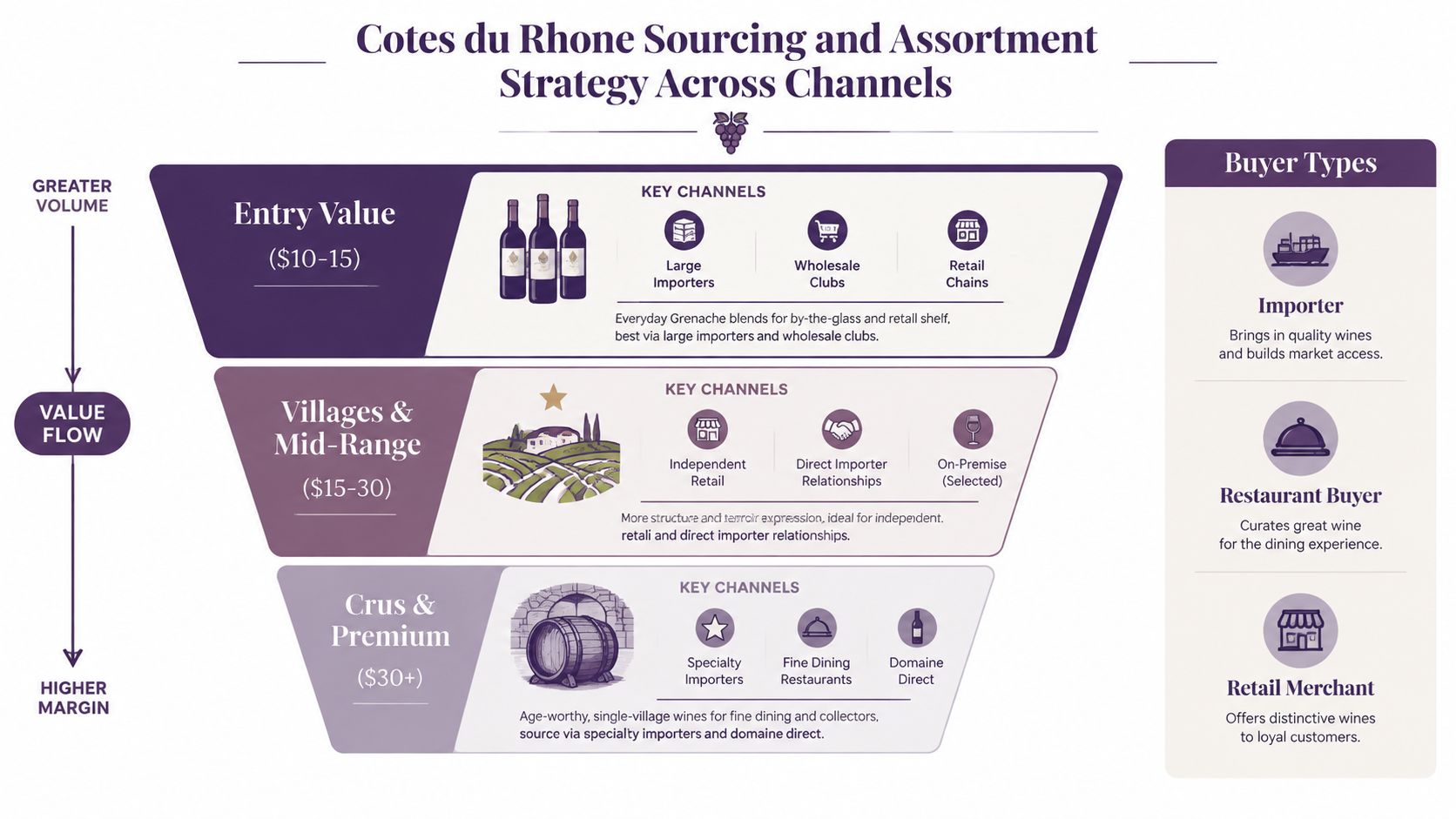
The channel mix should reflect the market's current tension: volume is declining while average price is rising. That signal supports tighter assortment decisions, not a blanket shift toward expensive bottles. White, rosé, and lighter red placements can widen consumption occasions while preserving a regional red anchor.
Allocation timing requires direct confirmation. Large regional programs can often move through established importer and distributor relationships, while named Villages and Cru selections may require earlier discussions with specialty importers or domaines. Unlike Burgundy or Bordeaux, Rhône négociant allocations open in spring. Confirm release timing with each importer rather than assuming a September calendar.
Vintage selection should remain practical. For a by-the-glass program, taste the incoming lot and compare it with the current listing. For retail, staff should explain why a white or rosé earns space in the range, rather than present it as a token alternative to red.
Assortment rule: Build around occasions first, then classification. A regional red, a lighter red, a white, a rosé, and a carefully selected Villages bottle can cover more customer needs than a shelf crowded with near-identical red blends.
Glassware affects how these styles perform in service. Restaurants and hosts comparing bowls, stems, and serving formats can use this practical guide to choosing the right wine glasses, especially when one list must present both fresh whites and aromatic Rhône reds.
<a id="investment-case-and-market-signals-to-watch"></a>
Investment Case and Market Signals to Watch
Côtes du Rhône is primarily a consumption category, not a dependable standalone investment. Regional and Villages wines circulate widely and are generally made for drinking, which limits scarcity and secondary-market liquidity. Their quality may be strong, but broad availability makes resale less predictable.
The financial case is clearer in established Rhône Crus and producers with documented provenance. Secondary-market demand remains concentrated in Côte-Rôtie, Hermitage, and Châteauneuf-du-Pape, while broader Rhône bottlings see far less trading activity. Secondary prices for 2019 Châteauneuf-du-Pape from top estates have held above release price, while generic regional bottlings rarely appear at auction.
<a id="signals-worth-monitoring"></a>
Signals worth monitoring
- Volume and price together: Lower appellation volume alongside a higher average bottle price indicates selective resilience, not blanket scarcity.
- Style migration: Demand for white, rosé, and lighter red wines may influence which producers receive allocation attention as the appellation broadens its positioning.
- Trading depth: Auction turnover, merchant sell-through, and repeat buyer activity matter more than a high shelf price.
- Provenance: Storage records, producer identity, and documented condition shape resale potential.
- Release versus secondary pricing: The gap between first release and later listings indicates whether demand is durable.
| Tier | Liquidity Profile | Scarcity | Buying Focus | Key Risk |
|---|---|---|---|---|
| Regional Côtes du Rhône | Broad distribution, limited secondary activity | Low | Drinking cellar and restaurant use | Weak resale timing |
| Côtes du Rhône Villages | More selective, but still consumption-led | Moderate by producer and bottling | Provenance and direct sourcing | Uneven buyer recognition |
| Named Villages | Narrower market and stronger local identity | Higher than regional AOC | Producer reputation and sell-through | Limited trading depth |
| Established Cru | Strongest Rhône liquidity when producer and vintage are recognized | More constrained | Condition, provenance, auction and merchant demand | Entry price and vintage risk |
The market signal is a split between improving commercial pricing power and concentrated investment liquidity. Distinctive whites, rosés, and lighter reds may gain shelf and restaurant space as buyers seek more occasions from the appellation. Resale demand, however, remains focused on a small group of recognized Crus and producers.
Wine Labs helps merchants, importers, collectors, and investors compare wine pricing across retail, auction, exchange, and restaurant channels while tracking product identities and market history. Visit Wine Labs to evaluate Rhône listings, monitor price movement, and compare sourcing options across channels.