Wine Labs · Market intelligence
Cotes De Provence Rose: The Complete Buyer's Guide
Explore Cotes de Provence rose, from grape blends and climate to top producers, vintage quality, food pairings, and real market pricing
Provence rosé exported 192 million bottles in 2023, equal to 92% of all French rosé exports, and generated €1.24 billion in export revenue according to regional data cited in the appellation material (Provence export figures and regional context). That single fact changes the frame. Côtes de Provence rosé isn't just a seasonal pink wine. It's a global market with real pricing power, broad channel exposure, and a premium image that deserves scrutiny.
From a fine wine pricing perspective, that scrutiny starts with an uncomfortable question. Does the category earn its premium through appellation rules, climate, and producer discipline, or does branding do more of the work than buyers admit? The answer isn't binary. Côtes de Provence rosé has unusually strong structural support for quality, but observed retail dispersion shows that not every shelf price reflects the same underlying value.
Table of Contents
- Why Cotes de Provence Rose Matters Now
- The Appellation and Its Terroir Explained
- Grape Varieties and Winemaking Rules That Shape the Style
- Sub-Appellations and Notable Producers Worth Knowing
- Vintage Quality and What Recent Harvests Tell Buyers
- Food Pairings That Justify the Premium
- Pricing, Export Trends, and How to Buy Smart
- Sourcing Cotes de Provence Rose Like a Pro
<a id="why-cotes-de-provence-rose-matters-now"></a>
Why Cotes de Provence Rose Matters Now
42% of Provence rosé sales now go to export markets, up from 16% a decade earlier, and the United States has become the largest foreign market according to recent trade reporting on Provence rosé exports and demand shifts in the US market (https://www.vinetur.com/en/amp/provence-rose-finds-its-biggest-market-in-the-united-states.html). That change matters because it alters how Côtes de Provence rosé should be judged. Once a wine category depends this heavily on international distribution, price formation starts to reflect placement strategy, brand concentration, freight, and retailer margin stacking as much as cellar work.
That is why Côtes de Provence rosé now deserves the kind of scrutiny usually reserved for more established premium categories. The question is not whether the wines are pleasant. The question is whether the premium image holds up across channels once you compare producer positioning with what buyers pay in different markets.
Observed retail behaviour makes that a live issue. In categories with strong lifestyle branding and broad export reach, shelf prices often separate into three layers: entry labels competing on availability, mid-tier wines trading on appellation recognition, and prestige bottlings priced on scarcity cues that are not always easy to verify from the bottle alone. Côtes de Provence rosé fits that pattern unusually well.
<a id="why-buyers-should-treat-it-as-a-pricing-category-not-just-a-style-category"></a>
Why buyers should treat it as a pricing category, not just a style category
For importers, merchants, and restaurant buyers, four checks matter more than generic descriptors like pale colour or freshness:
- Retail dispersion: The same appellation can show wide price gaps across supermarkets, independents, and restaurant lists, which means headline reputation does not guarantee consistent value.
- Export dependency: A category with rising foreign sales is more exposed to currency moves, shipping costs, and shifts in US demand than a region sold mainly at home.
- Brand concentration: A handful of visible names can shape consumer expectations for the whole category, pulling lesser-known wines up in price without proving equivalent quality.
- Premium resilience: The test is whether higher prices persist when demand softens, not whether rosé can command a summer markup in a strong season.
A buyer who ignores those factors is not really buying Provence. They are buying a mix of origin, marketing, and channel economics.
That broader commercial framing also explains why Côtes de Provence rosé appears in wider industry reporting on hospitality, celebrity-backed Provençal brands, and shifting global wine demand, including Wine Labs' coverage of celebrity Provencal rosé and global wine diversification.
<a id="the-appellation-and-its-terroir-explained"></a>
The Appellation and Its Terroir Explained
Côtes de Provence covers a large vineyard area by French rosé standards, but scale alone does not explain its pricing power. The more useful point is that the appellation combines breadth with unusually tight commercial recognisability. Buyers see one name on the label, yet that name sits on a geographically mixed production base whose consistency depends on rules, climate, and supply discipline rather than on a single homogeneous terroir.
The regulatory timeline helps explain that outcome. The area was formally recognized in 1943, received VDQS status in 1951, and became an AOC by decree on 24 October 1977. Its geographic scope also widened, moving from 42 communes at the VDQS stage to 84 communes at AOC recognition. INAO documentation notes that the vineyard had to be rebuilt after the phylloxera crisis, which matters because the modern identity of the appellation was shaped through reconstruction and regulation, not simple inheritance (INAO appellation history and reconstruction context).
That history has a market consequence. Regions rebuilt under modern appellation logic often show stronger alignment between style expectations, vineyard economics, and export positioning. In Côtes de Provence, that helps explain why a broad area can still function as a coherent premium category in retail and restaurant channels.
Scale still matters, but in a narrower way than producers' marketing usually suggests. INAO has described Côtes de Provence as the largest Provence vineyard appellation, and that size gives supermarkets, national distributors, and export markets enough volume to treat it as a dependable supply source rather than a niche regional wine. Size does not prove quality. It does help explain why the appellation appears so frequently in multi-market pricing data and why its benchmark labels can anchor category-wide price expectations.
Climate is the stronger part of the premium story. An INAO technical dossier reports annual rainfall in the roughly 640 to 1000 mm range and only 0 to 6 frost days. The same document describes a high-sun, wind-exposed environment associated with the dry conditions of Provence, including the Mistral, which reduces disease pressure (INAO technical climate profile for the appellation).
Those conditions support the style the market already rewards. Low frost incidence reduces one source of yield volatility. High light exposure helps ripening. Wind can limit rot pressure and make clean fruit easier to bring in for direct-press or short-maceration rosé. The result is not that every wine tastes the same. The result is that the appellation has a structural advantage in producing pale, dry rosé at commercial scale with fewer climatic obstacles than many cooler or wetter regions.
That distinction matters for buyers. Pale colour is often marketed as an aesthetic cue, but in Provence it is also a production outcome that the local growing conditions make easier to repeat year after year.
Terroir inside the appellation is far from uniform. Soils, altitude, and distance from maritime influence vary enough to create meaningful differences in texture, salinity, and fruit profile. That internal variation helps explain why retail shelves can show wide price dispersion within the same AOC without all of it being pure branding. Some of the spread reflects producer reputation and channel markup. Some reflects genuine site differences compressed under one highly legible regional name.
For a buyer, the practical conclusion is simple. Côtes de Provence is best understood as a broad, climate-favoured appellation with controlled stylistic boundaries and uneven micro-terroirs. That combination supports reliable category identity, but it also creates room for pricing gaps that only become visible once you compare labels across merchants and export markets rather than treating the appellation as a single taste profile.
<a id="grape-varieties-and-winemaking-rules-that-shape-the-style"></a>
Grape Varieties and Winemaking Rules That Shape the Style
The fastest way to understand Côtes de Provence rosé is to read the rules as style instructions. This is not a free-form pink wine category. It is a regulated blend category with deliberate limits on how far a producer can drift.
Official INAO documentation defines the red and rosé identity of the appellation mainly through Grenache, Cinsault, Syrah, Mourvèdre, and Tibouren, while whites are based on Vermentino, Sémillon, and Clairette (INAO producer profile for authorised varieties). The technical documents describe the rosé vineyard base as centred on the Grenache, Cinsault, Syrah triangle.
<a id="the-blend-rules-that-prevent-stylistic-drift"></a>
The blend rules that prevent stylistic drift
For red and rosé wines, producers must use at least two authorized varieties. Principal varieties must account for at least 70% of vineyard plantings, and no single principal variety may exceed 90%. In the finished red or rosé blend, principal varieties must exceed 50%, and secondary varieties are capped at 10% (AOP specification for blend structure).
Those ratios do something important in the market. They reduce the risk that an AOC lot becomes effectively monovarietal and fruit-forward in a way that weakens appellation identity. For merchants, that's a quiet but useful quality signal.
<a id="dryness-and-production-method-matter-as-much-as-grape-choice"></a>
Dryness and production method matter as much as grape choice
EU and French regulatory text also set a firm stylistic floor. Wines must have a minimum natural alcoholic strength of 11% and fermentable sugar content not exceeding 4 grams per litre after fermentation (EU regulatory text for strength and sugar limits)). So when a bottle presents as lush or overtly fruity, the sweetness impression usually comes from aroma and texture, not actual residual sugar above that ceiling.
Production methods for rosé can include direct press, saignée, or draining, and the rules permit up to 10% white grapes in the blend for rosé wines under the regional summary. That same summary also notes a more specific Fréjus designation rule tied to principal varieties, including Grenache and Tibouren (regional regulatory summary for production methods and Fréjus conditions/Les-appellations/Cotes-de-Provence-A.O.C)).
| Variety | Role | Typical Blend Share | Notes |
|---|---|---|---|
| Grenache | Principal variety | Usually material in the core blend | Drives the central fruit profile in many wines |
| Cinsault | Principal variety | Often part of the core blend | Helps support delicacy and lighter colour expression |
| Syrah | Principal variety | Supporting to material role | Adds structure and darker fruit tones |
| Mourvèdre | Principal variety | Often used selectively | Can add grip and more serious texture |
| Tibouren | Principal variety in appellation identity | Usually limited | Distinctive local component, especially relevant in certain zones |
| White grapes | Accessory in rosé | Up to the permitted regulatory limit | Allowed within the rules, but not the defining feature |
| Direct press | Production method | Common stylistic route | Favors pale colour and a cleaner profile |
| Saignée | Production method | More selective use | Can produce more structure and deeper tone |
<a id="sub-appellations-and-notable-producers-worth-knowing"></a>
Sub-Appellations and Notable Producers Worth Knowing
The hardest mistake to reverse in this category is treating all Côtes de Provence rosé as interchangeable. Buyers pay different prices because labels carry different geographic signals, and some of those signals are more meaningful than others.
The broad appellation is the commercial backbone, but named designations inside Côtes de Provence can matter when pricing stretches upward. The one sub-zone for which the verified data gives specific regulatory detail is Fréjus, where rosé under that geographic designation must source a strong share of fruit from principal varieties, with part of that share coming from Grenache and Tibouren under the stated rule set in the regional summary linked earlier. That tells you something real: sub-zone identity in Provence isn't only marketing language. It can be encoded into production requirements.
<a id="how-to-read-producer-names-against-the-label"></a>
How to read producer names against the label
Several producers dominate buyer awareness: Domaines Ott, Château d'Esclans, Château Minuty, Château Sainte-Marguerite, Miraval, and Figuière. But the commercial meaning of those names changes depending on what the front and back labels say.
A generic Côtes de Provence AOC bottling from a famous house may trade mostly on house recognition. A bottle carrying a named geographic designation inside the wider appellation should invite a different question: does the retail premium reflect a more constrained origin and a more specific style, or is it the halo effect of the brand?
<a id="a-comparison-buyers-can-actually-use"></a>
A comparison buyers can actually use
The available verified data does not provide commune lists, elevation figures, or soil percentages for each sub-appellation named in the brief, so any precise zone-by-zone numeric comparison would be invented. What the data does support is a more disciplined buying distinction: broad AOC, named geographic designation, and prestige producer are three different value drivers.
| Sub-Appellation | Terroir Signature | Representative Producers | Standout Cuvée |
|---|---|---|---|
| Côtes de Provence | Broad regional benchmark for pale, dry rosé | Domaines Ott, Château Minuty, Miraval | Producer flagship AOC rosé |
| Côtes de Provence Fréjus | More tightly specified blend expectations under the geographic designation rule | Producers working with Grenache and Tibouren emphasis | Geographic designation bottlings where labelled |
| Côtes de Provence Sainte-Victoire | Distinct market identity, but assess bottle by label specificity | Château Sainte-Marguerite and other local estates where applicable | Cru-labelled rosé where stated |
| Côtes de Provence La Londe | Often sought for terroir-specific positioning | Figuière and local estates where applicable | Label-specific cru bottlings |
| Côtes de Provence Pierrefeu | Useful for buyers checking named-origin pricing against broad AOC peers | Estate and négociant bottlings carrying the designation | Designation-labelled rosé |
If a wine is priced as though the sub-appellation itself guarantees quality, check whether the bottle actually carries that designation. Many shoppers pay cru-like prices for generic AOC stock from famous producers.
That single label check prevents a lot of overpayment.
<a id="vintage-quality-and-what-recent-harvests-tell-buyers"></a>
Vintage Quality and What Recent Harvests Tell Buyers
Vintage analysis for Côtes de Provence rosé is tricky because the verified dataset doesn't provide the year-by-year harvest and yield series needed for hard conclusions on 2020 through 2024. So any analyst pretending to rank those vintages numerically from the evidence here would be guessing.
What the evidence does support is a narrower and more useful conclusion. This is a category structurally built for consistency, thanks to climate stability, low frost exposure, and production methods designed around freshness rather than long extraction. That doesn't eliminate vintage variation. It compresses it.
<a id="what-buyers-can-infer-without-inventing-a-vintage-chart"></a>
What buyers can infer without inventing a vintage chart
When a region has very limited frost days in the official technical dossier and a climate profile shaped by sunshine and drying winds, buyers should expect fewer catastrophic style swings than in cooler, wetter rosé regions. The likely effect is not identical wines each year. It is a narrower lane of outcomes.
That matters commercially because rosé buyers often overreact to branding and underreact to storage and release timing. In Côtes de Provence, the bottle's handling and route to market can matter as much as subtle year differences, especially for wines intended for early drinking.
<a id="a-cautious-vintage-workflow"></a>
A cautious vintage workflow
Without verified annual yield figures, the sensible move is to treat recent vintages through buyer intent:
- For by-the-glass programs: prioritise the freshest well-stored release from a reliable importer.
- For retail shelves: avoid building the sale around abstract vintage prestige. Build it around producer consistency and arrival condition.
- For small cellaring experiments: use more structured cuvées and named-origin bottlings, but keep expectations grounded.
| Vintage | Yield (hl/ha) | Key Climate Event | Recommended Action |
|---|---|---|---|
| 2020 | Not verified in the provided data | Not verified in the provided data | Buy based on producer and provenance, not vintage mythology |
| 2021 | Not verified in the provided data | Not verified in the provided data | Check storage history carefully |
| 2022 | Not verified in the provided data | Not verified in the provided data | Focus on balance and importer handling |
| 2023 | Not verified in the provided data | Not verified in the provided data | Suitable for current-release programs if pricing is right |
| 2024 | Preliminary data not verified in the provided data | Preliminary data not verified in the provided data | Wait for clearer market observation before paying up |
That table may look restrained. It should. Precision without evidence is worse than qualified judgment.
<a id="food-pairings-that-justify-the-premium"></a>
Food Pairings That Justify the Premium
A premium rosé earns its keep when it performs where cheaper pink wine falls short. That usually isn't on a tasting note sheet. It's at the table, where dryness, texture, and salt-handling show whether the wine has real composure.
<a id="pairings-that-reveal-value-not-just-refreshment"></a>
Pairings that reveal value, not just refreshment
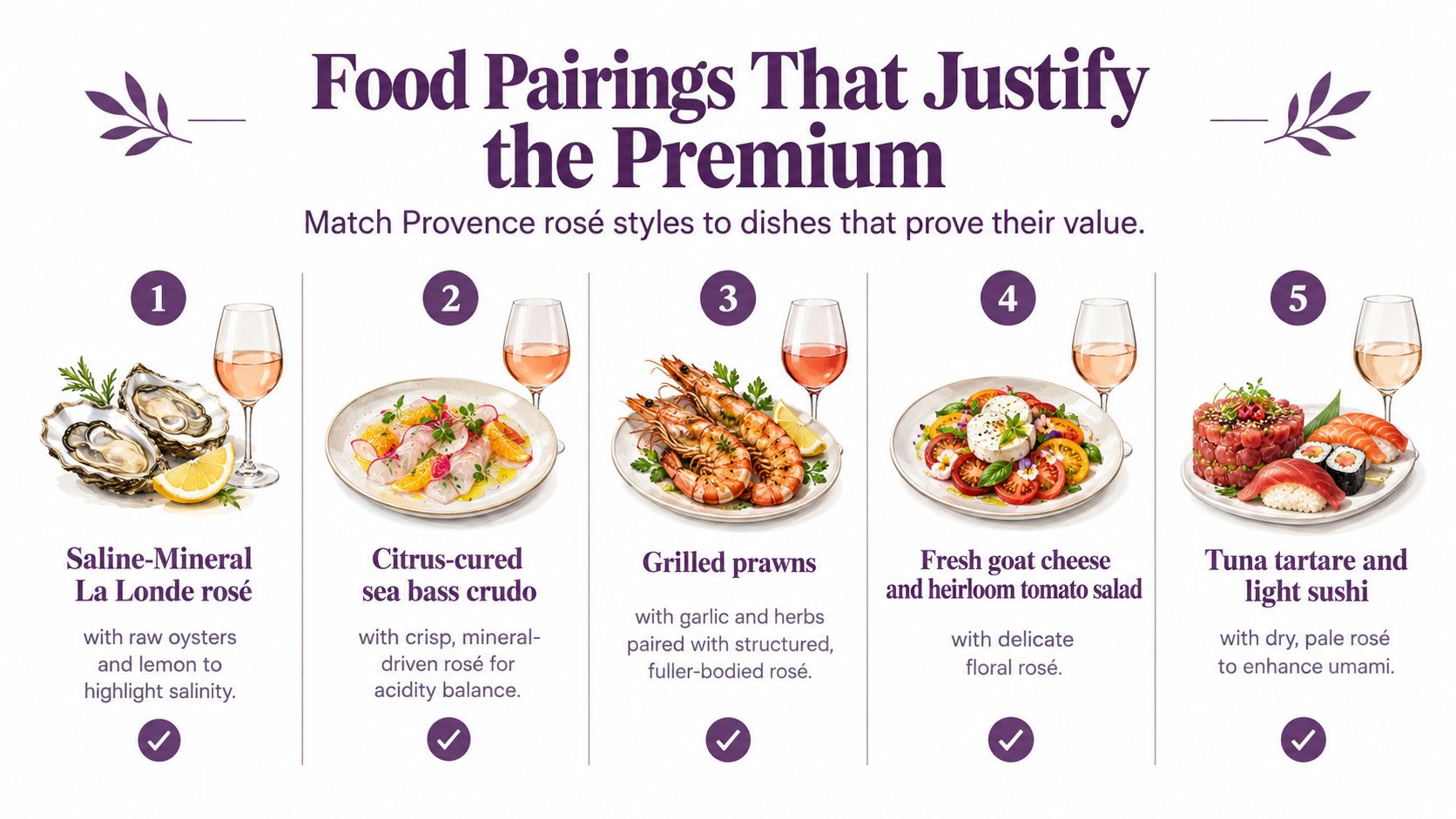
A more saline, mineral Côtes de Provence rosé works best with raw or lightly cured dishes. Oysters, sea bass crudo, and clean sushi service expose whether the wine is dry and precise. If the bottle turns broad or confected beside raw seafood, the premium story weakens fast.
A rounder style with more texture does better with grilled prawns, tomato-led Mediterranean dishes, or fresh goat cheese. In those settings, fruit generosity can be an asset rather than a flaw.
The right pairing doesn't make an ordinary rosé great. It exposes whether the wine had enough structure and freshness to justify its price in the first place.
Restaurant buyers understand this instinctively. A Provence rosé that can move from aperitif to food service saves list space and lowers decision friction for guests.
A short visual guide helps make those distinctions practical:
<iframe width="100%" style="aspect-ratio: 16 / 9;" src="https://www.youtube.com/embed/UPWkAECVbgA" frameborder="0" allow="autoplay; encrypted-media" allowfullscreen></iframe><a id="service-details-that-affect-perceived-quality"></a>
Service details that affect perceived quality
Temperature matters more than many buyers admit. Overchilling suppresses texture and can make an expensive rosé taste anonymous. Warming it too much pushes fruit forward and can make the alcohol feel coarse.
Glassware also changes the value equation. A tighter white-wine bowl tends to preserve tension in delicate examples. Broader bowls flatter richer saignée-influenced rosés but can make simple wines seem diffuse. For gifting and outdoor entertaining, pairing competence is what turns a premium bottle from expensive decoration into obvious value.
<a id="pricing-export-trends-and-how-to-buy-smart"></a>
Pricing, Export Trends, and How to Buy Smart
A single Provence rosé showing 39 observed US retail prices, from $14.99 to $83.92, says more about this category than any average bottle price can (observed Miraval price dispersion and wider rosé retail context). The striking point is not that one label can be found cheaply or expensively. It is that Côtes de Provence rosé often trades on brand recognition, channel economics, and seasonal merchandising at the same time, which makes shelf price a weak proxy for underlying quality.
Export demand still matters. It helps explain why the region sustains a premium image across multiple markets and why large retailers continue to give the category prominent placement. Earlier data cited in this article showed that Provence rosé has held up better than broader French wine exports in some recent periods, with the United States taking a larger role in absorbing volume. That supports the case for structural demand. It does not validate every retail markup attached to a pale bottle from a famous name.
The practical conclusion is simple. Buyers need to separate category strength from bottle-level value.
<a id="retail-dispersion-is-a-feature-of-the-category"></a>
Retail dispersion is a feature of the category
Côtes de Provence rosé is unusually exposed to cross-channel price distortion because the labels are easy to recognise, the style is broadly familiar, and summer promotions can move fast. Fine wine buyers would call this a visibility premium. In Provence rosé, that premium can attach to wines whose production scale and appellation level do not always justify the spread.
| Tier | Format | Typical US Retail Positioning | Example Producers |
|---|---|---|---|
| Value-oriented branded AOC | Standard bottle | Lower end of the premium band | Larger négociant and broad-distribution labels |
| Mid-tier estate AOC | Standard bottle | Mid-market premium positioning | Château Minuty, Miraval, Figuière |
| Prestige producer bottling | Standard bottle | Higher shelf positioning | Domaines Ott, Château d'Esclans |
| Highly promoted branded outlier | Standard bottle or special placement | Can show extreme dispersion | Miraval in the observed range above |
That table is directional, not predictive. Verified public data does not support a clean price ladder that holds across all merchants, formats, and release windows.
<a id="how-disciplined-buyers-read-the-market"></a>
How disciplined buyers read the market
Three checks do more work here than long tasting notes.
- Compare channels separately: Specialist wine merchants, supermarket-style chains, and restaurant lists solve for different margins and customer behaviour.
- Check what the appellation is: A well-known producer's standard AOC bottling can price above a less famous but more site-specific wine.
- Track the timing of release: New-arrival pricing, peak summer demand, and end-of-season clearance can produce very different value signals for the same SKU.
A broader market frame helps. Wine Labs' reporting on fine wine trade value and Provence rosé limits is useful because it places Provence rosé inside wider trade conditions rather than treating it as a lifestyle category insulated from pricing pressure.
<a id="what-to-inspect-before-you-buy"></a>
What to inspect before you buy
Label checks still matter, especially in a segment where image travels faster than detail.
- Appellation wording: The bottle should clearly state AOC or AOP Côtes de Provence if that is the basis for the price.
- Back-label specificity: Importer, producer, and origin details should be clear enough to verify.
- Bottle condition: Heat exposure and poor storage flatten freshness quickly, and rosé shows that damage sooner than many reds buyers are used to.
The buyer's edge comes from comparing live offers, not from assuming export success makes every bottle a fair deal.
<a id="sourcing-cotes-de-provence-rose-like-a-pro"></a>
Sourcing Cotes de Provence Rose Like a Pro
Most mistakes in Côtes de Provence rosé sourcing are small and expensive. A buyer pays up for a famous label without checking whether it's generic AOC. A retailer buys too early from a weak importer. An on-trade list chases name recognition and misses cleaner value one shelf over.
The better approach is repeatable and boring. That's usually where margin lives.
<a id="a-five-step-workflow-that-holds-up-in-practice"></a>
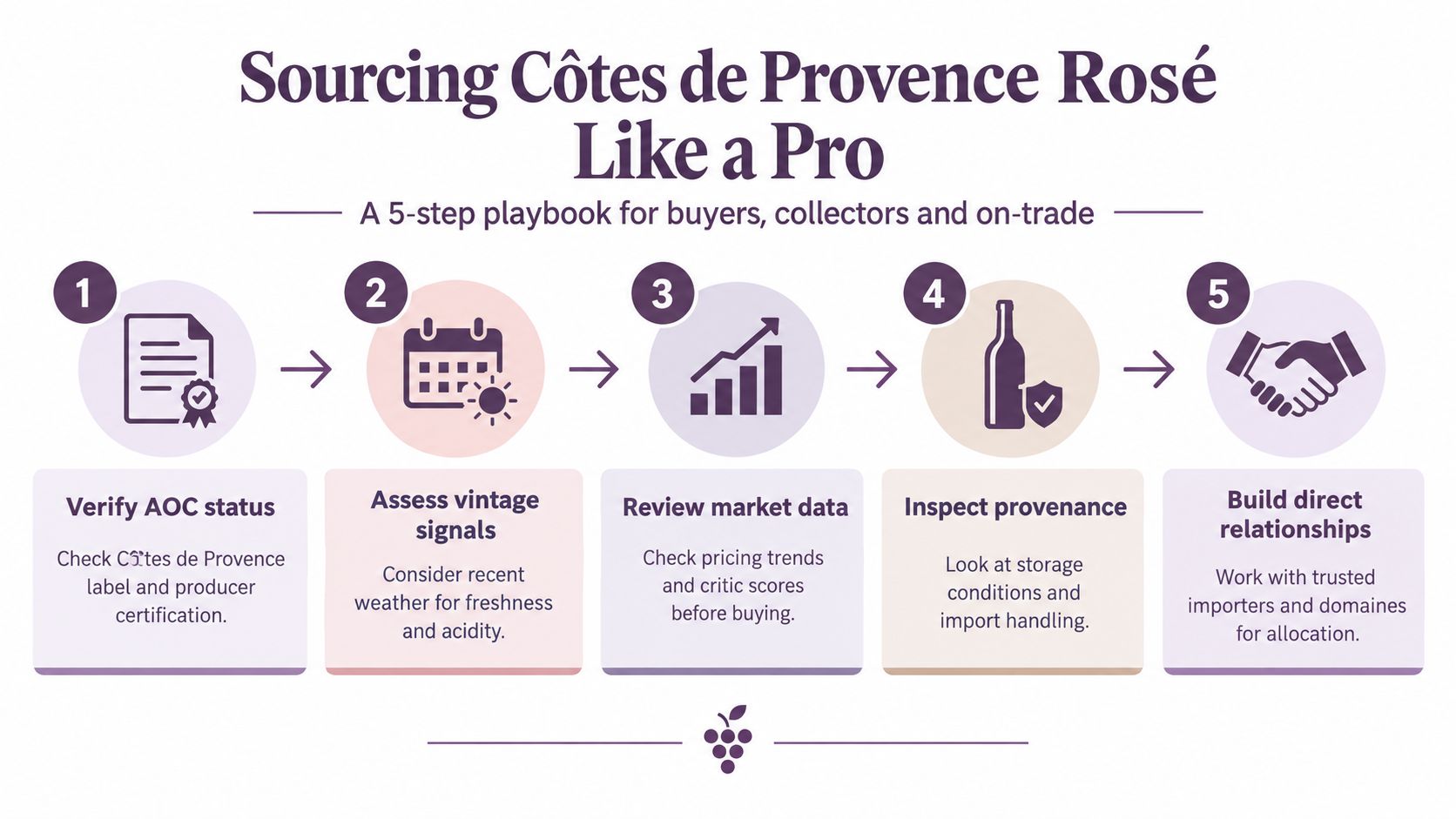
A five-step workflow that holds up in practice
-
Verify the appellation first.
Check that the bottle states Côtes de Provence in the appellation field. If the wine is sold on a sub-zone story, confirm that the designation appears on the label rather than in shop copy. -
Match bottle style to intended turnover.
For fast retail and by-the-glass service, freshness and logistics matter more than narrative. For slower-moving allocations, named-origin bottlings and structured blends deserve more attention. -
Benchmark pricing across several merchants.
Compare at least three retailers before accepting a shelf premium. Tools differ. Wine-Searcher gives one view. Vivino gives another. A consolidated platform can also help with identity matching and like-for-like comparison across channels. -
Inspect provenance, not just price.
Rosé is unforgiving of poor storage. Clear importer details, temperature-conscious handling, and recent arrival often matter more than a small apparent discount. -
Pressure-test the wine blind.
If you're building a range, run it through simple comparative service with staff or buyers. These easy blind wine tasting steps are useful because they strip away packaging cues and force attention onto dryness, texture, and finish.
<a id="where-relationships-still-matter"></a>
Where relationships still matter
Direct estate relationships can make sense for recognised houses such as Domaines Ott or other allocation-sensitive producers, especially if you need continuity and presentation value. Spot buying can work better for broader AOC stock where substitution risk is lower and margin sensitivity is higher.
For buyers who want market context while checking labels and offers, the wider Provence news flow also matters. This recent Wine Labs digest on Provence, Château Vignelaure, and wine market shifts is one example of the kind of surrounding information that can help frame sourcing decisions.
The professional advantage in Côtes de Provence rosé isn't secret access. It's disciplined comparison, clean provenance checks, and the willingness to ignore a famous name when the bottle doesn't justify the premium.
That discipline is what keeps a fashionable category from becoming an expensive habit.
Wine Labs gives merchants, importers, and collectors a way to compare wine prices across retail, auction, exchange, and restaurant channels with cleaner identity matching and market context. If you're evaluating Côtes de Provence rosé beyond branding, from shelf pricing to producer comparisons, visit Wine Labs to see how a data-led view changes the buying conversation.