Wine Labs · Market intelligence
Coteaux Du Layon Market Guide and Pricing Signals
Explore Coteaux du Layon sweet wines, from strict appellation rules and terroir to market pricing signals and collecting strategies for fine wine portfolios.
The most revealing Coteaux du Layon figure isn't a tasting note. It's 99,187 hectoliters harvested in 2024, produced by 444 operators across 3,381 hectares, according to INAO's appellation record. That scale challenges the image of Coteaux du Layon as a tiny, uniformly scarce sweet-wine niche. The more useful market question is narrower: where does scarcity appear, and how can buyers identify it?
Coteaux du Layon is a Loire Valley AOP for sweet white wine, formally recognized on 18 February 1950, and spread across 27 communes in Maine-et-Loire along the Layon River, a tributary of the Loire. Its regional output is substantial, but its commercial identity depends on a more fragmented reality, 100% Chenin Blanc, successive hand-harvested pickings, commune-specific tiers, and producer-level differences that the headline appellation figures conceal.
Table of Contents
- Understanding the Scale of Coteaux du Layon
- Production Rules That Drive Market Scarcity
- Navigating the Commune Hierarchy and Labeling Tiers
- Terroir and the Slate Soils of the Massif Armoricain
- Market Signals and Vineyard Land Economics
- Collecting Strategies and Portfolio Tracking
<a id="understanding-the-scale-of-coteaux-du-layon"></a>
Understanding the Scale of Coteaux du Layon
<a id="a-substantial-appellation-with-a-fragmented-offer"></a>
A substantial appellation with a fragmented offer
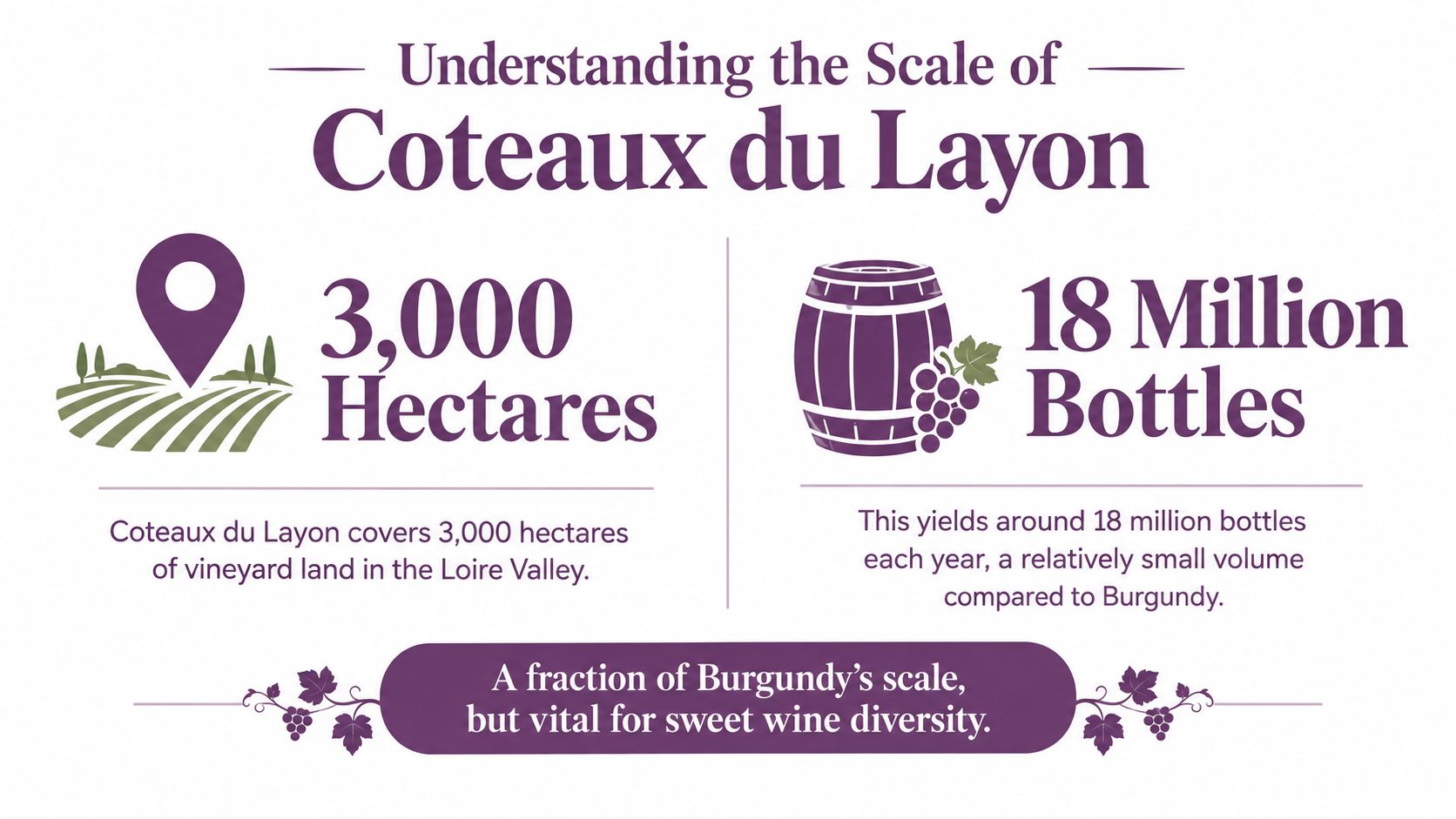
The appellation's footprint gives merchants an important starting point. INAO records 3,381 hectares, 444 operators, and a 2024 harvest of 99,187 hectoliters in its current Coteaux du Layon data. This isn't a historical appellation surviving on reputation alone. It remains an active regional production system with enough volume to support broad distribution, varied producer portfolios, and a meaningful secondary market.
Yet the regional total doesn't describe what a buyer sees on a shelf or an auction list. Coteaux du Layon is divided across 27 communes, and the wine is made from grapes harvested by hand in successive pickings. A large appellation-level harvest can therefore coexist with limited availability for a particular estate, vintage, commune designation, or carefully selected cuvée.
That distinction matters because regional scale and bottle-level liquidity are different things. A merchant may be able to source generic Coteaux du Layon with relative consistency while struggling to replace a specific named-commune bottling. A collector may find that a familiar appellation name offers broad availability, but a low-production wine from a more restrictive tier behaves like a scarce product.
<a id="why-chenin-blanc-defines-the-commercial-identity"></a>
Why Chenin Blanc defines the commercial identity
The appellation is reserved for white still wines made from Chenin Blanc, with a style built around sweetness, acidity, and concentration. INAO describes hand-harvested grapes selected through successive pickings, a process that supports the region's long-standing reputation for sweet wines affected by botrytis.
The production model creates an unusual balance. The region has enough hectares and operators to be commercially relevant, but the most distinctive wines depend on selective harvesting rather than uniform, high-throughput picking. That makes the appellation easier to underestimate from a volume perspective and easier to misprice when catalogers treat every bottle carrying the name as interchangeable.
For trade teams, geographic coverage and label precision should be handled together. A useful overview of wine data coverage can help frame the broader cataloging problem, but the wine itself still requires human interpretation. The label must be read as a hierarchy, not merely as a regional tag.
Market reading: Coteaux du Layon's large appellation footprint creates availability at the broad category level, while successive pickings and commune distinctions create scarcity at the bottle level.
The result is a market with two simultaneous truths. Coteaux du Layon is a significant Loire sweet-wine region, and the best individual wines can remain difficult to replace. Buyers who focus only on appellation-wide production will miss the commercial value of fragmentation.
<a id="production-rules-that-drive-market-scarcity"></a>
Production Rules That Drive Market Scarcity
<a id="the-legal-bottleneck"></a>
The legal bottleneck
Coteaux du Layon's market positioning begins in the vineyard, where production rules constrain both volume and ripeness. The base appellation has a maximum yield of 35 hectoliters per hectare, while commune-named wines are capped at 30 hl/ha. Coteaux du Layon Chaume is subject to an even lower limit of 25 hl/ha, according to the appellation's production-rule summary.
The rules also require high sugar concentration in the must. The generic appellation requires a minimum of 221 g/L, while village-designated wines require 238 g/L, with minimum alcohol requirements of 11% and 12%, respectively, as detailed in the same Coteaux du Layon specification overview.
These thresholds create a practical sequence for evaluating supply:
- Yield is restricted first. A producer can't increase output per hectare to satisfy demand.
- Ripeness must be achieved. The grapes need to reach high must-sugar levels before they qualify for the intended designation.
- Harvesting becomes selective. Successive pickings allow workers to return to the vineyard and select fruit at the required stage.
- Finished wine must retain sweetness. The base appellation requires at least 34 g/L residual sugar, alongside a minimum natural alcohol level of 11% vol, according to the INAO cahier des charges.
<a id="why-tries-matter-to-supply"></a>
Why “tries” matter to supply
Successive pickings, often called tries, are more than a traditional detail. They change the economics of labor, vineyard passes, and usable fruit. A producer doesn't harvest the whole parcel at one uniform moment. Instead, the team selects suitable bunches as they reach the desired concentration, which can reduce the quantity available for a particular wine while increasing the labor required to make it.
The rules therefore operate as a quality filter and a supply filter. They help preserve the category's identity, but they also mean that regional output can't be translated directly into the number of commercially equivalent bottles. A high harvest total may include a broad range of wines, while the most concentrated lots remain limited.
The official specification also confirms the base yield target and the minimum fermentable sugar requirement of 34 g/L in the finished wine through the INAO production document. For merchants, this gives the appellation a defensible technical foundation. Premium positioning isn't based solely on branding or tasting language. It's reinforced by rules that make dilution of the style more difficult.
Practical rule: Treat yield, must sugar, and residual sugar as supply indicators. They tell you why two wines from the same broad appellation may have very different replacement costs.
The labor and compliance questions also connect to a wider operational issue for wine businesses. Anyone comparing regional production models can use this Finger Lakes winery coverage guide as a useful reference point for how vineyard and winery risks are framed elsewhere. For Coteaux du Layon, however, the central commercial constraint remains clear: concentration requires selection, and selection limits uniform supply.
<a id="navigating-the-commune-hierarchy-and-labeling-tiers"></a>
Navigating the Commune Hierarchy and Labeling Tiers
<a id="the-label-is-a-pricing-signal"></a>
The label is a pricing signal
A bottle labeled Coteaux du Layon belongs to the base appellation. A bottle carrying a commune name signals a narrower geographic origin and stricter production conditions. INAO confirms that the appellation covers 27 communes, while secondary coverage identifies six commune-specific versions that can add their names to the label and operate under tighter rules.
This is the point at which cataloging accuracy becomes market analysis. A generic listing collapses distinctions that affect yield, ripeness, concentration, and scarcity. For a retailer, that can lead to inconsistent search results. For a collector, it can make a more specific bottle look comparable to a broader regional wine when it shouldn't be.
The hierarchy is easiest to understand by comparing the production limits:
| Tier | Max Yield (hl/ha) | Min Must Sugar (g/L) |
|---|---|---|
| Coteaux du Layon | 35 | 221 |
| Commune-named Coteaux du Layon | 30 | 238 |
| Coteaux du Layon Chaume | 25 | Not specified in the provided data |
The yield and must-sugar figures in this table come from the published Coteaux du Layon appellation rules. The table should be read as a commercial hierarchy, not as a guarantee of preference. A stricter designation creates a stronger quality signal and a more constrained production framework, but producer, vintage, storage, provenance, and bottle condition still determine the value of an individual wine.
<a id="comparing-generic-and-named-commune-bottles"></a>
Comparing generic and named-commune bottles
The generic appellation is the broadest buying category. It can make sense for merchants seeking approachable regional representation or for collectors building familiarity with the style. Its wider geographic definition also means that the label alone provides less information about site specificity.
A named-commune wine offers more information before the bottle is opened. It narrows the origin and indicates that the wine met stricter yield and ripeness requirements. That doesn't automatically make it the best purchase, but it gives buyers a more meaningful starting point for comparing price and availability.
Chaume sits at the most restrictive end of the supplied hierarchy. Its 25 hl/ha yield cap communicates stronger production scarcity than the base category, although buyers still need to distinguish the appellation designation from assumptions about every producer's style.
Cataloging principle: Never normalize a named commune into a generic Coteaux du Layon record when the label provides the more precise designation.
This distinction is especially important for trade users managing valuation workflows. If a bottle is listed only as “Coteaux du Layon,” a merchant may compare it against a wide and inconsistent group of wines. Canonical identity should preserve the commune qualifier, producer, cuvée, vintage, and format wherever those details are available.
The hierarchy also explains why appellation-level production figures can mislead. A region may have substantial total output, yet a named commune with tighter rules and a low-production producer can remain difficult to source. Buyers should therefore use the label as a first filter, then verify the producer and cuvée before making a pricing judgment.
<a id="terroir-and-the-slate-soils-of-the-massif-armoricain"></a>
Terroir and the Slate Soils of the Massif Armoricain
<a id="shallow-slate-changes-the-ripening-equation"></a>
Shallow slate changes the ripening equation
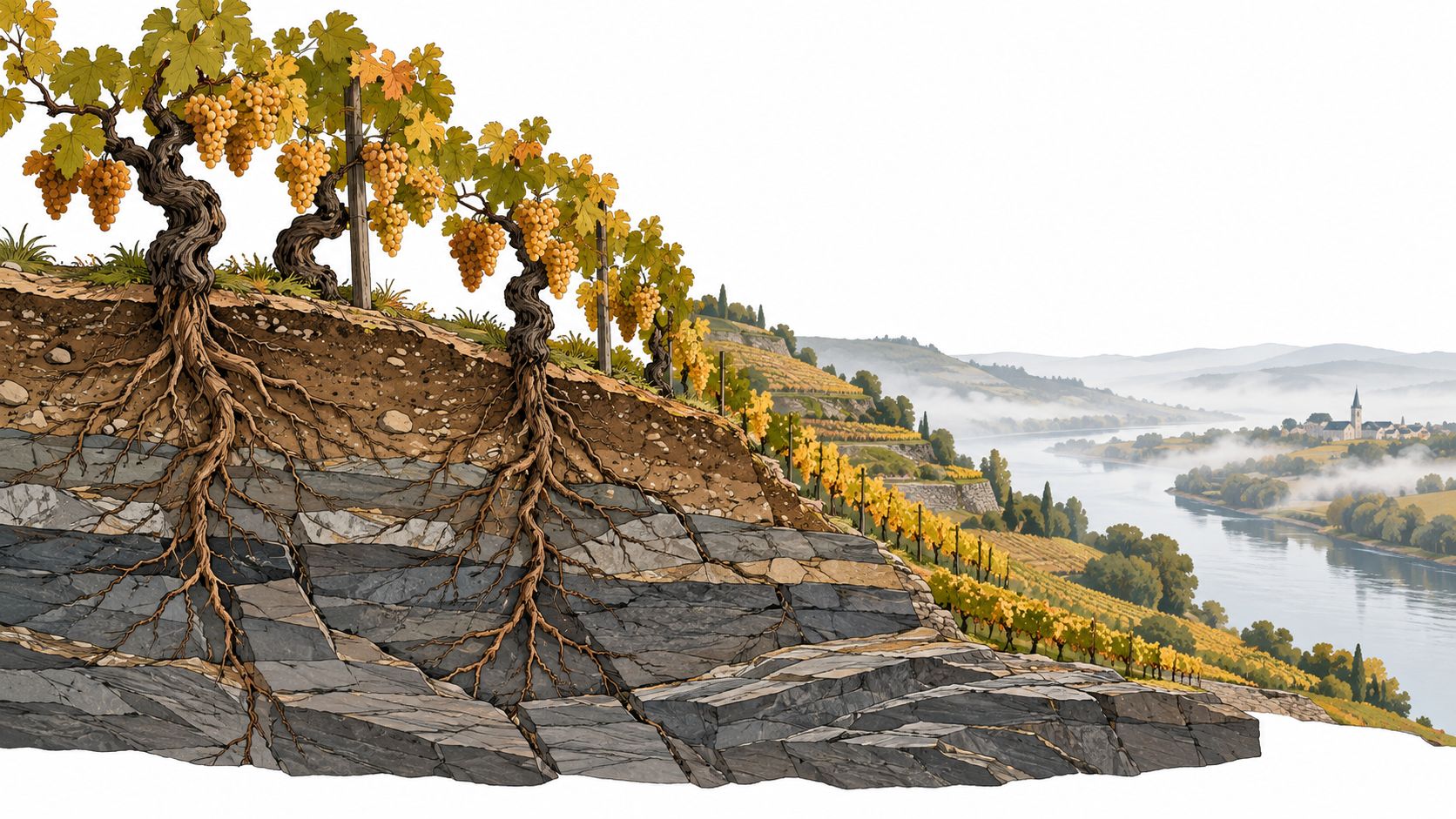
Coteaux du Layon belongs to the geological setting of the Massif Armoricain, where vineyards are mainly planted on shallow slate soils with low to moderate water reserves. Independent viticulture research describes these conditions in its analysis of environmental variability.
For Chenin Blanc, the significance is practical. Soil depth and water availability influence how vines develop through the growing season, while slope and river proximity help create differences between sites. A shallow, rocky soil profile doesn't produce a single uniform flavor, but it can create distinct ripening behavior from parcel to parcel.
<a id="from-site-conditions-to-buyer-expectations"></a>
From site conditions to buyer expectations
The market often reduces sweet Chenin Blanc to sweetness alone. That misses the structural reason Coteaux du Layon can appeal to collectors. Chenin Blanc supplies acidity, while the region's conditions and selective harvesting support concentration. Botrytis-affected fruit can add another layer of complexity, but its occurrence depends on vineyard conditions and harvest decisions rather than appearing identically in every bottle.
The result is a category where sweetness can coexist with freshness and site character. Buyers should avoid treating all wines as equally rich, equally botrytised, or equally age-worthy. The label and producer matter because the physical environment gives winemakers raw material, not a predetermined finished profile.
Collector's lens: Terroir is most useful when it helps explain variation between bottles, not when it replaces bottle-specific research.
This is also why the commune hierarchy has more importance than its label length suggests. A named place can help narrow the expected production framework, while slate-dominated sites provide the geological context for differences in water availability and ripening. Together, those signals help merchants sort wines into more useful comparison groups.
The commercial implication is subtle. A broad appellation with a coherent identity may attract consumers through recognisable sweetness and Chenin Blanc freshness, but serious buyers often pay attention to the interaction of site, harvest selection, producer practice, and designation. That combination creates the possibility of selective scarcity without requiring the entire appellation to be rare.
<a id="market-signals-and-vineyard-land-economics"></a>
Market Signals and Vineyard Land Economics
<a id="land-softness-doesnt-erase-bottle-scarcity"></a>
Land softness doesn't erase bottle scarcity
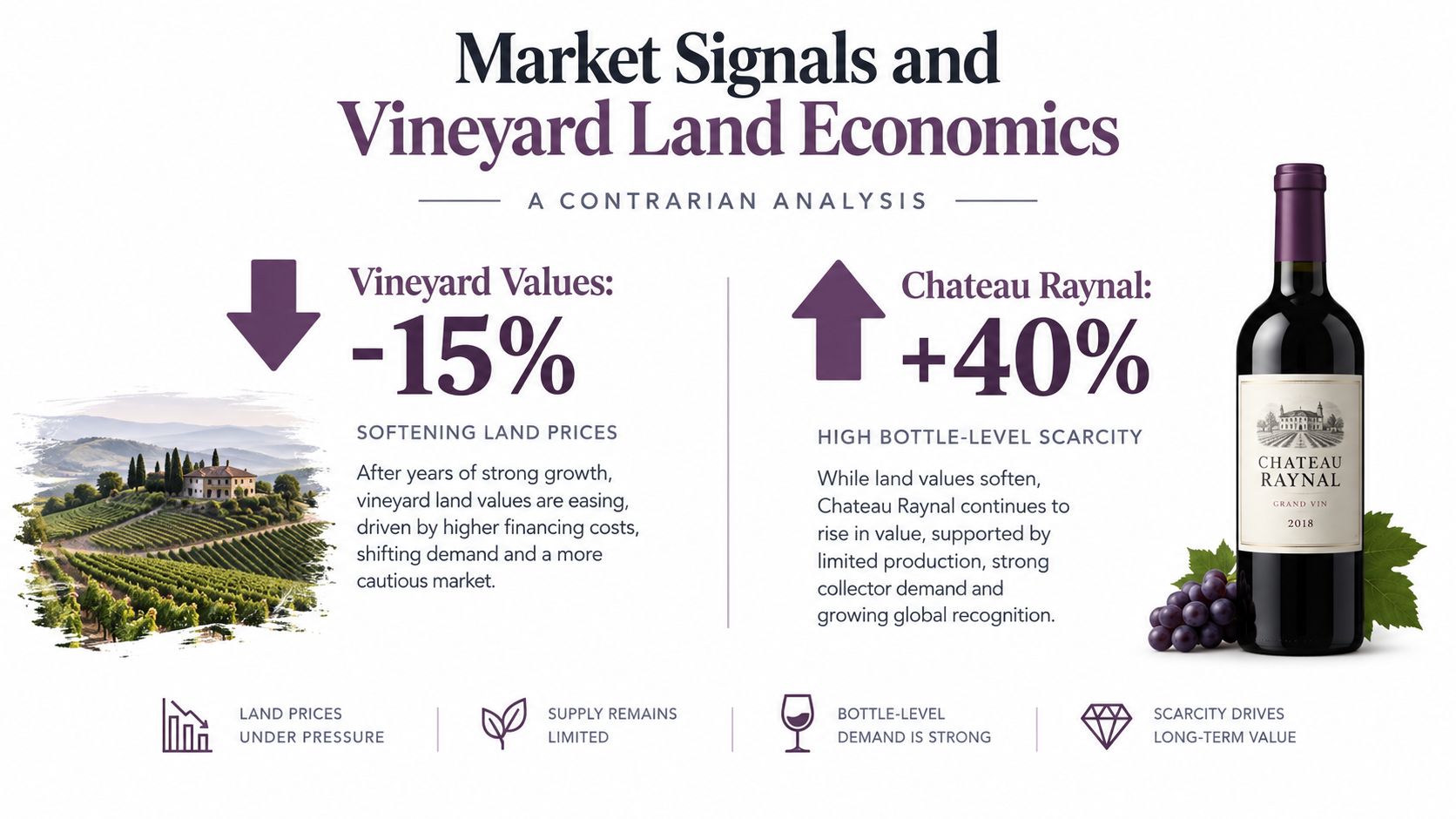
The underlying vineyard market sends a more cautious signal than the wine's reputation might suggest. Independent French vineyard-land data report an average Coteaux du Layon land price of about €18,000 per hectare in 2025, with a range of €15,000 to €25,000 per hectare and a 1-year change of -18%, as reported by Le Figaro's appellation guide.
That decline should not be read as a direct forecast for every bottle. Vineyard land values reflect broader production economics, ownership decisions, buyer confidence, and regional conditions. Bottle prices reflect a different set of variables, including producer reputation, parcel identity, vintage, distribution, provenance, and the willingness of buyers to compete for a specific wine.
A general explanation of measuring land value for policy is useful here because it highlights the distinction between an underlying asset and the economic signals attached to it. For wine analysis, the key error is treating land value as a complete proxy for bottle value.
<a id="the-contrarian-opportunity-sits-below-the-appellation-headline"></a>
The contrarian opportunity sits below the appellation headline
A recent trade publication reports annual Coteaux du Layon production above 52,000 hectoliters, reinforcing the point that the category isn't tiny. That headline volume, discussed in this trade coverage of Chenin Blanc's market shifts, still says little about the availability of a particular commune, producer, or cuvée.
The apparent contradiction is therefore productive. Land values can soften while selected bottles become harder to replace. A fragmented appellation allows scarcity to emerge at the level where collectors buy, even when regional supply remains meaningful.
For an importer, the opportunity may lie in finding a reliable producer with a distinctive named-commune identity rather than buying the appellation indiscriminately. For a collector, the better question isn't whether Coteaux du Layon as a whole is “investable.” It's whether a specific wine has identifiable scarcity, strong provenance, and a buyer base that understands the distinction.
Three signals deserve separate treatment:
- Land signal: The reported decline points to softer vineyard economics, not an automatic collapse in bottle value.
- Volume signal: Appellation-wide production above 52,000 hectoliters confirms relevance, but it doesn't measure the supply of any single cuvée.
- Bottle signal: Named communes, restrictive rules, producer reputation, and limited distribution can create scarcity beneath the regional total.
Buying implication: Use land data to assess structural risk, then use bottle-level evidence to assess opportunity.
The strongest conclusion is selective rather than bullish. Coteaux du Layon shouldn't be treated as a uniform investment category, but neither should softer land values discourage research into specific low-production wines. The market is most interesting where broad regional availability and narrow bottle-level scarcity overlap.
<a id="collecting-strategies-and-portfolio-tracking"></a>
Collecting Strategies and Portfolio Tracking
<a id="buy-the-identity-before-the-sweetness"></a>
Buy the identity before the sweetness
A collector building a Coteaux du Layon position should begin with precise identification. Record the producer, vintage, commune qualifier, cuvée, bottle size, purchase channel, and provenance. A generic appellation entry can make later valuation unreliable because it may merge wines subject to different yield caps and minimum must-sugar rules.
The practical workflow is straightforward:
- Separate the tiers: Keep generic Coteaux du Layon, named-commune wines, and Chaume-designated bottles in distinct records.
- Track replacement cost: Compare current retail, auction, and specialist listings rather than relying on one advertised price.
- Watch availability: A bottle that appears frequently at one retailer may still be scarce across the broader market, or the reverse.
- Document provenance: Sweet wines can reward patience, but storage history remains central to value and drinking quality.
Cellaring decisions should follow balance rather than sweetness alone. Chenin Blanc's acidity can give sweet wines structural freshness, while botrytis-affected fruit and concentration can add complexity. Buyers should still assess each producer and vintage individually instead of assuming that every Coteaux du Layon bottle will develop in the same way.
<a id="pairing-and-portfolio-use"></a>
Pairing and portfolio use
At the table, the wine's sweetness and acidity make it more versatile than a dessert-only classification suggests. It can work with salty or blue cheeses, rich pâté, and fruit-led desserts, provided the dish has enough intensity to meet the wine's concentration. The pairing should reinforce the contrast between sweetness, freshness, salt, and richness rather than flattening the wine with a dish that's too delicate.
A merchant can also use the category strategically. Generic bottlings may provide an accessible entry point, while named communes offer a clearer premium ladder for customers who want greater specificity. A specialist wine club or producer allocation, such as exclusive wine club access from Clos Pegase, can be useful as a model for how direct relationships and curated access differ from open-market purchasing, even when the wines in question come from different regions.
For portfolio tracking, the essential capability is canonical identity matching. Wine lists often vary in producer spelling, commune formatting, vintage presentation, and cuvée names. A data system that consolidates those variations can prevent duplicate records and make price comparisons more meaningful. Wine Labs describes this approach through its fine wine market data capabilities, but the analytical principle applies broadly: compare like with like before drawing conclusions.
Portfolio rule: Treat Coteaux du Layon as a group of differentiated assets, not as one price series.
A sensible allocation might combine a readily sourced generic wine for drinking with a smaller number of named-commune bottles selected for provenance and scarcity. Review the records when listings change, when a producer gains distribution, or when a specific cuvée becomes difficult to replace. That approach won't eliminate uncertainty, but it will stop regional volume from obscuring bottle-level value.
Wine Labs helps merchants, importers, and collectors compare fine-wine prices across retail, auction, exchange, and restaurant channels while keeping producer, commune, cuvée, and vintage identities aligned. Visit Wine Labs to track Coteaux du Layon pricing signals, monitor scarce listings, and build a more accurate portfolio view.