Wine Labs · Market intelligence
Clos De La Roche Complete Guide to Terroir and Value
Explore Clos de la Roche Grand Cru history, terroir, top producers and market pricing. Understand what drives value and how vintages perform.
A six-bottle Clos de la Roche lot can carry an estimate of £2,000–£2,600 under one producer, while another six-bottle lot from a different estate is estimated at €11,000–€14,000. A third example, twelve bottles from a historic house, reaches HK$30,000–HK$40,000. Those figures aren't competing valuations of one uniform product. They describe a fragmented market in which producer, vintage, provenance and format can matter more than the Grand Cru name on the label.
Table of Contents
- Introduction to Clos de la Roche and Why It Matters Now
- Understanding Grand Cru Status in Burgundy
- History and Expansion of the Vineyard
- Terroir Soils and the Power Precision Style
- Top Producers and What Sets Them Apart
- Vintage Performance Pricing and Auction Behavior
- How to Buy Price and Cellar Clos de la Roche Wisely
<a id="introduction-to-clos-de-la-roche-and-why-it-matters-now"></a>
Introduction to Clos de la Roche and Why It Matters Now
Before quoting a Clos de la Roche bottle, a merchant needs to identify the producer, parcel and format behind the label. The appellation includes around 40 producers and more than 100 parcels, according to the published overview of Clos de la Roche's production and ownership structure. That ownership structure makes the Grand Cru a fragmented market rather than a single, uniform product.
The commercial consequence is substantial. A producer with strong secondary-market recognition can command a premium for a relatively young vintage, while an older bottle from another estate may trade at a different level because provenance, format, condition and buyer confidence point elsewhere. The appellation supplies the terroir framework. Producer identity converts that framework into a specific market asset.
Physical scarcity reinforces the dispersion. In 2008, the site recorded 13.41 hectares in production and 448 hectolitres of wine, equivalent to about 44,800 litres or just over 59,733 bottles for the appellation that year. Those figures, reported in the published reference material, indicate enough volume for international recognition while leaving individual producer bottlings vulnerable to rapid disappearance from retail, auction and restaurant channels.
A bottle therefore moves through several pricing systems. Retail buyers may compare current offers, auction participants may pay for provenance and scarcity, and restaurants may value a reliable supply of a recognizable name. The same Grand Cru designation can support different prices across those channels because the underlying asset changes with estate, vintage, condition and presentation.
Market implication: Treat “Clos de la Roche” as the first field in an identity record, not the final price signal.
For buyers, the task is to separate terroir value from label premium. Sellers should avoid quoting against a broad appellation average that ignores estate reputation or bottle format. Collectors should assess whether the specific bottle is sound, well-provenanced and fairly priced against comparable listings. That discipline matters more here than the Grand Cru designation alone.
<a id="understanding-grand-cru-status-in-burgundy"></a>
Understanding Grand Cru Status in Burgundy
Burgundy's hierarchy works like a map of increasing geographic precision. Regional appellations cover broad areas, village appellations identify a commune, Premier Cru wines narrow the location to recognized higher-status climats, and Grand Cru appellations identify the region's most restricted vineyard sites. Clos de la Roche sits at the top of that ladder within Morey-Saint-Denis.
A useful analogy is a city. The village appellation identifies the neighborhood. A Premier Cru identifies a particularly valued street or block. A Grand Cru identifies a landmark address whose location carries independent weight, even before you know which architect built the property. The analogy breaks down if taken too far, but it clarifies the commercial reality: place creates the framework, while the producer determines much of the bottle's individual expression and market reputation.
The official Burgundy Wines profile for Clos de la Roche describes the site as a Pinot Noir Grand Cru with an area under production of about 16.73 hectares. Clos de la Roche is red-only in practical production terms, so the appellation's identity is tightly tied to concentrated Pinot Noir rather than a mixed red-and-white category.
<a id="what-grand-cru-status-guarantees"></a>
What Grand Cru status guarantees
Grand Cru status gives buyers a strong geographic signal. It indicates that the bottle comes from a designated high-ranking site governed by Burgundy's appellation framework. It also points toward limited supply, because a named Grand Cru covers a constrained vineyard area rather than an entire broad regional zone.
It doesn't guarantee a single style, a perfect vintage or a uniform price. Two bottles bearing the same appellation can differ meaningfully because of vine position, farming, harvest decisions, extraction, élevage, bottle age and provenance.
<a id="why-comparison-must-go-beyond-the-label"></a>
Why comparison must go beyond the label
A merchant comparing a young estate bottling with an older auction lot isn't comparing like with like. The correct benchmark should align producer, vintage, bottle size, condition and sales channel before any conclusion is drawn. That process matters more in fragmented Burgundy than in markets where one producer controls most of a named vineyard.
The appellation tells you where the wine comes from. The market record tells you what that particular bottle is worth.
<a id="history-and-expansion-of-the-vineyard"></a>
History and Expansion of the Vineyard
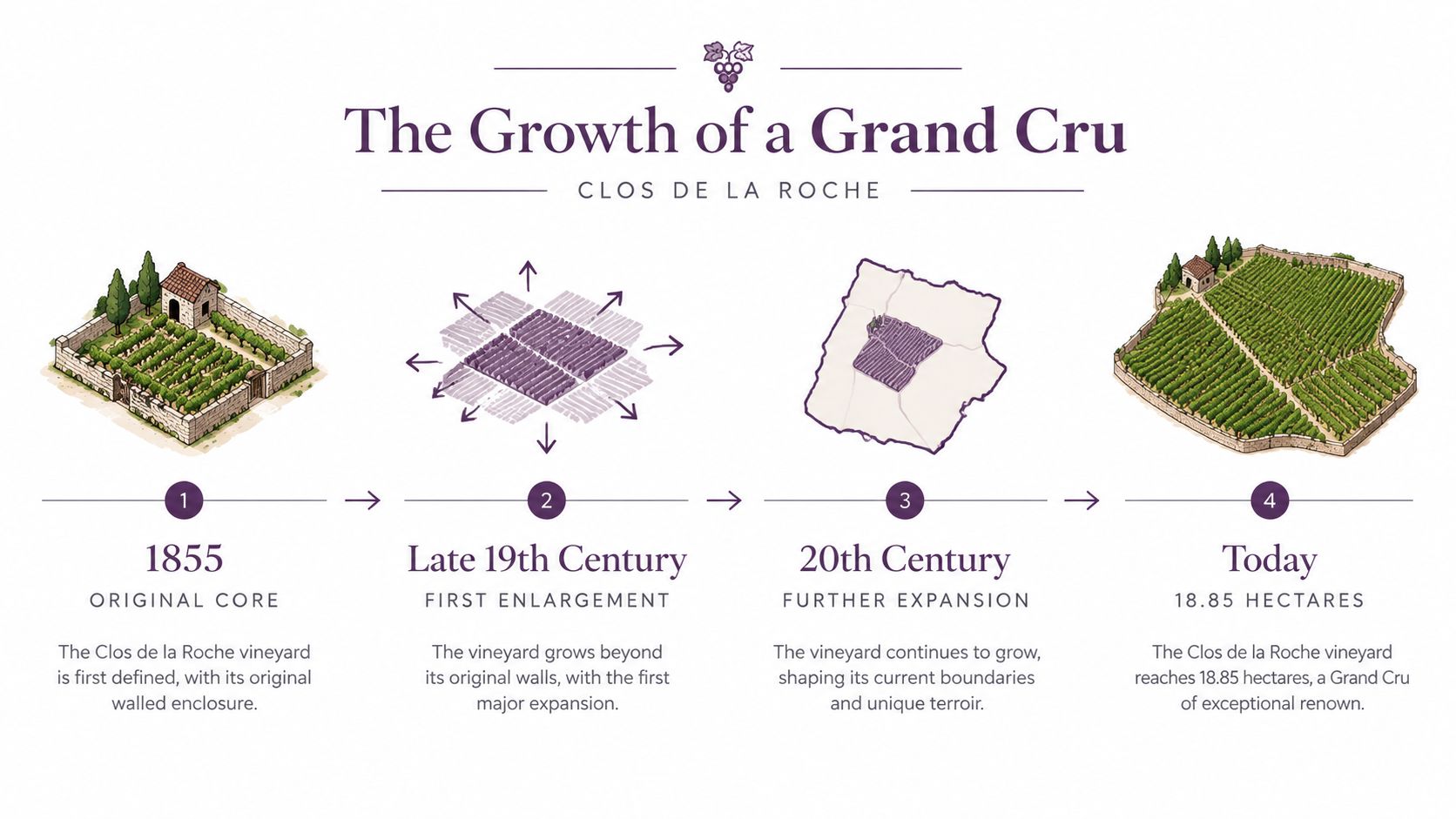
Clos de la Roche grew from 4.5740 hectares in the 19th century to about 16.90 hectares by 1971. The historical account of the appellation's expansion records the sequence: an initial enlargement in 1936, a further expansion in 1944, and later additions culminating in the 1971 figure.
The chronology matters commercially. Clos de la Roche is not a single, tightly bounded monopoly vineyard. Its Grand Cru identity developed through the incorporation and reclassification of adjoining parcels, creating a larger appellation divided among multiple owners and site positions.
The additions included Les Chabiots, Les Fremières, Les Froichots, Les Mochamps and Monts Luisants, followed by parts of Les Genavrières and Les Chaffots. Producer references generally place the appellation at around 16.7–16.9 hectares, while official totals can vary slightly with the source and reference year.
<a id="why-enlargement-changed-the-market"></a>
Why enlargement changed the market
The original enclosed core supports a concentrated historical image. The enlarged Grand Cru is a more fragmented commercial asset. Producers hold different parcels, bottle at different scales and release wines through different channels, so the same appellation name can represent markedly different offers.
That distinction affects price comparison. A cellar-release bottle from a recognized estate, a current merchant listing and an older auction lot may all carry the Clos de la Roche name while differing in producer, parcel identity, vintage, format, condition and provenance. Treating them as interchangeable can distort both valuation and stock decisions.
The label also creates an identification problem. A listing may shorten the estate name, omit a cuvée designation or use a different parcel reference. Canonical matching is therefore part of market analysis, not clerical housekeeping. Without it, merchants can mistake separate wines for duplicates or compare unlike bottlings as if they were the same asset.
<a id="the-commercial-consequence"></a>
The commercial consequence
Expansion changed Clos de la Roche from a narrow walled-vineyard concept into a large, multi-owner Burgundy cru. The historical core and Grand Cru classification still support the name's market strength, while the broader footprint explains its price dispersion.
The useful question is not, “What does Clos de la Roche cost?” It is: Which producer, which parcel identity, which vintage and which format? History becomes pricing intelligence only after those variables are aligned.
<a id="terroir-soils-and-the-power-precision-style"></a>
Terroir Soils and the Power Precision Style
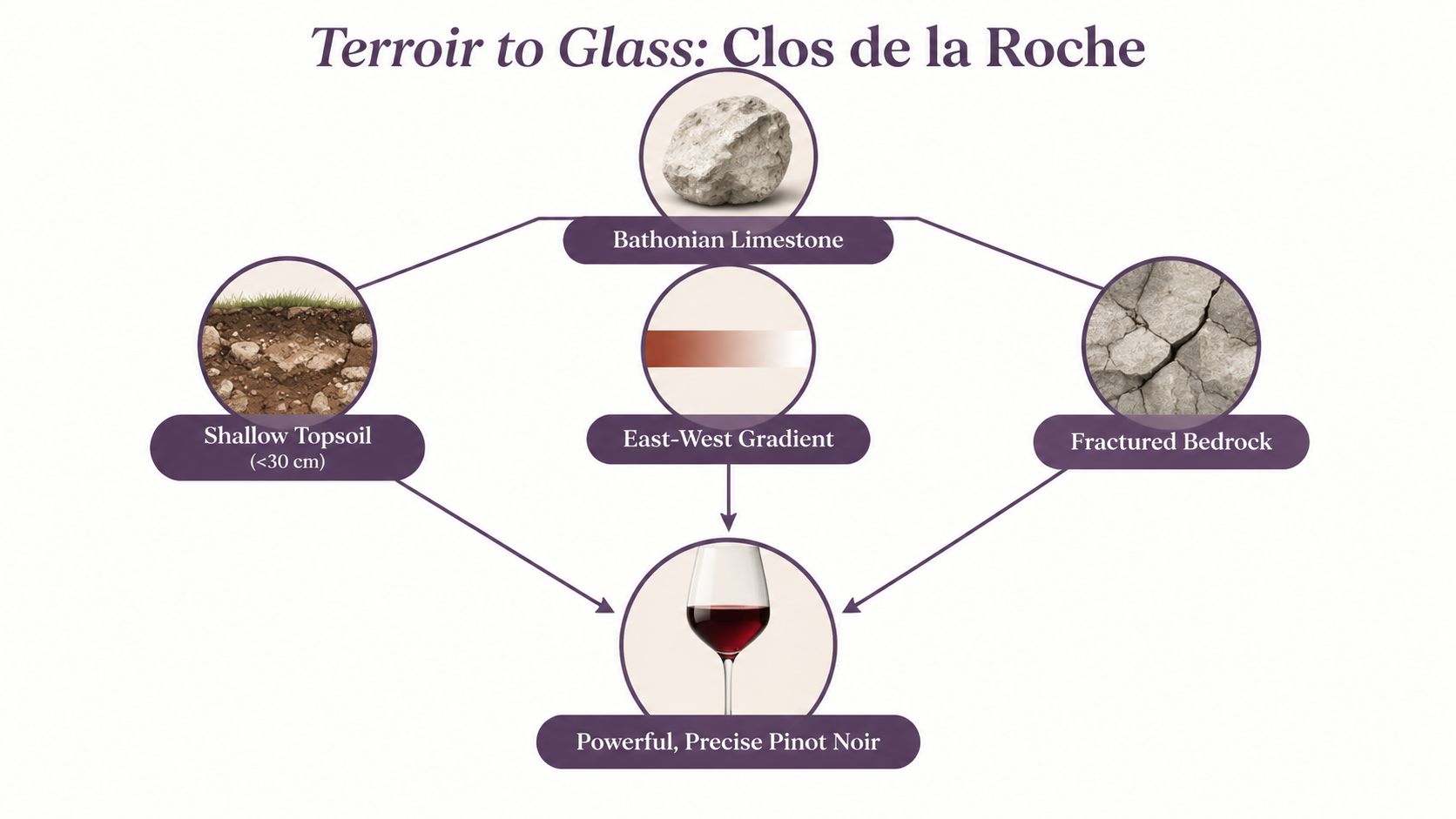
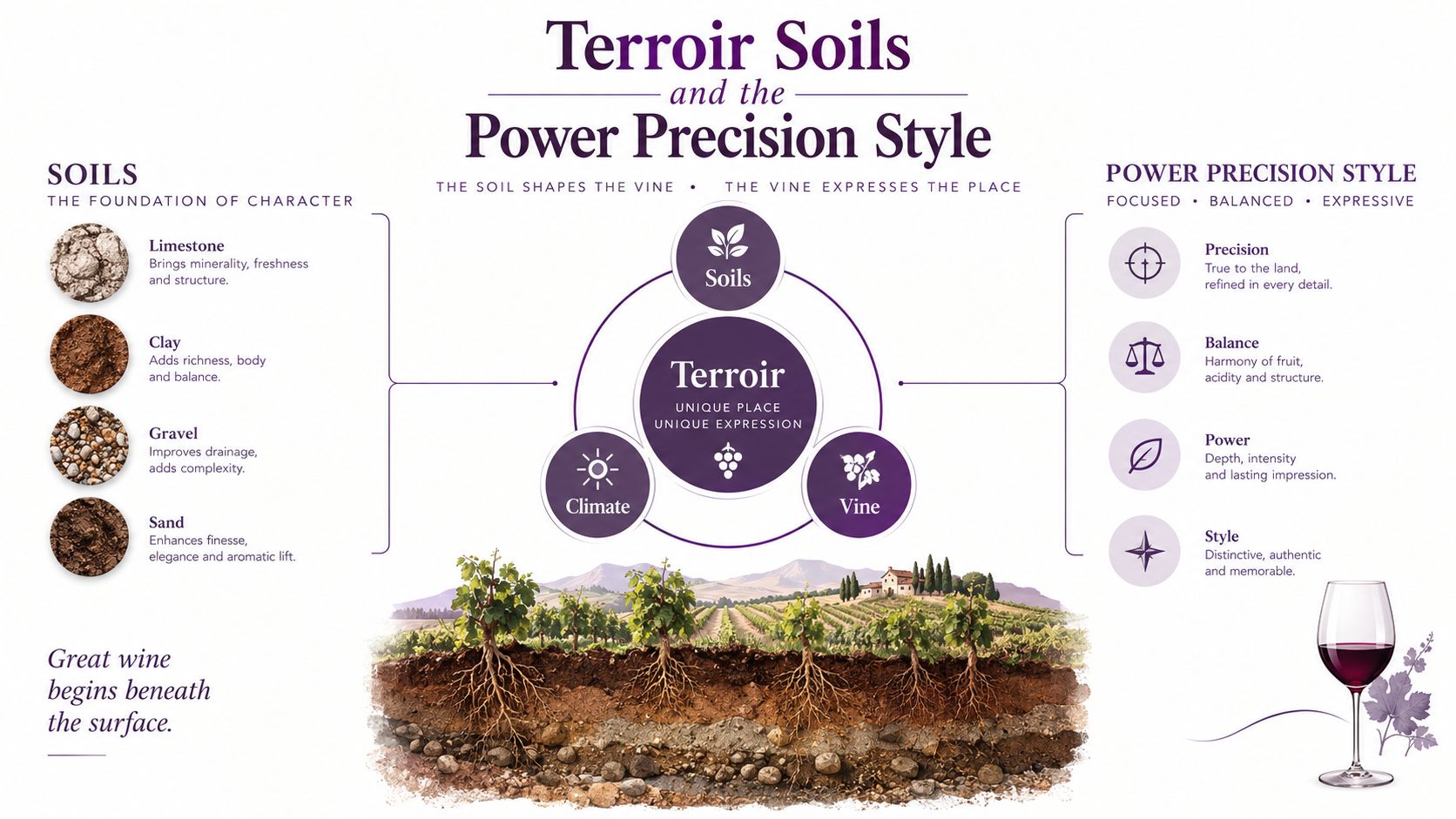
Clos de la Roche's style begins with a soil profile that leaves little room for complacency. The technical description of Clos de la Roche terroir places the topsoil at roughly 30–50 centimetres over fractured Bathonian limestone or rocky scree, while the most authoritative descriptions characterize the topsoil as barely 30 centimetres deep, with few pebbles but large boulders.
Thin soil stores less water than a deeper profile. Vines must exploit fissures in the limestone, and the fractured bedrock becomes an active part of the root environment rather than a distant geological layer. That setting supports strong drainage and can intensify hydric stress, conditions associated with smaller berries and a more concentrated fruit profile.
The geology isn't uniform across the entire climat. Technical vineyard notes describe an east-to-west movement from reddish-brown soils containing angular limestone fragments toward steeper western zones marked by limestone gravel and scree over Premeaux or Comblanchien limestone substrata. That gradient can influence drainage, vine vigor and the way individual parcels carry ripeness and structure.
<a id="from-rock-to-texture"></a>
From rock to texture
In the glass, the expected signature is not “minerality.” Clos de la Roche is generally described as dense, firm, structured and charpenté, meaning well-framed. The shallow calcareous profile encourages concentration, while the site's drainage and rocky structure support tannins that can feel firm rather than plush.
That combination explains why the wine often occupies the more powerful end of Morey-Saint-Denis Grand Cru expression. Aromas may develop slowly, and the palate can remain tightly coiled when young. A bottle that seems severe at first isn't necessarily deficient. It may be showing the architecture that allows the wine to evolve.
Practical reading rule: Don't confuse early restraint with lack of depth. For Clos de la Roche, structure is part of the asset, but it also creates a time and storage commitment.
The Wine Labs editorial digest on niche terroirs and operational shifts is useful context for merchants tracking how terroir narratives affect sourcing and inventory decisions. The central commercial lesson remains straightforward: intra-vineyard differences matter, and a broad appellation description can't replace producer and parcel-level analysis.
<iframe width="100%" style="aspect-ratio: 16 / 9;" src="https://www.youtube.com/embed/oIVr95pxDPo" frameborder="0" allow="autoplay; encrypted-media" allowfullscreen></iframe><a id="top-producers-and-what-sets-them-apart"></a>
Top Producers and What Sets Them Apart
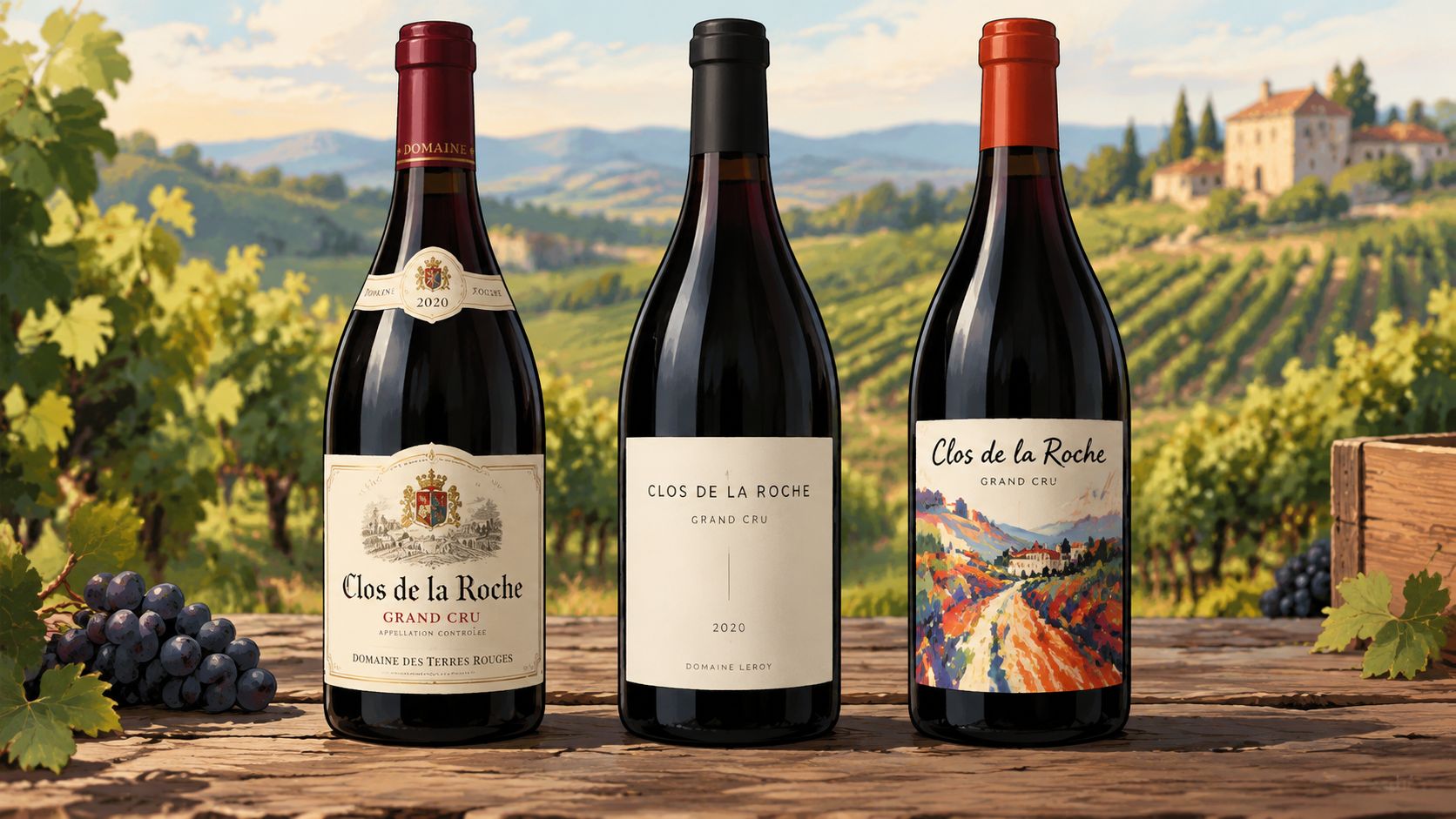
Clos de la Roche trades less like one prestige label than a set of producer-specific assets. Ponsot, Dujac and Armand Rousseau offer useful reference points, but their holdings, cuvées and market identities are not interchangeable. The appellation's internal fragmentation is documented in this industry reference on the appellation's fragmentation, while the commercial implication is clear: the Grand Cru name establishes provenance, not a uniform drinking profile or resale value.
Ponsot is closely associated with Vieilles Vignes bottlings, giving vine age and cuvée identity a prominent role in how buyers read the wine. Dujac is often assessed through its estate style and cellar choices, while Armand Rousseau carries a powerful producer reputation that can affect demand independently of the site's general standing. These are not rankings. They show why producer identity belongs beside appellation identity in catalogues, price lists and cellar records.
<a id="reading-producer-differences"></a>
Reading producer differences
A producer's interpretation can shift the balance between power and perfume. Some bottlings emphasize limestone-driven firmness and dense structure. Others may appear more open or aromatic because of harvest decisions, extraction and cellar handling. Vine age, parcel position and élevage affect the final expression, so a drinking window observed for one estate should not be transferred automatically to another.
The label also changes the buyer's reference set. A recognized estate may attract collectors seeking scarcity, reputation and confidence in resale. A less sought-after producer can provide a more accessible route into the vineyard, although its pricing may depend more heavily on vintage, provenance and the strength of the selling explanation.
Availability differs by channel. A merchant may list one estate regularly, while an auction house sees another mainly through older private collections. Restaurant lists can reveal bottles absent from ordinary retail searches, but format, vintage and storage history still require verification.
<a id="a-sourcing-lens-for-professionals"></a>
A sourcing lens for professionals
For merchants and marketplaces, producer names signal liquidity, search demand and the depth of comparable records. A trophy producer can draw immediate attention, yet its price may separate from the wider appellation. A quieter label may leave more room for margin or discovery, but demands clearer provenance and more careful customer education.
A sound catalogue record should retain:
- Estate and cuvée: Preserve the producer's full identity, including Vieilles Vignes or other bottling distinctions.
- Vintage and format: A six-bottle case is not equivalent to a twelve-bottle lot, even when wine and vintage appear similar.
- Parcel context: Record the specific vineyard identity when the label supplies it.
- Channel evidence: Compare retail, auction and restaurant references separately before forming a market view.
The Grand Cru name provides shared geography. Producer, parcel and format determine how that geography is priced and traded.
<a id="vintage-performance-pricing-and-auction-behavior"></a>
Vintage Performance Pricing and Auction Behavior
Clos de la Roche pricing behaves like a group of micro-markets, not a single asset class. The clearest evidence comes from auction estimates involving different producers, vintages and lot sizes. A 2018 Armand Rousseau six-bottle lot carried an estimate of £2,000–£2,600, while a 1990 Ponsot Vieilles Vignes six-bottle lot was estimated at €11,000–€14,000. A 1975 Bouchard Père et Fils twelve-bottle lot was listed at HK$30,000–HK$40,000, as documented by auction records for Clos de la Roche producer and format comparisons.
| Lot Example | Estimate Range | What Drives the Premium |
|---|---|---|
| 2018 Armand Rousseau, six bottles | £2,000–£2,600 | Producer identity, vintage and six-bottle format |
| 1990 Ponsot Vieilles Vignes, six bottles | €11,000–€14,000 | Older vintage, cuvée identity and producer scarcity |
| 1975 Bouchard Père et Fils, twelve bottles | HK$30,000–HK$40,000 | Age, historic producer, larger lot and provenance considerations |
These estimates shouldn't be converted into a single cross-currency average. They answer different market questions. The Ponsot lot reflects the interaction of mature age and a named Vieilles Vignes bottling. The Bouchard lot introduces a larger format and a historic vintage. The Rousseau example demonstrates that a younger vintage can sit at a very different level even within the same Grand Cru.
<a id="scarcity-has-policy-limits"></a>
Scarcity has policy limits
Clos de la Roche is red-only and subject to a maximum permitted yield of 35 hectolitres per hectare, according to recent independent coverage of the appellation's production rules. Climate pressure has prompted discussion about whether higher yields could become appropriate, but approved increases remain restricted.
That creates a tension for future supply. Producers face a site that is naturally limited by shallow soils and a regulatory framework that constrains output. If climate conditions intensify vintage variation, producer-level scarcity may become even more important than the appellation average.
Recent market evidence reinforces that separation. 2025 Hospices de Beaune Clos de la Roche Grand Cru Cuvée Georges Kritter barrel lots averaged €142,500, while tracking for 2014–2019 Domaine Castagnier remained clustered around roughly €150–€175 per bottle, as reported in the coverage of supply constraints and market pricing. Those are not interchangeable benchmarks. One reflects a barrel-sale context, while the other reflects retail and auction tracking for a named producer over several vintages.
Pricing discipline: Compare like-for-like records first. Currency conversion can't correct for differences in producer, age, format, provenance or channel.
For merchants, Wine Labs fine wine market data can support that comparison by bringing disparate market records into a common analytical view. The useful output isn't a simplistic average. It's a clearer picture of which listings represent active liquidity, which are trophy-priced and which may be anomalies requiring further verification.
<a id="how-to-buy-price-and-cellar-clos-de-la-roche-wisely"></a>
How to Buy Price and Cellar Clos de la Roche Wisely
A rational Clos de la Roche purchase starts with identity, not price. Confirm the producer, cuvée, vintage, bottle format and parcel reference before comparing an offer with another listing. Then separate the channel. A retail bottle, an auction lot and a restaurant offer may each reflect different fees, provenance standards and buyer expectations.
Use this order of operations:
- Match the bottle: Normalize the estate and cuvée name before searching comparables.
- Assess the vintage: Treat structure and maturity as separate from producer reputation.
- Check the format: Lot size changes the apparent price and can affect liquidity.
- Review provenance: Storage, fill level, label condition and original packaging matter especially for mature bottles.
- Set the holding period: Clos de la Roche is firm and structured, with a 10–20 year cellaring window and the potential to develop over 30–50 years in great vintages, according to Domaine Amiot et Fils' technical description.
For a merchant, the strongest quote is one supported by recent comparable offers rather than an appellation-level assumption. For a collector, the best bottle isn't necessarily the cheapest. It's the one whose producer, maturity and provenance align with the intended drinking or holding strategy.
A cellar file also needs more than a purchase price. Cellar Pricer can be used to organize file-based valuations and portfolio records, helping owners distinguish an appreciating bottle from one that merely appears expensive because the comparison set is poorly matched.
Wine Labs consolidates retail, auction, exchange and restaurant pricing into comparable wine records, which is especially useful when Clos de la Roche listings vary by producer, vintage and format. Visit Wine Labs to compare market evidence, monitor relevant bottles and make more defensible sourcing, pricing and cellar decisions.