Wine Labs · Market intelligence
Cabernet Sauvignon Price Guide by Region and Channel
Cabernet Sauvignon price benchmarks across retail, auction, DTC, and bulk channels in 2026, with regional comparisons and valuation guidance for buyers.
A Cabernet Sauvignon bottle can sit below $1 per liter in bulk trade while a prestige auction lot reaches the equivalent of hundreds of dollars per bottle. Australia's bulk Cabernet offer was reported at 49 U.S. cents per liter, while Napa County Cabernet grapes averaged $9,002 per ton in the cited California crush data, and Premiere Napa Valley's 2026 auction averaged $174 per bottle wholesale. These aren't competing answers to the same question. They're different market signals.
The right Cabernet Sauvignon price depends on the channel, region, unit, vintage, and buyer. A grocery shopper needs a shelf benchmark. A winery buyer may need grape or bulk-wine pricing. A collector needs auction clears, while a merchant needs comparable prices across retail, DTC, restaurants, and secondary markets. This guide separates those reference points so a single average doesn't distort the decision.
Table of Contents
- Why One Cabernet Sauvignon Price Number Is Misleading
- The Main Pricing Channels and Tiers You Should Know
- U.S. Retail and DTC Pricing for Cabernet Sauvignon
- Napa Cabernet Pricing from Grape to Bottle
- California Australia and South Africa Compared
- Auction Pricing and the Top End of the Market
- How to Choose the Right Reference Price for Your Role
- Quick Reference Benchmarks by Channel and Tier
- Using a Price Intelligence Platform to Compare Across Channels
- Related Resources and Next Steps
- Key Takeaways for Cabernet Sauvignon Pricing in 2026
<a id="why-one-cabernet-sauvignon-price-number-is-misleading"></a>
Why One Cabernet Sauvignon Price Number Is Misleading
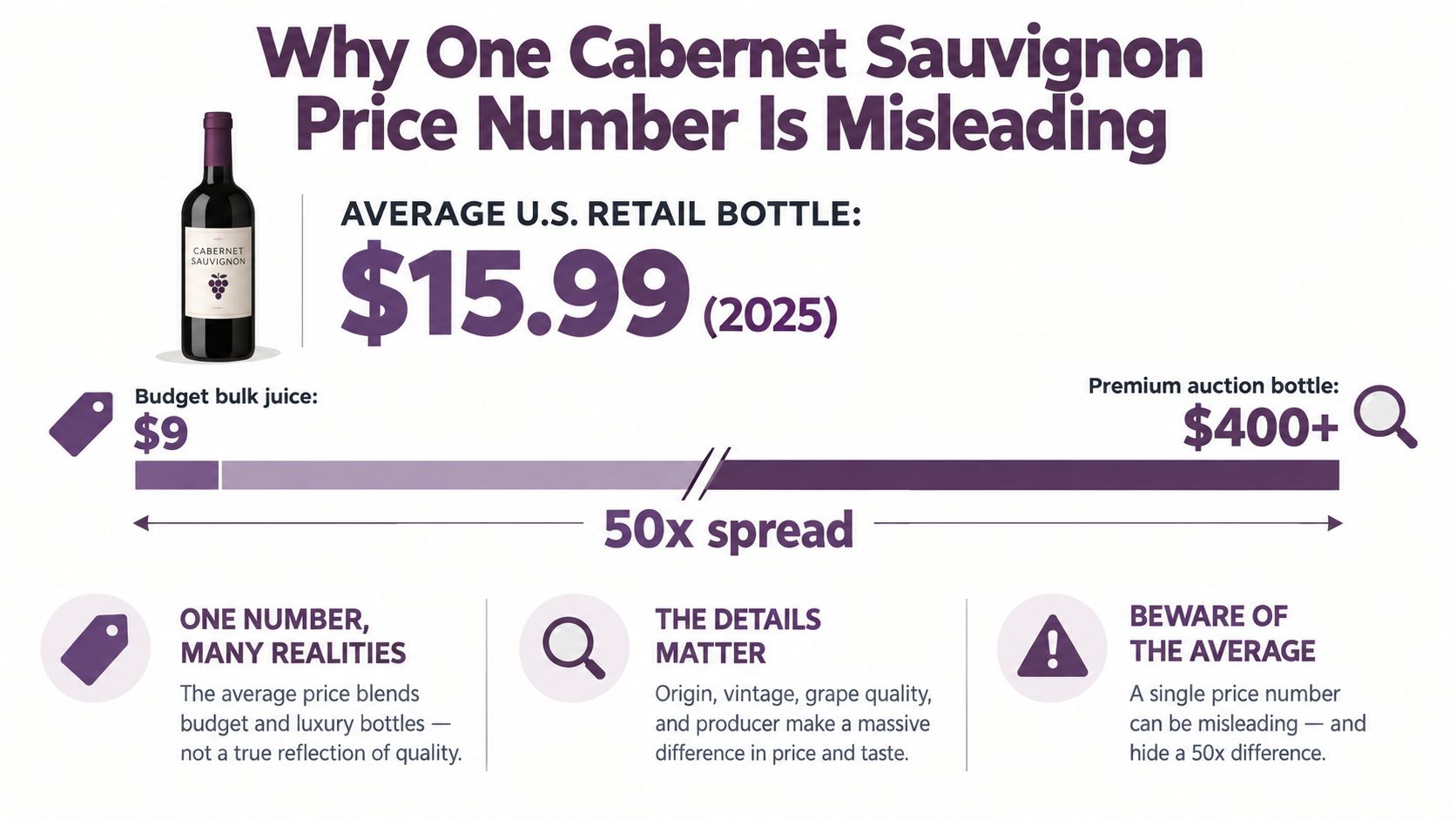
A U.S. DTC Cabernet Sauvignon bottle averaged $98.35, while shipment volume declined 13% year over year and the varietal represented 29% of total value, according to Sovos ShipCompliant's mid-year DTC report. That is a premium-channel signal, not a grocery-shelf benchmark. The same label category can carry a very different reference price in retail, DTC, bulk trade, grape contracts, or auctions.
Production data shows why region must be separated as well. California Cabernet grapes averaged $2,127.33 per ton in 2025. Napa County reached $9,002 per ton, compared with $2,770 per ton in Sonoma, as reported in the California grape crush coverage. Napa's premium describes a specific fruit market. It does not establish the value of every Cabernet Sauvignon bottle.
<a id="four-reference-frames"></a>
Four reference frames
Use four questions to identify the relevant benchmark:
- What does the consumer pay? Retail and restaurant prices show shelf or menu positioning.
- What does the winery realize? DTC and mailing-list prices reflect direct customer economics.
- What does the trade pay? Bulk wine and grape contracts indicate production inputs.
- What does scarcity command? Auctions show collectible and allocation-driven value.
Bulk wine provides another sharp contrast. Napa Cabernet had 1.2 million gallons actively for sale, including 930,000 gallons from the 2024 vintage. Recent transactions ranged from $10 to $19 per gallon, with some deals between $6 and $12 per gallon and a few below $6, according to Turrentine Brokerage's Napa market update.
These figures should not be blended into one consumer average. A price per ton, gallon, liter, bottle, or auction lot answers a different commercial question. Identify the channel first, then compare region, quality, vintage, appellation, and transaction type within that market.
<a id="the-main-pricing-channels-and-tiers-you-should-know"></a>
The Main Pricing Channels and Tiers You Should Know
Cabernet pricing becomes easier to interpret when each channel has a defined job. Retail measures visible consumer availability. DTC measures direct winery demand. Bulk and grape markets measure production inputs, while auctions measure scarcity and collector appetite.
| Channel | Typical Price Range | Primary User | Tier |
|---|---|---|---|
| Off-premise retail | Entry to premium shelf pricing | Grocery shoppers, retailers | Entry to premium |
| On-premise and by-the-glass | Menu-dependent pricing | Restaurants, diners | Premium to fine |
| DTC shipments | Winery-direct pricing | Mailing-list buyers, collectors | Premium to cult |
| Bulk wine and grape contracts | Trade-unit pricing | Wineries, négociants, growers | Production input |
| Auction and secondary market | Scarcity-driven realized pricing | Collectors, investors, merchants | Fine to icon |
<a id="match-the-channel-to-the-decision"></a>
Match the channel to the decision
A shopper comparing a $12 grocery bottle should use nearby shelf prices from the same market, not a Napa auction result. A winery with a $45 mailing-list offer needs to compare against DTC wines with similar allocations and customer access. A collector evaluating a $250 auction lot should focus on hammer prices, condition, provenance, buyer premiums, and liquidity rather than retail list prices.
The tier also changes the meaning of a discount. In entry retail, a promotion may reflect inventory management. In DTC, a lower price can signal a broader release or weaker allocation demand. At auction, a high result may reflect rarity, vintage reputation, lot composition, or competitive bidding.
Practical rule: Use the price paid by the same type of buyer, through the same channel, for a comparable wine. A different channel may be useful context, but it isn't a clean substitute.
The audience determines the reference point:
- Consumers should begin with local retail and restaurant comparisons.
- Producers should separate grape cost, bulk wine value, packaging, and direct realization.
- Merchants need both acquisition cost and realized resale price.
- Collectors and investors should prioritize auction clears and repeatable secondary-market evidence.
This channel-first approach prevents the most common error, treating an iconic Napa Cabernet and a globally traded bulk lot as observations from one unified price series.
<a id="us-retail-and-dtc-pricing-for-cabernet-sauvignon"></a>
U.S. Retail and DTC Pricing for Cabernet Sauvignon
Retail and DTC prices answer different commercial questions. Retail shelves show how a Cabernet competes for attention against neighboring bottles, promotions, and store-level assortment. DTC pricing captures winery realization, allocation access, hospitality, and the strength of the producer's customer relationship. A single U.S. bottle average therefore obscures the channel setting the price.
Retail comparisons work best when segmented by tier. Entry-level Cabernet is judged against nearby grocery and mass-market offerings, where visibility and promotion shape the realized price. Premium retail bottles compete within a narrower regional and quality set. Higher-priced wines may appear in specialty shops, where scarcity, critic attention, vintage, and producer reputation matter more than broad shelf velocity.
| Metric | Off-Premise Retail | DTC Shipments |
|---|---|---|
| Primary signal | Shelf price, promotion, and consumer availability | Winery realization and customer willingness to pay |
| Cabernet reference | Mainstream, premium, and regional shelf sets | Allocation, mailing-list, and winery-direct offers |
| Market interpretation | Broad consumer comparison | Premium concentration and relationship-led demand |
| Best use | Shopping and retail assortment decisions | Release pricing, allocation strategy, and producer benchmarking |
<a id="why-the-averages-diverge"></a>
Why the averages diverge
Retail shoppers can compare several producers in one visit. That visibility puts pressure on posted price, package presentation, and promotional timing. DTC customers often buy from a smaller group of wineries, with access shaped by membership, release timing, allocation limits, and prior purchasing. The price can therefore include access and loyalty value that a retail shelf cannot express.
The spread is especially important for producers. A winery-direct offer may support a higher bottle realization, yet fulfillment, shipping, compliance, customer acquisition, and service costs reduce the amount retained. Retail pricing carries different deductions, including distributor and merchant margins, promotional allowances, and slower-moving inventory risk.
For a retail buyer, the reference question is direct: which Cabernet occupies the same shelf position, price tier, and regional set? For a producer, the comparison should separate the posted DTC price from net realization after channel costs. For a consumer, retail provides the cleaner benchmark for immediate substitution, while DTC pricing is more informative when the purchase includes allocation access or a direct winery relationship.
The correct reference price depends on how the wine trades. Retail, DTC, auction, bulk, and grape markets describe different stages and buyers, not interchangeable observations in one Cabernet Sauvignon price series.
<a id="napa-cabernet-pricing-from-grape-to-bottle"></a>
Napa Cabernet Pricing from Grape to Bottle
Napa Cabernet pricing is a value-accumulation problem, not a single conversion from fruit cost to shelf price. Grape prices capture vineyard location and scarcity. Bulk transactions value finished liquid. Bottle prices also reflect élevage, packaging, compliance, distribution, brand positioning, allocation access, and consumer demand.
The same appellation can therefore produce very different reference points. A vineyard buyer evaluates fruit by ton, a bulk buyer evaluates wine by gallon, and a retailer or collector evaluates a bottle through its channel, packaging, provenance, and expected demand. Comparing those observations directly can make a high-value input appear to explain more of the final price than it does.
| Tier | Unit | Pricing question | Bottle implication |
|---|---|---|---|
| Napa Cabernet grapes | USD per ton | What does the vineyard input command? | Indicates origin and scarcity, not finished-wine value |
| Napa Cabernet bulk wine | USD per gallon | What does available liquid command? | Excludes brand, package, route to market, and consumer margin |
| Prestige bottle | USD per bottle | What does the controlled release command? | Includes provenance, scarcity, and channel access |
| Ultra-premium bottle | USD per bottle | What does secondary demand support? | May diverge sharply from production economics |
<a id="where-the-stack-widens"></a>
Where the stack widens
The gap between vineyard input and bottle price widens when a wine carries a recognized appellation, estate identity, limited production, or strong secondary demand. Napa's grape market has maintained a premium position even as other parts of the market softened. The Napa Valley grape-market analysis supports using fruit value as evidence of regional scarcity, while cautioning against treating it as a direct bottle-price formula.
Bottle pricing does not move in lockstep with grape pricing. A producer can absorb expensive fruit and release at a restrained price to support a long-term market position. Another can purchase less expensive inputs and achieve a higher bottle price through brand strength, allocation, packaging, or established demand. Production yield, cellar time, financing, compliance, fulfillment, and channel deductions further separate gross bottle price from producer realization.
Napa references such as Oakville, Rutherford, and Stags Leap District should therefore be compared within the same channel and tier. A retail shelf price, winery-direct release, auction result, and grape transaction answer different valuation questions.
For a current view of how vineyard conditions and trade conditions affect Napa valuation, consult Wine Labs' Napa Cabernet market insights. The practical conclusion is simple: use grape data to assess regional scarcity, bulk data to assess liquid-market conditions, and bottle data to judge the price paid by the target buyer.
<a id="california-australia-and-south-africa-compared"></a>
California Australia and South Africa Compared
Cross-country Cabernet comparisons are most reliable at the grape and bulk-wine level, where the traded unit is clearer. Finished-bottle prices combine taxes, freight, importer and retailer margins, packaging, and brand equity. The same shelf price can therefore represent very different production economics and producer returns.
California's earlier grape-price coverage provides the premium benchmark for this comparison. Its main use is to show the spread between a broad statewide input reference and Napa's tighter, higher-value supply base, not to establish a universal bottle price. California grape data should remain in that regional context.
Australia offers a clearer commodity reference. A Wine Australia update placed Cabernet Sauvignon at 49 U.S. cents per liter, the lowest bulk offer price by country in that period, while Shiraz stood at 43 cents per liter. These figures describe bulk trade rather than fine-wine bottle value, as explained in Wine Australia's bulk-wine market update.
South Africa shows a firmer bulk-market signal in the cited report. Cabernet Sauvignon rose from R10.74 per liter to R11.12 per liter in 2022, a 3.5% year-over-year increase. The share trading above R12.50 per liter increased from 18% to 25%, while the sample's longer-run compound annual growth rate was 7.6%, according to Vinpro's quarterly wine report.
| Region | Best comparison point | Market signal | Bottle interpretation |
|---|---|---|---|
| California | Earlier grape-price coverage | Regional input values vary sharply | Use for supply and appellation context |
| Australia | Bulk Cabernet | $0.49 per liter in the cited update | Commodity bulk reference |
| South Africa | Bulk Cabernet | R10.74 to R11.12 per liter in 2022 data | Rising bulk-market benchmark |
<a id="why-bottle-comparisons-mislead"></a>
Why bottle comparisons mislead
A California Cabernet, an Australian Cabernet, and a South African Cabernet may share a shelf price while reflecting different land costs, labor structures, exchange rates, logistics, and channel margins. Bottle price alone cannot show which part of the supply chain captured the value.
The regional signals also move independently. California's earlier grape-price coverage points to a different input environment from Australia's reported upward pressure on major inland red grape-price indicators in 2026 compared with 2025 and 2024. South Africa's bulk figures add another signal rather than confirming either market. A global Cabernet average would conceal these divergent movements.
Use the reference that matches the trade. Compare California grapes with California grapes, Australian bulk with Australian bulk, and South African bulk with South African bulk. Then evaluate how each cost base supports the target retail, restaurant, or DTC bottle price.
<a id="auction-pricing-and-the-top-end-of-the-market"></a>
Auction Pricing and the Top End of the Market
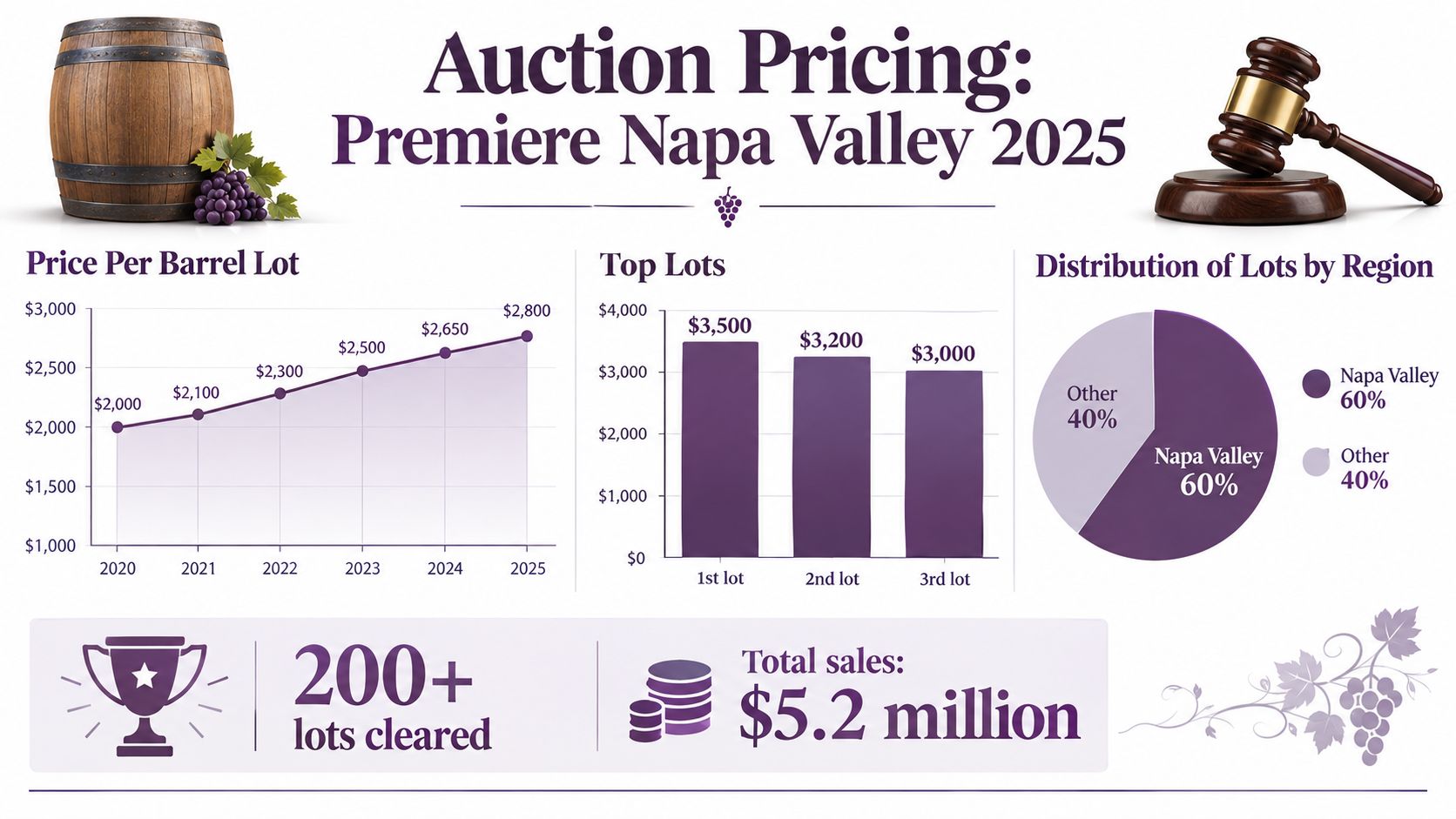
Auction pricing measures scarcity, provenance, competition, and collectibility rather than ordinary retail demand. The introduction's Premiere Napa Valley figures establish a high but softer 2026 benchmark. The more useful question is how individual lots performed within that average, and whether buyers accepted the same value across producers, formats, and vintages.
Cabernet remained the dominant category, accounting for seven of the top ten lots by average bottle price. However, no lot reached the $1,000-per-bottle wholesale level that had been common in earlier years. The reported $286 average for 2023 and $195 average from two years earlier show why a headline auction average needs historical context. Prestige prices can remain high while shifting sharply with vintage supply, bidding intensity, and buyer confidence.
<a id="read-the-result-correctly"></a>
Read the result correctly
The hammer price is not the buyer's delivered cost. Buyer premiums, taxes, shipping, storage, and bottle condition can materially change the final value. Barrel-lot and fundraising auctions also differ from secondary-market sales because they may include early access, limited production, or a direct producer relationship unavailable through retail.
Lot-level review matters. Compare realized prices by producer, vintage, bottle format, condition, and auction house rather than treating every Cabernet result as interchangeable. A related example is Wine Labs' ZACHYS auction digest, which organizes results around individual lots and broader market research.
Collectors should look for repeat sales across comparable auctions. One exceptional result may reflect a narrow bidding contest; recurring clears provide a stronger reference for the top end of Cabernet pricing.
The supplied auction video offers additional visual context for how prestige wine sales are presented:
<iframe width="100%" style="aspect-ratio: 16 / 9;" src="https://www.youtube.com/embed/mRenpt5sUpA" frameborder="0" allow="autoplay; encrypted-media" allowfullscreen></iframe><a id="how-to-choose-the-right-reference-price-for-your-role"></a>
How to Choose the Right Reference Price for Your Role
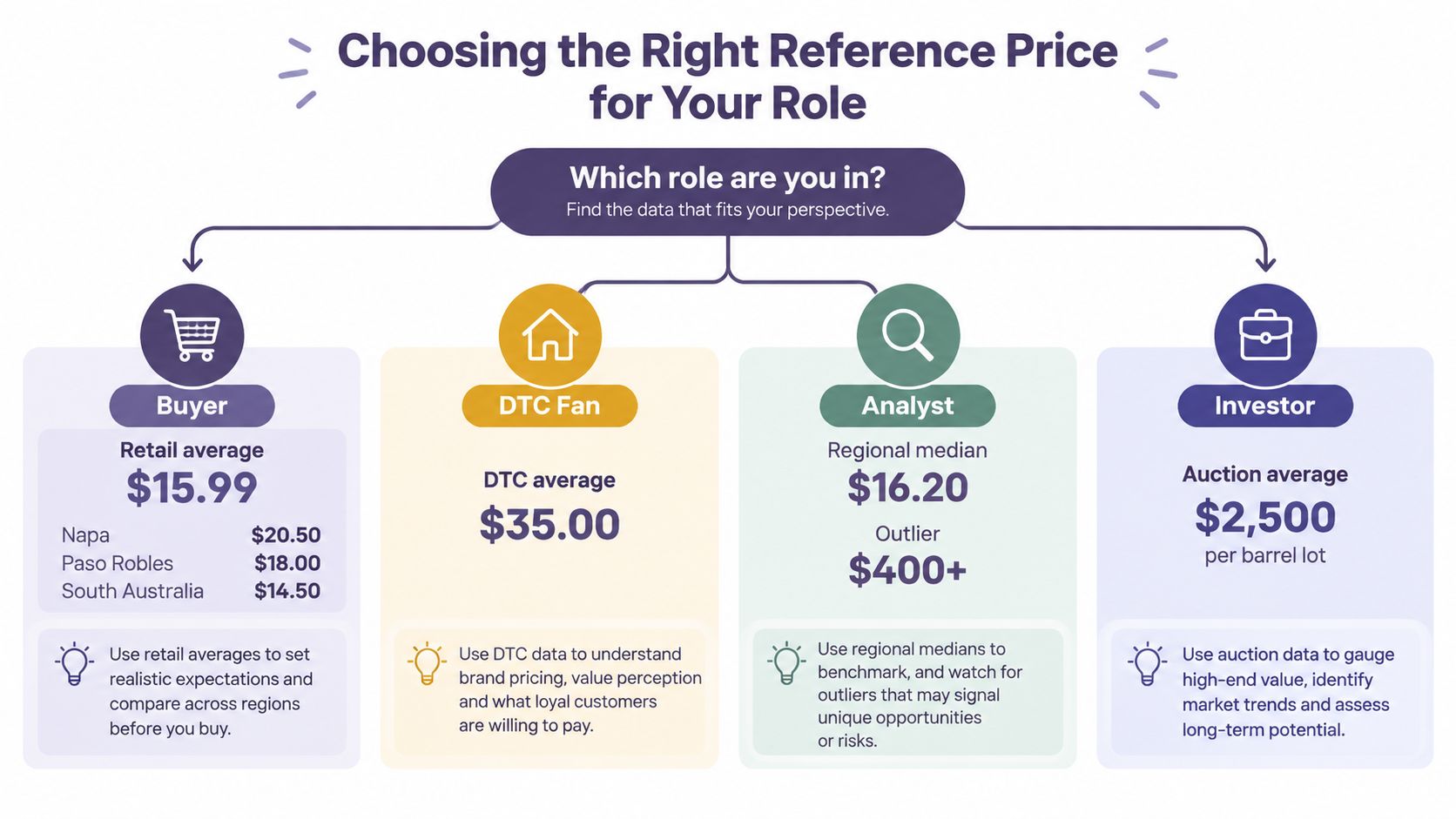
The right cabernet sauvignon price depends on the transaction ahead. Buyers, sellers, investors, and merchants can assess the same bottle differently because they face different channels, costs, and risks.
<a id="buyers"></a>
Buyers
Begin with comparable bottles in the channel where you will purchase. Align region, vintage, appellation, producer position, and bottle size before comparing prices. A retail shopper should not treat an auction result as a shelf target, while a DTC member should compare winery-direct releases with similar access conditions.
Use retail as the primary anchor and DTC as a premium-context check. For Napa, compare Napa Cabernets with similar producers and appellations rather than relying on a national average. This approach separates local scarcity from broad category pricing.
<a id="sellers"></a>
Sellers
Sellers should monitor completed DTC orders, wholesale transactions, and auction clears. A listed price shows the seller's intended position. A completed transaction shows what the market accepted.
DTC remains a useful premium-channel reference, as noted in the earlier discussion. Sellers should apply that channel evidence to comparable releases, then test it against their own producer, region, vintage, and customer base. A premium benchmark can inform positioning without becoming a universal release target.
<a id="investors"></a>
Investors
Investors need repeat auction evidence, provenance checks, and vintage alignment. Track the same label across comparable sales, and separate hammer price from the buyer's delivered cost. One unusually high result may reflect a narrow bidding contest rather than durable liquidity.
Bottle condition, format, auction house, and lot context can shift the result. The strongest reference comes from recurring clears among comparable bottles.
<a id="merchants"></a>
Merchants
Merchants need parity between acquisition and resale. Compare wholesale, retail, DTC, restaurant, and auction references to identify where margin is created or lost. The practical question is, “Which buyer and channel can support this price?”
Decision filter: Choose the reference price that mirrors your next transaction, then use other channels to explain the gap.
<a id="quick-reference-benchmarks-by-channel-and-tier"></a>
Quick Reference Benchmarks by Channel and Tier
A benchmark is useful only when its unit, channel, tier, and transaction context remain visible. These figures are reference points, not interchangeable measures of cabernet sauvignon price.
| Tier | Retail | DTC | Auction Hammer | Bulk | Grape |
|---|---|---|---|---|---|
| Entry | Use local shelf comparables | Channel-dependent | Not applicable | Commodity market varies | Regional contract |
| Mid | Use regional shelf comparables | Winery-direct comparables | Not applicable | Regional bulk quotes | Regional contract |
| Premium | Appellation and producer set | $98.35 average for Cabernet | Comparable lots only | Napa deals below $6 to $19 per gallon | California average $2,127.33 per ton |
| Fine | Producer and vintage set | Premium allocation market | $174 average per bottle wholesale at Premiere Napa Valley 2026 | Segment by vintage and appellation | Napa County $9,002 per ton |
| Icon | Scarce shelf availability | Allocation and mailing list | Above the standard prestige average, highly variable | Usually not the relevant reference | Vineyard-specific evidence required |
The DTC figure is the earlier report benchmark. Napa bulk and grape figures likewise refer back to the earlier market and crush-data sections. The auction figure is the previously cited Premiere Napa Valley reference and excludes the reported buyer's premium. These callbacks keep the table concise while preserving the distinction between consumer prices, trade values, and agricultural inputs.
Use the row that matches the next transaction. A retailer should prioritize comparable shelf offers, a producer should separate DTC positioning from grape and bulk costs, and an auction analyst should compare similar lots rather than apply a retail average. Regional context matters throughout, especially when Napa, broader California, Australia, and South Africa occupy different market tiers.
For recurring comparisons across these channels, readers can browse subscription options when a one-off check is insufficient.
<a id="using-a-price-intelligence-platform-to-compare-across-channels"></a>
Using a Price Intelligence Platform to Compare Across Channels
Cross-channel analysis starts with normalization. Bottle, case, bulk-liter, gallon, and grape-ton observations require separate units, channel labels, vintage, region, producer, and transaction status. Combining them without those fields can make unlike values appear comparable.
A workable process has five steps:
- Normalize units. Convert each quote into a clearly labeled comparison measure, while retaining the original unit for auditability.
- Aggregate sources. Bring retail offers, DTC shipment records, auction results, and bulk quotes into one searchable view.
- Flag divergence. Measure gaps between DTC and retail rather than treating one channel as confirmation of the other.
- Align vintages. Match harvest years before comparing releases, auction results, or regional pricing.
- Export decisions. Send cleaned records through API or CSV workflows for sourcing, portfolio valuation, assortment planning, or trading.
The Wine Labs' fine-wine market data platform supports this type of comparison across retail, auction, exchange, and private data. Its practical value lies in connecting listings to a consistent wine identity while retaining the channel and transaction context attached to each observation. That distinction matters because the relevant reference price changes by role: a retailer needs shelf comparables, a producer needs DTC, bulk, and grape inputs, and an auction analyst needs comparable lots.
A merchant can reduce manual reconciliation among shelf offers, auction outcomes, and trade quotes. A producer can separate direct-customer positioning from broader retail placement. A collector can build a clearer valuation trail than a single current listing provides. For repeated checks, structured exports and saved filters also make regional and tier comparisons easier to reproduce.
<a id="related-resources-and-next-steps"></a>
Related Resources and Next Steps
A useful Cabernet reference begins with the decision, not with a favorite source. Identify whether the task concerns a retail shelf, DTC release, bulk lot, grape contract, or auction result, then collect records that share the same unit, region, vintage, format, and transaction status.
Use each resource for a defined research function:
- Cross-channel comparison: A Wine Labs workflow can match retail, auction, exchange, and private records while preserving their market context.
- Grape economics: California crush reporting provides an earlier-stage reference for fruit valuation and supply conditions.
- Napa bulk supply: Turrentine's market update helps frame active gallons and reported transaction ranges for Napa Cabernet bulk wine.
- Top-end discovery: Premiere Napa Valley reporting adds bottle-level wholesale and category context for prestige releases.
- Secondary-market comparison: The Liv-ex Fine Wine 1000 index can place collectible Cabernet beside other established fine-wine categories.
- Programmatic research: A Wine Labs API workflow supports machine-readable matching, retrieval, and export for repeatable checks.
- Alerts: Threshold monitoring can flag changes in selected Cabernet SKUs, auction lots, or producer releases.
- Portfolio valuation: Apply the same identity fields to each lot, including producer, cuvée, vintage, format, and condition.
Keep a source register that records what each dataset measures and which channel it represents. Grape reports inform supply economics, bulk updates inform intermediate inventory, retail and DTC records show consumer realization, and auction archives indicate scarcity and resale demand. The resulting benchmark is auditable because every figure retains its market role rather than being folded into one headline bottle price.
<a id="key-takeaways-for-cabernet-sauvignon-pricing-in-2026"></a>
Key Takeaways for Cabernet Sauvignon Pricing in 2026
A single average bottle price is a weak reference. A bulk quote, grape contract, DTC release, and prestige auction result represent different stages and forms of trade. Combining them produces false precision and can conceal the spread between input costs, intermediate inventory, consumer realization, and resale demand.
Region must remain visible. California, Australia, and South Africa can show materially different pricing signals because they cover different supply conditions, units, and market stages. The figures are not interchangeable. Their value lies in showing why a Cabernet benchmark needs geographic and channel context, rather than a headline number.
The buyer's role sets the relevant comparison. Buyers should prioritize nearby retail and DTC offers. Sellers should examine completed transactions. Investors need repeated auction evidence, while merchants need acquisition-to-resale comparisons. Producers and growers should start with grape and bulk economics before interpreting bottle prices.
Use this checklist before accepting any Cabernet Sauvignon price:
- Channel: Where did the transaction occur?
- Unit: Is it per bottle, liter, gallon, ton, case, or lot?
- Region: Is the wine or fruit tied to a defined appellation?
- Vintage: Are the releases comparable?
- Status: Is it a list price, offer, completed sale, or auction hammer?
- Costs: Are buyer premiums, freight, tax, and fulfillment included?
A defensible benchmark answers all six and preserves the source market behind each observation.
Wine Labs brings retail, auction, exchange, and other fine-wine pricing into a comparable market view, with tools for historical analysis, portfolio valuation, alerts, and programmatic access. Visit Wine Labs to compare Cabernet Sauvignon prices by channel, region, vintage, and transaction context before you buy, sell, or quote.