Wine Labs · Market intelligence
Bourgogne Pinot Noir: Terroir, Pricing, and Market Trends
Explore Bourgogne Pinot Noir through its appellation hierarchy, terroir-driven styles, and market pricing. Learn how supply shocks and value tiers shape
Burgundy's wine economy is large enough to shape global fine-wine pricing, yet Bourgogne Pinot Noir is often treated as a simple entry-level category. The region covers about 30,052 hectares, produces roughly 206 million bottles, generates about €2 billion in worldwide sales, and exports one in every two bottles on average. Those figures place Bourgogne Pinot Noir inside a market system whose supply, distribution, and pricing signals matter far beyond casual regional Burgundy. Burgundy's regional market profile shows why the category deserves analysis as a commercial benchmark, not just a tasting-note exercise.
Table of Contents
- The Scale and Significance of Bourgogne Pinot Noir
- Appellation Rules and Terroir Mechanics
- Market Segmentation and Pricing Dispersion
- Supply Shocks and Vintage Scarcity
- Finding Value Across the Quality Spectrum
- Strategic Sourcing and Portfolio Integration
<a id="the-scale-and-significance-of-bourgogne-pinot-noir"></a>
The Scale and Significance of Bourgogne Pinot Noir
Burgundy's appellation structure was formally organized in the 1930s, with Bourgogne AOC established by decree on 31 July 1937. That legal foundation gave the regional category a defined identity within one of the world's most influential wine regions. Bourgogne Pinot Noir therefore sits at the base of a hierarchy that connects broad regional bottlings with village wines, Premier Crus, and Grand Crus.
The commercial scale is equally important. Burgundy's production and export footprint gives merchants a reference point for monitoring demand, availability, and price behavior across red Burgundy. Bourgogne Pinot Noir may carry a regional designation, but it remains linked to the same origin story, regulatory framework, and international distribution network that supports the region's more prestigious wines.
<a id="a-benchmark-category-not-a-residual-category"></a>
A benchmark category, not a residual category
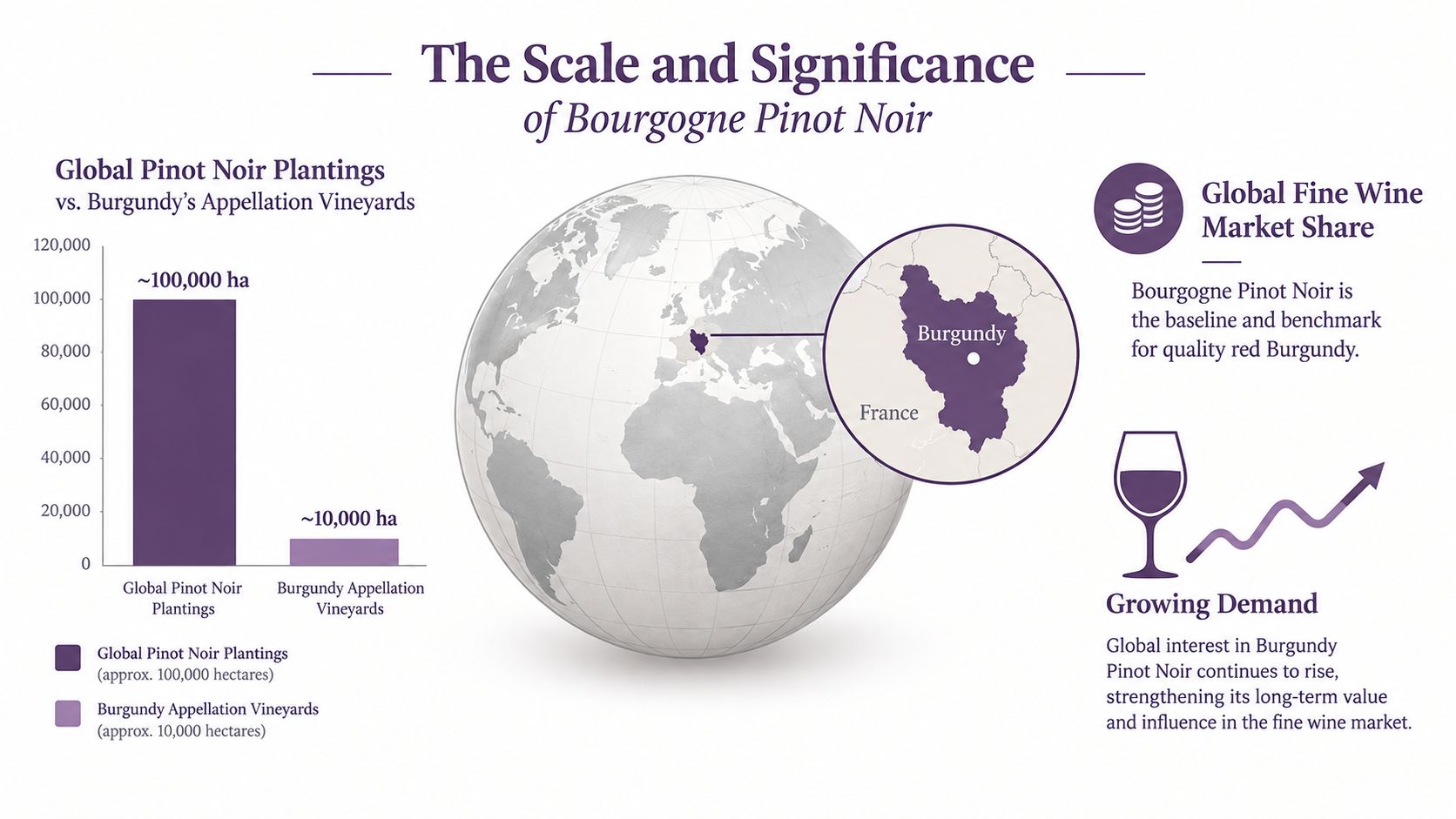
Pinot Noir is central to Burgundy's red-wine identity. One recent regional summary lists 32,301 hectares of Pinot Noir, while another official Burgundy figure lists 30,815 hectares, a difference that reflects differing reporting bases rather than a challenge to the grape's importance. The official figures also place Pinot Noir at about 4% of France's vineyard area. Burgundy's official regional figures establish the grape's national and regional significance.
That scale creates a useful analytical distinction. The category isn't one homogeneous pool of wine. It includes different producers, sourcing models, vintages, and distribution channels. A merchant comparing two bottles labeled Bourgogne Pinot Noir is often comparing agricultural exposure, production philosophy, and commercial positioning as much as liquid quality.
The export pattern reinforces the point. Burgundy's leading volume markets include the United States at 20%, the United Kingdom at 16%, Canada at 9%, Belgium at 8%, and Japan at 8%. Such concentration means regional supply interruptions or shifts in buyer sentiment can produce uneven effects across countries.
Market implication: Bourgogne Pinot Noir is a useful baseline for judging how Burgundy's broad market absorbs scarcity, changing demand, and channel-specific price pressure.
For merchants and collectors, the practical question is not whether the wine is good. It's whether a given bottling accurately reflects the category's position, producer identity, vintage conditions, and route to market. A broader Burgundy market valuation and auction briefing can add context when regional bottles are evaluated alongside the wider fine-wine market.
<a id="appellation-rules-and-terroir-mechanics"></a>
Appellation Rules and Terroir Mechanics
Bourgogne Pinot Noir's market position begins with rules that constrain what producers can do. Under Bourgogne AOC requirements, Pinot Noir is the primary and effectively defining red variety for Bourgogne Rouge. The appellation has a maximum yield of 58 hl/ha, and irrigation is prohibited. The Bourgogne AOC specification links the label to both grape identity and production limits.
Those constraints matter because regional status doesn't mean unrestricted volume production. A yield ceiling limits the amount of wine that can be produced from eligible vineyard land, while the irrigation prohibition leaves growers more exposed to natural water availability and seasonal conditions. The result is a production model in which viticulture, site selection, and harvest decisions influence the commercial profile of the finished wine.
<a id="how-the-rules-shape-the-wine"></a>
How the rules shape the wine
A useful way to read the framework is to follow four connected steps:
-
Variety defines the red identity. Bourgogne Rouge is built around Pinot Noir, so the category isn't primarily a blend designed to standardize flavor through multiple dominant grapes.
-
Yield limits constrain supply. The 58 hl/ha maximum creates a formal boundary around production volume. That boundary helps explain why regional Burgundy can show scarcity even before a producer reaches a village or cru designation.
-
No irrigation increases vintage exposure. Producers can't correct water stress through irrigation under the appellation rules. Weather therefore affects both vineyard decisions and the availability of compliant fruit.
-
Place remains commercially relevant. The label is regional, but the underlying parcels can differ in slope, drainage, soil composition, and exposure. A regional designation doesn't erase those differences.
Bourgogne Pinot Noir is shaped by Burgundy's semi-continental climate and Jurassic marl-limestone soils. East- to southeast-facing slopes can benefit from drainage, wind exposure, and longer winter sunshine, conditions that help manage a frost-prone and variable climate. Pinot Noir's need for careful water balance and slow ripening makes those physical differences commercially meaningful. GuildSomm's Burgundy guide explains the relationship between climate, geology, and site sensitivity.
<a id="why-regional-wines-can-diverge"></a>
Why regional wines can diverge
Small changes in the ratio of limestone to clay can alter drainage and water retention. Slope exposure can also affect the vineyard's exposure to wind and sunlight. These variables help explain why two regional wines can occupy different stylistic and pricing positions even when both use the same grape and carry the same appellation.
For buyers arranging luxury wine itineraries France, the commercial lesson is straightforward. Vineyard geography isn't decorative background. It's part of the provenance information that should accompany a regional Burgundy purchase.
<a id="market-segmentation-and-pricing-dispersion"></a>
Market Segmentation and Pricing Dispersion
The phrase “cheap Burgundy” hides too much variation. Bourgogne Pinot Noir occupies a fragmented value spectrum shaped by producer reputation, sourcing model, vintage, importer relationships, retail geography, and channel liquidity. Two bottles can share the appellation while carrying very different risk and scarcity profiles.
Independent market commentary describes a broader reset in Burgundy trading. The Burgundy 150 index fell 28% over two years and 4.8% during the first five months of 2025, while remaining 16% higher over five years. The same commentary described auction prices as still above pre-Covid levels and top Burgundy as a bright spot within a weaker market. Decanter's Burgundy market analysis is useful because it separates the performance of top investment wines from the assumptions buyers often apply to regional bottlings.
<a id="one-appellation-several-commercial-tiers"></a>
One appellation, several commercial tiers
Retail examples in the category range from the low-$20s to the high-$30s, with some bottles extending beyond that range. The dispersion isn't evidence of a single “correct” Bourgogne Pinot Noir price. It shows that the label covers multiple commercial products.
| Metric | Value / Range | Market Implication |
|---|---|---|
| Burgundy growing area | About 30,052 hectares | The regional market has substantial production breadth, but not every bottling has equal availability. |
| Burgundy annual production | Roughly 206 million bottles | Regional scale supports international distribution and broad comparability. |
| Burgundy worldwide sales | About €2 billion | Burgundy remains commercially significant beyond its most expensive wines. |
| Average export share | One in two bottles | Price and supply signals can travel quickly across national markets. |
| Burgundy 150 change | Down 28% over two years | Broad market sentiment has weakened at the upper end. |
| Five-year Burgundy 150 change | Up 16% over five years | A shorter correction doesn't erase longer-term market gains. |
| Retail category spread | Low-$20s to high-$30s and beyond | Producer, channel, vintage, and local availability create distinct value tiers. |
The table's most important conclusion is the mismatch between macro and micro data. A falling top-end index doesn't automatically make every Bourgogne Pinot Noir cheaper, just as resilient auction prices don't guarantee strength for every regional bottle. The category needs its own comparisons.
A regional appellation should be priced against comparable regional bottlings, not against a headline index dominated by prestigious wines.
Merchants need to normalize producer, vintage, bottle size, market, and channel before treating a quote as attractive or expensive. Collectors should apply the same discipline. Fine-wine market data and cross-channel comparisons can help distinguish a genuine discount from a bottle that looks inexpensive only because its provenance or market context is unclear.
<a id="supply-shocks-and-vintage-scarcity"></a>
Supply Shocks and Vintage Scarcity
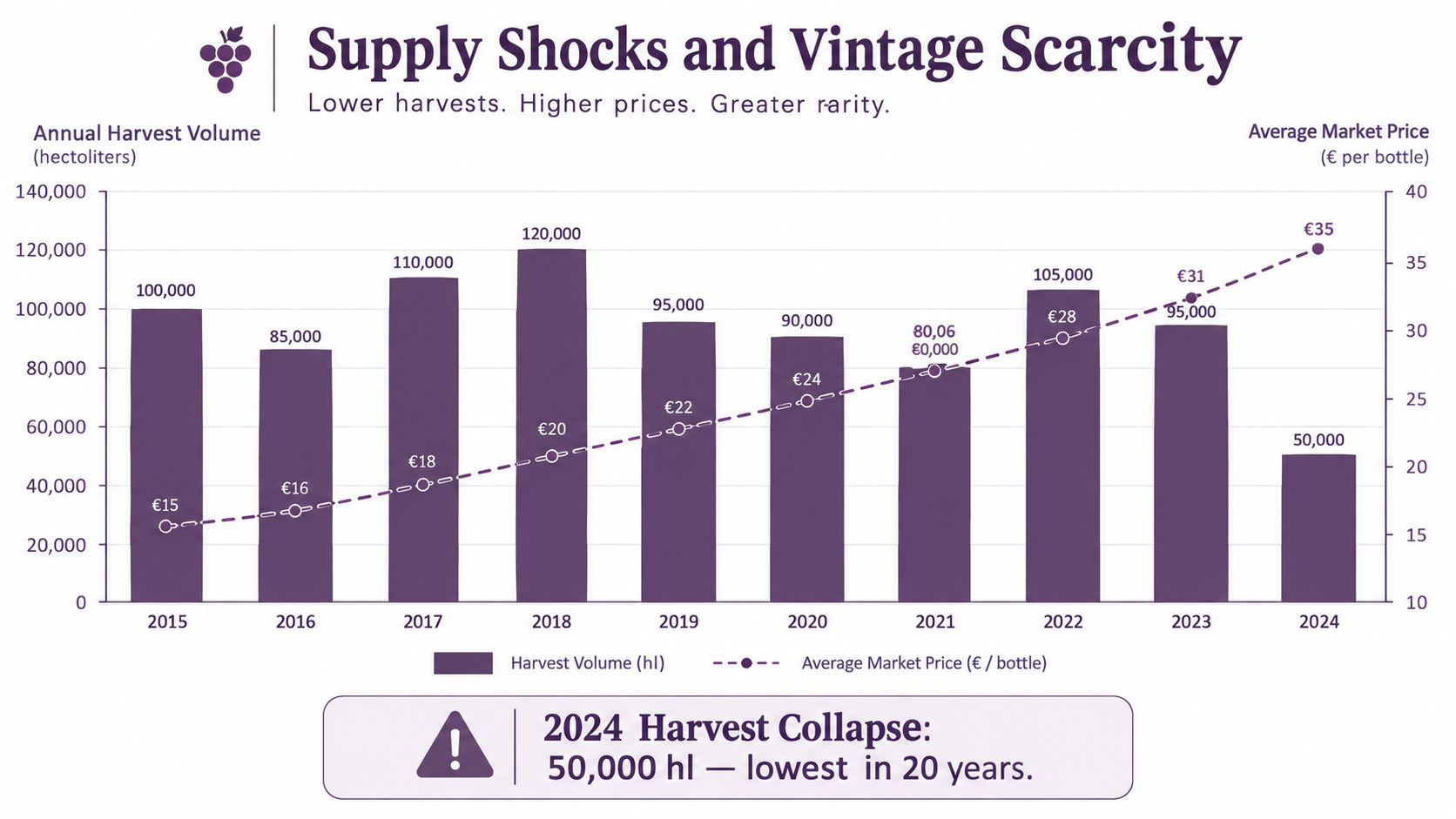
Stable availability is a dangerous assumption in Bourgogne Pinot Noir. Coverage of the 2024 Burgundy harvest described volumes at roughly half a normal harvest, with severe subregional losses and approximately 50% lower Pinot Noir output in the Côte-d'Or. Regional reporting on the Burgundy harvest crisis connects the agricultural shock to the supply conditions now facing buyers.
The immediate commercial consequence isn't that less wine exists. A short harvest can fragment allocations, change importer priorities, encourage substitution between markets, and widen the difference between an established bottling and an opportunistic replacement. Regional wines may be especially exposed because buyers often expect them to be readily available.
<a id="availability-is-a-market-variable"></a>
Availability is a market variable
The export channel adds another layer. A Burgundy industry report recorded the United States as the largest export market in 2025, with 19.3 million bottles, down 7.9%. That decline doesn't prove that every Bourgogne Pinot Noir bottling became scarce in the United States, but it does show that large-market distribution was under pressure.
The effect can be uneven:
- Importers may receive smaller or less predictable allocations, particularly when producers must manage reduced stock across established markets.
- Retailers may replace missing bottlings with nearby producer or vintage alternatives, creating wider price differences within the same appellation.
- Collectors may see market-specific premiums, especially when a particular label is available in one country but difficult to source in another.
- Merchants may mistake dispersion for producer re-rating, when the cause is localized inventory pressure.
The category's observed retail spread, from around $20 to more than $40 depending on bottling and country, supports the conclusion that availability is fragmented rather than globally uniform. That range shouldn't be interpreted as a universal price guide. It's evidence that location, producer, and channel can materially change the buying decision.
A visual showing scarcity should be treated as an analytical prompt, not a promise that prices rise whenever harvest volumes fall. Demand, inventory, substitution, and buyer confidence still determine outcomes.
The wider implications of weather damage and regional wine stress can be followed in this Burgundy and Rhône market briefing.
A related video provides additional context for readers who want a visual discussion of Burgundy's production pressures.
<iframe width="100%" style="aspect-ratio: 16 / 9;" src="https://www.youtube.com/embed/Ilxtb1ddEog" frameborder="0" allow="autoplay; encrypted-media" allowfullscreen></iframe><a id="finding-value-across-the-quality-spectrum"></a>
Finding Value Across the Quality Spectrum
The most useful comparison isn't between “cheap” and “expensive” Burgundy. It's between bottles whose price reflects identifiable provenance and bottles whose price relies mainly on the Burgundy name.
At the basic Bourgogne AOC level, still red Bourgogne Rouge is made from 100% Pinot Noir, while Bourgogne Blanc is made from 100% Chardonnay. A Bourgogne AOC reference makes the distinction clear. Burgundy's regional red category is therefore not a generic red blend with a famous place name.
The rules have nuance. Red Bourgogne is described as “almost always” pure Pinot Noir, but limited accessory varieties are permitted in some cases, including up to 10% César and up to 30% Gamay, with accessory varieties generally capped at 15% in the blend framework for the appellation. Independent Burgundy appellation coverage is useful when provenance and blend interpretation matter.
<a id="what-buyers-should-compare"></a>
What buyers should compare
A high-volume négociant bottling may offer broad market availability and consistent commercial positioning. Its value depends on sourcing transparency, vintage handling, distribution strength, and whether the price remains competitive with comparable regional wines.
An estate-grown regional wine from a respected domaine may offer clearer parcel identity and a stronger connection between vineyard conditions and the finished bottle. That doesn't automatically make it superior. It does give buyers a different proposition, particularly when the producer communicates sourcing and bottling decisions clearly.
| Buying profile | What can support the price | Main question |
|---|---|---|
| Broad négociant bottling | Distribution, consistency, and established identity | Is the market access worth the premium? |
| Estate regional wine | Greater provenance transparency and site specificity | Does the estate character show at regional level? |
| Scarce vintage release | Limited availability and allocation pressure | Is scarcity durable or temporary? |
| Lesser-known producer | Potentially lower entry price | Is the discount compensation for weaker information? |
A collector should also separate drinking value from investment value. Bourgogne Pinot Noir can offer a credible route into Burgundy's grape, climate, and soil system without carrying village or cru pricing. Yet its lower entry point doesn't guarantee liquidity, appreciation, or easy resale.
Practical rule: Pay for traceable identity first, producer fit second, and scarcity only when the market can verify it.
That ordering helps prevent buyers from confusing an expensive regional label with a differentiated asset. It also gives merchants a clearer basis for assortment decisions, especially when supply shocks make replacement bottles look deceptively similar.
<a id="strategic-sourcing-and-portfolio-integration"></a>
Strategic Sourcing and Portfolio Integration
Bourgogne Pinot Noir should be managed as a dynamic regional category, not as an afterthought beneath village and cru Burgundy. The combination of strict appellation rules, site sensitivity, export concentration, harvest risk, and cross-channel dispersion creates a market that rewards disciplined comparison.
A practical sourcing process starts with identity. Match the exact producer, cuvée, vintage, appellation, bottle format, and market before comparing prices. Regional Burgundy names can appear in inconsistent forms across retailer catalogs, auction listings, restaurant lists, and distributor files, so a superficial name match can produce false comparables.
<a id="a-decision-framework-for-merchants-and-collectors"></a>
A decision framework for merchants and collectors
First, establish the reference set. Compare the bottle with similar Bourgogne Pinot Noir wines, not with Grand Cru benchmarks or a broad Burgundy index. The relevant question is whether the offer is competitive within its own tier.
Then, test availability. A price below familiar retail levels may reflect a genuine opportunity, an older listing, a different market, or a bottling with limited replenishment. Supply conditions should be recorded alongside price, not treated as a separate issue.
Next, separate market signals. Auction resilience, retail discounting, export changes, and restaurant pricing can point in different directions. Each channel reflects a different buyer, inventory cycle, and liquidity condition.
Finally, track the position after purchase. Collectors need a defensible valuation history, while merchants need alerts when replacement costs or market listings change. Portfolio decisions become harder when every bottle is researched manually and each channel uses a different identity.
Wine Labs offers a relevant model for this workflow. Its platform consolidates pricing from retail, auction, exchange, and restaurant channels, uses canonical wine identities for comparison, and provides historical tracking, alerts, portfolio tools, and market analytics. Used alongside producer knowledge and direct trade relationships, that type of data layer can reduce blind spots when evaluating Bourgogne Pinot Noir.
The central conclusion is measured rather than promotional. Bourgogne Pinot Noir isn't automatically an investment wine, and it isn't automatically a bargain. It's a broad, supply-sensitive category whose value depends on the relationship between producer, vintage, provenance, channel, and current availability.
Use Wine Labs to compare Bourgogne Pinot Noir pricing across retail, auction, exchange, and restaurant channels, then monitor historical movements and alerts for the exact producer and vintage you're considering. Visit Wine Labs to bring canonical identity matching and portfolio-level market context into your next Burgundy sourcing decision.