Wine Labs · Market intelligence
Bordeaux Wine Price: What Actually Drives It
Understand what actually moves Bordeaux wine price across retail, auction, and exchange channels, plus how to read market signals before buying or selling.
A Bordeaux wine price headline can look reassuring until you examine the transaction underneath it. In 2025, Bordeaux trading volume rose 9.3% year over year, yet the average price for wines traded in both years fell 7.15%, from £2,042 to £1,896, and 80% of repeatedly traded Bordeaux wines changed hands at lower prices. The market review captures the central problem: people were still trading Bordeaux, but executable values were declining.
That distinction matters for collectors, merchants, restaurants, and investors. A retail shelf can remain firm while exchange bids weaken. An auction hammer can reveal distress in older stock while a restaurant list preserves a high nominal price. Vineyard land and bulk wine can fall sharply even as famous bottles retain global liquidity.
The useful question isn't, “What is Bordeaux worth?” It is, which Bordeaux, in which channel, at which tier, and against which comparable transaction?
Table of Contents
- Why Bordeaux Wine Price Is More Than One Number
- How to Read a Bordeaux Price Index
- The 2026 Pricing Picture Across Channels
- Price Behavior by Tier and Vintage Age
- Where Each Channel Helps You Price a Bottle
- Historical Cycles and What the 2022 Peak Teaches
- Turning Price Data Into Buying and Selling Decisions
<a id="why-bordeaux-wine-price-is-more-than-one-number"></a>
Why Bordeaux Wine Price Is More Than One Number
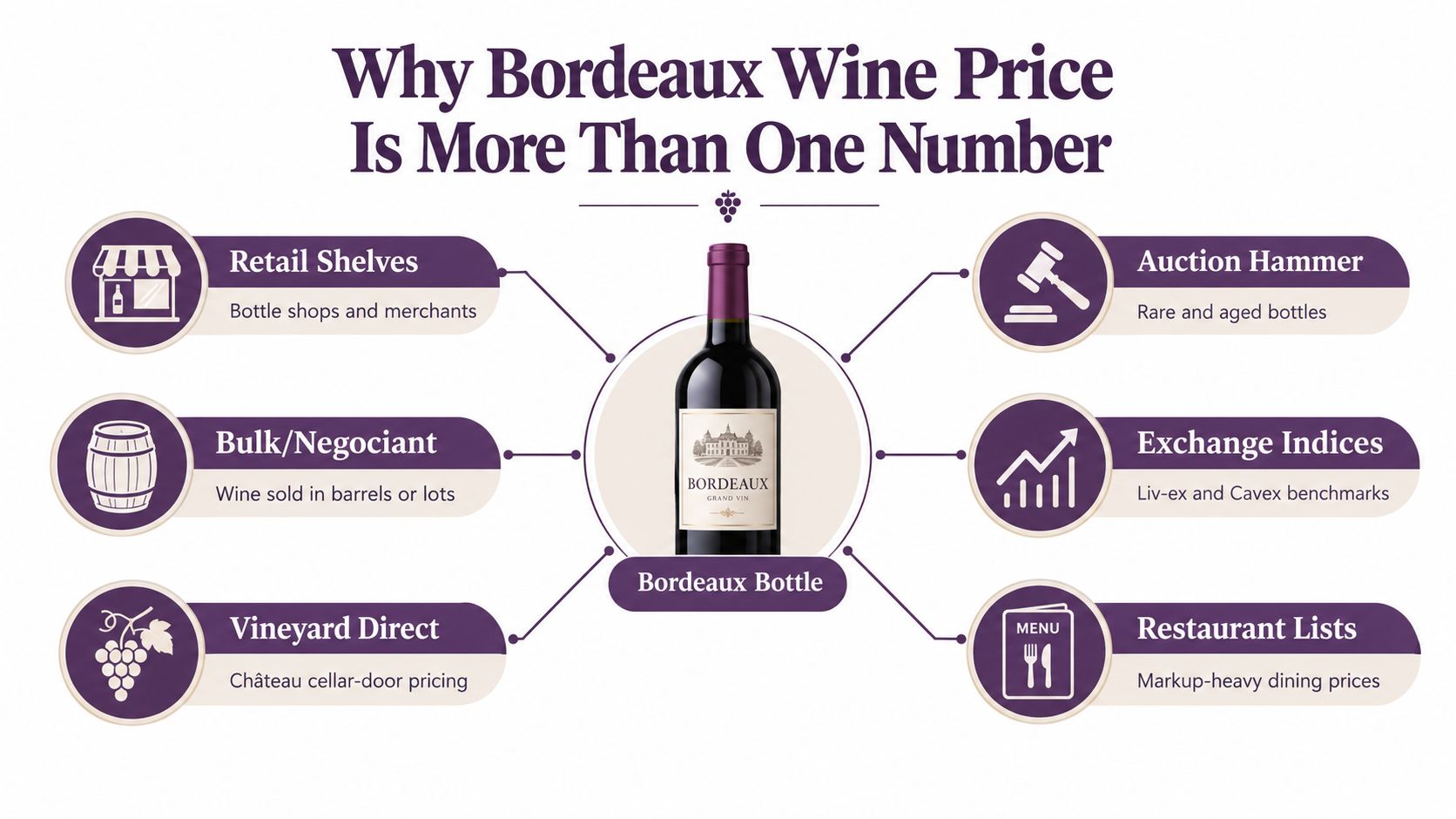
Bordeaux wine price is a multi-channel question. A bottle can carry a retail offer, auction estimate, exchange quote, restaurant-list price, négociant value, and an implied vineyard or château-gate cost. Each figure belongs to a different point in the supply chain, so none can stand in for the others.
<a id="six-lenses-on-the-same-bottle"></a>
Six lenses on the same bottle
- Retail shelves show the consumer-facing amount charged by a merchant. Distribution, storage, taxes, margin, and promotional discounting can all sit inside that figure.
- Auction hammer prices record what a particular lot attracted in a competitive sale. They help with rare or mature bottles, but condition, provenance, lot size, buyer's premium, and unsold inventory can weaken comparisons.
- Exchange indices such as Liv-ex benchmarks provide a standardized view of actively traded wines. They indicate market direction, although liquidity usually concentrates in recognizable labels.
- Restaurant lists show an end-consumer offer rather than a wholesale clearing price. Operating costs and venue-specific markups can make the list price a poor proxy for bottle value elsewhere.
- Bulk and négociant trade covers wine sold in barrels, tanks, or larger lots. It can expose financial pressure beneath the branded-bottle market. In June 2026, generic Bordeaux rouge was reported at €700 to €800 per tonneau, against production costs near €1,400 per tonneau, with all reported bulk red volumes sold at a loss. The June market digest also reported that dry whites and crémants were moving in the opposite direction.
- Vineyard direct pricing reflects land value or wine sold close to the producer. Bordeaux appellation vineyard prices fell to €6,500 per hectare in 2025, while another market summary placed the Bordeaux vine median at €15,434 per hectare after a 56% five-year decline. The market reporting illustrates how vineyard economics can diverge from bottle-level prestige.
<a id="a-split-channel-split-tier-framework"></a>
A split-channel, split-tier framework
The second filter is tier. First growths, other classified growths, and broad regional labels differ in liquidity, buyer recognition, and scarcity premium. A broad index can stabilize when trophy labels hold up, even while less celebrated classified growths continue to reprice.
Apply the framework in sequence. Identify the channel, then the tier, then the comparable transaction. A mature bottle intended for drinking may be better judged against auction results than an en primeur release. A merchant setting a list price should compare landed retail cost with current offers, not rely on a distant exchange index.
Repeat comparisons also need a consistent process for testing assumptions. Otter A/B's pricing plans provide a reference for evaluating experimentation and decision workflows. The underlying Bordeaux judgment still depends on matching the market channel and tier to the bottle.
<a id="how-to-read-a-bordeaux-price-index"></a>
How to Read a Bordeaux Price Index
An index is a measurement system, not a price tag. Before acting on a move, establish what the index contains, how its components are weighted, and whether those components resemble the wine you own or want to buy.
The Liv-ex Bordeaux 500 is a broad benchmark for Bordeaux secondary-market pricing. On 3 August 2026, it stood at 275.7, with a 0.2% year-to-date decline, a 0.4% one-year increase, an 11.2% two-year decline, and a 19.4% five-year decline. Liv-ex's index data shows why a short-term stabilization can coexist with weaker medium-term valuations.
<a id="read-the-time-horizon-before-the-direction"></a>
Read the time horizon before the direction
A monthly change answers a narrow question: what happened recently? Year-to-date movement gives a partial calendar-year view. A one-year comparison captures a longer market regime, while two-year and five-year windows reveal whether a recent bounce sits inside a larger correction.
Don't confuse a stable index with stable prices across every tier. A basket dominated by recognizable, liquid labels may soften less than a thinly traded mid-tier wine. Currency also matters when the benchmark is quoted in GBP but the buyer's account is in USD or EUR. A nominal gain can shrink after conversion, and a nominal decline can look different once currency is included.
<a id="use-repeat-trades-for-the-decision"></a>
Use repeat trades for the decision
The strongest practical comparison is a recent trade involving the same wine, vintage, format, condition, and provenance. Academic work on Bordeaux en primeur pricing assembled 1,177 secondary-market prices across vintages 2005 to 2020, alongside 296 en primeur prices for vintages 2018 to 2021, covering 74 red Bordeaux wines. The peer-reviewed study demonstrates why release pricing and after-market pricing should be read together across vintages.
| Metric | What it measures | Common blind spot |
|---|---|---|
| Index level | The current level of a defined wine basket | It isn't the value of your individual bottle |
| Monthly change | Very recent direction | Noise, thin trading, and component effects |
| Year-on-year change | Movement against the same period | It can conceal a longer correction |
| Two-year or five-year change | Medium and long-cycle performance | Older composition may not match today's holdings |
| Last trade | The latest observed transaction | One trade may not represent executable liquidity |
| Bid to offer | The gap between buyer and seller expectations | A narrow quote can still involve limited volume |
For a specific label such as Lafite 2018, the latest comparable trades and current bid-to-offer spread are more useful than a headline index move. Fine-wine market data tools can help organize those comparisons, but the analyst still needs to check whether the records describe comparable bottles.
<a id="the-2026-pricing-picture-across-channels"></a>
The 2026 Pricing Picture Across Channels
The 2026 Bordeaux picture is best described as liquid but selective. Bordeaux regained leadership of the global fine-wine market by traded value, accounting for 37.4% of activity, according to Liv-ex reporting on the market. That leadership doesn't mean every Bordeaux label is recovering. It means the region still supplies a deep pool of recognizable wines that buyers and sellers can transact.
At the broad benchmark level, the Bordeaux 500's five-year decline remains much more significant than its recent stability. That combination suggests a market searching for equilibrium rather than one that has returned to its former pricing regime.
<a id="en-primeur-is-the-first-stress-test"></a>
En primeur is the first stress test
En primeur creates a built-in comparison between a release price before bottling and the later secondary market. When the release price sits too close to available back-vintage alternatives, buyers have less reason to accept waiting, storage risk, and uncertainty around future liquidity.
The same logic applies across recent releases. A buyer who sees a younger vintage offered at a meaningful discount to a comparable older bottle may prefer immediate physical stock. A château or négociant that ignores those alternatives risks pushing the adjustment into the secondary market instead.
The Bordeaux en primeur market analysis is most useful when read as a comparison exercise, not as a single release-price verdict. Ask whether the release creates value against bottled vintages, not whether the nominal discount sounds attractive.
<a id="secondary-market-and-retail-are-separate-negotiations"></a>
Secondary market and retail are separate negotiations
Exchange prices can drift lower while retail shelves adjust slowly because merchants hold stock acquired at older costs. Retailers may use discounts to clear inventory, but the advertised price can still remain above the latest executable exchange level. Conversely, a merchant with favorable stock may offer a bottle below a formal index without implying that the entire appellation has repriced.
Bulk trade provides a different warning. Reports of generic red Bordeaux trading below estimated production cost show that pressure is not confined to investment bottles. Yet stronger movement in dry whites and crémants confirms that Bordeaux has internal dispersion, not one uniform curve.
The likely equilibrium will therefore differ by tier. Trophy first growths may retain stronger liquidity, while broader Bordeaux and weaker classified-growth positions require deeper price discovery. Buyers should wait for repeat trades, inventory turnover, and release-to-secondary comparisons to align before treating a stabilization headline as a durable floor.
<a id="price-behavior-by-tier-and-vintage-age"></a>
Price Behavior by Tier and Vintage Age
A flat Bordeaux index can conceal opposite outcomes. First growths, other classified growths, and broad Bordeaux labels respond to different buyer priorities, even when they share an appellation or vintage.
First growths trade on global recognition, scarcity, provenance, and collector confidence. Other classified growths depend more heavily on relative value, merchant support, and the availability of substitutes. Broad Bordeaux labels are more exposed to consumer affordability, distribution costs, and the economics of the bulk market.
<a id="vintage-age-changes-the-spread"></a>
Vintage age changes the spread
Young wines carry release risk. Buyers are still comparing en primeur pricing, expected quality, delivery timing, and the cost of waiting. Once wines are in bottle, the market can compare physical stock directly, and condition becomes more important. Mature bottles add provenance, storage history, ullage, and drinking readiness to the calculation.
The market has also shown an age split. Coverage of the current correction has described pre-2017 Bordeaux as generally more resilient and earlier to stabilize, while the 2022 vintage was identified as an exception. The vintage analysis supports a practical conclusion: age isn't merely a consumption attribute. It changes the risk profile attached to the price.
| Tier | Young Vintage (1-4 yrs) | Mid-Age (5-12 yrs) | Mature (13+ yrs) |
|---|---|---|---|
| First growths | Release discipline and brand demand dominate | Secondary liquidity becomes clearer | Provenance and scarcity can support a premium |
| Classified growths | Relative value drives buyer selection | Substitution between estates matters | Auction depth and condition become decisive |
| Broader Bordeaux | Consumer affordability and distribution costs matter | Retail turnover can outweigh prestige | Physical condition may limit comparable trades |
<a id="specific-comparisons-need-caution"></a>
Specific comparisons need caution
Lafite 2010 and generic Bordeaux 2018 aren't interchangeable just because both are red Bordeaux. The first is a globally recognized trophy wine with a mature-vintage profile, while the second belongs to a much broader market with different liquidity and consumer use.
The same issue applies to Margaux 2015 and Léoville Poyferré 2015. Shared vintage and region don't erase differences in brand hierarchy, stock availability, buyer base, or trading frequency. A BBR retail price may diverge from an exchange mark because one reflects an offer to a consumer and the other reflects a market quote for a specific trading context.
The right comparison is therefore tier-adjusted and channel-matched. A first-growth index can remain firm while a classified-growth retail shelf is discounted, and neither observation automatically prices the other.
<a id="where-each-channel-helps-you-price-a-bottle"></a>
Where Each Channel Helps You Price a Bottle
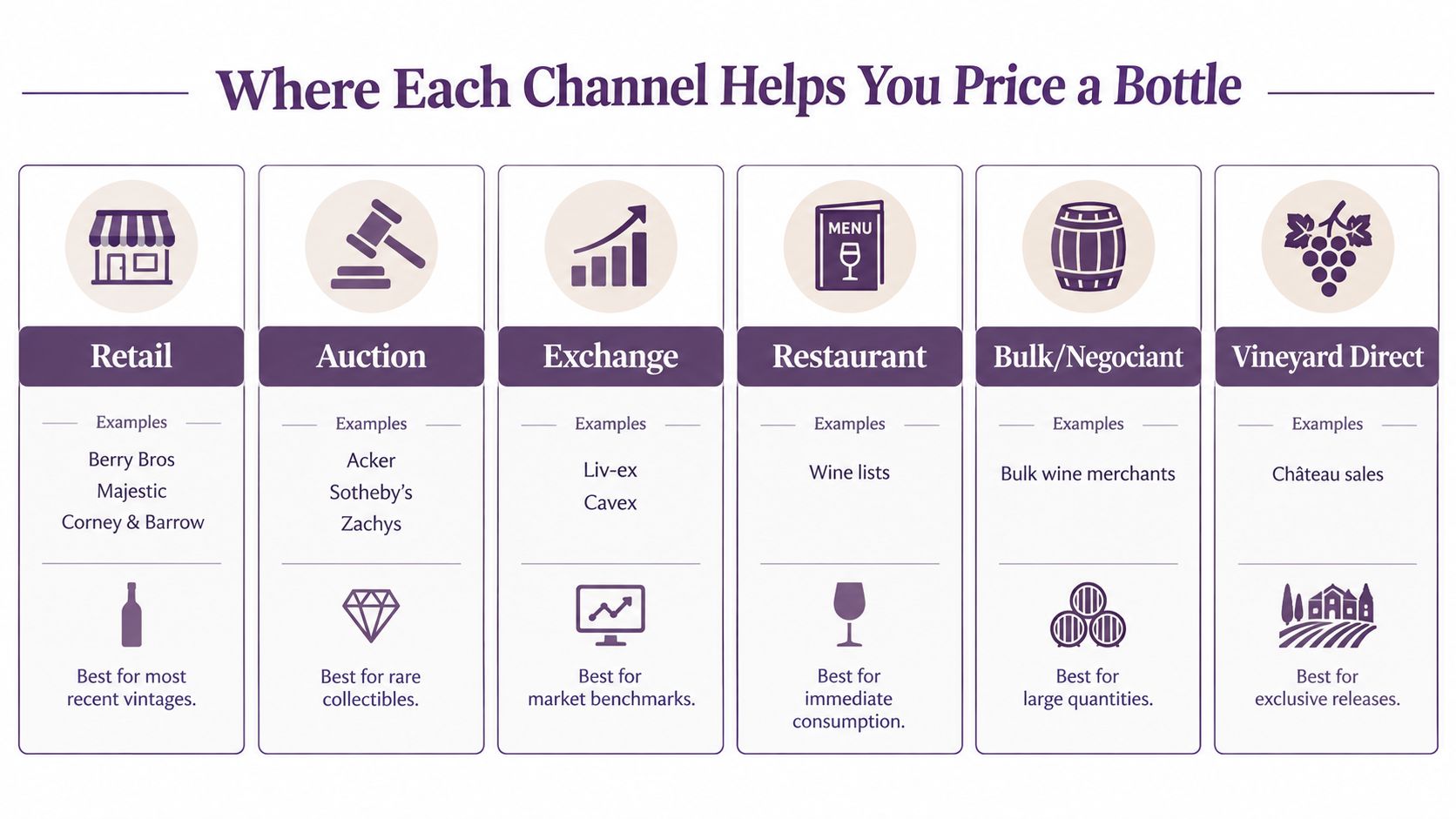
No channel is universally correct. Each one answers a different commercial question, and each introduces a predictable distortion.
<a id="retail-and-auction"></a>
Retail and auction
Retail, including Berry Bros, Majestic, and Corney & Barrow, is the best lens for current consumer replacement cost. It tells a collector what it may cost to acquire another bottle through a merchant today. Its bias is margin, tax, shipping, stock age, and promotional pricing. A listed price isn't necessarily the price at which the merchant would buy your bottle.
Auction houses such as Acker, Sotheby's, and Zachys help price rare, mature, or collectible stock. Their hammer results reveal what buyers accepted for a defined lot, but the result can be affected by bottle condition, provenance, lot size, buyer's premium, and whether comparable lots attracted competition. Auction is a distress marker when sellers need liquidity, but it isn't a frictionless wholesale quote.
<a id="exchange-restaurant-bulk-and-vineyard"></a>
Exchange, restaurant, bulk, and vineyard
Liv-ex and Cavex provide institutional market benchmarks and quote-based context. They're valuable for recognizing direction, bid-to-offer spreads, and repeat-trade behavior. Their limitation is liquidity bias. A quoted market may not offer the same depth for every label, vintage, or format.
Restaurant wine lists show end-consumer reality. They matter to producers, importers, and diners because they reveal what a venue is willing to ask for immediate consumption. The bias is markup, list discounting, and venue economics. A restaurant price shouldn't be used as a direct valuation of cellar stock.
Bulk and négociant merchants reveal landed cost and production pressure. They're particularly useful for understanding generic wine and large-lot economics, but vintage blending, lot specifications, and contract terms can make like-for-like comparisons difficult.
Vineyard-direct or château sales show allocation pricing and producer intent. They can expose scarcity and release strategy, yet allocation-only access means the price may not be available to an ordinary buyer.
Practical rule: Never price a bottle from one channel. Cross-reference at least three, then adjust for condition, provenance, format, taxes, and transaction costs.
For a collector, that might mean exchange data, current retail replacement cost, and auction outcomes. For a merchant, it may mean supplier cost, competing shelf offers, and restaurant demand. The signal becomes stronger when all three point in the same direction.
<a id="historical-cycles-and-what-the-2022-peak-teaches"></a>
Historical Cycles and What the 2022 Peak Teaches
The Bordeaux correction shows why base years and regime changes matter. A wine can recover from a recent low while remaining well below its previous high. A stable monthly index can also conceal continued medium-term weakness. The headline depends on the comparison date, channel, and tier.
The 2026 review reported that Bordeaux prices were down 27% on average from their 2022 peak and still about 4% lower year over year from the start of the 2024 en primeur campaign. It also cited a Liv-ex Bordeaux-related index at 275.7, with a two-year change of -11.2% and a five-year change of -19.4%. The Bordeaux correction and global market digest places those movements in a wider market context, but the figures still require separation by channel and label.
<a id="two-regimes-not-one-continuous-story"></a>
Two regimes, not one continuous story
The pre-2017 market reflected a China-driven rally and strong international demand for recognizable classified growths. After 2017, buyers operated under different conditions, placing greater weight on entry price, relative value, and secondary-market alternatives.
Those periods should not be compressed into one historical average. A bottle that looks inexpensive against the 2022 peak may remain costly relative to older physical stock or its original release economics. A mature vintage that corrected earlier may offer better risk-adjusted value than a newer release whose pricing expectations remain unresolved.
<a id="different-channels-peaked-at-different-times"></a>
Different channels peaked at different times
During the 2020 to 2022 boom, en primeur releases, secondary-market bids, and retail shelves moved at different speeds. Producers set release prices around expected demand. Exchange buyers repriced available stock as liquidity changed. Retailers adjusted later, according to acquisition cost, inventory age, and turnover.
That timing gap matters when assessing bordeaux wine price. A shelf can remain unchanged after exchange values fall, while a secondary-market discount may take longer to reach restaurant lists. First growths may also retain stronger support than broader labels, so an index decline does not describe every tier equally.
<a id="what-to-watch-for-the-next-regime-shift"></a>
What to watch for the next regime shift
Trading volume provides context, not direction. The 2025 Bordeaux data showed active trading alongside lower repeat-trade prices, meaning higher activity can occur during a bearish clearing process. Watch whether bid-ask spreads narrow as buyers return, release prices become more disciplined, and older stock begins to outperform newer vintages.
Trophy vintages such as 1982, 1990, 2000, 2005, 2009, 2010, 2015, 2016, and 2019 can move independently of broad Bordeaux. A portfolio treated as one exposure will miss that dispersion. Regional headlines become more useful after they are separated from label-level evidence, provenance, and the channel in which a buyer can transact.
<a id="turning-price-data-into-buying-and-selling-decisions"></a>
Turning Price Data Into Buying and Selling Decisions
Price intelligence becomes useful only when it changes a decision. The process should begin with the bottle, not the index.
<a id="screen-the-asset-before-comparing-prices"></a>
Screen the asset before comparing prices
Confirm the château, appellation, vintage, bottle size, provenance, storage history, and ullage. A six-bottle case with documented provenance isn't equivalent to a single bottle with uncertain storage, even if both carry the same label.
Then choose the relevant channel. Retail is appropriate for replacement cost. Auction is more informative for mature or rare stock. Exchange data helps establish institutional market context. Restaurant pricing matters when assessing consumption economics, not when estimating a cellar's liquidation value.
<a id="calibrate-by-tier"></a>
Calibrate by tier
For first growths, prioritize the latest comparable trade and the bid-to-offer spread over a broad index headline. For classified-growth sellers, compare exchange depth with auction hammer results. Thin exchange liquidity can make a quoted price look more authoritative than it really is.
For broader Bordeaux, test the offer against retail turnover and the underlying bulk or négociant environment. A label may be commercially sound but still require a lower price if the surrounding category is under pressure.
<a id="separate-entry-timing-from-exit-timing"></a>
Separate entry timing from exit timing
En primeur buyers are paying for future delivery and accepting uncertainty. Secondary-market buyers can compare physical stock immediately. Those are different risk decisions, so the same discount shouldn't automatically carry the same meaning.
A seller should define an exit rule before emotion takes over. Possible triggers include a vintage compounding above a pre-set multiple, a sustained deterioration in comparable trades, or a negative turn in 12-month momentum. These are decision rules, not universal thresholds. The correct level depends on acquisition cost, tax, storage, liquidity, and the owner's purpose.
<a id="manage-the-portfolio-not-just-the-bottle"></a>
Manage the portfolio, not just the bottle
Set concentration limits by appellation and avoid allowing too many holdings to depend on one vintage cluster. Track currency-adjusted returns when Liv-ex reports in GBP but the purchase or sale occurs in USD or EUR. A sterling-denominated gain may not translate into a gain in the investor's home currency.
Wine Labs consolidates retail, auction, exchange, and restaurant pricing, with identity matching and portfolio tools that support like-for-like comparisons. That kind of cross-channel record is useful when a cellar valuation needs more than a single merchant offer.
Decision discipline: If the bottle identity, condition, channel, and comparable trade aren't aligned, the price comparison isn't ready for action.
Use the five-step sequence consistently: verify the bottle, select the channel, check comparable trades, calibrate for condition and momentum, then execute and monitor. The objective isn't to predict every Bordeaux move. It's to avoid paying a channel-specific price for a market-wide assumption.
Wine Labs offers consolidated fine-wine pricing across retail, auction, exchange, and restaurant channels, alongside historical tracking and portfolio tools for valuation work. Visit Wine Labs to compare Bordeaux prices across the channels that matter to your next purchase, sale, or cellar review.