Wine Labs · Market intelligence
Best Cabernet Sauvignon Buying Guide 2026
Find the best cabernet sauvignon with our 2026 buyer guide. Compare styles, vintages, and prices with Wine Labs data for merchants and collectors.
Cabernet Sauvignon covers 342,000 hectares worldwide, narrowly ahead of Airén at 336,500 hectares, according to 2023 data from the International Organisation of Vine and Wine. That lead of 1.7% changes how buyers should define the “best Cabernet Sauvignon.” The question isn't which bottle receives the highest score. It's which wine delivers the right combination of identity, drinking window, channel price, provenance, and intended use.
Wine Labs' consolidated pricing approach treats Cabernet as a market rather than a list of tasting notes. Retail, auction, exchange, and restaurant prices can describe very different commercial realities for the same label. A bottle that looks expensive at retail may be competitively priced against auction offers, while a restaurant listing may reveal positioning rather than a realistic acquisition cost.
| Buyer objective | Most useful evidence | Practical buying signal |
|---|---|---|
| Immediate enjoyment | Drinking window, fruit profile, retail availability | Favor approachable, fruit-forward releases |
| Cellar building | Vintage, provenance, structure, auction history | Pay for condition and identity, not prestige alone |
| Restaurant sourcing | List placement, channel price, regional style | Compare replacement cost with menu positioning |
| Merchant inventory | Cross-channel benchmarks and stock movement | Separate sell-through potential from headline reputation |
Table of Contents
- The Global Rise of Cabernet Sauvignon
- Defining Quality Standards and Price Tiers
- Comparing Major Production Regions
- Leveraging Market Intelligence Tools
- Sourcing Strategies for Merchants and Collectors
- The Shift Toward Approachable Cabernet
- Ensuring Sourcing Accuracy and Consistency
<a id="the-global-rise-of-cabernet-sauvignon"></a>
The Global Rise of Cabernet Sauvignon
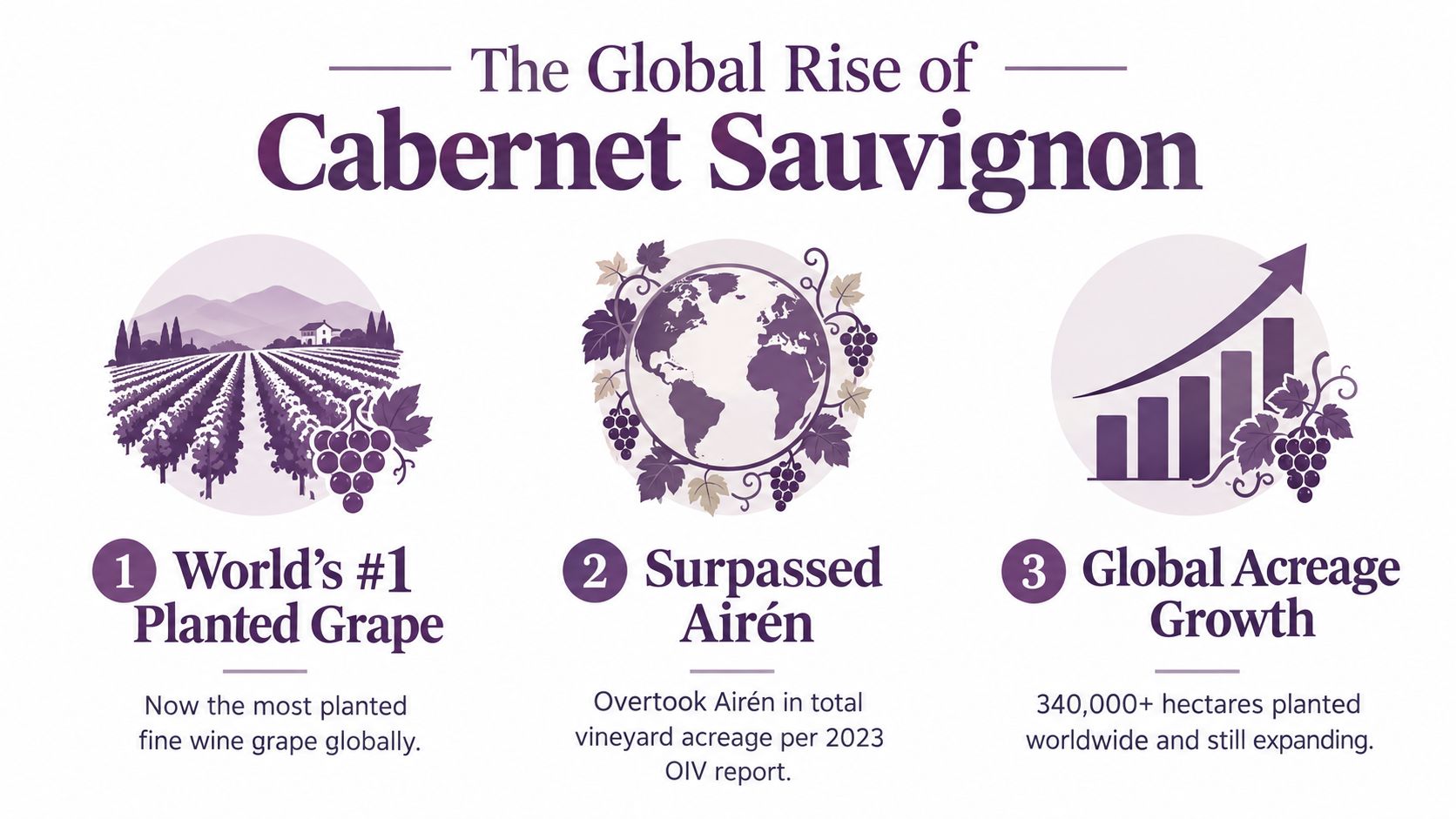
Cabernet Sauvignon now sits at the center of cross-channel comparison. In 2023, it became the world's most widely planted wine grape, with 342,000 hectares, compared with 336,500 hectares for Airén, according to the 2023 OIV-based comparison. For merchants and collectors, the practical consequence is not prestige. It is a larger reference set for pricing, substitution, and regional differentiation.
That scale is easier to interpret through Cabernet's history. The grape emerged in Bordeaux from a natural cross between Cabernet Franc and Sauvignon Blanc, with DNA confirmation completed in 1997. Archival references place it in Bordeaux by the 18th century, and the Médoc became a major stronghold. By the early 21st century, Bordeaux still represented roughly 60% of France's Cabernet Sauvignon plantings, as documented in the historical overview of Cabernet Sauvignon.
<a id="why-scale-changes-the-buying-equation"></a>
Why scale changes the buying equation
A widely planted grape gives buyers comparability. Bordeaux can be weighed against Napa, Australia against Chile, and a current release against an older bottle within the same category. That makes Cabernet Sauvignon a useful anchor for portfolios that need both recognizable demand and regional spread.
The category's history supports that role. Cabernet Sauvignon covered 341,000 hectares in 2015, or about 4% of the world's vineyards, showing that its global presence has remained large across reporting cycles. Scale does not guarantee quality. It does widen the field in which quality, price, and availability can be tested against one another.
Practical rule: Treat Cabernet Sauvignon's global scale as a pricing advantage. It gives you more substitutes, more transaction history, and more ways to test whether regional prestige is translating into actual value.
Wine Labs' Cabernet Sauvignon climate and trade insights adds a useful market view for current sourcing conditions. The working conclusion is simple. The best Cabernet Sauvignon is the bottle whose regional identity and market price fit the buyer's purpose.
<a id="defining-quality-standards-and-price-tiers"></a>
Defining Quality Standards and Price Tiers
Cabernet Sauvignon quality is usually measured on two tracks, sensory score and market position. Expert reviews often use a 100-point sensory rubric that weighs aroma intensity, palate texture, and finish length. One independent roundup evaluated wines on aroma, flavor, texture, and finish, and its highest-ranked bottles clustered in the 94 to 98 point range, with flagship prices averaging roughly $100 to $260, according to VinePair's 2025 Cabernet Sauvignon roundup.
That pricing band is a benchmark, not a rule. It shows how top-tier Cabernet is commonly priced, but it does not define quality on its own. Concentration matters only when it is matched by structure, freshness, and balance.
<a id="from-vineyard-chemistry-to-bottle-value"></a>
From vineyard chemistry to bottle value
Growers and winemakers use chemistry to decide whether fruit has reached the right point of ripeness and balance. Common production targets include 24 to 25 °Brix, pH 3.5 to 3.6, and titratable acidity of 6.0 to 7.0 g/L, expressed as tartaric acid, according to technical Cabernet Sauvignon quality guidance. Those markers help guide harvest timing and point toward aging potential, but they still need sensory judgment and site context.
Finished wine analysis adds another layer. Total polyphenols correlate with anthocyanins and color absorbance indices at 420 and 520 nanometers, so color depth often tracks phenolic load and can support a claim of stronger structural material, as the same technical Cabernet Sauvignon quality guidance explains. For buyers, the implication is straightforward. Dense color and a powerful palate can signal quality, but only if freshness and texture are present too.
A practical price-tier reading looks like this:
- Benchmark prestige: High-scoring flagship wines often sit in the premium range above, but buyers still need to test whether provenance, vintage, and supply justify the gap.
- Regional premium: A wine can offer strong value when it expresses a respected region without the scarcity premium attached to the most famous names.
- Commercial accessibility: Fruit-forward Cabernet can satisfy immediate-drinking demand without the cost of extended cellaring or mature-bottle scarcity.
Vintage variation matters because the same producer can show different levels of ripeness, acidity, tannin, and aromatic intensity from one release to the next. Regional typicity matters for the same reason. A buyer who wants firm structure may prefer a very different bottle from someone seeking generous fruit and early drinkability.
The strongest purchase decision combines three filters, sensory quality, expected drinking window, and channel-adjusted price. A 96-point wine at a flagship price may be rational for a collector. A less celebrated bottle with clean provenance and a lower acquisition cost may be the better choice for a restaurant or retail buyer.
<a id="comparing-major-production-regions"></a>
Comparing Major Production Regions
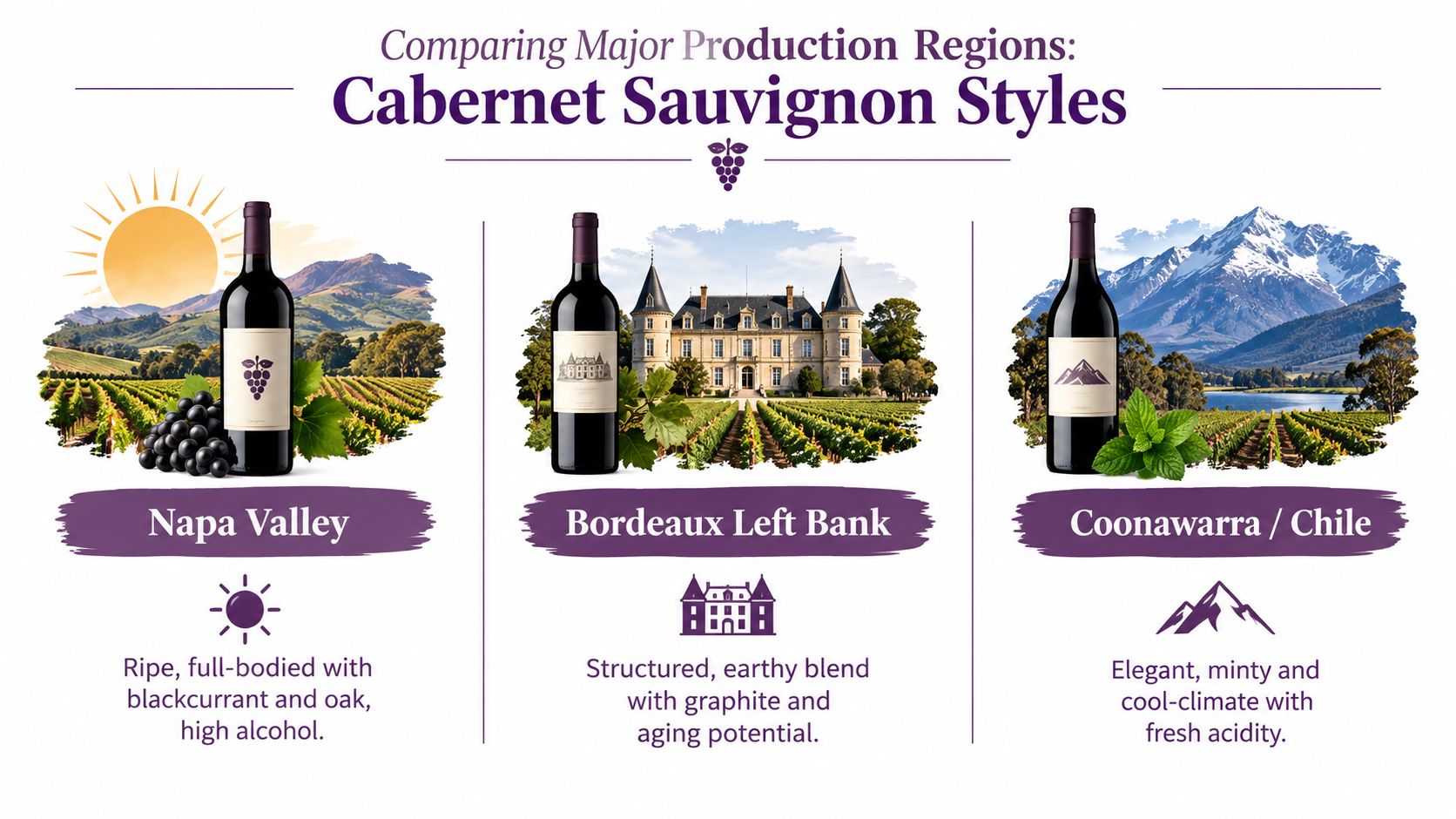
Cabernet Sauvignon's regional differences are commercial signals as much as stylistic ones. Napa Valley often attracts buyers seeking ripe, full-bodied wines with blackcurrant and oak. Bordeaux's Left Bank is associated with structured, earthy blends marked by graphite and aging potential. Coonawarra and Chile offer a different proposition, often emphasizing elegance, mint, and cool-climate freshness.
| Region or group | Typical commercial position | Style cue | Best fit |
|---|---|---|---|
| Napa Valley | Strong premium recognition | Ripe, broad, oak-marked | Buyers seeking immediate impact |
| Bordeaux Left Bank | Historic blend-based prestige | Structured, earthy, graphite-like | Collectors planning for development |
| Coonawarra and Chile | International premium alternative | Fresh, elegant, minty | Value-seeking buyers wanting lift |
<a id="comparing-prestige-with-substitution"></a>
Comparing prestige with substitution
Bordeaux remains central to Cabernet's historical identity. France's Cabernet acreage is concentrated in Bordeaux, with about 60% of French Cabernet Sauvignon grown in the region, while California's Cabernet acreage is roughly equal to Bordeaux at about 75,000 acres, according to regional Cabernet coverage. The commercial consequence is that Bordeaux and California can function as reference markets, but they shouldn't automatically define value for every buyer.
Napa's fuller profile can make a young bottle compelling at release, particularly for consumers who prioritize rich fruit and oak integration over tertiary development. Bordeaux may reward patience and blending complexity, but that potential only creates value when the buyer wants to hold the wine. Coonawarra and Chile can offer a cooler, more lifted profile for drinkers who find heavily extracted Cabernet tiring.
A price comparison must account for the channel. Retail prices reflect current availability and merchant margin. Auction prices incorporate condition, provenance, lot composition, and buyer competition. Exchange listings can signal active market expectations, while restaurant prices describe hospitality positioning rather than a direct bottle replacement cost.
Watch this regional comparison for a useful reason:
The most famous region isn't automatically the best-value region. A buyer should pay for the style and use case they want, then verify that the channel price supports that decision.
Regional news can affect perceived availability, sourcing interest, and market context. Wine Labs' Bordeaux market and vintage briefing provides one relevant reference point for buyers tracking that region.
A practical selection sequence is to choose style first, drinking window second, and region third. That reverses the prestige-led process many buyers follow. It also makes international Cabernet more competitive, because a bottle from outside Napa or Bordeaux can win on freshness, price, or food compatibility without imitating either benchmark.
<iframe width="100%" style="aspect-ratio: 16 / 9;" src="https://www.youtube.com/embed/21SHxYyRcBQ" frameborder="0" allow="autoplay; encrypted-media" allowfullscreen></iframe><a id="leveraging-market-intelligence-tools"></a>
Leveraging Market Intelligence Tools
Static rankings answer only part of the buying question. A review can describe quality, but it may not tell you whether the bottle is priced consistently across retail, auction, exchange, and restaurant channels. A market-intelligence workflow fills that gap by treating every listing as evidence that needs to be normalized and compared.
<a id="a-practical-validation-workflow"></a>
A practical validation workflow
Start with the exact bottle. Record producer, cuvée, vintage, format, region, and appellation before comparing prices. “Cabernet Sauvignon” is too broad for a reliable benchmark, and even a producer's standard bottling can sit beside a reserve or vineyard-designated wine with a different market profile.
Use a portfolio valuation tool. Wine Labs' Cellar Pricer can convert a file-based inventory into market-aware valuations, while a portfolio tracker can help monitor holdings over time. The purpose isn't to produce a flattering number. It's to establish a repeatable reference point for buying, selling, insurance, and client conversations.
Compare channels separately. A retail offer is useful for replacement cost. An auction result can help assess realized demand for older or scarcer bottles. Exchange and restaurant data can add context, but they shouldn't be blended into one unqualified average. Each channel answers a different commercial question.
Set movement alerts. Configurable price-movement alerts can flag changes in tracked wines before a manual review would catch them. For a merchant, that may support repricing or replenishment. For a collector, it can identify a more favorable entry point or a change in the opportunity cost of holding a bottle.
<a id="why-identity-matching-comes-first"></a>
Why identity matching comes first
A price graph is only as reliable as the product identity beneath it. Vintage, bottle size, producer naming, and label variations can create false comparisons when listings aren't matched to a canonical record.
Wine Labs' fine wine market data tools combine cross-channel pricing, historical tracking, portfolio tooling, and programmatic access. Used properly, that kind of system shifts the decision from “Which bottle has the highest score?” to “Which specific bottle has the strongest evidence for my objective at this price?”
The final check is qualitative. Review condition, storage, provenance, and seller reliability alongside the price signal. A market benchmark can reveal an apparent bargain, but it can't make a damaged or ambiguously identified bottle safe to buy.
<a id="sourcing-strategies-for-merchants-and-collectors"></a>
Sourcing Strategies for Merchants and Collectors
Merchants, collectors, and restaurants shouldn't source Cabernet Sauvignon through the same playbook. Their cash cycles, customer expectations, and tolerance for inventory aging differ. A bottle that works for a collector's cellar may be commercially awkward for a retailer, while a young, accessible wine that sells quickly may have limited interest at auction.
<a id="merchants-need-sell-through-evidence"></a>
Merchants need sell-through evidence
Retailers should separate prestige from repeatable demand. A recognizable producer can attract attention, but the decisive question is whether the style and price make sense for the store's customers. Young, fruit-forward Cabernet deserves particular attention because it can support immediate consumption rather than requiring a long explanation about future maturity.
Merchants can use retail prices for replacement-cost planning, then compare auction and exchange signals to test whether a premium is supported beyond the storefront. Restaurant listings can reveal how the same wine is positioned in hospitality, although that price shouldn't be treated as a direct retail equivalent.
<a id="collectors-should-pay-for-provenance"></a>
Collectors should pay for provenance
Collectors have a different priority. Older Cabernet can offer complexity and scarcity, but only when bottle condition and storage history are credible. Auction sourcing may be appropriate for mature releases, while direct retail or producer allocation can make more sense for younger bottles whose provenance is easier to document.
A collector's core decision is not ageability. It's whether the expected drinking experience, holding period, and market liquidity justify the purchase. The U.S. labeling framework for Cabernet Sauvignon also matters when assessing blends. A U.S. bottle labeled Cabernet Sauvignon must contain at least 75% Cabernet Sauvignon, and an AVA claim such as Napa Valley requires 85% of the grapes to come from that appellation.
<a id="restaurants-need-flexibility"></a>
Restaurants need flexibility
Restaurants should source across styles rather than build a list around one prestige profile. A structured Bordeaux blend can serve one menu role, while a ripe Napa Cabernet or fresh Chilean example can meet another. Channel comparison helps buyers understand the replacement cost before setting list prices and reduces dependence on a single supply route.
A strong Cabernet program serves different occasions. It doesn't force every guest to buy the most age-worthy or expensive expression.
The commercial synthesis is clear. Retailers should prioritize velocity, collectors should prioritize provenance and fit, and restaurants should prioritize menu compatibility plus replacement access. All three benefit from checking whether the market price reflects the bottle's actual role rather than its reputation alone.
<a id="the-shift-toward-approachable-cabernet"></a>
The Shift Toward Approachable Cabernet
The traditional definition of the best Cabernet Sauvignon favors structure, concentration, and the ability to improve with age. That definition remains useful for collectors, but it's a poor default for every customer. Independent market coverage identifies young Cabernet Sauvignon as the fastest-growing preference segment, while broader forecasts point to continued category growth driven by premiumization and expanding e-commerce, according to market coverage of Cabernet Sauvignon demand.
This changes the value conversation. If customers increasingly want fruit-forward wines they can open sooner, a young Cabernet may offer more practical value than a legendary older release whose price reflects scarcity, storage, and prestige. The best bottle for immediate consumption may not be the bottle with the greatest aging potential.
<a id="why-ageability-can-mislead-buyers"></a>
Why ageability can mislead buyers
Ageability is a capability, not a benefit that every buyer will use. A wine with firm tannins and substantial structure may be technically impressive, but it creates less value for someone buying dinner wine for the near term. Conversely, an approachable release can deliver a satisfying experience without the capital tied up in cellaring.
Merchants can turn this insight into clearer segmentation:
- Open-now shoppers: Lead with fruit profile, texture, food pairing, and current availability.
- Cellar-oriented collectors: Emphasize structure, provenance, vintage conditions, and a realistic drinking window.
- Trade buyers: Match style to menu, service format, and replacement cost rather than relying on a single critic hierarchy.
The shift also affects pricing. A younger wine may look less prestigious beside an older bottle, but its lower friction can be commercially valuable. It needs no storage plan, no decanting explanation, and no promise that patience will eventually deliver quality.
<a id="a-better-definition-of-best"></a>
A better definition of “best”
The best Cabernet Sauvignon is therefore conditional. For a collector, it may be a structured Bordeaux or Napa bottle with credible provenance. For a retailer, it may be a fruit-forward release with broad customer appeal and reliable replenishment. For a restaurant, it may be a regionally distinctive wine that performs well beside the menu without making the list inaccessible.
That isn't a rejection of classic Cabernet. It's a correction to the assumption that classic age-worthiness should dominate every recommendation. Market demand now makes drinking window and channel-specific value as important as long-term cellaring potential.
<a id="ensuring-sourcing-accuracy-and-consistency"></a>
Ensuring Sourcing Accuracy and Consistency
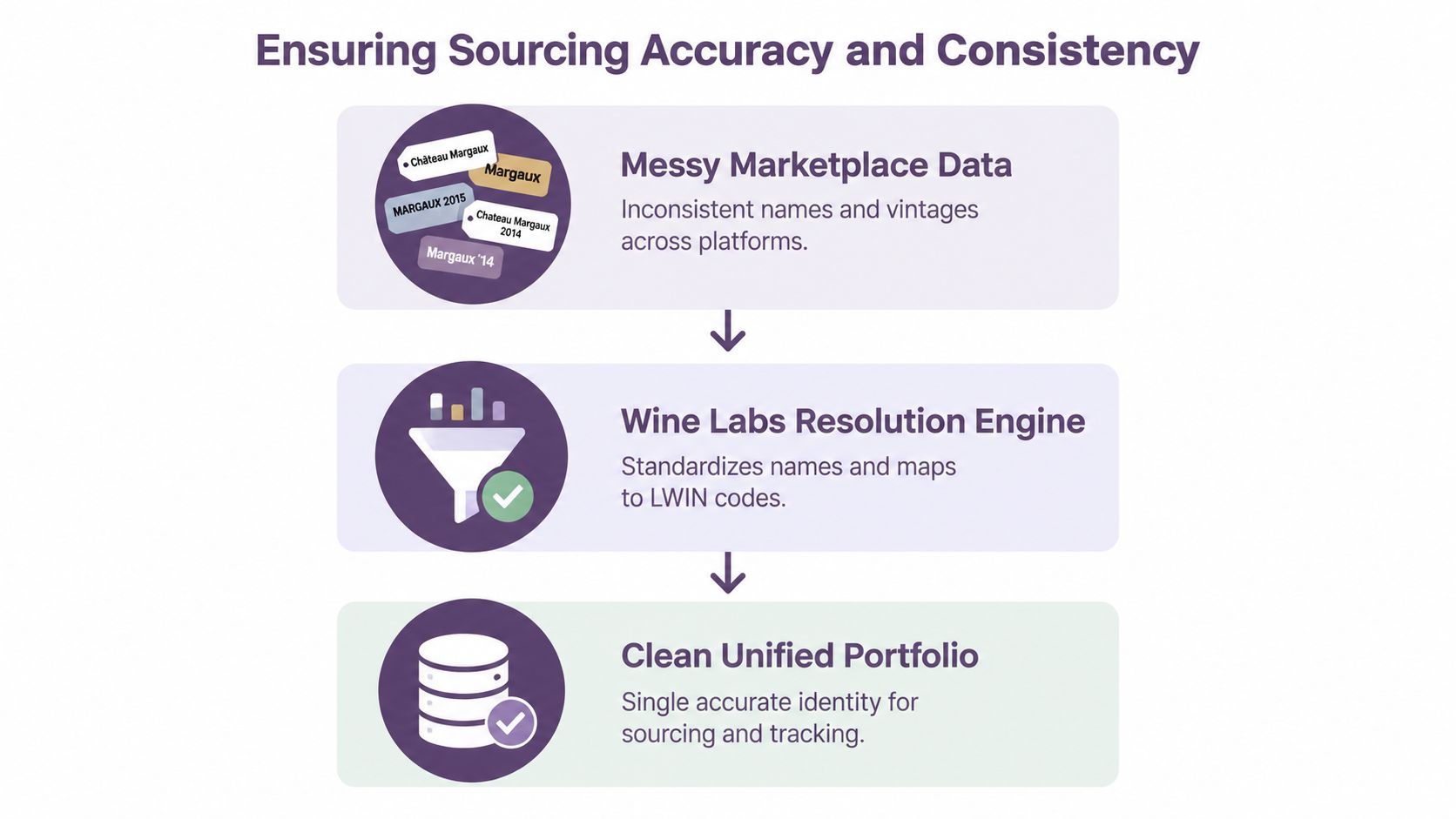
Price intelligence fails when product identity fails. Global wine marketplaces often present the same Cabernet Sauvignon with different producer names, abbreviated cuvées, inconsistent vintage formatting, or incomplete appellation details. If those listings remain separate, a buyer can mistake duplicates for distinct wines or compare unlike bottles as though they were identical.
<a id="the-identity-problem-behind-the-price-problem"></a>
The identity problem behind the price problem
Canonical matching resolves those inconsistencies by mapping heterogeneous listings to one standardized product record. That record can connect producer, wine name, vintage, format, region, and LWIN information, allowing prices from different marketplaces to describe the same bottle rather than a loose family of similar labels.
The value is operational. A merchant quoting a client needs confidence that the reference price belongs to the exact cuvée and vintage in question. A collector reviewing a cellar needs confidence that a valuation hasn't merged a standard Cabernet with a reserve bottling or confused a bottle format.
A reliable matching process should answer four questions:
- Is the producer exact? Parent companies, estate names, and brand variants can create false duplicates.
- Is the cuvée exact? Reserve, vineyard-designated, and proprietary bottlings shouldn't share a default identity.
- Is the vintage exact? A vintage mismatch can distort both availability and market value.
- Is the format exact? Bottle size affects comparability and transaction value.
<a id="why-unified-records-improve-decisions"></a>
Why unified records improve decisions
Once listings are normalized, cross-channel benchmarks become more useful. A merchant can compare current retail replacement cost with auction realizations. A collector can distinguish a genuine market movement from a change caused by a different format or mislabeled vintage. A distributor can connect catalog data with pricing workflows without repeatedly cleaning the same records by hand.
The persuasive case for canonical identity matching is simple. Cabernet Sauvignon has enough global scale to generate abundant market data, but abundance also creates noise. More listings don't automatically produce better intelligence. They produce better intelligence only when the listings refer to the right products.
A buyer evaluating the best Cabernet Sauvignon should therefore treat identity resolution as a prerequisite, not an administrative afterthought. Correct matching protects pricing accuracy, sourcing discipline, portfolio reporting, and the credibility of every recommendation built on top of the data.
Wine Labs consolidates fine wine pricing from retail, auction, exchange, and restaurant channels, with portfolio tools and canonical identity matching for more dependable Cabernet Sauvignon comparisons. Visit Wine Labs to evaluate bottles by exact identity, channel, drinking objective, and market context before you buy or source.